Media
A CNN journalist spent years reporting on al-Qaeda. Now he’s handing over a massive archive.
On the 25th anniversary of 9/11, Peter Bergen donated more than 150,000 pages of documents to Georgetown University.
September 7, 2026
6 min
By Scott Nover
Peter Bergen has a unique collection, not stamps or coins or baseball cards but something altogether more lurid: a comprehensive trove detailing the rise of al-Qaeda.
Bergen, 63, a journalist who has covered national security for CNN since the 1990s, produced the network’s 1997 interview with Osama bin Laden — bin Laden’s first television interview — and has been one of the foremost chroniclers of the U.S. war on terror.
Get a curated selection of 10 of our best stories in your inbox every weekend.
In the process, Bergen has amassed stacks of papers, photographs, recordings and artifacts.
For the 25th anniversary of the attacks on Sept. 11, 2001 — planned and executed by al-Qaeda — Bergen is donating his archive to Georgetown University’s library so it can be a resource for scholars, students and the public.
“I believe in history as being useful for people to try to understand,” Bergen said. “Not that history repeats itself, but it does have a rhyme or two.”
Georgetown is getting 150,000 pages of printed and digital files — documentation from a lifetime of scouring the Middle East. And then there are some special items.
Bergen holds a super-rare paper copy of a fatwa issued by Omar Abdel-Rahman (known as the “blind sheikh”), whom he’s called the “spiritual guide” of the September 11 attacks. Abdel-Rahman issued the theological order while incarcerated in the United States and possibly had it relayed by his lawyer, who was later convicted of relaying violent messages he sent from jail. It was then distributed to attendees at what Bergen called “the one and only al-Qaeda press conference” in Afghanistan in 1998.
“Kill them in the sea, on land, and in the air,” it read. Bergen did not attend the press conference, but obtained the card with an Arabic message from an attendee afterward. He said the fatwa gave religious permission to al-Qaeda’s members to kill Americans and set the stage for the 2001 attacks.
The other crown jewel of the collection is a complete run of al-Jihad magazine, a publication that started in 1984 — before al-Qaeda was even formed — and was sold around the world, even in Brooklyn. Eventually it became what Bergen called the “in-flight magazine of al-Qaeda.”
“When I teach about it, I say that it’s like the Vanity Fair of terrorist publications,” said Bruce Hoffman, a leading terrorism scholar and professor at Georgetown’s School of Foreign Service. “It was glossy, it was colorful, it had arresting prose, really dramatic photographs.”
Hoffman, who helped connect Bergen with librarians at Georgetown, said the collection is one of a kind. And it’s especially important, he said, for students who are too young to remember September 11. “It makes history come alive, in essence, when you can look at these archival materials and trace this trajectory, this lineage that led to 9/11,” Hoffman said. “You can understand how earth-shattering it was.”
Bergen first traveled to the Middle East in 1983 when he was 20 years old. A student at Oxford University, Bergen and two friends journeyed to Pakistan to film a documentary about Afghan refugees.
Ask The Post AI
Dive deeper
He worked for ABC News before moving to CNN in 1990. After the 1993 World Trade Center bombing, Bergen went to his bosses at CNN and said he wanted to investigate what was happening in Afghanistan since the bombers trained there.
It was not until 1996 that he even heard the name Osama bin Laden: “He was trying to keep a low profile,” Bergen said. “He was an unindicted co-conspirator in the 1993 Trade Center attacks, which is code for, ‘we don’t know what this guy did.’ … He was in the ether. He was a name that came up.” That year, a State Department analysis first identified bin Laden as a financier of radical Islamist groups.
By 1997, a CNN team that included Bergen and correspondent Peter Arnett secured an interview with bin Laden. They agreed to be taken from their hotel in Jalalabad blindfolded to an unknown location in Afghanistan in one vehicle, then another, and then another — all under the cover of darkness — to meet bin Laden and interview him. Bergen was never scared, he said, because he was focused on the job and not the potential danger.
The photos, interview notes, and tapes from that day are part of the archive now in Georgetown’s care.
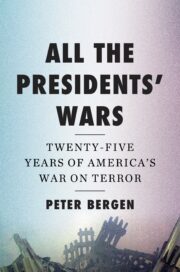
Bergen wears many hats these days: He’s a CNN national security analyst, author of a new book called “All the Presidents’ Wars,” a vice president at the think tank New America, and is a professor at Arizona State University.
Despite his other academic affiliation, he felt that the collection belonged at Georgetown. Not only is it in Washington, a hub for researchers, and has a leading terrorism studies program, but there’s a personal reason, too: His mother was one of the first female students at the Georgetown School of Foreign Service.
Allan Stypeck, the owner of Second Story Books in Washington’s Dupont Circle neighborhood, appraised the collection.
Stypeck, who is an accredited book and manuscript appraiser and whose projects include Henry Kissinger’s estate, said Bergen’s collection is the “most comprehensive” from a counterterrorism journalist that he has seen. Bergen declined to share the appraisal value, but Stypeck said he “stunned” Bergen with the value of certain items in the collection.
Ask The Post AI
Dive deeper
Ryan Stevenson, who worked with Stypeck on the appraisal, said the comprehensiveness of the collection is what makes it so special.
“The real value of the collection is what it means in its totality and what it’s going to mean for a future researcher to be able to not just find one document that they’re looking for, but to see [how] these social networks actually were interacting with each other in real time,” he said. “You have the [individual] gems, but the real gem is the collection.”