“The Longest War: America and Al-Qaeda.” Arizona State University, Phoenix
CNN’s Bergen to address ongoing war with al-Qaeda

1:30 p.m.
With the death of bin Laden, the end of the war in Afghanistan nearing, and hundreds of militants killed in U.S. drone strikes in Pakistan, it seemed like the end of the war on terror was finally at hand. But then came Benghazi. Since then, news from across the Middle East and North Africa – from places like Mali, Yemen and Syria – has raised fears that al-Qaeda has a new lease on life.
Ongoing instability in Egypt and Afghanistan has given rise to additional fears. What impact will the rise of Islamist political parties in places like Egypt have on al-Qaeda? And with a resurgence of Taliban violence, what will the future of religious terrorism look like?
To help make sense of what is going on, Peter Bergen, CNN national security analyst and director of the New America Foundation’s national security studies program, will give a free public lecture titled, “The Longest War: America, al-Qaeda, and the Middle East,” at Arizona State University on Jan. 31.
The lecture, sponsored by the Center for the Study of Religion and Conflict, will take place from 1:30 to 3 p.m., in Old Main’s Carson Ballroom, on the Tempe campus.
“Jihadist militants have proven surprisingly resilient despite the wide range of forces arrayed against them,” writes Bergen.
Still, the greatest threat to U.S. security may not come from these groups in North Africa, but from the impending withdrawal of U.S. troops from Afghanistan in 2014, arguments Bergen has made in a series of recent articles and books.
“We are supposed to believe that because Ansar al-Sharia – a group inspired by al Qaeda’s ideas, but having no links to the terrorist group that attacked the United States on 9/11 – was able to pull off a deadly attack in a Middle Eastern country ravaged by a recent war against a lightly defended U.S. mission … that al-Qaeda is suddenly an important threat again to the United States.”
A careful analysis, according to Bergen, suggests that the biggest security threat may come in the form of a proxy war in Afghanistan between Pakistan and India, a scenario made more likely if the U.S. zeroes outs its troops.
Bergen’s hard hitting observations are based on over twenty years of reporting and writing on al-Qaeda and its affiliates throughout Central Asia, the Middle East and North Africa.
In award-winning and bestselling books such as “Holy War, Inc.: Inside the Secret World of Bin Laden,” “The Longest War: The Enduring Conflict Between America and Al-Qaeda,” and “Manhunt: The Ten Year Search for bin Laden, from 9/11 to Abbottabad,” Bergen has been lauded for his clear-eyed writing that not only details the history of the conflict from the standpoint of the U.S., but also brings to the surface the views of ordinary Muslims, most of whom reject “bin Ladenism,” as well as the views of the terrorists and sympathizers, themselves.
“For readers interested in a highly informed, wide-angled, single-volume briefing on the war on terror so far, “The Longest War” is clearly that essential book,” wrote New York Times book reviewer Michiko Kakutani, in just one example of the accolades accorded to Bergen’s writings.
Bergen’s lecture marks the tenth anniversary of the Center for the Study of Religion and Conflict, notes Linell Cady, its founding director.
“Bergen is one of the clearest writers on the intersection of religion and violence. He makes important distinctions between the everyday religious practices and identities of most people, and those that develop, and act on, violent ideologies,” says Cady.
“He delivered our inaugural lecture in 2013, and it was fitting to bring him back now.”
In addition to the public lecture, Bergen is also speaking to classes and community groups while on campus. His newest book, “Talibanistan: Negotiating the Borders Between Terror, Politics and Religion,” has just been released.
“Talibanistan,” book launch New America Foundation, Washington DC
Talibanistan: Negotiating the Borders Between Terror, Politics, and Religion

The longest war the United States has ever fought is the ongoing war in Afghanistan. But when refer to “Afghanistan,” we really mean a conflict that straddles the border with Pakistan — and the reality of Islamic militancy on that border is enormously complicated. In Talibanistan, an unparalleled group of experts offer a nuanced understanding of this critical region.
Please join the New America Foundation’s National Security Studies Program for a conversation with some of these experts about the militancy and extremism that continue to plague Afghanistan and northwestern Pakistan.
On Twitter? Follow @AfPakChannel and use #Talibanistan for updates.
Participants
Col. Thomas Lynch III
Colonel-Retired, U.S. Army
Distinguished Research Fellow, National Defense University
Anand Gopal
Bernard L. Schwartz Fellow, New America Foundation
Hassan Abbas
Senior Advisor, Asia Society
Professor, National Defense University
Brian Fishman
Philanthropic Engineer, Palantir Technologies
Counterterrorism Research Fellow, New America Foundation
Sameer Lalwani
Research Fellow, National Security Studies Program, New America Foundation
Ken Ballen
President, Terror Free Tomorrow
Peter Bergen
Director, National Security Studies Program, New America Foundation
Event Time and Location
Washington, DC 20036
|
||||||||||||||||||||
Book Description
Best Value
Customers Who Viewed This Item Also Viewed




Editorial Reviews
Review
About the Author
Product Details
- Paperback: 528 pages
- Publisher: Oxford University Press, USA (January 14, 2013)
- Language: English
- ISBN-10: 0199893098
- ISBN-13: 978-0199893096
- Product Dimensions: 9.2 x 6.1 x 1.5 inches
- Shipping Weight: 1.5 pounds (View shipping rates and policies)
- Average Customer Review: Be the first to review this item
- Amazon Best Sellers Rank: #353,936 in Books (See Top 100 in Books)
Hunt for bin Laden, Chicago
Congregation Beth Shalom – Chicago
An Evening with CNN Analyst Peter Bergen in Cambridge, MA
An Evening with CNN Analyst Peter Bergen in Cambridge, MA
07 May 2013
Holy Trinity Church of Greater Boston will host a presentation by Peter Bergen, CNN National Security Analyst and best-selling author of Manhunt: The Ten-Year Search for Osama bin Laden – From 9/11 to Abbottabad, on Tuesday, May 7, beginning at 7 p.m.
Mr. Bergen will give a talk titled “The Awakening: The Remaking of the Middle East.” The evening is organized as part of the Dr. Michael and Joyce Kolligian Distinguished Speaker Series.
The event is free and open to the public. A reception and book signing will follow the presentation.
Holy Trinity Church is located at 145 Brattle Street in Cambridge, MA. For information, contact the Holy Trinity Church office at (617) 354-0632, or via e-mail at office@htaac.org.
Romney endorses Obama’s national security policies, CNN
Editor’s note: Peter Bergen, CNN’s national security analyst, is director of the National Security Studies Program at the New America Foundation and the author of the new book “Manhunt: The Ten-Year Search for Bin Laden — From 9/11 to Abbottabad.”
(CNN) — Mitt Romney came to Monday night’s debate with a choice.
He could run to the right of President Obama on national security issues and also differentiate himself on such tricky matters as what to do about Syria, or the United States’ complicated alliance with Pakistan.
Or he could essentially endorse Obama’s aggressive campaign against American enemies such as al Qaeda and the Iranian regime and his administration’s approach to knotty problems such as Syria and Afghanistan.
Despite some earlier campaign rhetoric, Romney chose to align himself almost completely with the Obama administration’s approaches to these issues.
In a general election this makes good sense, as this happens to be in tune with what most Americans think. A majority do not want to become embroiled in a war with Iran and are comfortable with the muscular use of CIA drones against al Qaeda in Pakistan, which is one of the hallmarks of the Obama administration’s approach to combating terrorism.
Romney decried the deaths of 30,000 Syrians in the revolt against dictator Bashar al-Assad and was adamant that the al-Assad regime must and will go, but underlined that in his administration there would be no U.S. military role to end the bloodshed. “I don’t want to have our military involved in Syria,” Romney declared.
Romney also explained that he would ensure that “responsible” Syrian opposition groups would get arms while simultaneously halting “arms that get into the — the wrong hands. Those arms could be used to hurt us down the road.”
That’s exactly the Obama administration’s position. It is not getting the U.S. military involved in Syria and is working with Saudi Arabia and Qatar, which are arming the Syrian rebels, but is also pressuring those allies to ensure that heavy weapons do not flow into the hands of jihadist groups — not an easy task, given the present chaos in Syria.
Neither Obama nor Romney raised the idea in the debate of enforcing some kind of no-fly zone over Syria, which would likely be a real game changer, as al-Assad’s forces presently enjoy almost complete air superiority over the rebels.
On Iran, Romney was adamant that the country must not acquire a nuclear weapon, saying that he would impose “crippling” sanctions to ensure this goal.
That’s, of course, the Obama administration’s current policy. The sanctions currently in place on Iran, as Obama correctly noted in the debate, have caused the Iranian currency to drop 80% in value since the end of 2011.
And the Obama administration, working closely with the Israelis, has unleashed a quite effective series of cyberattacks against the Iranian nuclear program — known as the Stuxnet and Flame viruses — which have set back the nuclear program significantly, a fact that neither candidate mentioned.
Romney did proffer the slightly batty idea of indicting Iranian president Mahmoud Ahmadinejad, who has called for the destruction of Israel, under what Romney termed the Genocide Convention, on the grounds that Ahmadinejad’s “words amount to genocide incitation.”
When there are still real genocides to be prosecuted, this seems both like a waste of time and also promotes the un-American idea of prosecuting hateful speech.
On the covert CIA drone program in countries like Pakistan and Yemen, Romney gave the Obama administration a ringing endorsement: “I support that entirely and feel the president was right to up the usage of that technology.”
And on whether the Egyptian dictator Hosni Mubarak had to go during the “Arab Spring,” both Romney and Obama strongly agreed: He had to go.
Each candidate tried to outdo the other to express the strongest possible support for Israel, saying interchangeable things about Israel being a true friend and the U.S. having Israel’s back if it was attacked. Swing voters in Florida won’t find any “daylight” between the candidates on this issue!
Neither candidate suggested what a plausible way forward might entail to help shape a lasting Israeli-Palestinian peace agreement, something the United States once played a leading role in trying to negotiate.
When asked by the moderator, CBS’s Bob Schieffer, if it was time to “divorce” America’s problematic ally Pakistan, Romney was adamant: “No, it’s not time to divorce a nation on earth that has a hundred nuclear weapons and is on the way to double that at some point, a nation that has serious threats from terrorist groups.”
This is exactly the Obama administration’s stance on Pakistan.
Both candidates avoided discussing in any detail what surely will consume considerable time of the next commander in chief after he assumes office in January 2013 — how to responsibly wind down America’s longest war, the conflict in Afghanistan.
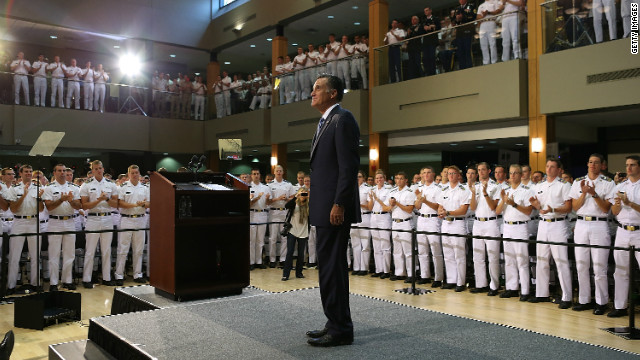
Just two weeks ago in a keynote foreign policy speech at the Virginia Military Institute, Romney said of the Afghanistan drawdown, “I’ll evaluate conditions on the ground and weigh the best advice of our military commanders. And I will affirm that my duty is not to my political prospects, but to the security of the nation.”
This seemed to leave on the table the prospect of U.S. combat troops remaining in Afghanistan after the scheduled drawdown date at the end of 2014 were Romney to be elected and was one of the few tangible significant differences on national security between the two candidates.
But during Monday’s debate, Romney echoed the Obama position: “When I’m president, we’ll make sure we bring our troops out by the end of 2014. The commanders and the generals there are on track to do so.”
Romney’s change of heart may have something to do with the fact that according to a poll in March, less than a quarter of Americans continued to back the Afghan War. Another poll in the same month found that half of Americans actually favored speeding up the planned 2014 withdrawal.
There is also the small matter that the date of the planned 2014 withdrawal of U.S. combat troops has been negotiated and agreed to not only by the Afghan government, but also by NATO allies and the more than 40 countries with some kind of presence in Afghanistan.
For his part, during the debate Obama did not mention the Strategic Partnership Agreement that his administration has spent considerable effort in negotiating with Afghanistan that would keep some as-yet-unspecified number of American troops in an advisory role in Afghanistan up until 2024.
Whoever is in the Oval Office next year is scheduled to complete the negotiations of this long-term agreement with the Afghan government. It will spell out in detail the roles and numbers of what will likely be many thousands of American troops who could remain in Afghanistan for a decade beyond 2014.
This fact went unmentioned in Monday’s debate because few Americans have any appetite left for the Afghan intervention.
Where there was major disagreement was on defense spending, which the Romney campaign says should not be cut. Romney cited a factoid that he has used before on the campaign trail, which is that the U.S. Navy today is supposedly smaller than it was in 1917.
This set up Obama for some of his best lines of the night: “Well, Governor, we also have fewer horses and bayonets, because the nature of our military’s changed. We have these things called aircraft carriers, where planes land on them. We have these ships that go underwater, nuclear submarines.”
This served implicitly to make a larger point, which is that other than some vague gauzy rhetoric about the need for America to be stronger, Romney has never really articulated a strategy distinct from Obama’s that would necessitate the larger military that he is calling for.
In any event, the notion that the U.S. is falling behind militarily is laughable. Last year the U.S. spent more on defense than the 13 countries with the next highest defense budgets combined.
Jihadi terror suspect could face tough odds in court, CNN
Jihadi terror suspect could face tough odds in court
By Peter Bergen, CNN National Security Analyst, and Jennifer Rowland, Special to CNN
updated 8:58 AM EDT, Fri October 19, 2012
STORY HIGHLIGHTS
Man from Bangladesh charged with attempting to detonate bomb outside Federal Reserve building
Peter Bergen: Jihadists arrested as a result of many law enforcement sting operations
He says they haven’t succeeded in getting acquittals by using the entrapment defense
Bergen: Jihadist terrorism cases have declined steadily since 2009
Editor’s note: Peter Bergen, CNN’s national security analyst, is a director at the New America Foundation and the author of the new book “Manhunt: The Ten-Year Search for Bin Laden — From 9/11 to Abbottabad.” Jennifer Rowland is a program associate at the New America Foundation, a Washington-based think tank that seeks innovative solutions across the ideological spectrum.
(CNN) — The man charged Wednesday with attempting to blow up the Federal Reserve Bank of New York, the latest alleged jihadist to be charged in a law enforcement sting, may or may not have had the capability to create a major terrorist incident. But if his case follows the pattern of other similar sting operations, what is clear is that he faces very long odds in court.
Quazi Mohammad Rezwanual Ahsan Nafis, a 21-year-old Bangladeshi from Queens, is accused of plotting to detonate a 1,000-pound bomb outside the Federal Reserve building in Manhattan.
Sounds pretty terrifying. But as acting Assistant FBI Director Mary Galligan explained, “It is important to emphasize that the public was never at risk … because two of the defendant’s ‘accomplices’ were actually an FBI source and an FBI undercover agent.”
According to the complaint against him, Nafis did travel to the United States by his own account to wage “jihad.” But Nafis doesn’t seem like the sharpest aspiring terrorist. According to the complaint, Nafis believed that the undercover agent he was talking to had traveled overseas to meet al Qaeda’s leadership to get approval for the New York plot during the summer of this year.
Not too many folks are known to have traveled to Pakistan’s tribal regions from the United States to meet with al Qaeda’s leaders in recent years.
Yet Nafis will be quite unlikely to successfully mount a defense that he was entrapped by the feds.
Since September 11, 2001, 207 individuals have been indicted on charges related to jihadist terrorism. Of those, 94 had interacted with an informant or an undercover law enforcement officer in the leadup to their arrest, according to data compiled by the New America Foundation.
Defense attorneys and members of the local community have in many of those cases accused authorities of entrapment, though that claim is rarely used as an official defense, since entrapment is extremely difficult to prove.
In one such contentious case in 2004, two imams at a mosque in Albany, New York, Yassin Aref and Mohammed Hossain, became embroiled in an elaborate terrorism plot created entirely by the FBI after Hossain approached a longtime FBI informant to ask about obtaining an illegal driver’s license for his brother. Then, after agreeing to launder money that the FBI informant said would be used to buy a surface-to-air missile for terrorists, the two men were tried and convicted and sentenced to 15 years in prison on money laundering and terrorism charges.
Aref — who spoke broken English — maintained throughout the trial that he hadn’t even known he was laundering money, much less that he was supporting terrorism, and dozens of community members — Muslim and non-Muslim — wrote letters to the courts and to local newspapers describing Aref as a devoted father and peace-loving, law-abiding member of society.
However, the odds are stacked against suspects like Aref. Of the 81 jihadist terrorism suspects who have gone to trial since 9/11 in cases involving an undercover agent or informant, every single one has either been convicted or pleaded guilty.
Quazi Mohammad Rezwanual Ahsan Nafis was charged with planning to blow up the Federal Reserve Bank of New York.
Entrapment defenses just haven’t worked in post-9/11 jihadist terrorism cases.
By contrast, of the 45 non-jihadist terrorism suspects — who include neo-Nazis, anarchists and anti-government extremists — who have gone on trial since 9/11 in plots involving undercover agents or informants, the rate of successfully obtaining convictions or guilty pleas was about 77% rather than the 100% conviction rate in jihadist terrorism cases.
New York City Police Commissioner Ray Kelly said Wednesday, “Whether al Qaeda operatives like Iyman Faris or those inspired by them like Jose Pimentel, terrorists have tried time and again to make New York City their killing field. We’re up to 15 plots and counting since 9/11, with the Federal Reserve now added to a list of iconic targets that previously included the Brooklyn Bridge, the New York Stock Exchange and Citicorp Center.”
But few of these 15 plots were truly threatening to New York.
One of the terrorist suspects Kelly mentioned, Pimentel, allegedly came close last year to completing the construction of three pipe bombs he planned to use against New York police officers and returning U.S. troops, before authorities arrested him.
But the FBI had turned down more than one request from the New York City Police Department to get involved with the investigation because its agents were of the opinion that Pimentel “didn’t have the predisposition or the ability to do anything on his own,” according to one anonymous law enforcement official.
In fact, multiple acquaintances of Pimentel’s told police he was mentally unstable and had once tried to circumcise himself. He had difficulty drilling the holes in the pipe bomb parts that the undercover informant had provided him with and asked an upstairs neighbor to help him. This doesn’t sound like a cunning terrorist plotting to wreak havoc on the American public.
Similarly, the other terrorist mentioned by Kelly, Pakistani-American Iyman Faris, was certainly someone who had met with al Qaeda leaders in Pakistan, but the harebrained plan he hatched to bring down the Brooklyn Bridge was to use a blowtorch to burn through the massive steel cables of the bridge, which had no chance of succeeding and which he never attempted.
The good news is that even these not especially threatening cases, like that of Nafis, are becoming increasingly unusual. Since 2009, jihadist terrorism cases in the United States has been on a steady decline, with only three suspected jihadists indicted in 2012, compared with 25 in 2011 and a record 44 in 2009.
Why these jihadists’ terrorism cases have so precipitously declined in number is hard to diagnose precisely. But law enforcement efforts, which are well-publicized as in the Nafis case, have surely had a significant deterrent effect, and the ideology of al Qaeda has continued to lose whatever appeal it once enjoyed among a tiny minority of Muslims living in the United States.
Romney’s sorta-kinda call to arms, CNN
Romney’s sorta-kinda call to arms
- Peter Bergen: Romney sought to draw clear line between his and Obama’s foreign policy
- He says Romney’s problem is Obama set a tough line with drone war, bin Laden mission
- Romney made sense on idea of tying Egypt aid to democracy, fulfilling peace treaty, he says
- Bergen: Romney trying to create illusion of substantive differences with Obama
Editor’s note: Peter Bergen, CNN’s national security analyst, is director of the National Security Studies Program at the New America Foundation and the author of the new book “Manhunt: The Ten-Year Search for Bin Laden — From 9/11 to Abbottabad.” CNN Opinion will stream a foreign policy debate at 1 p.m. Wednesday between representatives of the Obama and Romney campaigns.
(CNN) — On Monday, Mitt Romney delivered what his campaign billed as a major foreign policy address, in which he sought to distinguish himself from the man he called the “lead from behind” president.
The speech at the Virginia Military Institute, which largely focused on the Middle East, served as something of a warm-up for the two remaining debates between Romney and Obama to be held later this month, one of which will focus entirely on foreign policy, while the other will deal with both domestic and national security issues.
In the forthcoming debates Romney will have the tricky job of trying to position himself as tougher on national security than Obama — who tripled the number of U.S. troops in Afghanistan during his presidency and ordered the raid that killed Osama bin Laden.
Obama has also authorized six times as many drone attacks as George W. Bush did in Pakistan against suspected members of al Qaeda and the Taliban. The attacks during the Obama administration have killed at least 1,400 people, almost double the number of prisoners that were transferred to the Guantanamo Bay prison camp by the Bush administration.
Obama is also the first American president to authorize the assassination of a U.S. citizen, Anwar al-Awlaki, who played an operational role in al Qaeda’s Yemeni affiliate and was killed by a US drone strike in Yemen last year. Indeed, Obama has vastly escalated the American covert war in Yemen, using CIA drones and U.S. Special Operations Forces, such as SEAL Team 6.
Criticism of Obama’s national security policies is growing on the left about the overall legality of CIA drone strikes and, in particular, the al-Awlaki killing.
Fact Check: Romney’s comparison of past, present Navy pointless
Given those facts, how then do you run to the right of Obama on national security? Well, you might say that you are planning to go to war with Iran because of its advancing nuclear program. Or you might say that you will institute an American no-fly zone over Syria without a United Nations authorization for such a measure. Or that you will keep U.S. combat troops in Afghanistan well past the withdrawal date of 2014 announced by the Obama administration.
The problem with such policy choices is that the American public has little appetite for more wars in the Muslim world. No such policies were mentioned in Romney’s speech on Monday, nor will they likely feature in his future debates with the president.
On Monday Romney did say, regarding Syria, that his administration would “identify and organize those members of the opposition who share our values and ensure they obtain the arms they need to defeat Assad’s tanks, helicopters, and fighter jets,” a policy that is more aggressive than providing “nonlethal” help, such as communications equipment, which the Obama administration is already giving to Syrian opposition forces.
But even this supposed distinction from Obama was less than meets the eye, as Romney did not directly say that his administration would arm the Syrian rebels. And close American allies Saudi Arabia and Qatar are already providing weapons to them.
If the U.S. were to start arming the rebels directly, identifying exactly which parts of the Syrian opposition should get arms might be difficult, because the opposition is a tangled mess of many factions that even includes elements of al Qaeda.
Fact Check: Was Obama ‘silent’ on Iran 2009 protests?
According to Leila Hilal, a Middle East expert at the New America Foundation, there are more than 800 militias now operating in Syria, making it a complex task to sort out the ones that are both militarily viable and more aligned with American interests.
In his Monday speech, Romney advanced the sensible idea that the $1.5 billion in yearly American aid to Egypt should be conditioned on its building up its democratic institutions and maintaining its peace treaty with Israel.
But other than this good idea, Romney offered few specific policies to distinguish himself from what the Obama administration is already doing in the greater Middle East.
Romney explained that he would prevent Iran from acquiring nuclear weapons capability and would not hesitate to put more sanctions on Iran. But this is basically the position of the Obama administration, which has said it will not allow Iran to have nuclear weapons and has imposed such onerous sanctions on the country that the Iranian currency has plunged in value as much as 80% against the dollar since the beginning of the year.
On Afghanistan, Romney said he will work to transition from U.S. combat troops to Afghan security forces by the end of 2014, which is — the Obama administration’s policy.
Romney said he would not make a “politically timed retreat” from Afghanistan, a somewhat mystifying construction, since this year Obama negotiated a well-publicized Strategic Partnership Agreement with the Afghan government that will keep an as-yet-unspecified number of U.S. troops in Afghanistan in an advisory and counterterrorism role until 2024. That is something that Romney didn’t mention in his Monday speech and hardly suggests a precipitous Obama-led retreat from Afghanistan, which is already America’s longest war.
Famously, Romney didn’t mention that longest war in his acceptance speech at the Republican convention in August, so his new embrace of the Afghan War seems a tad belated.
Romney’s Monday speech underlined the fact that there is more agreement than disagreement between mainstream Democrats and mainstream Republicans on foreign policy issues.
Fact Check: Did Obama say he wants ‘daylight’ between U.S., Israel?
To create the illusion that there are genuine substantive policy differences, Romney enlisted the issue of trade, saying on Monday that he would “champion free trade. … The president has not signed one new free trade agreement in the past four years.”
There have been serious critiques of Obama for not being more active in negotiating new trade deals, but to claim that he hasn’t signed any in the past four years is demonstrably false. In fact, the Obama administration signed trade deals with Panama, Colombia and South Korea last year, which a headline on FoxNews.com termed the “biggest since NAFTA.”
When stories on Fox undercut your claims as a Republican contender for president, you have a problem.
Romney was also grasping at straws when he said on Monday that “the size of our Navy is at levels not seen since 1916.”
That isn’t really true even in the trivial, numerical sense — but more importantly, the U.S. Navy in 1916 did not consist of nuclear-powered aircraft carriers and submarines with enough nuclear weapons to wipe out life on much of the planet.
The United States today has 11 aircraft carriers, while the Chinese have recently built their first one, which won’t actually be able to handle aircraft operations for years into the future.
And the overall idea that the U.S. is falling behind militarily is nonsensical. The U.S. spent more on defense in 2011 than the countries with the next 13 highest defense budgets combined.
Fact Check: Has Obama ‘not signed one new free-trade agreement’?
If Monday’s speech is a preview of how Romney will handle the foreign policy debates with Obama, the president will be on much firmer ground than he was with his uncertain performance during the first debate, which focused exclusively on domestic issues.
Talking to the Taliban with Anatol Lieven, New America Foundation, Washington DC
Talking to the Taliban
Monday October 15, 2012
2:00 p.m. – 3:30 p.m.
New America Foundation
1899 L St. NW Suite 400
Washington DC, 20036
Please join the New America Foundation’s National Security Studies Program for a conversation with award-winning author Anatol Lieven. He will discuss his talks in July with figures close to the Taliban and the views these figures expressed on the contours of a possible peace settlement.
Officials recently dismissed the possibility of securing a political deal to end the conflict in Afghanistan, a longtime keystone of the American military strategy in Afghanistan, saying their goal now is to leave Afghanistan with the best tools possible for maintaining security and political stability. After 11 years of war, has the conflict budged at all in either the coalition’s or the insurgents’ direction? Lieven and Bergen will discuss this question, as well as the likelihood of different future scenarios for Afghanistan and Pakistan.
Featured Speakers
Anatol Lieven
Senior Research Fellow, New America Foundation
Author, America Right or Wrong: An Anatomy of American Nationalism
Peter Bergen
Director, National Security Studies Program, New America Foundation
To RSVP for the event, click on the red button or go to the event page:
http://newamerica.net/events/2012/talking_to_the_taliban
For questions, contact Stephanie Gunter at New America at (202) 596-3367 or gunter@newamerica.net.
www.NewAmerica.net
Daniel Pearl Memorial Lecture at Stanford University
Peter Bergen, CNN National Security Analyst, to speak at Stanford
On Wednesday, November 14 at 7:30 p.m. Hillel at Stanford and the Pearl Foundation will sponsor a Daniel Pearl Memorial lecture, “Manhunt: The Search for Bin Laden,” with Peter Bergen, CNN’s National Security Analyst.
CNN National Security Analyst Peter Bergen will discuss the 10-year hunt for Osama Bin Laden in a lecture at Stanford University this month.
Bergen, the author of four books about Bin Laden and Al Qaeda, will deliver the Daniel Pearl Memorial Lecture at 7:30 p.m. Wednesday, Nov. 14, at the CEMEX Auditorium in the Knight Management Center complex at the intersection of Serra Street and Arguello Way. The lecture is free to the public.
Bergen’s most recent book is “Manhunt: The Ten-Year Search for Bin Laden from 9/11 to Abbottabad,” published in May. The Washington Post, in reviewing the book, said that it “virtually crackles with insider details,” and noted Bergen’s journalistic coup of conducting an in-person interview with Bin Laden in 1997. Bergen will sign copies of his book after the lecture.
Bergen is a print and television journalist and author, the director of the national security studies program at the New America Foundation in Washington D.C. and a fellow at Fordham University’s Center on National Security. He has held teaching positions at the Kennedy School of Government at Harvard University and at the School of Advanced International Studies at Johns Hopkins University.
The lecture honors the memory of Pearl, a Stanford graduate and Wall Street Journal foreign correspondent who was kidnaped and murdered by Islamic militants 10 years ago while investigating terrorist networks in Pakistan. Co-sponsors of the lecture are the Daniel Pearl Foundation, Hillel at Stanford, the John S. Knight Journalism Fellowships and the Center for International Security and Cooperation at Stanford.
Foreign correspondent Daniel Pearl of The Wall Street Journal was a Stanford alumnus murdered by Al Queda 10 years ago in the course of covering the War on Terror. This lecture series was founded to honor Danny’s commitment to the improvement of the human condition.
Peter Bergen is a print and television journalist and author, the director of the national security studies program at the New America Foundation in Washington D.C., a fellow at Fordham University’s Center on National Security, and CNN’s national security analyst. His most recent book, Manhunt, is a New York Times bestseller.
Please join Peter Bergen on stage for a book signing after his presentation.
When:
Wednesday, November 14, 2012. 7:30 PM.
Where:
CEMEX Auditorium,Stanford Graduate School of Business (Map)
Audience:
General Public
Faculty/Staff
Students
Alumni/Friends
Sponsor:
Hillel at Stanford, Journalism Fellowships, the Daniel Pearl Foundation.
Contact:
723-1602
hillelatstanford@stanford.edu
Admission:
Admission is free.
Witness to a Revolution: Barak Barfi on Egypt, Libya, and Syria, New America Foundation, Washington DC
Witness to a Revolution: Documenting Visits to Egypt, Libya, and Syria Friday, October 12, 2012 2:00 p.m. – 3:30 p.m. New America Foundation 1899 L St. NW Suite 400 Washington DC, 20036 The attack on the American mission in Benghazi once again highlighted the dangers the United States faces in a tumultuous region. The post-revolutionary government is too weak to impose its authority throughout the country as anti-Western movements proliferate and exploit the security vacuum to build their infrastructure. In Egypt, a young and inexperienced democratically elected government is trying to navigate between society’s desire to distance itself from Washington and the economic needs that have forced Cairo to historically seek a superpower benefactor. At the same time, jihadists have established a presence in the remote Sinai peninsula. And in Syria, a popular revolution has degenerated into a civil war exploited by foreign extremists that has regional ramifications as Iran, Israel, and Hezballah jockey to preserve their clout and prevent their adversaries from profiting from the turmoil. Please join the New America Foundation’s National Security Studies Program for a conversation with Barak Barfi as he discusses his recent visits to Egypt and Syria, where he traveled to the province of Aleppo and met with rebel leaders, as well as the six months he spent in Libya during the 2011 revolution. Featured Speakers Barak Barfi Research Fellow, New America Foundation Peter Bergen Director, National Security Studies Program, New America Foundation To RSVP for the event, click on the red button or go to the event page: http://newamerica.net/events/2012/witness_to_a_revolution For questions, contact Stephanie Gunter at New America at (202) 596-3367 or gunter@newamerica.net. www.NewAmerica.net
FEATURED BOOK

All the Presidents’ Wars:
RECENT ARTICLES

RECENT FILM AND TV SERIES
GHOSTS OF BEIRUT: SHOWTIME
The Fall of Osama bin Laden, National Geographic

BIN LADEN'S HARD DRIVE, NATIONAL GEOGRAPHIC

