New Voices from Pakistan and India, Dubai
The New America Foundation is pleased to announce that it is now accepting applications for participants in our “South Asia 2020” conference to be held in Dubai from Friday, January 18 to Sunday, January 20, 2013, hosted by Steve Coll and Peter Bergen.
The conference will bring together a total of 30 “new voices” from Pakistan and India to discuss issues of common interest such as trade, business, IT, water, energy, microfinance, climate change, public health and media.
The intent of the conference is to encourage the collaboration of a new generation of experts from both nations in order to develop greater regional integration in South Asia.
TO APPLY: Please send your resume and a letter of intent describing how and what you could contribute to the conference to nssp@newamerica.net no later than Monday, November 26, 2012.
New America will cover economy airfare, as well as hotel costs and meals.
“Death from Above: Drones and Targeted Killings,”The Center for National Policy, Washington DC
The Center for National Policy (CNP) holds an event on “Death from Above: Drones and Targeted Killings,” focusing on counter-terrorism strategy, the morality of America’s drone war and the negative impact it may have on the future of foreign affairs.
TIME: 12 noon
LOCATION: Center for National Policy, 1 Massachusetts Avenue NW, Suite 333, Washington, D.C.
CONTACT: Dan Glassman, 202-682-1800, events@cnponline.org [Note: Register at http://cnponline.org/ht/display/EventDetails/i/40305
PARTICIPANTS: Peter Bergen, director of national security studies at the New America Foundation; and Christopher Swift, adjunct professor of national security studies at Georgetown University
A dangerous new world of drones, CNN
A dangerous new world of drones
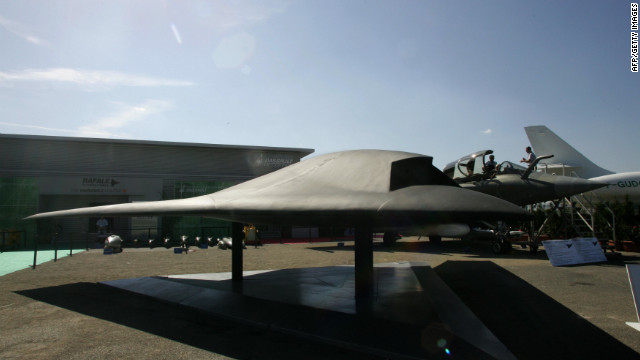 A model of of the European “Neuron” UAV at the Paris Air Show in Le Bourget, France in 2005. The UAV is an European Research project led by Dassault Aviation.
- Peter Bergen: American monopoly on drones is long gone; 70 nations have them
- He says drones will change warfare and lead to a new arms race
- China, Iran, Israel, European nations are among those with drones, he says
- Bergen: U.S. use of drones is setting a precedent without enough discussion of the legal issues
Editor’s note: Peter Bergen, CNN’s national security analyst, is director of the national security studies program at the New America Foundation, a Washington-based think tank that seeks innovative solutions across the ideological spectrum, and the author of the new book “Manhunt: The Ten-Year Search for Bin Laden — From 9/11 to Abbottabad.” Jennifer Rowland is a program associate at the New America Foundation
Washington (CNN) — A decade ago, the United States had a virtual monopoly on drones.
Not anymore. According to data compiled by the New America Foundation, more than 70 countries now own some type of drone, though just a small number of those nations possess armed drone aircraft.
The explosion in drone technology promises to change the way nations conduct war and threatens to begin a new arms race as governments scramble to counterbalance their adversaries.
Late last month, China announced that it would use surveillance drones to monitor a group of uninhabited islands in the South China Sea that are controlled by Japan but claimed by China and Taiwan.
In August 2010, Iran unveiled what it claimed was its first armed drone. And on Tuesday, the country’s military chief, Gen. Amir Ali Hajizadeh, disclosed details of a new long-range drone that he said can fly 2,000 kilometers (1,250 miles), which puts Tel Aviv easily in range.
But without an international framework governing the use of drone attacks, the United States is setting a dangerous precedent for other nations with its aggressive and secretive drone programs in Pakistan and Yemen, which are aimed at suspected members of al Qaeda and their allies.
Just as the U.S. government justifies its drone strikes with the argument that it is at war with al Qaeda and its affiliates, one could imagine that India in the not too distant future might launch such attacks against suspected terrorists in Kashmir, or China might strike Uighur separatists in western China, or Iran might attack Baluchi nationalists along its border with Pakistan.
This moment may almost be here. China took the United States by surprise in November 2010 at the Zhuhai Air Show, where it unveiled 25 drone models, some of which were outfitted with the capability to fire missiles.
It remains unclear just how many of China’s drones are operational and how many of them are still in development, but China is intent on catching up with the United States’ rapidly expanding drone arsenal.When President George W. Bush declared a “War on Terror” 11 years ago, the Pentagon had fewer than 50 drones.
Now, it has around 7,500.
As Bush embarked on that war, the United States had never used armed drones in combat. The first U.S. armed drone attack, which appears to be the first such strike ever, took place in mid-November 2001 and killed the military commander of al Qaeda, Mohammed Atef, in Afghanistan.
Since then, the CIA has used drones equipped with bombs and missiles hundreds of times to target suspected militants in Pakistan and Yemen.
CNN Radio: Drone debate — who can you trust?
Only the United States, United Kingdom and Israel are known to have launched drone strikes against their adversaries, although other members of the International Security Assistance Force in Afghanistan, such as Australia, have “borrowed” drones from Israel for use in the war there.
Drone technology is proliferating rapidly. A 2011 study estimated that there were around 680 active drone development programs run by governments, companies and research institutes around the world, compared with just 195 in 2005.
In 2010, U.S.-based General Atomics received export licenses to sell unarmed versions of the Predator drone to Saudi Arabia, Egypt, Morocco and the United Arab Emirates. And in March, the U.S. government agreed to arm Italy’s six Reaper drones but rejected a request from Turkey to purchase armed Predator drones.
An official in Turkey’s Defense Ministry said in July that Turkey planned to arm its own domestically produced drone, the Anka.
Israel is the world’s largest exporter of drones and drone technology, and the state-owned Israeli Aerospace Industries has sold to countries as varied as Nigeria, Russia and Mexico.
Building drones, particularly armed drones, takes sophisticated technology and specific weaponry, but governments are increasingly willing to invest the necessary time and money to either buy or develop them, as armed drones are increasingly seen as an integral part of modern warfare.
Sweden, Greece, Switzerland, Spain, Italy and France are working on a joint project through state-owned aeronautical companies and are in the final stages of developing an advanced armed drone prototype called the Dassault nEURon, from which the France plans to derive armed drones for its air force.
And Pakistani authorities have long tried to persuade the United States to give them armed Predator drones, while India owns an armed Israeli drone designed to detect and destroy enemy radar, though it does not yet have drones capable of striking other targets.
The Teal Group, a defense consulting firm in Virginia, estimated in June that the global market for the research, development and procurement of armed drones will just about double in the next decade, from $6.6 billion to $11.4 billion.
States are not alone in their quest for drones. Insurgent groups, too, are moving to acquire this technology. Last year, Libyan opposition forces trying to overthrow the dictator Moammar Gadhafi bought a sophisticated surveillance drone from a Canadian company for which they paid in the low six figures.
You can even buy your own tiny drone on Amazon for $250. (And for an extra $3.99, you can get next-day shipping.)
As drone technology becomes more widely accessible, it is only a matter of time before well-financed drug cartels acquire them. And you can imagine a day in the not too distant future where armed drones are used to settle personal vendettas.
Given the relatively low costs of drones — already far cheaper than the costs of a fighter jet and of training a fighter jet pilot — armed drones will play a key role in future conflicts.
Opinion: When are drone killings illegal?
While the drone industry thrives and more companies, research institutes and nations jump on board the drone bandwagon, the United States is setting a powerful international norm about the use of armed drones, which it uses for pre-emptive attacks against presumed terrorists in Pakistan and Yemen. It is these kinds of drone strikes that are controversial; the use of drones in a conventional war is not much different than a manned aircraft that drops bombs or fires missiles.
According to figures compiled by the New America Foundation, drone attacks aimed at suspected militants are estimated to have killed between 1,900 and 3,200 people in Pakistan over the past eight years.
While there has been considerable discussion of the legality of such strikes in a number of U.S. law schools, there has been almost no substantive public discussion about drone attacks among policymakers at the international level.
The time has come for some kind of international convention on the legal framework surrounding the uses of such weapons, which promise to shape the warfare of the future as much as tanks and bombers did during the 20th century.
(Fatima Mustafa and Farhad Peikar contributed to the research for this article.)
Follow @CNNOpinion on Twitter
Join us at Facebook/CNNOpinion
Rebuilding Afghanistan’s Highway One, New America Foundation, Washington DC
Men at Work: Rebuilding Afghanistan’s Highway One
Please join the New America Foundation’s National Security Studies Program for a conversation with Xavier Cronin, author of The Asphalt Ribbon of Afghanistan, on the circumstances surrounding the long, costly U.S. effort to reestablish a key portion of Afghanistan’s roads. Was it worth the loss of life that occurred, the $300 million price tag, and the post-completion destruction of many of its new bridges and sections of road?
Since 2002, the United States has spent tens of billions of dollars on Afghanistan’s infrastructure. Now, we are left to determine what we have to show for it. Cronin and Bergen will discuss what American investments have achieved in Afghanistan, as well as the status of several big-ticket projects that are still in the works.
PARTICIPANTS
Featured Speaker
Xavier A. Cronin
Author, The Asphalt Ribbon of Afghanistan
Discussant
Peter Bergen
Director, National Security Studies Program, New America Foundation
Northwestern Lake Forest Hospital, Chicago, Illinois
Global Partnership for Afghanistan, Asia Society, New York
Global Partnership For Afghanistan’s Work Harvesting Peace Global Partnership for Afghanistan invites you to celebrate its role as a catalyst for development and peace and to discuss Afghanistan’s future with Peter Bergen, CNN national security analyst, journalist and author. Wednesday, October 24, 2012 Asia Society and Museum 725 Park Avenue @70th Street New York, New York 6:00 p.m. | Cocktail Reception and Program 7:45 p.m. | Dinner Reception & Program $350 | Reception, Program & Dinner $1,000 Sponsorship packages also available Purchase tickets online at www.gpfa.org For more information, event sponsorships, or to purchase tickets by phone, contact Kate McLetchie at kmcletchie@gpfa.org or 212-735-2541.
Keynote Speaker Peter Bergen
Co-Chairs Tom Freston and Dave Hardman Global Partnership for Afghanistan Host Committee (In Formation) Tom Freston, Co-chair Dave Hardman, Co-chair Ann Carmel and Daniel Wolk Drs. Joan and Peter Cohn Amy Foote and Lee Wolosky Dana and Bruce Freyer Jack and Betsy Hellmann Tyler and Jesse Jenner Polly and James McTaggart Professor Ishaq Nadiri and Dr. Tahira Homayun Ambassador Ronald E. Neumann (ret) Albert J. Zdenek, Jr. GPFA Board of Directors Dana Freyer, Chair and Co-founder Professor Ishaq Nadiri, Co-chair and Co-founder Amy Foote, Secretary Jay Shreiner, Treasurer Faruq Achikzad Thomas Casten Akram Fazel Bruce Freyer, Co-founder Dave Hardman Fred Kittler Maureen Quinn Nicole Sandford James Seymour Suzanne Thompson
With an estimated 80% of Afghans dependent on farming for their livelihoods, GPFA enables struggling farm families to create farm businesses that alleviate poverty, build sustainable livelihoods and renew the environment. Since 2004, with the help of our global and local partners, GPFA has provided the inputs, capital and training needed for rural Afghans to build a better future for their families.
Peter Bergen, Keynote Speaker CNN National Security analyst, Director of the New America Foundation’s National Security Studies Program, journalist and author of several New York Times best-selling books including The Longest War: The Enduring Conflict between America and Al-Qaeda and the recently released Manhunt: The Ten-Year Search for Bin Laden; from 9/11 to Abbottabad, Peter Bergen is a leading expert on international security and Central Asian geopolitical issues. He produced Osama bin Laden’s first television interview in 1997 and is the only outside observer to tour his Abbottabad compound. Bergen has won countless awards for his reporting and written for numerous publications including The New York Times, The Washington Post, Vanity Fair, Foreign Affairs, Rolling Stone, TIME, Newsweek, etc. He is a fellow at New York University’s Center on Law & Security.
Hood Hargett Breakfast Club, Charlotte, North Carolina
Peter Bergen – CNN National Security Analyst and Best-Selling Author of Holy War, Inc. and Manhunt

RSVP To This Event
 Peter Bergen – CNN National Security Analyst and Best-Selling Author of Holy War, Inc. and Manhunt
Nov 7, 2013
7:30 AM – 9:45 AM
Carmel Country Club
4735 Carmel Rd
Charlotte, NC 28226
Peter Bergen
CNN National Security Analyst and Best-Selling Author of Holy War, Inc. and Manhunt
One of the few Westerners to interview Osama bin Laden, journalist Peter Bergen is the foremost authority on foreign policy, national security, and the new generation of terrorism. In addition to serving as CNN’s terrorism analyst, he is the New York Times best-selling author of Holy War, Inc., which was translated into 18 languages. An expert in his field, Bergen serves as the director of the national security studies program at the New America Foundation in Washington D.C., where he leads the Foundation’s analysis of terrorism, counterinsurgency, South Asia’s geopolitics and other national security concerns. His latest book, Manhunt: The Ten Year Search for Osama bin Laden: From 9/11 to Abbottabad was released in May 2012.
His New York Times best-seller, The Longest War: the Enduring Conflict between America and Al-Qaeda, won the Gold Prize in the 2011 Washington Institute for Near East Policy’s annual book awards, which aims to reward outstanding writing and stimulate new contributions to the field of Middle East affairs. Writes the prize jury: “Peter Bergen draws on years of meticulous reporting, to uncover the thinking of al-Qaeda’s top strategists and the pitched battles in Washington over US policy. The ten-year war against al-Qaeda, in Afghanistan and elsewhere, is now the longest in American history. Yet while terror groups remain a threat, Bergen’s riveting account shows how American grit thwarted al-Qaeda’s drive to become the acclaimed champion of Islamism — at a price Americans still ponder and debate.” New York Times book reviewer Michiko Kakutani writes, “For readers interested in a highly informed, wide-angled, single-volume briefing on the war on terror so far, The Longest War is clearly that essential book.” Kirkus Reviews named The Longest War among its “Best Non-Fiction Books for 2011,” and the Times’ Tom Ricks describes the book as “stunning.”
Bergen also wrote The Osama bin Laden I Know: An Oral History of al Qaeda’s Leader, named one of the best non-fiction books of 2006 by The Washington Post. The book was translated into French, Spanish and Polish, and CNN produced a two-hour documentary, In the Footsteps of bin Laden, based on the book. Bergen was one of the producers of the Emmy-nominated documentary, which was named the best documentary of 2006 by the Society of Professional Journalists. His 2001 book, Holy War, Inc.: Inside the Secret World of Bin Laden, was a New York Times best-seller and was named one of the best non-fiction books of 2001 by The Washington Post. A documentary based on the book, which aired on National Geographic Television, was nominated for an Emmy in 2002.
Bergen has traveled repeatedly to Afghanistan, Pakistan, Egypt, and Saudi Arabia to report on bin Laden and al Qaeda. In his 2011 National Geographic Channel documentary, Last Days of Osama bin Laden, Bergen obtains rare access to interview former CIA agents, Navy SEAL operatives, and a Black Hawk pilot who reveal how the US gathered the intelligence needed to pull off the surprise attack. He talks to a White House and Pakistani intelligence officials as well as neighbors of the Pakistani compound and eyewitnesses to the raid.
Bergen also serves as a research fellow at New York University’s Center on Law and Security; a member of the Bipartisan Policy Center’s National Security Preparedness Group; is a former adjunct lecturer at the Kennedy School of Government at Harvard University; and a former Pew Journalist in Residence at the School of Advanced International Studies at Johns Hopkins University.
Bergen has written for a variety of publications including the New York Times, Los Angeles Times, The New Republic, Foreign Affairs, The Washington Post, Wall Street Journal, The Atlantic, Rolling Stone, TIME, The Nation, The National Interest, Mother Jones, Washington Times, Vanity Fair, The Guardian, The Times, The Daily Telegraph, and Prospect. He has also worked as a correspondent for National Geographic Television and Discovery Television. He is on the editorial board of Studies in Conflict & Terrorism, a leading scholarly journal in the field, and has testified on numerous occasions before congressional committees.
In 1997, as a producer for CNN, Bergen produced bin Laden’s first TV interview. He was the recipient of the Leonard Silk Journalism Fellowship in 2000 and a Pew fellowship in 2001 for Holy War, Inc, and in 1994 he won the Overseas Press Club Edward R. Murrow award for best foreign affairs documentary.
From 1998 to 1999, Bergen worked as a correspondent-producer for CNN. He was program editor for CNN Impact, a co-production of CNN and TIME, from 1997 to 1998. Previously, he worked for CNN as a producer. From 1985 to 1990, he worked for ABC News in New York. Bergen holds a master’s degree in modern history from New College, Oxford University.

Peter Bergen – CNN National Security Analyst and Best-Selling Author of Holy War, Inc. and Manhunt
Nov 07, 2013 (07:30 -09:45)
Carmel Country Club, Charlotte NC
Election 2012, AEI/CNAS/New America, Washington DC
With the country’s fiscal challenges at the center of the national conversation, little attention has been focused on the candidates’ national security policies. With less than a month remaining in the campaign season, join the Center for a New American Security, the American Enterprise Institute, and the New America Foundation for a debate between top-level surrogates of the Obama and Romney presidential campaigns. Dov S. Zakheim, Special Advisor on Foreign Policy and National Security for the Romney campaign, will join Richard Verma, member of the National Security Advisory Committee for the Obama campaign, to discuss the defense and foreign policy agendas of the two candidates.
This is the sixth in a series of events that continues a unique collaboration among these institutions during the U.S. presidential campaign season. Past conversations have covered the U.S. role in the world, the U.S. national security budget and U.S. policy in East Asia and the Middle East.
Willard InterContinental Hotel
Grand Ballroom
1401 Pennsylvania Avenue NW, Washington, DC.
Wednesday, October 10
1:00-2:30 p.m.
Registration and lunch will begin at 12:30 p.m.
Please click here to RSVP.
Featured Speakers
Richard Verma
Member, National Security Advisory Committee, Obama Campaign
Dov S. Zakheim
Special Adviser on Foreign Policy and National Security, Romney Campaign
Moderators
Thomas Donnelly
Resident Fellow and Co-Director of the Marilyn Ware Center for Security Studies, American Enterprise Institute
Richard Fontaine
President, Center for a New American Security
Peter Bergen
Director, National Security Studies Program, New America Foundation
This event will be webcast live at CNN.com/opinion. On Twitter? Follow this event @CNASdc and use #natsecurity2012.
About the Series:
This fall’s presidential election comes at a critical moment for the United States and the world. The demands for U.S. leadership are substantial–particularly in the dynamic Middle East and Asia-Pacific–yet fiscal challenges are forcing reductions in defense spending, sparking new thinking about American engagement with the world. In this important election season, many Americans will look to the next U.S. president to repair the economy, but he will nonetheless inherit complicated military and diplomatic engagements and govern as commander-in-chief of the globe’s most powerful nation. As a result, the discussion of national security issues must take a central role in the 2012 presidential election.
This event is the fifth in a series of campaign-season seminars on the critical issues of U.S. foreign and defense policy, sponsored by AEI, the Center for a New American Security and the New America Foundation.
Hunt for bin Laden. Sulgrave Club, Washington DC
“Kill or Capture” Book event with Dan Klaidman, New America Foundation, Washington DC
Kill or Capture
The War on Terror and the Soul of the Obama Presidency
Please join the New America Foundation’s National Security Studies Program for a conversation with senior Newsweek correspondent Daniel Klaidman, the author of a recent book on U.S. national security policies under the Obama Administration.
When Barack Obama entered office in 2009, many expected him to advance national security policies that prioritized civil liberties, shift America’s image away from that of an aggressor, and even end our involvement in conflicts around the world. Instead, he tripled the number of troops in Afghanistan, intensified the CIA drone program in Pakistan, and still hasn’t fulfilled his promise to close the detention facility at Guantanamo Bay. Klaidman and National Security Studies Program Director Peter Bergen will discuss the factors driving many of the Obama administration’s biggest decisions, and the impact those decisions have had on the nation’s effort to defeat al-Qaeda and its affiliates.
PARTICIPANTS
Featured Speaker
Daniel Klaidman
Author, Kill or Capture: The War on Terror and the Soul of the Obama Presidency
Interviewed by
Peter Bergen
Director, National Security Studies Program
New America Foundation
FEATURED BOOK

All the Presidents’ Wars:
RECENT ARTICLES

RECENT FILM AND TV SERIES
GHOSTS OF BEIRUT: SHOWTIME
The Fall of Osama bin Laden, National Geographic

BIN LADEN'S HARD DRIVE, NATIONAL GEOGRAPHIC

