Washington Golf and Country Club. Speaker Series – Peter Bergen. Hunt for Bin Laden
Washington Golf and Country Club. … Speaker Series – Peter Bergen. Wednesday, October 03, 2012 6:30 …
Hunt for bin Laden, DACOR, Washington DC
DACOR Bacon House is at the corner of 18thand F Streets in Northwest Washington. Our street address is 1801 F Street NW.
12 – 12:30 A reception in Mr. Bergen’s honor
12:30 – 1:05 Lunch
1:10 – 1:40 His presentation
1:40 – 1:55 Q & A
2:00 Finish
Is Al-Qaeda Defeated? An Experts’ Debate, New America Foundation, Washington DC
|
||||


“Manhunt”, Macalester College, St.Paul, Minnesota
Peter Bergen, Author of “Man Hunt: The Ten-Year Search for bin Laden from 9/11 to Abbottabad,” to Speak
Starts 7:00 PM
Tuesday Oct 30, 2012
Weyerhaeuser Memorial Chapel
Peter Bergen, a print and television journalist and author; the director of the national security studies program at the New America Foundation in Washington D.C.; a fellow at Fordham University’s Center on National Security and CNN’s national security analyst, has a new book call Man Hunt: The Ten-Year Search for bin Laden from 9/11 to Abbottabad. It is based on exhaustive research and unprecedented access to White House officials, CIA analysts, Pakistani intelligence, and the military; this is the definitive account of ten years in pursuit of bin Laden and of the twilight of al-Qaeda. Books will be available for purchase and signing following his talk.
This event is for: Students, Staff and Faculty
Sponsored By: International Studies
Categories: Front Page Events and Lectures and Speakers
Hoban Forum Lecture Series, Lackawanna Bar Association, Scranton, Pennsylvania
T. Linus Hoban Lecture
T. Linus Hoban Lecture – October 25 – 7:00 p.m. University of Scranton DeNaples Center
Guest Lecturer, Peter Bergen, CNN National Security Analyst &
Best Selling Author of Holy War, Inc. & Manhunt.
Members of the LBA may reserve 2 tickets by calling 570-969-9161. Additional tickets
will be distributed one week prior to event based on availability.
One of the few Westerners to interview Osama bin Laden, Peter Bergen, a CNN national security analyst, will discuss his recent book, “Manhunt: The Ten Year Search for Osama bin Laden: From 9/11 to Abbottabad,” at the Honorable T. Linus Hoban Memorial Forum at The University of Scranton. The lecture is slated for Thursday, Oct. 25, at 7 p.m. in the McIlhenny Ballroom of the DeNaples Center on campus.
The public is invited to attend the lecture free of charge.
A leading authority on foreign policy, national security and the new generation of terrorism, Bergen interviewed bin Laden in 1997. That encounter served as the basis for his 2006 book, “The Osama bin Laden I Know: An Oral History of al Quaeda’s Leader,” and the CNN documentary, “In the footsteps of bin Laden,” which he co-produced that year. The book was named one of the best non-fiction works of 2006 by The Washington Post, and the Emmy-nominated film was named the year’s best documentary by the Society of Professional Journalists.
In addition to his position at CNN, Bergen serves as the director of the National Security Studies Program at the New American Foundation in Washington, D.C., where he leads the foundation’s analysis of terrorism, counterinsurgency, South Asia’s geopolitics and other national security concerns. He also serves as a research fellow at New York University’s Center on Law and Security and is a member of the Bipartisan Policy Center’s National Security Preparedness Group.
An award-winning author, Bergen has written two New York Times best sellers. “The Longest War: the Enduring Conflict between America and Al-Qaeda” won the 2011 Gold Prize from the Washington Institute for Near East Policy. He was the recipient of the Leonard Silk Journalism Fellowship in 2000 and a Pew fellowship in 2001 for “Holy War, Inc.: Inside the Secret World of Bin Laden,” which has been translated into 18 languages.
Bergen has also written for The New York Times, The Wall Street Journal, Time, Rolling Stone and several other prestigious publications, and he was a correspondent for National Geographic Channel and Discovery Channel before coming to CNN.
For more information, call 941.7401.
Institutional Investor, Washington DC
Searching for Yield, Seeking Solutions
Corporate Funds Roundtable – Institutional Investor Institute
The combination of low interest rates and higher-than-expected inflation levels, given the slow growth environment, will continue to pose challenges for investors looking to meet their pension obligations now and in the future. How are plan sponsors responding with regards to the construction of portfolios, plan governance procedures and risk management practices? A series of presentations, workshops and discussion groups will allow participants to exchange ideas with industry leaders and government officials.
Monday, March 4, 2013 (Pre-Roundtable)
Join us for a special Investor-only session: Prior to the official start of the Roundtable, at 5pm on Monday, March 4th, we will be hosting an investor-only private conversation followed by cocktails & dinner at the acclaimed CityZen restaurant, please join your peers.
Investor-only Session/Private Conversation
5.00
Welcome Reception & Dinner for All Delegates at CityZen, Mandarin Oriental
6:00 -8:30
Opened by renowned Chef Eriz Ziebold (Spago, The French Laundry, Per Se) in 2004, CityZen has been awarded and recognized as one of the best restaurants in the country. Join us to kick off the conference.
Tuesday, March 5, 2013
Continental Breakfast & Registration
7:45
Welcome
8:30
Robin Coffey, Director, Institutional Investor Memberships
Global Macro Overview
8:45
Zachary Karabell, President of River Twice Research, author, and television commentator will challenge the audience with his intriguing views on economic and political trends. Designated a “Global Leader for Tomorrow” by the World Economic Forum in Davos, Karabell will discuss issues ranging from the economic outlook in China and the U.S. to the concept of “sustainable excellence”.
9:15
The hedge fund industry continues to be a driving force in the investment world. The range of instruments and strategies pursued by hedge funds is expanding along with the number of hedge fund portfolios. But while many investors are increasing their allocation to hedge funds, others are having second thoughts after several years of mixed results from the hedge fund industry. Are the days of significant outperformance gone? What’s going on in this important segment of the investment world, and what does it mean for pension funds?
Ben Appen, Founding Partner, Magnitude Capital
Steve Bulko, CIO, 1798 Fundamental Strategies Fund, Lombard Odier Investment Management Clint Carlson, Chief Investment Officer and Founder, Carlson Capital, L.P.
David Harmston, Head of Client Group, Albourne America LLC
Gregory T. Williamson, Chief Investment Officer & Director, Trust Investments, BP America Inc.
Zachary Karabell, President , River Twice Research
Back to Basics in Hedge Funds
Coffee Break
10:15
Less than Zero
10:45
Corporate Funds Roundtable – Institutional Investor Institute
The hunt for yield is putting a squeeze on investors. With low interest rates here for the foreseeable future, how are corporate investment officers thinking about portfolio construction in light of their liability obligations? Fixed income’s dwindling return expectations and equities’ volatility are causing institutional investors to lean more heavily than ever on alternative investments. While the trend toward alternatives is old news, what’s new is the quickening pace. This session will explore how and why corporate plan sponsors are thinking about portfolio construction in both the short and long term.
11:45
Building on the morning sessions, breakout groups will discuss the latest trends in portfolio construction, dynamic asset allocation and hedge fund strategies.
Moderator: Joseph Nankof, Partner, Rocaton Investment Advisors, LLC
Douglas J. Brown, Senior Vice President & Chief Investment Officer, Exelon Corporation
Christopher K. Li, President and Chief Investment Officer, Lockheed Martin Investment Management Company Brian Pellegrino, Chief Investment Officer, United Parcel Service of America Inc.
Additional speakers to be announced.
Discussion Groups – Portfolio Construction
DISCUSSION GROUP LEADERS:
- Sanjay Chawla, Senior Director Asset Allocation & Canada Pension, Dow Chemical Company
Harlan Fabrikant Saroken, Managing Director, Marketing & Investor Relations, Perry Capital LLC
- Robert A. Thompson, Fixed Income Portfolio Manager, UPS Group Trust
Robert E. Fried, Senior Relationship Manager, Bridgewater Associates, LP
- Bas NieuweWeme, Senior Vice President, Head of Institutional Sales, ING Investment Management
Steve Deutsch, Director of Investment & Risk Management, Underwriters Laboratories, Inc.
- Mike Mikytuck, Director, Business Development, Benchmark Plus Management LLC
Co-leader to be announced.
Lunch & Featured Speaker
12:45
Peter Bergen, National Security Analyst, CNN and Best-Selling Author of Holy War, Inc. and Manhunt
2:15
One of the few Westerners to interview Osama bin Laden face-to-face, journalist Peter Bergen is the foremost authority on foreign policy, national security, and the new generation of terrorism that threatens the West. The CNN terrorism analyst’s most recent book is Manhunt: The Ten-Year Search for Bin Laden — from 9/11 to Abbottabad, an account that now forms the basis of a major motion picture due out later this year.
Extremists and leaders incite violent protests, CNN
Extremists and leaders incite violent protests
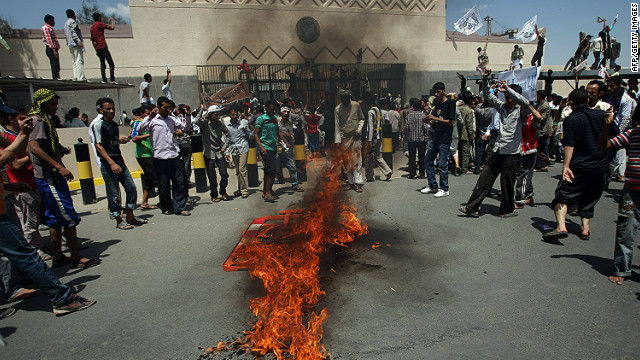
- Peter Bergen: Violence against U.S. over film is part of a pattern of incidents
- He says Christian and Muslim extremists have incited deadly protests for years
- Bergen: In several cases, the words of political leaders have helped spark violence
Editor’s note: Peter Bergen, CNN’s national security analyst, is director of the national security studies program at the New America Foundation, a Washington-based think tank that seeks innovative solutions across the ideological spectrum, and the author of the new book “Manhunt: The Ten-Year Search for Bin Laden — From 9/11 to Abbottabad.” Jennifer Rowland is a program associate at the New America Foundation.
Amsterdam (CNN) — On November 2, 2004, Dutch filmmaker Theo van Gogh was bicycling to work in Amsterdam when he was shot eight times at close range. He died instantly, but in a fit of rage, his assailant, Dutch-Moroccan Mohammed Bouyeri, also attempted to cut off his head with a machete.
Bouyeri killed van Gogh because of a short film he had recently produced with Somali-born Dutch politician Ayaan Hirsi Ali that criticized Islam’s treatment of women.
The film showed verses of the Quran projected onto the bodies of several naked young women. It was a film designed to provoke. And it did. Ali subsequently went into a self-imposed exile in the United States.
News: Six things to know about the attack
Now, seven years later, a short, amateurish film entitled “Innocence of Muslims,” purportedly created by Sam Bacile in the U.S., portrays the Prophet Mohammed as a philandering child molester. (“Sam Bacile” appears to be a pseudonym.)
Terry Jones, a Christian pastor based in Florida who has a long history of making incendiary statements about Islam, is promoting “Innocence of Muslims.” Jones also recently called for an “International Judge Mohammed Day” to be held on the 11th anniversary of 9/11, this past Tuesday.
News about the film has sparked outrage in the Muslim world. Mobs have attacked American embassies and consulates in Egypt, Libya and Yemen. The U.S. ambassador to Libya, J. Christopher Stevens, and three of his staff members were killed in what appears to have been a well-organized attack on the U.S. consulate in Benghazi on Tuesday. The attackers may have used the opportunity presented by the film protests to mount the assault.
These attacks came after the accidental burning of Qurans by U.S. soldiers at Bagram Air Base in Afghanistan in February sparked massive protests across the country, resulting in the deaths of at least 30 Afghans and six U.S. soldiers, all of whom were shot by men in Afghan security force uniforms.
Opinion: Survivor of 1979 consulate attack — Libya an eerie echo
And these are just the latest in a series of violent reactions to the perceived disrespect of the prophet and the Quran by Westerners — sometimes intentional and sometimes unintentional — that, in an increasingly globalized world of almost instantaneous communication, has intensified significantly during the past several years. And Muslim extremists as well as Christian fundamentalists in the West have increasingly intentionally amplified this trend.
Politicians and the media in the Muslim world have also played an important, though perhaps unintended, role in stirring up violence in the wake of a number of these perceived attacks on Islam.
A YouTube video of “Innocence of Muslims” that provoked the Libyan mob to attack the U.S. consulate in Benghazi was initially published in July, but it was not until versions of it dubbed in Arabic appeared online and were broadcast by religious Egyptian news channel al-Nas that protests sprouted in Egypt.
A May 2005 Newsweek article claiming that American soldiers at Guantanamo had flushed a copy of the Quran down the toilet went unnoticed for nearly a week before Pakistani politician Imran Khan pointed the article out in a news conference. More than a dozen people were subsequently killed during protests in Afghanistan. (Newsweek later retracted the story.)
Similarly, when Jones burned a copy of the Quran at his church on March 20, 2011, two weeks went by without any incident. But then President Hamid Karzai of Afghanistan made a speech calling for his arrest. Within 24 hours, protesters stormed the United Nations compound in Mazar-e Sharif in northern Afghanistan, killing seven foreign employees, and demonstrations across the country killed more than a dozen other people.
In 2005, the Danish newspaper Jyllands-Posten published 12 cartoons of the Prophet Mohammed, setting off a wave of protests and attacks over the next several years in which as many as 200 people have been killed.
In 2008, for instance, al Qaeda claimed responsibility for the bombing of the Danish Embassy in Islamabad, which killed a half-dozen bystanders, saying the powerful suicide car bomb was in retaliation for the offensive cartoons. Two years later, Kurt Westergaard, one of the cartoonists, barely escaped from a Somali man linked to Al-Shabaab, al Qaeda’s Somali affiliate, who broke into the cartoonist’s home in Denmark with a knife and ax.
But the violence sparked by the Jyllands-Posten cartoons, one of which depicted the Prophet Mohammed with a turban-wrapped bomb on his head, began a full four months after the images were published by the newspaper and were the result of a carefully orchestrated campaign by two Danish Muslim clerics who toured the Middle East, presenting a dossier about the cartoons to important religious and political figures.
Opinion: Libya killings show U.S. at risk in Arab world
Included in the dossier were cartoons that had never appeared in the Jyllands-Posten newspaper, showing offensive images of the Prophet Mohammed.
As a result, entering the Jyllands-Posten newspaper in Copenhagen today is akin to visiting a prison, with a heavily barred set of metal gates securing entrance to the building. And just as author Salman Rushdie remains under threat decades after the 1989 fatwa against him for his novel “The Satanic Verses,” so too the threat against Jyllands-Posten is likely to endure for many years.
On Wednesday, Karzai released a public statement strongly condemning the recent “criminal act.” This was not a reference to the assault on the U.S. consulate in Libya a day earlier that resulted in the four deaths there but to the release of “Innocence of Muslims,” the video that denigrates the Prophet Mohammed.
News: Unanswered questions after the attack
Karzai did express his condolences about the deaths at the Libyan consulate when he spoke privately to President Obama. However, his public statement will surely draw attention to an issue that is likely to cause additional violent protests in Afghanistan, which NATO forces are steeling themselves for.
With allies like these, who needs enemies?
Follow @CNNOpinion on Twitter
Join us at Facebook/CNNOpinion
11 years after 9/11: Who are the terrorists? CNN
11 years after 9/11: Who are the terrorists?

- In 11 years since September 11, 2001, sources of terror in U.S. have been diverse
- Peter Bergen: Terrorists unaffiliated with jihadi groups have taken a toll
- He says law enforcement naturally focused on jihadi groups after 9/11 but should broaden scope
Editor’s note: Peter Bergen, CNN’s national security analyst, isdirector of the national security studies program at the New America Foundation, a Washington-based think tank that seeks innovative solutions across the ideological spectrum, and the author of the new book “Manhunt: The Ten-Year Search for Bin Laden — From 9/11 to Abbottabad.” Jennifer Rowland is a program associate at the New America Foundation.
(CNN) — On August 15, Floyd Lee Corkins allegedly walked into the Family Research Council in Washington, a conservative think tank, and shot the building manager Leo Johnson in the arm, saying something along the lines of, “I don’t like your politics,” as he did so.
Despite his gunshot wound, police say, Johnson was able to tackle Corkins and wrestle his weapon away before he could harm anyone else. (Corkins pleaded not guilty when he was indicted.)
Corkins was volunteering at a Washington community center for lesbian, gay and transgender individuals and his parents said their son had “strong opinions with respect to those he believes do not treat homosexuals in a fair manner.” The Family Research Council promotes the view that homosexuality is harmful to society.
Three years earlier, also in Washington, rabid anti-Semite James von Brunn was charged with shooting and killing Holocaust Museum security officer Stephen Johns. He died while in custody.
Opinion: After 9/11, how we honored our son’s memory
The shootings at the Holocaust Museum and Family Research Council underlined the fact that acts of political violence against civilians, commonly referred to as terrorism, can be carried out by those espousing many different types of ideology.
 NYPD’s Kelly: NYC safer today
 ‘American altruism’ of 9/11 responders
 9/11 1st responders get cancer coverage
In fact, since the terrorist attacks that killed nearly 3,000 people at the World Trade Center and Pentagon 11 years ago, 19 people have died in terrorist attacks in the United States that were motivated by ideologies that have nothing to do with the ideas of Osama bin Laden, but rather were the victims of terrorists motivated by extreme anti-government views or virulent anti-Semitic/neo-Nazi views.
Jihadist terrorists, on the other hand, have killed 17 people, according to data compiled by the New America Foundation from thousands of news reports and court documents. (“Jihadist” terrorists are defined in this database as those associated with or motivated by al Qaeda, or its affiliates or like-minded groups.)
There have been 10 deadly attacks in the United States by nonjihadist extremists since 9/11 compared to just four by jihadists. (One of those incidents was at Fort Hood, Texas, in 2009 in which 13 were killed.)
The New America Foundation study suggests that law enforcement’s tendency to regard Muslim-American communities as the most likely source of terrorism risks missing the threat from other extremists.
Since 9/11, jihadist and nonjihadist terrorists have killed about the same number of people in the United States, yet 61% of the 337 people indicted for terrorism-related activities since the 9/11 attacks are jihadists, according to the New America Foundation data.
Revisiting the mosque at Ground Zero
Since 2009 and 2010 there has been a sharp drop in the number of jihadist defendants, which peaked at 43 and 34 respectively. This year the number of jihadist defendants has dropped to 7, suggesting that the threat from these kinds of terrorists is receding.
The spike in jihadist terrorism defendants in 2009 and 2010 was itself largely due to the indictment of a ring of men in Minneapolisconspiring to send themselves and others to Somalia in order to fight on behalf of the al Qaeda linked militant group al-Shabaab.
Nine of the 43 jihadists indicted in 2009 were involved in plans to send fighters to Somalia, and 18 of the 34 jihadists indicted in 2010 were also part of this network.
U.S. authorities have recently come under fire for purportedly discriminatory counterterrorism tactics, such as the unjustified monitoring of mosques and cafes frequented by Muslims and the inclusion of language in FBI documents and textbooks that stereotypes or presents factually incorrect information about Muslims.
Of course, 9/11 rightly brought great law enforcement focus on possible jihadist terrorists. But the New America Foundation’s data tends to support the view that law enforcement is more likely to target suspected Muslim militants than other extremists.
Although authorities are just as likely to use information provided by a confidential informant in the investigation of both jihadist and nonjihadist terrorist suspects, they are far more likely to place an undercover agent with a suspected jihadist terrorist suspect than a right-wing or left-wing extremist. An overwhelming 78% of the terrorism-related indictments that relied on an undercover agent were jihadist cases.
Of the 16 people who have been indicted since 2001 on terrorism-related weapons charges after some sort of sting operation in which the weapons were provided by the U.S. government, 75% were jihadists.
Yet the data indicates that nonjihadist terrorists are actually much more likely to have acquired weapons. Since 2001, 64% of the 127 people indicted on terrorism-related weapons charges were nonjihadist terrorists, such as Isaac Aguigui, one of four U.S. Army soldiers indicted in June for allegedly amassing $87,000 worth of guns and bomb parts that they planned to use in terrorist attacks against their home base of Fort Stewart, Georgia, and a park in nearby Savannah, Georgia.
Belief: Atheists continue battle against World Trade Center cross at memorial
Just last month, seven people, including two with links to the militant anti-government Sovereign Citizens movement, were indicted in connection with the shooting of four police officers in LaPlace, Louisiana, two of whom were killed. Authorities say Brian Smith allegedly opened fire with an assault rifle on a policeman directing traffic, and then led cops on a high-speed chase that ended at a trailer park, where others were waiting. The two officers were killed in the ensuing gunfight. (Smith has pleaded not guilty.)
Additionally, the New America Foundation found that no jihadist terrorists have acquired or even attempted to acquire chemical and biological weapons since 9/11, while 11 anarchist, white supremacist or right-wing extremists have been indicted for possessing such materials, and another four were indicted for attempting to produce them.
Some politicians and much of the public continue to believe that the threat from terrorists comes from violent jihadists, when in reality far-right extremists pose as much or possibly even more of a threat, something that we would do well to consider on the 11th anniversary of 9/11.
(Thanks to Megan Braun, Fatima Mustafa, Farhad Peikar, and Umar Farooq for their research help.)
Drone is Obama’s weapon of choice, CNN
Drone is Obama’s weapon of choice
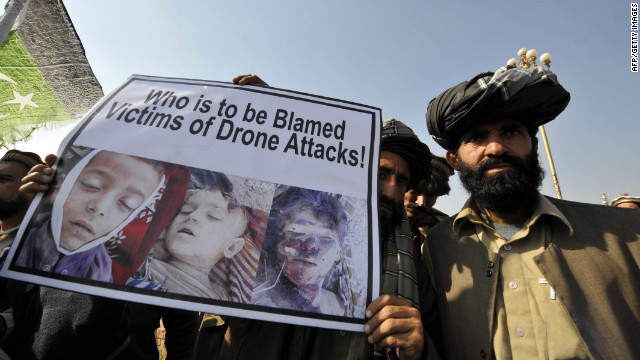
- Peter Bergen: Obama’s drone campaign shifts to Taliban militants, not al Qaeda leaders
- Bergen: Obama has stepped-up drone attacks as a key part of national security policy
- Drone strikes deeply resented in Pakistan, he says, but campaign there is waning
- Yemen in the sights now, he says, as Obama ahead of Romney on national security
Editor’s note: Peter Bergen, CNN’s national security analyst, is a director at the New America Foundation, a Washington-based think tank that seeks innovative solutions across the ideological spectrum. Megan Braun is a Rhodes scholar studying for an M. Phil at St. John’s College, Oxford.
(CNN) — Covert drone strikes are one of Obama’s key national security policies. He has already authorized 283 strikes in Pakistan, six times more than the number during President George W. Bush’s eight years in office.
As a result, the number of estimated deaths from the Obama administration’s drone strikes is more than four times what it was during the Bush administration — somewhere between 1,494 and 2,618.
Under Obama, the drone campaign, which during the Bush administration had put emphasis on killing significant members of al Qaeda, has undergone a quiet and unheralded shift to focus increasingly on killing Taliban foot soldiers.
Obama revealed: The man, the president
To the extent that the targets of drone attacks can be ascertained, under Bush, al Qaeda members accounted for 25% of all drone targets compared to 40% for Taliban targets. Under Obama, only 8% of targets were al Qaeda compared to just over 50% for Taliban targets.
And while under Bush, about a third of all drone strikes killed a militant leader, compared to less than 13% since President Obama took office, according to an analysis of thousands of credible media reports about the strikes undertaken by the New America Foundation.
While Bush sought to decapitate the leadership ranks of al Qaeda, Obama seems to be aiming also to collapse the entire network of allied groups, such as the Pakistani Taliban.
As a result, so-called “signature strikes” have become a hallmark of Obama’s drone war. These are drone attacks based on patterns of merely suspicious activity by a group of men, rather than the identification of a particular individual militant.
These have decimated the ranks of low-level combatants, killing somewhere between 1,332 to 2,326 reported militants. In April 2010, a militant told a New York Times reporter, “It seems they really want to kill everyone, not just the leaders.”
Obama’s drone campaign is quite controversial: Some claim that a substantial number of civilians are killed in the attacks, while U.S. government officials assert that the civilian casualty rate is now zero.
In Pakistan, the program is deeply unpopular and the Pakistani parliament voted in April to end any authorization for the program, a vote that the United States government has simply ignored.
The New America Foundation analysis of the drone campaign in Pakistan found that:
— The civilian casualty rate has been dropping sharply since 2008. The number of civilians, plus “unknowns,” those individuals whose precise status could not be determined from media reports, reported killed by drones in Pakistan during Obama’s tenure in office were 11% of fatalities. So far in 2012 it is close to 2%. Under President Bush it was 33%.
— Conversely, the percentage of militants killed has been rising over the life of the drone program. The number of militants reported killed by drone strikes is 89% of the fatalities under Obama compared to 67% under Bush.
— Some of these attacks were designed to help Pakistani interests. In the first eight months of 2009, the U.S. carried out 19 drone strikes targeting affiliates of the leader of the Pakistani Taliban, Baitullah Mehsud, who had carried out an extensive campaign of attacks against Pakistani police officers, soldiers and politicians. Mehsud was eventually killed by a CIA drone strike.
— Since it began in 2004, the drone campaign has killed 49 militant leaders whose deaths have been confirmed by at least two credible news sources. While this represents a significant blow to the militant chain of command, these 49 deaths account for only 2% of all drone-related fatalities.
Osama bin Laden himself recognized the devastation that the drones were inflicting on his organization, writing a lengthy memoabout the issue in October 2010 that was later recovered in the compound in Abbottabad, Pakistan, where he was killed by a team of U.S. Navy SEALs. In the memo to a lieutenant, bin Laden advised that his men leave the Pakistani tribal regions where the drone strikes have been overwhelmingly concentrated and head to a remote part of Afghanistan and he also suggested that his son Hamza decamp for the tiny, rich Persian Gulf kingdom of Qatar.
Buzz ramps up over SEAL’s bin Laden book
The year 2010 marked the most intense point of the Obama drone campaign, with a record 122 strikes. This combined with the May 2011 raid on bin Laden’s compound in Abbottabad, and the killing of at least 24 Pakistani soldiers in a NATO air strike in November severely damaged the relationship between the United States and Pakistan, and resulted in the eviction of CIA-controlled drones from Shamsi air base in Baluchistan in southwestern Pakistan.
At the same time, Cameron Munter, then-U.S. ambassador to Pakistan, was urging that there be more judicious targeting of the drone strikes as well as increased consultation with the Pakistanis about them.
In the past two years, there has also been increased congressional oversight of the program. The chairwoman of the Senate Intelligence Committee, Sen. Dianne Feinstein, D-California,explained in a May letter to the Los Angeles Times that “Committee staff has held 28 monthly in-depth oversight meetings to review strike records and question every aspect of the program including legality, effectiveness, precision, foreign policy implications and the care taken to minimize noncombatant casualties.”
Some combination of pushback from the State Department, increased congressional oversight, the closure of the CIA drone base in Pakistan and, perhaps, a declining number of targets in the tribal regions and a greater desire to heed Pakistani sensitivities about drone attacks has led to a sharp fall in the number of strikes since 2010.
The number of drone strikes in 2011 fell by 40% from the record number of strikes in 2010. So far this year, the number of strikes has dropped by a further 25%.
This is a welcome development. If the price of the drone campaign that increasingly kills only low-level Taliban is alienating 180 million Pakistanis — that is too high a price to pay.
While the drone campaign in Pakistan may be on the wane, it is amping up against the al Qaeda affiliate in Yemen. This year alone, Obama has authorized around 30 drone strikes in Yemen, while Bush only launched one drone attack there during his two terms in office.
Small wonder that as Obama prepares to address the Democratic Party convention in Charlotte, North Carolina, he continues to enjoy a considerable advantage over Mitt Romney on national security.
A Reuters poll in August found Obama leading Romney by a comfortable 12 percentage points on national security, which is traditionally regarded as a Republican strength.
Thanks to Fatima Mustafa, Farhad Peikar and Jennifer Rowland for their research help.
Morgenbladetsamtalen and Peter L. Bergen, Oslo, Norway
Morgenbladetsamtalen med Peter L. Bergen
Fredag 7. september kl. 1900, Kjelleren
Gratis
Arrangør: Morgenbladet

I ti år jaktet USA på Osama bin Laden, verdens mest ettersøkte person. I Manhunt, eller Menneskejakten på norsk, beskriver Peter L. Bergen denne intense jakten ved hjelp av eksklusive kilder og hittil ukjent materiale. Boken er en drivende fortelling om en av vår samtids mest dramatiske hendelser.
Peter L. Bergen intervjuet bin Laden for CNN i Afghanistan i 1997. I dette intervjuet erklærte al-Qaida-lederen for første gang krig mot USA overfor et vestlig publikum. Bergens første bok om bin Laden var ferdig skrevet en uke før 11. september 2001. Bergen er en autoritet på terrornettverket som den saudiske milliardærsønnen grunnla i 1988. 16 måneder etter bin Ladens død, lever al-Qaida videre. Hvor sterkt er nettverket i dag?
Bergen samtaler med Morgenbladets Tove Gravdal om jakten på bin Laden og al-Qaidas posisjon i dag.
Arrangør og tekst: Morgenbladet
For spørsmål om innhold, deltakere eller eventuelt billettsalg, ta kontakt direkte med arrangør.
FEATURED BOOK

All the Presidents’ Wars:
RECENT ARTICLES

RECENT FILM AND TV SERIES
GHOSTS OF BEIRUT: SHOWTIME
The Fall of Osama bin Laden, National Geographic

BIN LADEN'S HARD DRIVE, NATIONAL GEOGRAPHIC

