The threat Robert F. Kennedy Jr. poses to Covid-19 vaccination efforts, CNN.com
The threat Robert F. Kennedy Jr. poses to Covid-19 vaccination efforts
Opinion by Peter Bergen, CNN National Security Analyst
“Peter Bergen is CNN’s national security analyst, a vice president at New America and a professor of practice at Arizona State University. He is the senior editor of the Coronavirus Daily Brief and author of the new book “The Rise and Fall of Osama bin Laden.” The opinions expressed here are his own. Read more opinion at CNN.”
(CNN)For many years, Robert F. Kennedy Jr. has been a leader of the anti-vaccination movement in the United States. And, for much of that time, he has been seen as an outlier. Even before the pandemic, several of his family members — including Kathleen Kennedy Townsend, the former lieutenant governor of Maryland and former US Rep. Joseph P. Kennedy II — had taken him to task for spreading “dangerous misinformation” about vaccines.
Now Kennedy is one of the leaders of a movement that is encouraging Americans to risk their own health and even that of others, since those who are vaccinated can help reduce the risk of severe disease and help to limit the scope of the pandemic, according to the US Centers for Disease Control and Prevention (CDC). Kennedy, by virtue of his family name and the anti-vaxxer organization he leads — the innocuously named Children’s Health Defense Fund — as well as his high profile on social media, is now one of the largest sources of vaccine disinformation in the United States.
On Friday, a CDC report noted, “During October-November, unvaccinated persons had 13.9 and 53.2 times the risks for infection and COVID-19-associated death, respectively, compared with fully vaccinated persons who received booster doses.” In other words, a person could be more than 50 times more likely to die of Covid-19 if not vaccinated and boosted.
Notably, the vaccines against Covid-19 are also extremely safe. More than half a billion doses of these vaccines have been administered in the US, yet reports of serious adverse reactions or deaths attributable to the vaccinations are quite rare, according to the CDC.
Meanwhile, more than 860,000 Americans have died of Covid-19 since the pandemic began. But the US is so flooded with vaccine misinformation — and it’s only complicating further vaccination efforts. As of December 2021, 15% of American adults 18 and older remained unvaccinated, having not received even a first shot, according to the US Census Bureau — a figure that amounts to tens of millions of unvaccinated Americans.
Kennedy has contributed to this sorry state of affairs as one of the leading sources of vaccine misinformation in the US, according to a recent study released by the Center for Countering Digital Hate, a nonprofit nongovernmental organization seeking to address digital hate and misinformation.
On Sunday, Kennedy addressed a crowd of anti-vaxxers at a Washington, DC, rally convened, in part, by his Children’s Health Defense Fund. He claimed that the Biden administration’s policies on vaccines were worse than the Nazis’ persecution of the Jews, saying, “Even in Hitler Germany (sic), you could, you could cross the Alps into Switzerland. You could hide in an attic, like Anne Frank did.”
One of Kennedy’s majors may have been history at Harvard, but it seems to have had little effect on his actual understanding of the subject.
The Biden administration’s legitimate public health push for vaccine mandates to save an untold number of American lives is quite the opposite of the Nazis hunting down and killing 6 million Jews during the Holocaust. The use of safe vaccines by more than 200 million Americans is not a perversion of science as practiced by the Nazis, but a legitimate and approved use of medical science. And that’s to say nothing of his reference to Anne Frank, who ultimately perished in Bergen-Belsen, a Nazi concentration camp.
Though Kennedy’s invocation of the Nazis in the context of Covid-19 vaccine mandates is bonkers, it is not uncommon among anti-vaxxers. At Sunday’s rally, CNN reported on a number of anti-vaxxers carrying signs about Nazism — including “Make the Nuremberg Code great again!” The code, which explained the context in which medical experiments were permissible on human beings, was established during the prosecution of Nazis who experimented on Jews in the Holocaust.
And, in November, Fox Nation commentator Lara Logan compared Dr. Anthony Fauci, the chief medical adviser to Biden, to Dr. Josef Mengele, who infamously performed experiments on children and others prisoners held at Auschwitz concentration camp. Logan has since disappeared from the airwaves.
Kennedy, who has degrees from Harvard University, the London School of Economics and the University of Virginia School of Law, has had notable success in his career as an environmental lawyer who helped spearhead efforts to clean up the Hudson River. And all of his education and professional success makes his crusade against vaccines even more puzzling.
Yet, today, approximately two years into the worst global pandemic in a century, Kennedy is no longer a small-time anti-vaxxer, but one of the leaders of a movement that is imperiling the lives of many Americans.
How Aafia Siddiqui became an icon for terrorists, CNN.com
Peter Bergen is CNN’s national security analyst, a vice president at New America and a professor of practice at Arizona State University. His new book is “The Rise and Fall of Osama bin Laden.” The views expressed in this commentary are his own. View more opinion on CNN.
(CNN)The hostage-taker at the synagogue in Colleyville, Texas, Saturday was believed by US law enforcement to be motivated by the imprisonment of Aafia Siddiqui, a Pakistani who is serving an 86-year sentence at a prison in Fort Worth. She was arrested by US forces in Afghanistan almost a decade and half ago, yet her arrest continues to reverberate today.
To most Americans Siddiqui is an obscure figure, but among Islamist terrorists the mother of three is an icon.
After ISIS kidnapped American journalist James Foley in Syria in 2012 the terrorists sent an email to Foley’s family in August 2014 demanding the release of Siddiqui.
In 2009, US soldier Bowe Bergdahl was taken hostage by the Taliban in Afghanistan. One of the key Taliban demands for Bergdhal’s release was Siddiqui being freed from US custody.
Siddiqui, a slight Pakistani in her mid-thirties, was arrested in eastern Afghanistan in July 2008. US officials said she was carrying documents about the manufacture of “dirty bombs,” which are radiological weapons. They said she was also carrying notes about attacks against New York City landmarks such as the Empire State Building and the Brooklyn Bridge.
Siddiqui, who lived in the United States between 1991 and 2002, graduated from top US universities with a degree in biology from the Massachusetts Institute of Technology and a PhD in neuroscience from Brandeis.
After Siddiqui was arrested in Ghazni, Afghanistan, she was interrogated on July 18, 2008 by US soldiers and FBI officials. During that interrogation Siddiqui found an unattended rifle and fired it at a US officer and other members of the interview team. She also attacked an FBI agent and a US army officer as they tried to disarm her. She was subsequently charged with attempted murder.
In her native Pakistan, Siddiqui is lionized by some as a victim of the “war on terrorism.” Thousands took to the streets in protest when she was convicted of the attempted murder of the US army officer in 2010.
Now, once again, Siddiqui’s imprisonment in Texas is being used as a rationale for terrorism against Americans, this time in the United States itself.
American troops may have all departed Afghanistan in August, but America’s long war there continues to reverberate today.
Guantanamo at Twenty What is the Future of the Prison Camp? New America online
[ONLINE] – Guantanamo at Twenty
What is the Future of the Prison Camp?
January 11, 2022, marks the 20th anniversary of the opening of the military prison at Guantanamo Bay, which was established in the wake of the 9/11 attacks. It also marks the start of the prison’s second year under the direction of the Biden administration. So far, the Biden administration has released only one detainee, Abdul Latif Nasser. Thirty-nine detainees remain. What will happen to the prison and its detainees under the Biden administration? Will anyone else be released? Will the prison ever close?
Join New America’s International Security Program as they welcome Karen J. Greenberg, Thomas B. Wilner, and Andy Worthington for a discussion about what is next for the prison.
Join the conversation online using #GTMOat20 and following @NewAmericaISP.
PARTICIPANTS
Karen J. Greenberg, @KarenGreenberg3
Director, Center on National Security at Fordham Law School
Fellow, New America International Security Program
Author, Subtle Tools: The Dismantling of American Democracy From the War on Terror to Donald Trump
Thomas B. Wilner
Co-Founder, Close Guantanamo
Of Counsel, Shearman & Sterling, LLP
Andy Worthington, @GuantanamoAndy
Co-Founder, Close Guantanamo
Author, The Guantanamo Files: The Stories of the 774 Detainees in America’s Illegal Prison
MODERATOR
Peter Bergen, @peterbergencnn
Vice President of Global Studies & Fellows, New America
When
Jan. 11, 2022
10:30 am – 11:30 am
Where
Online Only
Webcast link
RSVP
The infectious disease expert who warned us 800,000 Americans would die of Covid-19, CNN.com
Updated 2:02 PM ET, Thu December 9, 2021
Peter Bergen is CNN’s national security analyst, a vice president at New America and a professor of practice at Arizona State University. He is the senior editor of the Coronavirus Daily Brief and author of the new book “The Rise and Fall of Osama bin Laden.” The opinions expressed here are his own. Read more opinion at CNN.
(CNN) Michael Osterholm is director of the Center for Infectious Disease Research and Policy at the University of Minnesota and author of The New York Times bestseller, “Deadliest Enemy: Our War Against Killer Germs.” He has been publicly warning of the dangers of a global pandemic for more than a decade and half and was a member of Joe Biden’s Covid task force during the presidential transition. In April 2020, he told me that he estimated that there could be 800,000 deaths from Covid-19 within 18 months in the US. That prediction has proven eerily prescient; a year and a half after Osterholm made that prediction more than 793,000 Americans have died from the disease. I spoke to Osterholm this week about what he sees ahead for the pandemic. Our conversation was edited for clarity.
BERGEN: There are about 30% of Americans who have chosen not to be vaccinated. What’s your message to them?
OSTERHOLM: You cannot outrun the game clock with this pandemic. This virus will find you and, unfortunately, many of the outcomes are very sad. Look at what’s happening right now in the US. We have health care systems around the country, including in my home state of Minnesota, that are hanging on by a thread. We’ve seen health care systems virtually broken by this pandemic. They just couldn’t provide critical care to non-Covid patients.
If you’re not going to get vaccinated for yourself, please get vaccinated for your loved ones and for the community because this is a very challenging situation.
The other thing to emphasize is that I don’t know if the Omicron variant will replace the Delta variant. But I think it is likely. Could that be a good thing? Maybe if it results in milder illness than we see with the Delta variant. But nonetheless, you still are going to get infected if you are not vaccinated.
BERGEN: Can the pandemic continue indefinitely? We are already almost two years into it in the US.
OSTERHOLM: I look at this through a lens of evolution. Early on in the pandemic, I anticipated this would go at least 18 months. That was because the only real perspective I had to understand what this coronavirus might look like was previous influenza pandemics. And I think that many of us assumed that at some point it would become a seasonal infection like influenza after two years or so.
I got a rude awaking earlier this year in March and April when I saw the new Alpha variant emerge as well as the Beta and Gamma variants, and I had a sense that this was going to change how the pandemic would unfold. As a result, I thought that some of the darkest days of the pandemic would be ahead of us and that was at a time in the spring when case numbers were dropping markedly in the United States and vaccine was flowing. But I realized that variants were like 210-mile-an-hour curveballs, and we couldn’t predict if they might have increased transmissibility or the ability to cause severe illness. This conclusion was not popular among many of my colleagues and policy makers.
So, when Delta emerged in December 2020, it wasn’t really a surprise. There are still many unanswered questions. Why, for example, did we see Delta emerging in India rather than in other countries, which had a major surge of Covid-19 cases in late spring, early summer 2021?
BERGEN: Do you have a theory about why Delta emerged first in India?
OSTERHOLM: No, I don’t. India has already had a big surge of Delta. I don’t know why India is not having another surge now given only 35% of the population is fully vaccinated. And you can’t attribute the lack of current cases to seasonality. Here we are in the middle of South Africa’s summer seeing the emergence of the recently identified Omicron variant.
Earlier this year, the hottest Covid regions in the world were simultaneously in South Asia — India, Pakistan and Nepal — and South America — Argentina, Paraguay and Uruguay. One region is in the Northern Hemisphere around 30 degrees latitude and the other is around 30 degrees latitude in the Southern Hemisphere.
So there just hasn’t been a predictability about why or where Covid will take root.
If I could understand why surges occur or why they go away or why they don’t happen, then I’d be in a better place to answer questions about where Covid is headed. All I can tell you is when a surge starts, the level of vaccination has a tremendous impact on how much pain and suffering occur with that surge.
In the States, we’ve seen an extended surge in Minnesota since early September and Michigan just hit a record number of Covid-19 hospitalizations. Our experience in Minnesota and Michigan is similar to what is being seen in the United Kingdom, where their Delta surge has been ongoing since July. Why? I don’t know. I’d just say with great humility, I know less about this virus today than I probably did a year ago.
BERGEN: The travel bans on South Africa and other African countries — are they helpful?
OSTERHOLM: No. The new variant was all around the world in the month of November. It clearly is highly infectious.
A “travel ban” is something that nations might do initially just to lock things down while they understand what’s going on — it is not meant to be a long-term solution. It’s like police at a crime scene. They lock it down for several hours to gather information and then open it back up again.
The political reaction of implementing a travel ban is not helpful in most cases. If it gives you 24 to 36 hours to at least get a lay of the land about what’s happening, then I think it can be useful. But if it persists after that, particularly when you have widespread transmission of the virus in other parts of the world already, it’s counterproductive.
BERGEN: You predicted in April 2020 that there could be 800,000 deaths in the United States in 18 months, and we’re now at 790,000-plus deaths right around that 18-month time frame. How did you make that prediction?
OSTERHOLM: I based my estimates at the time on historic data from previous pandemics.
What is troubling to me is our fascination with modeling. I think modeling, particularly when it’s erroneous, can be very detrimental. I’ve watched so many different estimates of case numbers from these models taken literally by policymakers and the public and particularly the media.
The reality is you can’t model beyond 30 days out. Just look at what is happening right now. We can’t even predict why these surges occur or when they occur. Who, 30 days ago, could have developed a model that would accurately predict what we’re seeing right now with Omicron? Who could have predicted that?
BERGEN: Do we know how deadly the Omicron variant is compared to previous variants?
OSTERHOLM: While it’s early, I believe that Omicron is less virulent than Delta. The variant is being studied in South Africa, which is important because the virus has been in that country longer than others. And we do know that hospitalizations, serious illness and deaths are lagging indicators. Rates often rise two to three weeks after rises in case numbers start to occur. But as of today, the epidemiologic and clinical data on Omicron cases around the world support this virus is less lethal than Delta.
When I look at these major Covid case clusters that are occurring right now, the outbreaks in Norway, Denmark, and in the UK, it’s been quite remarkable to see how many of these large numbers of cases involve fully vaccinated people, and how often these have resulted in very mild illnesses.
BERGEN: How necessary are boosters?
OSTERHOLM: When we first investigated the Covid-19 vaccines, we had to prioritize the assessment of the safety of the vaccines, which was done well. But we never really understood how to best use the vaccine in terms of number of doses, dose spacing, even the dose amount to maximize our immune response both for the short and long-term. We know that oftentimes the best immune response occurs when you have an extended period between the doses; in other words, allowing the immune system to basically recover and be capable of this enhanced response with the next dose. Look at how many vaccine schedules we have where that’s the case.
We already had a history suggesting that immunity from a coronavirus infection may be short-lived. So, I was concerned that we had concluded that we do only need two doses, with the mRNA vaccines, and we’re done.
When we started seeing breakthrough infections in midsummer, often six months or more from their second dose, I was initially very concerned about waning immunity. In fact, I repeatedly addressed this issue in my public statements about the remarkable success of the vaccines. I called these breakthrough infections “the future of Covid-19.”
Subsequently, the Israeli data, which was collected because of Israel’s unique national health system, was clear and compelling in its findings that waning immunity does occur at six to seven months out, and that we do need that third dose — and not as a luxury dose, but the third dose of a three-dose prime series. It should have been three doses all along.
The whole world should have access to three doses of a mRNA Covid vaccine and there would be nothing more tragic to me than having someone protected by a two-dose regimen for six to eight months, and then to get seriously ill and die because they didn’t get a booster. I think that one day this won’t even be a question. It will be a minimum three-dose vaccine.
BERGEN: Two percent of the population of low-income countries has had one shot versus 65% for high income countries. does that portend for the future?
OSTERHOLM: Two things: One is that this pandemic has really provided a window into our global vaccine capacity in a way nothing else has ever done before.
I think that there’s been some red herrings in terms of what the issues are. For example, we keep hearing about technology transfer and giving these countries the ability to make their own vaccines, and yet the expertise needed to make these vaccines is really at a premium. It’s very difficult to find people who know how to do this. So, it’s not enough to transfer technology to a low-income country if you don’t provide the expertise to make these vaccines. It’s not as simple as making chicken soup.
Also, our focus has been almost solely on getting vaccines to people around the world, which is surely important. But we haven’t been thinking nearly enough about what it would take to turn a vaccine into a vaccination, that needle into the arm. We have seen the challenges in this country with administering vaccinations, and those challenges also exist around the world.
So, just shipping a couple of pallets of vaccines to a low-income country may be a useless effort if, in fact, they don’t have the infrastructure to deliver the vaccine and they don’t have a means for helping the population understand how and why they should want to be vaccinated. What this whole situation has highlighted, is the fact that we have a lot more work to do to understand not just how to make vaccines, but also how to turn vaccines into vaccinations.
National Intelligence University online
Silurians Meeting Online
December 15, Noon
Silurians Zoom Meeting:
Peter Bergen is our Speaker
Peter Bergen
Dear Silurians
How much damage did Donald Trump and his generals do to our national security? What’s the real story behind the pursuit and killing of Osama Bin Laden? Is Al-Qaeda regaining strength for new attacks on the West from hideouts in the Taliban’s Afghanistan?
For our December speaker, the Silurians Press Club will host a man who knows the answers to these questions better than most. Peter Bergen is a journalist, author, documentary producer and Vice President at New America. He is also a professor at Arizona State University, a fellow at Fordham University’s Center on National Security and CNN’s national security analyst. He has held teaching positions at the Kennedy School of Government at Harvard University and at the School of Advanced International Studies at Johns Hopkins University.
Peter is also a compelling writer and author of a series of books on the threat to the U.S. from global terrorism. His latest is The Rise and Fall of Osama bin Laden, which The Times describes as a page-turner that not only puts flesh on the terrorist icon but chronicles “the missed opportunities, ignored warnings and strategic blunders of the United States” that led up to 9/11. Bergen’s The Longest War takes us from that tragic day through the equally tragic war in Afghanistan that just ended in U.S. humiliation.
So tune in to Zoom on Dec. 15 at noon for our talk with Peter. And get ready to resume Silurian lunches and dinners, which we will launch February 4 with a gala celebrating the work of Times photographer Chester Higgins. In a few days we will send you an Eventbrite link to sign up for that milestone event.
Your president,
Michael Serrill
Afghanistan’s American University in exile, CNN.com
Afghanistan’s American University in exile
Opinion by Peter Bergen
Peter Bergen is CNN’s national security analyst, a vice president at New America and a professor of practice at Arizona State University. Bergen has reported from Afghanistan since 1993. His new book is “The Rise and Fall of Osama bin Laden.” The views expressed in this commentary are his own. View more opinion on CNN.
Doha, Qatar (CNN)Five years ago, Breshna Musazai was studying law at the American University of Afghanistan in Kabul. Her future seemed bright. She was attending the best university in Afghanistan, a coed institution offering an American-style education and was on a full scholarship provided by the US government.
Then, on August 24, 2016, Taliban gunmen stalked the campus killing anyone who moved. One of them shot Musazai in the leg. She pretended to be dead and the gunman shot her again to finish her off. A bullet struck her in the foot. For the next six hours, as the terrorists rampaged on the campus Musazai lay motionless in a hallway.
The Taliban killed a total of 15 students and staff that day. The university was a prominent symbol of the American presence in Afghanistan, which made it an appealing target for the Taliban. For students, particularly women like Musazai, the university represented the modern world of Enlightenment values to which the Taliban have long stood in staunch opposition.
Five years after their assault on the American University of Afghanistan, the Taliban took over the whole country.
Much of the world may have assumed that the evacuation of at-risk Afghans following the Taliban takeover of Afghanistan in mid-August is over. But for many Afghans the story is ongoing. Of the 4,000 students, alumni and staff of the American University of Afghanistan, only around 600 are now estimated to have departed Afghanistan, the university’s President, Ian Bickford, told me.
(Disclosure: In May, I took part in a planning meeting with university leaders in which they discussed what to do if the Taliban did take over).
Musazai’s journey
Breshna Musazai was one of the lucky ones who survived the Taliban assault on her university in 2016, but she was grievously wounded and spent four months in a hospital in Kabul. She was then flown to Dallas, Texas, where she spent over six months at the First Baptist Medical Center. Doctors performed surgery on her leg, which saved it.
In the summer of 2017, Musazai, now using a wheelchair, returned to Kabul to complete her studies at the American University of Afghanistan. The following year at her graduation ceremony the audience stood up and applauded when 28-year-old Musazai accepted her degree.
Musazai told me that during the years that followed, like many of the students, staff and alumni of her university, she was worried by the military advances that the Taliban were making in Afghanistan, especially after US President Joe Biden announced in April that the total withdrawal of US troops from the country would be completed by the 20th anniversary of the 9/11 terror attacks.
In the months following Biden’s announcement, most US troops pulled out of Afghanistan as did thousands of allied NATO troops and more than 15,000 contractors, which precipitated the collapse of the Afghan military and government.
On August 15, as the militants rolled into Kabul, a family member told Musazai “The Taliban are here.” Musazai was in shock.
Someone from the American University of Afghanistan texted Musazai and told her that she and her brother could get on a flight out of the country. On August 17, Musazai went to Kabul airport where many thousands of desperate Afghans were jammed up against the walls and gates of the airport trying to get out.
The Taliban were firing guns in the air to try to control the crowds. Musazai was frightened; she had found the sound of gunfire especially terrifying ever since the attack at the university.
Musazai’s brother helped her with her bags and wheelchair and they got on a flight that took them to Doha, the capital of Qatar. There they settled in a gated community of houses that the Qatari government had built to house players playing in the soccer World Cup, which will take place next year in Qatar.
The fortunate few
Also staying at the housing complex were seven Afghan female business students from the American University of Afghanistan. Unlike Musazai, their names have not been made public, so we are not identifying them.
The students had to make snap decisions to leave their families behind and make the difficult choice to leave Afghanistan quickly.
Their families urged them to continue their studies even if it meant leaving their country forever.
The students told me that they were unable to get through the bedlam at the airport gate by themselves. The university told them to contact Qatari diplomats located in the upscale Serena Hotel in Kabul who would help them navigate their way to the airport.
The students gathered at the hotel and were escorted to the airport by Qatari government officials, who maintain cordial relations with the Taliban.
On August 19 they arrived in Doha where they joined an exodus of their fellow students. As of this month, around 450 current students have left Afghanistan, while 375 remain there, says Bickford, the American University of Afghanistan’s president.
The students who made it out of Afghanistan are now dispersed around the world where they continue to be taught in online classes. One hundred and nine of the students attend the American University of Iraq in Sulimaniya, while 106 are at the American University of Central Asia in Bishkek, Kyrgyzstan, and others are in countries such as Pakistan and Turkey.
Qatar will house 100 students at Doha’s Education City where American universities such as Georgetown and Northwestern maintain satellite campuses.
Only 50 of the American University of Afghanistan’s students have made it to the United States where they are housed in military bases while they are getting settled.
The seven female business students who made it to Doha are now living on the military base at Fort Dix, New Jersey. From there they will go on to attend Bard, a small, highly regarded liberal arts college in upstate New York.
Musazai remains in Doha. The injuries caused by the Taliban have complicated her ability to travel. Much of her immediate family did get to the United States and they are now living at a military base in the Midwest.
Musazai hopes to continue her studies in the United States in a master’s program on human rights law. It’s a career path that would not likely be available to her in Taliban-controlled Afghanistan.
H.R. McMaster’s view of the assault on the US Capitol, CNN.com
Opinion by Peter Bergen, CNN National Security Analyst
Updated 8:00 PM ET, Thu November 11, 2021
Peter Bergen is CNN’s national security analyst, a vice president at New America and a professor of practice at Arizona State University. He is the author of “Trump and His Generals: The Cost of Chaos.” The opinions expressed here are his own. Read more opinion on CNN.
(CNN)Lt. Gen. H.R McMaster was one of the most accomplished and competent of former President Donald Trump’s cabinet picks. On Wednesday, McMaster gave me a tour d’horizon of his views, including those about the debacle in Afghanistan which he blames on the Obama, Trump and Biden administrations, a fiasco that he believes China is now trying to take advantage of. McMaster also pointed to the conspiracy theories used by Trump to “incite an assault” on the US Capitol on January 6.
Trump asked McMaster to serve as his national security adviser after Lt. Gen. Michael Flynn was pushed out for providing “incomplete information” to then-Vice President Mike Pence about discussions he had with the Russian ambassador to the United States.
An active duty three-star general, McMaster had served heroically in the first Gulf War. As an Army captain, he led a tank battle that destroyed 28 Iraqi tanks, 16 personnel carriers and more than 30 trucks in under half an hour. McMaster was awarded the Silver Star for valor.
Then, as a colonel in the Iraq War in 2005, he led the first major victory against Al-Qaeda in Iraq in the city of Tal Afar.
While a major, McMaster earned his PhD, which became the book “Dereliction of Duty.” The book caused something of a sensation in the US military when it was published, as it took the top Pentagon generals to task for failing to provide substantive military advice to President Lyndon Johnson during the Vietnam War.
Following is our discussion, which was edited for clarity and flow.
BERGEN: You’ve described the Taliban peace agreement with the United States that was signed by the Trump administration in 2020 and implemented by the Biden administration this year as a “surrender agreement.” Who’s responsible for this surrender?
McMASTER: Well, I think there’s responsibility across multiple administrations. And I would put a lot of responsibility on the Obama administration, especially in connection with announcing in 2009 the timeline for our withdrawal from Afghanistan and then trying to negotiate with a terrorist organization, the Taliban, and that was delusional.
And then the Trump administration for doubling down on those same flaws, not understanding the nature of the enemy, and again, giving a timeline for a withdrawal, making concession after concession, and then thinking you’re going to get a favorable agreement.
Then President Biden could have reversed those horrible decisions and that fundamentally flawed approach to the war, and he didn’t.
So, I would say three administrations share responsibility for what I would call the “surrender” to a terrorist organization.
We created the enemy we would prefer in Afghanistan: A Taliban that would be more benign, a Taliban that was separate from other jihadist terrorist groups, and that was a complete pipedream. All of us knew it, but you kept hearing the Department of Defense, the Department of State, the secretary of state, the President describing an enemy that didn’t exist in Afghanistan, and then surrender to terrorists.
BERGEN: Are you talking about Trump or Biden or both?
McMASTER: I’m talking about the Biden administration, especially toward the end. The Biden State Department said the Haqqanis were separate from the Taliban. And then we watched the Taliban’s elite unit, Badri-313, take over the Kabul airport, which is a Haqqani force.
BERGEN: On Siraj Haqqani, what’s your reaction? The United Nations has identified him as part of the leadership council of al-Qaeda, and now he’s the acting Afghan minister of the interior. What does this signify?
McMASTER: This is what happens when you surrender to terrorists: The terrorists are in charge.
BERGEN: Switching gears, it seems the Taiwan situation is heating up. Is this just the Chinese doing what they always do and is nothing particularly new, or is this something different?
McMASTER: I think it’s connected to Afghanistan. We are exuding weakness at this moment, and China thinks they can probably get away with intimidating Taiwan. After the humiliating withdrawal from Afghanistan, the message in Chinese state-controlled media to Taiwan was, “Hey, do you really think the United States has your back?”
What China really wants is the annexation of Taiwan by invitation, and they want to do that through intimidation in a sustained campaign of political subversion against the Taiwanese people to affect their will. This has many components to it: Economic coercion is involved, the co-option of elites, a sustained campaign of disinformation and propaganda, and military intimidation is part of that as well.
BERGEN: What’s America’s best policy here?
McMASTER: I think “strategic ambiguity” is still a solid policy. If it’s made clear to the Chinese Communist Party and the people of the People’s Liberation Army that they can’t accomplish their objectives using force because of the possibility of US intervention and because of the capabilities that we have positioned forward in the area of Taiwan.
Also, it’s important for our allies and partners to send the same message, and we’re seeing that now. You saw that with the former prime minister of Australia, Tony Abbott, giving a strong speech in Taiwan recently. And it was the Japanese deputy defense minister who said, “We’ll defend Taiwan,” and that sent shockwaves; Japan had never made a commitment like that before, and Japan is increasing its defense capabilities.
But the real key is to help Taiwan develop its own defensive capability, so it becomes indigestible from the perspective of the Chinese Communist Party.
BERGEN: Do you see continuities or differences between the Trump administration’s China approach that you were deeply involved in and the Biden team’s China approach?
McMASTER: I think there are mainly continuities. I think there’s a recognition that we can no longer adhere to the flawed assumptions of the past, and the primary assumption was (that) China, after having been welcomed into the international order, would play by its rules, and as it prospered would liberalize its economy and liberalize its form of governance.
China’s President Xi Jinping did the opposite. The Chinese Communist Party is driven by fear and ambition and is extending an exclusive grip on power through brutal means, including a campaign against the Uyghurs in Xinjiang, extending the party’s oppressive arm into Hong Kong, but also it’s become more and more aggressive internationally. I think it’s clear from Chinese Communist Party actions that this isn’t a Washington-Beijing problem. This is a free world-Beijing problem.
BERGEN: Should the Biden administration be saying more about the Uyghurs, more about Hong Kong?
McMASTER: I think so, and rally others to say more as well. And it’s not just talking about the issue: It’s imposing costs. The costs would be impeding the massive financial flows into China that allows China to base its decisions on its own strategic advantage rather than on real return on their investments. So, I think there’s a very important financial aspect to this, and I think economically is where we have the greatest leverage. You have European companies who are manufacturing cars in Xinjiang and saying, “What genocide? I didn’t know there’s genocide going on.” That’s ridiculous.
What we need across the free world is for China and the Chinese Communist Party to become the number one ESG (Environmental, Social and Governance) issue in boardrooms. How can genocide not be an ESG issue?
BERGEN: Biden: What’s he getting right? What’s he getting wrong?
McMASTER: There’s a lot of talk about processes. We’re hosting a conference on democracies when we just abandoned the Afghan people to live under the hell of Taliban? We keep talking about women’s rights and watching women’s rights be completely extinguished in Afghanistan. So, what I’m concerned about is credibility, because I think this is a performative administration, and it’s confusing what it says with what the reality is in the world.
BERGEN: Is it a good thing that the US is back in the Paris Climate Agreement?
McMASTER: The danger of thinking that everything is OK by being a member of the Paris Agreement is complacency, and the Paris Agreement will not achieve anything because even if the United States and the developed economies meet all their goals, emissions from China, India, Africa, and across developing economies are going to poison the world. So, it’s important that we pursue solutions and do not present what I think is a false dilemma between carbon emission reduction and energy security, because we have a broad range of solutions available, but we’re pursuing those solutions only selectively.
Advanced batteries and wind and solar, all of that is all good, but it’s insufficient. This idea that we can jump right ahead to renewables is a pipe dream, and we’ve seen that in Japan. Japan stopped nuclear power generation for reasons that are understandable after the Fukushima reactor disaster and said they were going to go to renewables. Well, now they’re burning more coal.
So, we should move to next-generation nuclear power, which is much safer, much more advanced technology that produces waste that is less toxic with a much shorter half-life.
BERGEN: The North Koreans? Where are they going?
McMASTER: Well, we don’t know. This is the only hereditary Communist dictatorship in the world, and our view into it is imperfect. But it’s quite likely that they are in a crisis that could threaten the Kim family regime in a substantive way. The crisis is one associated with food security and potential famine as well as the devastation that Covid brought to what was already a failing economy. And so I think what is important is to keep the pressure on North Korea, to convince Kim Jong-un that his regime is safer without nuclear weapons than he is with them. What you’re seeing is the regime still pouring resources into its missile program and into its nuclear program, even though it’s under severe economic duress and experiencing food insecurity.
And I think we must convince the Chinese to do more. Around 95% of trade into North Korea flows across China’s border. Almost all its fuel comes from China. One of the things President Trump used to say to Chinese President Xi Jinping, which I thought was useful was, “You know, you could solve this right now if you wanted to,” and it’s true.
BERGEN: What about Iran?
McMASTER: Iran is a great danger because we’re exuding weakness there as well, as we did in Afghanistan. We have a negotiating team that is anxious to make concession after concession as they did on the previous Iran nuclear deal that would result in a weak agreement that I think will just provide cover for Iran to continue its nuclear program, but it’s even worse than that. The concessions we make in lifting the sanctions will enrich the regime. Money associated with new contracts with Iran go right into the coffers of the Islamic Revolutionary Guard Corps or into the coffers of the businesses that are run mainly by the children of the clerical order, and therefore, what they do is they give Iran more resources to intensify its four-decade-long proxy war against the great Satan, the United States, the little Satan, the United Kingdom, and Israel. And so the danger to Israel and Iran’s Arab neighbors will increase, and I think a weak agreement with Iran will make the chances of war very high because the Israeli Defense Force will conclude that it has no option other than to strike Iran’s nuclear facilities.
BERGEN: What is Putin’s plan now?
McMASTER: Putin is under tremendous duress, and he’s under duress because of the stagnation of the economy, and he’s under duress because of the extremely poor Russian response to Covid and the ongoing health crisis associated with it. And he’s under duress because I think a lot of Russians are just tired of having him around.
So what will he do? He will do everything he can to maintain his grip on power because he depends on staying in power so he can reap the profits associated with all the money he’s diverted. And so what you’re seeing internationally is continuing aggression on his part, whether using Belarus as a way to weaponize migrants against Poland, for example, or the massive Russian military buildup in Crimea and on the Ukrainian border to intimidate Ukraine.
BERGEN: Should Trump run again?
McMASTER: I try and stay out of domestic politics. However, what I think is the American people need to pick somebody who can get to the politics of addition, who can convene a broader range of Americans around the issues we face and begin discussions with what we agree on, because I believe we can get a heck of a lot done if we just start with that. So, I think what we want are leaders who can help really bring Americans together, and I don’t think we’ve seen that in recent years. And that’s what we need.
BERGEN: Which brings me to the final question: The assault on the US Capitol on January 6th. Any thoughts?
McMASTER: January 6th was an assault on the first branch of government, and I think that what we must do is recognize that it was conspiracy theories that were used by the President and others used to whip up a crowd and incite an assault on the first branch of our government.
But then, also, we should be proud of our democratic institutions and how they stood up. This is often missed. We ought to be more optimistic. Think about what Vice President (Mike) Pence did and think about the speech that Republican Senate leader Mitch McConnell made. (McConnell later said, “The mob was fed lies. They were provoked by the President and other powerful people.”)
The investigation that’s ongoing is immensely important to understand why that happened. I hope they take a broader approach, and they consider why people felt so disenfranchised that they thought they were so easily convinced that their vote didn’t matter. Maybe we can conclude that we can ensure that every American who should vote can vote, but also increase the transparency and accountability of our system so that there’s no room any more for these conspiracy theories and for this demagoguery.
The Vanishing: The Twilight of Christianity in the Land of the Prophet with Janine di Giovanni
Some of the countries that first nurtured and characterized Christianity – along the North African Coast, on the Euphrates and across the Middle East and Arabia – are the ones in which it is likely to first go extinct. Christians have fled the lands where their prophets wandered. From Syria to Egypt, the cities of northern Iraq to the Gaza Strip, communities are losing any living connection to the religion that once was such a characteristic feature of their social and cultural lives. In her new book The Vanishing, Janine di Giovanni writes of small, hardy communities that have become wisely fearful of outsiders and where ancient rituals are quietly preserved.
To discuss her new book, New America welcomes Janine di Giovanni. In addition to being the author of The Vanishing, Janine di Giovanni is the winner of a 2019 Guggenheim Fellowship and in 2020 was awarded the Blake Dodd Prize from the American Academy of Arts and Letters for her lifetime achievement in non-fiction. She is a Senior Fellow at Yale University, the Jackson Institute for Global Affairs and a fellow with New America’s International Security program as well as the author of eight other books on conflict and war. She has written and reported from the Balkans, Africa and the Middle East.
Speaker:
Janine di Giovanni
Author, The Vanishing: Faith, Loss, and the Twilight of Christianity in the Land of the Prophets
Senior Fellow, Jackson Institute for Global Affairs
Fellow, New America International Security Program
Moderator:
Peter Bergen
Vice President, New America
Politics & Prose Live Kati Marton | The Chancellor with Peter Bergen, online
FEATURED BOOK
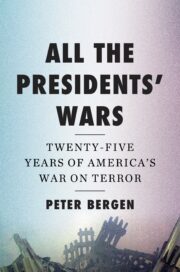
All the Presidents’ Wars:
RECENT ARTICLES

UPCOMING EVENTS
Wednesday, September, 09, 2026
GLOBAL SUMMIT ON TERRORISM AND POLITICAL VIOLENCE, NYC
Thursday, September, 10, 2026
Denver, CELL
Friday, September, 11, 2026
Duke University
Tuesday, September, 15, 2026
Lessons Learned: America’s Post-9/11 Wars, New America DC
Thursday, September, 17, 2026
Georgetown University
Tuesday, September, 22, 2026
International Spy Museum, DC. All the Presidents’ Wars, book event
Thursday, September, 24, 2026
Monterey World Affairs Council, Monterey, CA
Sunday, September, 27, 2026
ALL THE PRESIDENTS’ WARS: TWENTY-FIVE YEARS OF AMERICA’S WAR ON TERROR — AT CONN AVE, Politics & Prose, DC
Wednesday, September, 30, 2026
Gerald Ford School of Public Policy, “25 Years After 9/11: Reflections on the US War on Terror”, U. Michigan, Ann Arbor, MI
Thursday, October, 01, 2026
Arizona State Univ. , Tempe AZ
Monday, October, 05, 2026
Opal Group, DC
Thursday, October, 08, 2026
World Affairs Council of Connecticut, online 7p ET
Tuesday, October, 13, 2026
Arms Control book event, Amy Nelson, New America, DC
Monday, October, 19, 2026
Doha Security Forum, Qatar
Friday, November, 06, 2026
“American Valor,” Omni Shoreham, DC
RECENT FILM AND TV SERIES
GHOSTS OF BEIRUT: SHOWTIME
The Fall of Osama bin Laden, National Geographic
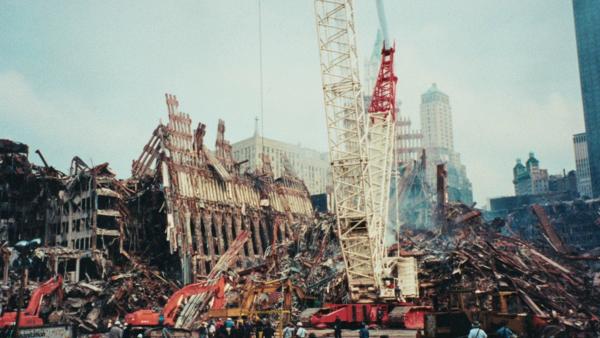
BIN LADEN'S HARD DRIVE, NATIONAL GEOGRAPHIC

