Seven years after Obama’s ‘worst mistake,’ Libya killing is rampant, CNN.com
Seven years after Obama’s ‘worst mistake,’ Libya killing is rampant
By Peter Bergen and Alyssa Sims
“Peter Bergen is a CNN national security analyst, a vice president at New America and a professor of practice at Arizona State University. He is writing a book for Penguin Random House about the national security decision-making of the Trump administration. Alyssa Sims is a policy analyst with the International Security Program at New America. The opinions expressed in this commentary are their own.”
(CNN)Years after then President Barack Obama made what he has described as his worst mistake by not adequately planning for the fall of Moammar Gadhafi in 2011, Libya remains in chaos. In the past seven years, four nations have conducted air strikes in Libya and hundreds of civilians have died in those strikes.
As the protests of the Arab Spring swept through Libya, Gadhafi mounted a war of attrition against his own people describing those who were protesting his rule as “rats.”
The Obama administration helped steer a UN resolution to take military action to protect Libyan civilians, which resulted in a US-led NATO intervention in Libya. Gadhafi was eventually killed by rebels.
However, the lack of planning for the “day after” the regime’s collapse helped set the stage for a civil war. Today that civil war grinds on. Taking advantage of the chaos in Libya, ISIS and al Qaeda have also taken root in the country.
A feature of the continuing conflict in Libya is the use of airstrikes by a number of foreign countries and local groups, spurred by the rise in militant organizations in the country as well as the ongoing civil war.
Since the NATO intervention officially ended on Oct. 31, 2011, there have been 2,158 reported airstrikes in Libya documented by the research organizations Airwars and New America in a new study released Wednesday. (This piece is partially adapted from that report.)
Four countries — Egypt, France, the United Arab Emirates (UAE), and the United States — as well as three local Libyan groups, including the Libyan government, known as the GNA, and a rival group led by Field Marshal Khalifa Haftar, carried out those air strikes.
Since 2014, Libya has increasingly become an arena for warfare by multiple states. The GNA is supported by the United States, which also carries out strikes against ISIS and al-Qaeda.
Egypt and the UAE are carrying out their own strikes either in support of Field Marshal Haftar or against Islamist militias.
France is also striking Islamist militant targets in Libya.
According to news reports and accounts on social media, at least 242 civilians were killed in these strikes, taking the lowest estimate, and as many as 395 killed, by the highest estimate, according to the Airwars/New America study.
No nation or local group has admitted responsibility for any of these civilian deaths.
The Airwars/New America study is the first overall accounting of these civilian deaths.
Officials from Egypt, France, and the United Arab Emirates and the three local Libyan groups didn’t respond when asked for comment about their air strikes.
According to the Airwars/New America study, the US has conducted at least 524 strikes on militant targets in Libya since the NATO intervention, primarily against ISIS in the city of Sirte during 2016, which according to Libyan reports, resulted in between 10 to 20 civilian fatalities.
Asked for comment on the allegations of civilian deaths, US Major Karl Wiest said that AFRICOM, which is in charge of US military operations in Libya, conducted “post-strike assessments” of all American military actions in the region and has investigated two allegations of civilian casualties in Libya, and found both to be not credible.
Of the four countries conducting air strikes in Libya, the United States is the most transparent about its operations, reporting publicly, for instance, on the 495 air and drone strikes it conducted against ISIS in Sirte.
The airstrikes by the four nations and the competing Libyan factions are intensifying the conflict in an already fragile country.
Egypt has defended its airstrikes in Libya using a self-defense argument that these strikes are aimed at terrorist groups that threaten their security; this is the same kind of argument the United States has made since 9/11 to defend its covert drone program aimed at suspected terrorists in the tribal areas of Pakistan along its border with Afghanistan and its counterterrorism operations in Somalia and Yemen.
The fact that four foreign countries are conducting airstrikes in Libya underscores the chaos and instability in the country, while battles between the two main competing Libyan factions have contributed to the conflict that prompted Obama to describe the post-Gadhafi conflict in Libya as his worst mistake.
Solving the conflict will not be easy. The US-led campaign against ISIS in Libya greatly reduced, but did not end the presence of the terrorist army there, so keeping up the pressure on both ISIS and al Qaeda in Libya is important for US national security interests.
Key to bringing peace to Libya is to end the civil war between the central government and the forces of Field Marshal Haftar, a civil war that is amplified by states such as Egypt and the UAE that are waging proxy warfare to support Haftar. Western countries should put additional effort into supporting an ongoing UN-led peace effort and urge Haftar to lay down his arms.
The Beltway and the Ivory Tower: Bridging the Gap, New America DC
The Beltway and the Ivory Tower: Bridging the Gap
Event
The gap between policy and academic research has bedeviled national security policy for years. What are the roots of this challenge and how can it be addressed? What kind of research do foreign policymakers want? How should we evaluate policy relevance and can it be ranked? Can blogs help bridge the gap? These questions are critical not only for policymakers but for the academic fields of research as well.
To discuss these issues, New America is pleased to welcome Dr. Paul Avey, Assistant Professor of Political Science at Virginia Tech; Dr. Michael Desch, a professor and Director of the International Security Center at the University of Notre Dame; Dr. Peter Campbell, Assistant Professor of Political Science at Baylor University; and Dr. Susan Peterson, Professor of Government at The College of William and Mary. The panel members are part of the Carnegie Corporation of New York’s Bridging the Gap project.
Join the conversation online using #BridgingtheGap and following @NewAmericaISP.
Panelists:
Paul Avey
Assistant Professor of Political Science, Virginia Tech
Peter Campbell
Assistant Professor of Political Science, Baylor University
Michael Desch, @mcdesch
Professor and Director, International Security Center at the University of Notre Dame
Susan Peterson
Professor and Director, Institute for the Theory and Practice of International Relations at William and Mary
Moderator:
Peter Bergen, @peterbergencnn
Vice President, New America
“Why Terrorist Groups Form International Alliances.” New America DC
The Washington Daybook
June 21, 2018
New America holds a book discussion on “Why Terrorist Groups Form International Alliances.”
SECTION: BOOK DISCUSSION; ||STATE/SECURITY/BOOK|| Foreign Affairs
LENGTH: 65 words
TIME: 2 p.m.
PARTICIPANTS: author Tricia Bacon, assistant professor at American University; and Peter Bergen, vice president of New America
LOCATION: New America, 740 15th Street NW, Suite 900, Washington, D.C.
How Obama’s team lost its innocence, CNN.com
How Obama’s team lost its innocence
By Peter Bergen, CNN National Security Analyst
June 12, 2018
“Peter Bergen is a CNN national security analyst, a vice president at New America and a professor of practice at Arizona State University. He is writing a book for Penguin Random House about the national security decision-making of the Trump administration. The opinions expressed in this commentary are his own.”
(CNN)Way back in the 20th century, America’s foreign policy principles were described with genteel phrases like the “Truman Doctrine,” “containment” and the “Pottery Barn rule.” In today’s cruder world, the policy of the Obama administration was summed up by its leader as “don’t do stupid shit.” And now, we learn from Jeffrey Goldberg’s conversation with a “senior White House official with direct access to the president and his thinking” that the Trump doctrine is “We’re America, bitch.”
But once you get past the fulminating rhetoric coming from today’s White House, it’s possible to see how President Donald Trump and President Barack Obama actually have a similar view about American military interventions — that a more modest US role in the world is desirable.
Trump has followed the Obama playbook of avoiding large-scale conventional wars and instead has relied on Special Forces, drones and cyberwarfare that were the hallmarks of Obama’s tenure as commander in chief. Trump is even pursuing diplomacy with the North Koreans, which is looking more and more like the diplomatic dance that Obama’s team engaged in with the Iranians.
Indeed, Trump has gone even further to curry favor with an adversary than Obama ever did with the Iranians by personally meeting with North Korea’s supreme leader, Kim Jong Un, on Tuesday in Singapore, where Trump declared, “We both want to do something. We both are going to do something. And we have developed a very special bond.”
For insight on that Obama playbook, it makes sense to consult Ben Rhodes’ fine new memoir of the Obama years. Rhodes, who began his career in Washington working for retired Democratic Congressman Lee Hamilton, the former vice chair of the 9/11 Commission, signed on in 2007 as a 29-year-old speechwriter for the Democratic primary candidate, Barack Obama, who was then mounting what seemed like a quixotic campaign against the Democratic frontrunner, Hillary Clinton.
Rhodes went on to be one of Obama’s deputy national security advisers. As a result, Rhodes was “in the room” for almost every foreign policy decision of significance that Obama made during his eight years in office and in a privileged position to chronicle how the idealism of the early Obama administration faded as it confronted the realities of an often-Hobbesian world.
High drama
Rhodes clearly kept good notes during his time in the West Wing, and he has written a fascinating account of the Obama administration, which began with the high drama of Obama’s speech in Cairo in 2009 and the hoped-for reset with the Muslim world and ended with the high drama of the election of President Trump, who has now largely undone Obama’s key foreign policy accomplishments, such as the Iranian nuclear deal, the Paris climate agreement and his rapprochement with Cuba.
Rhodes explains well the toll that a constantly demanding White House job took on his closest relationships. At one point, he hid in a closet in his apartment to check his BlackBerry so his long-suffering wife wouldn’t see him reading his messages for the millionth time, a scene that any workaholic will recognize with a dry chuckle.
Rhodes, whose mother’s family is Jewish, also paints a dispiriting picture of what it’s like to work in a highly polarized political environment where far-right media outlets simultaneously painted him as “part of a global Jewish conspiracy” and also as a “virulent anti-Semite, covering for the Muslim Brotherhood.”
As the pressure mounts, Rhodes smokes more and, succumbing to insomnia, watches every episode of Anthony Bourdain’s show, “Parts Unknown,” on CNN. It is Rhodes who engineers the dim sum dinner in Vietnam between Obama and Bourdain in 2016.
Rhodes spent a great deal of time with Obama, and there are sharp portraits of how the President thinks and acts interspersed throughout the memoir. Regarding Russian President Vladimir Putin, Rhodes writes, Obama “neither liked nor loathed Putin, nor did he subscribe to the view that Putin was all that tough. ‘If he was that sure of himself,’ Obama said, ‘he wouldn’t have his picture taken riding around with his shirt off.'”
In another scene, as Obama is close to ending his second term, the President jumps into “the Beast,” the heavily armored limo in which the president always rides, and takes out his iPad to play the rap song, “Thrift Shop,” by Macklemore. The President starts bopping and dancing to the beat, along with his usually ultrasober national security adviser, Susan Rice. The Secret Service agents in front of the limo continue to stare off into the distance, impassively.
Obama and American interventionism
Rhodes covers a lot of waterfront in his book, including his own leadership of the negotiations with the Cubans to normalize relations with the United States, which was achieved with considerable sotto voce help from the Vatican.
He also writes in some detail about the decision-making around the raid that killed Osama bin Laden, the opening that Obama made to the military regime in Burma and also about the Iran deal.
The title of Rhodes’ memoir, “The World As It Is,” suggests a certain pragmatism about the world, but that was not the state of mind that Rhodes and the other younger members of Obama’s newly minted national security team had when they first came into office in early 2009.
During the Rwandan genocide, Rice, who would become Obama’s first United Nations ambassador, was an official in the Clinton administration working on Africa.
Samantha Power, a senior director on Obama’s National Security Council (who later became UN ambassador), had literally written the book on genocide, the Pulitzer-winning, “A Problem from Hell,” and as a journalist, she had reported on Serbian atrocities during the civil wars in Yugoslavia.
For Rice and Power, “Never Again” was more than just a slogan, and the emerging liberal doctrine of the “Responsibility to Protect” civilians from the predations of dictators was an article of faith.
Casting aside an ally
When the crowds began to gather in Cairo’s Tahrir Square in January 2011 to protest the authoritarian rule of Egypt’s president-for-life, Hosni Mubarak, there was little doubt which side Rhodes, Power and Rice were on. They were on the side of the crowds. They were on the side of history! And that is where Obama also came down. Obama publicly demanded that Mubarak had to go — and in doing so cast aside a longtime American ally.
After Obama’s demand, Egyptian military officers pushed Mubarak out of office, but ultimately this did not produce a more democratic Egyptian state; quite the reverse.
The older members of Obama’s national security team, such as Secretary of Defense Robert Gates, Vice President Joe Biden and Secretary of State Hillary Clinton, had all cautioned against throwing Mubarak overboard on the basis that the devil you know is better than what may come next.
Their caution was merited. Flash forward seven years: after many years of unrest that has torpedoed Egypt’s vital tourism sector, today the country is ruled by another military strong man, Abdel Fattah el-Sisi, who is arguably even more repressive than Mubarak.
Obama’s intervention in Egypt to oust Mubarak seemed to make sense at the time, but in the longer sweep of history, the skeptics in Obama’s Cabinet look wiser than the Young Turks exemplified by Rhodes. At the end of his memoir, Rhodes acknowledges that he now sees “the world as it is” but still believes in “the world as it ought to be.”
Lessons of Libya
During the Obama administration, the disconnect between what the world actually is and how it ought to be was never clearer than in the case of Libya. As the protests of the Arab Spring swept through Libya, the Libyan dictator, Moammar Gadhafi, mounted a ferocious campaign against his own population.
At a meeting with Obama in the Situation Room to discuss Libya, Power passed Rhodes a note warning that this was going to be the “first mass atrocity to take place on our watch.”
Again the graybeards in the Situation Room argued for caution. Biden and Gates advised against embroiling the United States in Libya in yet another war in a Muslim country. Obama turned to Power and Rhodes for their advice. They both argued for American intervention to save civilians: the Responsibility to Protect.
Rice steered a strongly worded resolution through the United Nations that authorized a US-led NATO intervention to protect civilians. Gadhafi was subsequently killed by rebels, but there was scant American planning for the day after the fall of Gadhafi, and the country is now riven by a civil war. ISIS has also established itself there. Obama has described the lack of planning for post-Gadhafi Libya as his worst mistake.
Obama seemed to have overlearned the lessons of the post-Gadhafi chaos in Libya and opted to do little in Syria. One of the options Obama had in Syria was to order the bombing of the runways of Assad’s air force to stop the regime’s indiscriminate air strikes against civilians. Obama asked his national security team, “And what happens after we bomb the runways and Russia, Iran and Assad rebuild them?” The question wasn’t designed to elicit support for greater American intervention in the conflict.
Obama then famously/infamously drew his “red line” that the United States would take military action if the Syrian regime deployed chemical weapons. When it did so, Obama decided to seek congressional authorization for striking Syria. This decision was soon rendered moot by the Syrians, who said they would surrender their chemical weapons in a deal brokered by Putin.
However, it was only a partial surrender, as the Syrian regime continued to use such weapons during the Tramp administration. Trump responded with missile strikes on two separate occasions after the Syrians had used chemical weapons.
The US would largely stay out of the Syrian war, in which 12 million people have been forced out of their homes and some 500,000 have died.
Would greater American intervention have made the Syrian war less lethal? We can’t run the counterfactual, but the Syrian war is a graphic reminder that the United States doing too little overseas can be just as problematic as the United States doing too much.
In the grim calculus of war, however, greater American intervention in the Syrian conflict would surely have had real costs in American blood and treasure, as the wars in Afghanistan and Iraq demonstrate.
The United States is certainly capable of sins of commission: Overthrowing the Iraqi dictator Saddam Hussein in 2003 with no plan for the day after and overthrowing Gadhafi in 2011 with, again, no plan for the day after, helped to spark two civil wars in the Middle East.
The United States is also capable of sins of omission, such as doing nothing as the Rwandan genocide unfolded under President Bill Clinton. Obama also did little to stop Assad from waging a total war against many of his own people.
Any American president who makes the decision to intervene or not to intervene overseas is usually making this decision with a limited menu of unappealing options that all will likely have unintended second- and third-order effects.
The shock
We all know how Rhodes’ book is going to end: Americans will elect a president quite different from Obama who seems determined to roll back everything Obama had done in office. As Rhodes writes plaintively, “After all the work we’d done it was going to end like this.”
In Greg Barker’s film, “The Final Year,” which documents Obama’s foreign policy team in 2016, one of the last sequences in the film shows Rhodes early in the morning of Trump’s victory. Rhodes, the professional wordsmith and hyperarticulate speaker, tries to find the words to describe what he feels as he absorbs the full implications of what Trump’s victory means. Rhodes opens and closes his mouth several times, but he never finds the words to describe his shock. (Disclosure: I have worked on films with Barker and have spoken to Rhodes when he was in the White House.)
To understand the exact dimensions of how Obama absorbed the same shock, we will have to wait for his own forthcoming memoir. But for now, we have the next best thing, which is Rhodes’ gripping account of his decade working with Obama as he evolved from Obama’s amanuensis to his confidante and a key national security adviser.
Counternarcotics: Lessons from the U.S. Experience in Afghanistan, New America DC
Counternarcotics: Lessons from the U.S. Experience in Afghanistan
Event
Afghanistan’s drug trade presents a vexing challenge for policy makers in what has become America’s longest war. Despite the U.S. spending approximately $8.6 billion on counternarcotics in Afghanistan since 2002, the country is the world’s largest opium producer and opium poppy is the country’s largest cash crop. In a new lessons learned report, Counternarcotics: Lessons from the U.S. Experience in Afghanistan, the Special Inspector General for Afghanistan Reconstruction examines counternarcotics efforts in Afghanistan from 2002 to 2017, providing lessons and recommendations for the U.S. government.
New America welcomes John F. Sopko, the Special Inspector General for Afghanistan Reconstruction (SIGAR), for the launch of the new SIGAR report. New America also welcomes to discuss the report and counternarcotics efforts in Afghanistan, Ambassador Ronald Neumann (ret.), President of the American Academy of Diplomacy and former U.S. Ambassador to Algeria, Bahrain, and Afghanistan; Harold D. “Doug” Wankel, former Chief of Operations and Chief of Intelligence for the Drug Enforcement Administration andformer Director of the Kabul Counter Narcotics Office, U.S. Embassy Kabul; and Kate Bateman, Project Lead for the SIGAR counternarcotics report.
Join the conversation online using #SIGARand following @NewAmericaISP.
Keynote Address:
John F. Sopko
Special Inspector General for Afghanistan Reconstruction
Panelists:
Ambassador Ronald Neumann (Ret.)
President, American Academy of Diplomacy
Former U.S. Ambassador to Algeria, Bahrain, and Afghanistan
Harold D. “Doug” Wankel
Former Chief of Operations, Drug Enforcement Administration
Former Chief of Intelligence, Drug Enforcement Administration
Former Director, Kabul Counter Narcotics Office of U.S. Embassy Kabul (2004-2007)
Kate Bateman
Project Lead, Lessons Learned Program, SIGAR
Moderator:
Peter Bergen, @peterbergencnn
Vice President, New America
Countering Disinformation & Violent Extremism in the Digital Age, New America DC
Countering Disinformation & Violent Extremism in the Digital Age
Event
Hostile governments looking to influence foreign elections. Terrorists and terrorist groups communicating with each other and sharing extremist content. Unwitting consumption of fake news. These are just some of the many threats to individuals’ safety, security and privacy across social-media and online platforms. As the world becomes more networked, how are companies who manage the platforms on which so much of this divisive content exists managing to remove and stem its flow, protect their users, and ensure their users’ rights to freedom of expression?
To help address these and other issues, New America welcomes Monika Bickert, Facebook’s Vice President of Global Policy Management, who leads the team responsible for policies on what types of content can be shared on Facebook and how advertisers and developers can interact with the site. Prior to joining Facebook in 2012, Ms. Bickert was the resident legal advisor at the U.S. embassy in Bangkok and previously was an assistant United States attorney in Washington, D.C. and Chicago.
Participant:
Monika Bickert
Vice President of Global Policy Management, Facebook
Discussant:
Peter Bergen, @peterbergencnn
Vice President and Director, Global Studies and Fellows, New America
Moderator:
Mi-Ai Parrish, @publishorperish
Sue Clark-Johnson Professor in Media Innovation and Leadership, ASU
Follow the conversation online using #FacebookFightsExtremism and following @NewAmericaISP.
When
Jun. 6, 2018
12:00 pm – 1:30 pm
Where
New America
740 15th St NW #900 Washington, D.C. 20005
RSVP
New America
740 15th Street NW, Suite 900
Washington, DC 20005
From Revolution Muslim to Islamic State: The American Roots of ISIS’ Online Prowess, New America DC
From Revolution Muslim to Islamic State: The American Roots of ISIS’ Online Prowess
Event
ISIS has lost the vast majority of its territorial holdings in Syria and Iraq, yet attacks continue from France to Indonesia. Many have pointed to ISIS’ online capabilities as an explanation. However, little known is that ISIS’ online capabilities owe their strength in large part to a group of Americans known as Revolution Muslim, who developed the template and network ISIS later adapted. Mitchell Silber, former director of intelligence analysis at the NYPD, and Jesse Morton, the former leader of Revolution Muslim, provide a unique view into this history based on their experience working against each other in their report for New America, From Revolution Muslim to Islamic State: An Inside Look at the American Roots of ISIS’ Virtual Caliphate.
New America welcomes Mitchell Silber and Jesse Morton for a discussion and launch of their report. In addition to having previously being NYPD’s Director of Intelligence Analysis, Silber is an adjunct professor at Columbia University’s School for International and Public Affairs and a founder of the Guardian Group in New York. Before co-founding Guardian Group, Mr. Silber was the head of Geopolitical Intelligence at FTI Consulting. Jesse Morton is the former leader and co-founder of Revolution Muslim for which he served time in prison. More recently along with Mitch Silber and others he founded of Parallel Networks an organization founded to combat hate and extremism. He holds a Bachelor’s Degree in Human Services and a Master’s in International Relations from Columbia University. New America also welcomes to discuss the report, Candace Rondeaux, a Senior Fellow with New America’s International Security Program and Professor of Practice at Arizona State University, who formerly was a Senior Program Officer at the United States Institute of Peace, where she launched the RESOLVE Network, a global research consortium on conflict and violent extremism.
Participants:
Mitchell Silber, @MitchSilber
Author, From Revolution Muslim to Islamic State: An Inside Look at the American Roots of ISIS’ Virtual Caliphate
Former Director of Intelligence Analysis, NYPD
Jesse Morton, @_JesseMorton
Author, From Revolution Muslim to Islamic State: An Inside Look at the American Roots of ISIS’ Virtual Caliphate
Former Co-Founder, Revolution Muslim
Candace Rondeaux, @CandaceRondeaux
Senior Fellow, New America International Security Program
Professor of Practice, Arizona State University
Moderator:
Peter Bergen, @peterbergencnn
Vice President, New America
When
Jun. 4, 2018
12:15 pm – 1:45 pm
Where
New America
740 15th St NW #900 Washington, D.C. 20005
RSVP
New America
740 15th Street NW, Suite 900
Washington, DC 20005
The good news from Iraq, CNN.com
Bergen: The good news from Iraq
Peter Bergen
By Peter Bergen, CNN National Security Analyst
Peter Bergen is CNN’s national security analyst, a vice president at New America and a professor of practice at Arizona State University. He is writing a book for Penguin Random House about the national security decision-making of the Trump administration.
(CNN)On Saturday, Iraqis go to the polls to elect their new Parliament and prime minister.
And the news here is that Iraq — which only four years ago seemed on the brink of collapse as ISIS’s army menaced the Iraqi capital Baghdad — is in the best shape it has been for years.
In 2014, ISIS stormed onto the world stage seizing Mosul, Iraq’s second-largest city, declaring its self-styled “caliphate” there, while the Iraqi military fled in ignominious retreat.
Last year, ISIS lost Mosul and today its black flags no longer fly over any of Iraq’s territory. The group exists now only as a rump terrorist organization, capable of mounting only sporadic attacks in Iraq.
As a result, civilian deaths have fallen sharply in recent months and nightlife has even returned to Baghdad.
The defeat of ISIS was an Iraqi-led operation supported by the US-led coalition. It was Iraq’s elite Special Forces Counterterrorism Service that spearheaded the charge against ISIS.
As a result, the Iraqi military is no longer widely despised; indeed it is now the most admired of any of Iraq’s institutions. More than 80% of Iraqis had “confidence” in the Iraqi military, according to a nationwide poll conducted in March by the organization 1001 Iraqi Thoughts.
The halo effect around the defeat of ISIS also extends to Prime Minister Haider Al-Abadi, who also enjoys similarly high favorability ratings.
When Abadi became prime minister four years ago, he was seen as a colorless technocrat with scant chance of successfully governing Iraq’s fractious ethnic and sectarian groups — but there’s nothing quite like being invaded by ISIS to bring a nation together!
Abadi deftly managed the defeat of ISIS using the Iraqi military in alliance with Shia militias and Kurdish forces.
Abadi also benefited from another crisis when the Kurds, who dominate much of northern Iraq, voted in a referendum for independence in September — a referendum that the United States and the central Iraqi government warned them not to go through with.
The Kurdish independence referendum was a gross miscalculation by Kurdish politicians who already enjoyed a high degree of autonomy.
When the referendum took place, Abadi ordered the newly capable Iraqi army to take back key sections of Iraq held by the Kurds, including the oil-rich region around the city of Kirkuk. The central government also took control of all the border control points and airports in Kurdistan.
As former National Security Council director for Iraq, and New America senior fellow, Doug Ollivant observed earlier this month: “Iraq now has the best ground forces in the region.”
Abadi goes into Saturday’s election having vanquished ISIS and asserted central government control over the Kurds, which is a strong set of cards, but he is quite unlikely to win the outright majority that would enable him to become prime minister again, as there are a host of other parties competing in the election.
What is striking about these various parties is that none of them are running on overtly sectarian lines as “the Sunni party” or “the Shia party.” This bodes well for the future of Iraq.
What happens after the election will be as important as the election itself, because that is when the horse-trading will begin over which parties can create a majority bloc in Parliament, and then choose the prime minister. Abadi is regarded as the likely winner in this horse trading, although that isn’t certain.
That Iraqi politics is being settled at the ballot box rather than by the barrel of a gun is a great sign of hope for the country.
To be sure, there are significant problems. When Mosul was liberated from ISIS it was largely demolished, and reconstruction in Mosul and elsewhere is going to take many years and much investment.
And a wild card is Trump’s decision to pull out of the Iran nuclear deal. We have already seen Iranian forces and proxies launch rocket and missile attacks on Israel and Saudi Arabia since Trump announced the pullout on Tuesday.
Iran also has considerable sway in Iraq and could signal to those Shia militias that take some degree of direction from Tehran to turn up the heat inside Iraq.
That said, Iraq benefits from having among the largest oil reserves in the world and a relatively educated population, which is why Saturday’s election could portend a much better future for Iraq.
On Iran, Trump becomes a prisoner of his own hyperbole, CNN.com
On Iran, Trump becomes a prisoner of his own hyperbole
By Peter Bergen, CNN National Security Analyst
Updated 5:32 PM ET, Tue May 8, 2018
“Peter Bergen is CNN’s national security analyst, a vice president at New America and a professor of practice at Arizona State University. He is writing a book for Penguin Random House about the national security decision-making of the Trump administration.”
(CNN)In withdrawing the US from the Iran nuclear deal, President Donald Trump is taking a huge gamble. And aside from his desire to repudiate everything done by his predecessor, President Barack Obama, it’s really hard to see why he is making this decision.
Let’s stipulate first that the Iran nuclear deal is working surprisingly well. That’s according to the congressional testimony of Trump’s own secretary of defense, James Mattis, who testified in October that the Iran deal was in American national security interests.
That the deal is working is also the considered view of some of the most hawkish Israelis — for instance, Ehud Barak, who is a former Israeli prime minister and former defense minister as well as a former chief of staff of the Israeli army.
As recently as Monday, Barak told the Daily Beast that the Iranians have “kept the letter of the agreement quite systematically… [and] all in all it delays the new starting point or countdown towards a nuclear capability.”
Yukiya Amano, the head of the International Atomic Energy Agency (IAEA), which is monitoring the Iran agreement, said in March that, “The IAEA now has the world’s most robust verification regime in place in Iran. We have had access to all the locations that we needed to visit… As of today, I can state that Iran is implementing its nuclear-related commitments.”
So why blow up the Iran nuclear deal, given that this array of impressive, independent observers say it’s working?
Trump, it seems, has become a prisoner of his own hyperbolic rhetoric, constantly repeating his mantra that the Iran deal is “the worst deal ever negotiated.”
Of course, this is nonsense. For the Obama administration it was simply the best deal on offer. Could the Obama team have pushed harder for tougher “sunset” clauses on the deal that would have pushed even further into the future the moment when Iran could resume its nuclear program? Maybe.
But that is hardly an argument for effectively walking away from the deal, which delays the Iranian nuclear weapons program from resuming for around a decade from its inception three years ago.
In the tricky art of diplomacy, a reasonably good solution is not the enemy of a perfect solution, since those are rarely on offer. To be sure, the deal didn’t address the fact that Iran has a robust ballistic missile program, but the deal wasn’t about the unilateral disarmament of Iran — which Iran would be quite unlikely to agree to since its only real ally around the world is Syria! — but rather it was to stop the Iranians from acquiring nuclear weapons with all the new, additional leverage that would give them in the region.
Also, if Iran has nuclear weapons, that is sure to spark a regional nuclear arms race in which Saudi Arabia would also try to acquire them as soon as feasible.
Three of the United States’ closest allies, Britain, France and Germany, are all signatories to the Iran deal. In recent weeks leaders of these countries have all begged Trump to remain in the deal. These allies were even willing to negotiate amendments to the deal about issues such as Iran’s ballistic missile program under the rubric “fix it, don’t nix it,” but even that wasn’t sufficient for Trump.
Why? Historians will likely be debating this question for years. After all the Iran deal is quite popular with Americans, a healthy majority of whom — 63% — want to stay in the deal, while only 29% want to leave it, according to a new CNN poll.
Those numbers are quite similar to these who opposed President Trump’s decision to withdraw from the Paris climate agreement last year: 59% opposed that decision, while 28% supported it, according to a Washington Post-ABC News poll.
Similarly, Obamacare is now favored by a majority of Americans, according to a March poll by Kaiser.
Trump is intent, it seems, on undoing the key international and domestic accomplishments of the Obama administration. The question is: does he have a “plan B” that makes any sense? Trump said he would repeal and replace Obamacare, but when it came down to it he and the Republican Party didn’t have a real viable plan to do so.
The Iranians have repeatedly said they won’t renegotiate the nuclear deal, which means they could restart their nuclear enrichment program. That, of course, will lead to renewed tensions with the United States, Israel and the Gulf States that the nuclear deal was designed to tamp down. And that path takes us back to the real and renewed possibility of a war in the region.
We can all hope that Trump’s big bet that he will force the Iranians back to the negotiating table will pay off, but history suggests that these kinds of bets are easy to make on the campaign trail, but are much harder to pull off when you are sitting in the Oval Office.
Iraq After ISIS: What to Do Now, New America DC
Iraq After ISIS: What to Do Now
In 2017, the United States dealt ISIS a devastating blow eliminating its territorial holdings in Iraq and Syria. Iraq, which will hold national elections on May 12th, emerged out of the war against ISIS strong and in an increasingly positive mood.
Yet as Iraq looks ahead to a post-ISIS future, numerous challenges lie ahead. In a new policy report, Iraq After ISIS: What to do Now, Bartle Bull and Douglas Ollivant propose the contours of a positive, forward looking U.S.-Iraqi relationship.
New America welcomes Bartle Bull and Douglas Ollivant to discuss their report and the future of U.S.-Iraqi ties. Bartle Bull is an author and founder of Northern Gulf Partners, an Iraq-focused merchant banking firm. Douglas Ollivant is an ASU Senior Future of War Fellow with New America and former Director for Iraq on the National Security Council under both the George W. Bush and Barack Obama administrations. He is also Senior Vice President of Mantid International, LLC, a global strategic consulting firm with offices in Washington, Beirut, and Baghdad.
Join the conversation online using #IraqAfterISIS and following @NewAmericaISP.
Participants:
Bartle Bull, @bb_bull
Co-Author, Iraq After ISIS: What to do Next
Founder, Northern Gulf Partners
Douglas Ollivant, @DouglasOllivant
Co-Author, Iraq After ISIS: What to do Next
ASU Senior Future of War Fellow, New America
Moderator:
Peter Bergen, @peterbergencnn
Vice President, New America
Director, International Security Program, New America
When
May. 1, 2018
12:15 pm – 1:45 pm
Where
New America
740 15th St NW #900 Washington, D.C. 20005
RSVP
New America
740 15th Street NW, Suite 900
Washington, DC 20005
FEATURED BOOK
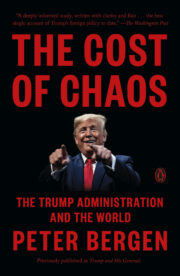
The Cost of Chaos: The Trump Administration and The World:
RECENT ARTICLES

UPCOMING EVENTS
Wednesday, March, 11, 2026
Reporting on the United States’ Long War Against Al-Qaeda, Georgetown University Library
Sunday, April, 12, 2026
2026 Global Security Forum, Doha
Monday, May, 04, 2026
“From Life Itself,” book event with author Suzy Hansen, NA/ASU online
Wednesday, September, 09, 2026
GLOBAL SUMMIT ON TERRORISM AND POLITICAL VIOLENCE, NYC
Thursday, September, 10, 2026
Denver, CELL
Friday, September, 11, 2026
Duke University
Tuesday, September, 22, 2026
Spy Museum, DC.
RECENT FILM AND TV SERIES
GHOSTS OF BEIRUT: SHOWTIME
The Fall of Osama bin Laden, National Geographic
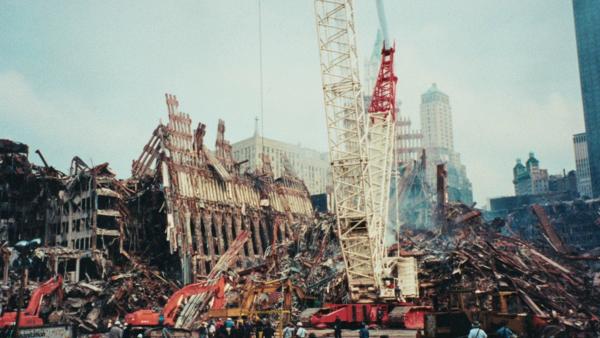
BIN LADEN'S HARD DRIVE, NATIONAL GEOGRAPHIC

