After Syria strikes, now what? CNN.com
After Syria strikes, now what?
By Peter Bergen, CNN National Security Analyst
“Peter Bergen is CNN’s national security analyst, a vice president at New America and a professor of practice at Arizona State University. He is writing a book about President Donald Trump’s national security policies.”
(CNN)The US-led military strikes in Syria raise a number of questions:
First, and most basic, what exactly is US policy in Syria? President Donald Trump said just two weeks ago in a speech in Ohio that the US would “be coming out of Syria like very soon.” Now, Trump has presided over a large-scale bombing operation aimed at several targets in Syria, including in Damascus, the Syrian capital.
So what is the Trump administration policy? Is it that Syrian leader Bashar al Assad must go, which has been the stated policy of the United States going back to the early days of the Syrian civil war under President Barack Obama? Or is there simply just a red line on Assad’s use of chemical weapons, but not much more?
The answer is far from clear. When President Trump announced the US-led strikes on Friday he emphasized the latter, while his own ambassador to the UN, Nikki Haley, said earlier this week that there is no political solution in Syria with Assad still in power.
Second, beyond responding to the Syrian regime’s use of chemical weapons, does the Trump administration have a plan to protect Syrian civilians in the war that has destroyed much of their country over the past seven years?
Nearly half a million Syrians have died in the war, of which chemical weapons have only killed a tiny fraction. On the campaign trail, candidate Trump sometimes raised the idea of creating “safe zones” for Syrian civilians.
Is the next step for the Trump administration the creation of such zones? And how would these work? Such safe zones would require “no fly zones” because the Syrian air force has hitherto enjoyed total air superiority allowing them to drop chemical weapons, “barrel bombs” and other munitions more or less at will. Enforcing such a no fly zone is complicated by the fact that there are considerable numbers of Russian aircraft flying over Syria.
Third, might Trump’s laudable concern about civilian casualties caused by chemical weapons in the Syrian civil war change his view about Syrian refugees entering the United States? Right now the Trump administration has effectively banned the entry of Syrian refugees into the US, despite the fact that most are women and children.
Fourth, do the strikes mark some kind of turning point between Trump and Russia? The President had been loathe to critique Russia President Vladimir Putin, yet on Friday he had harsh words for the Russians, saying: “To Russia, I ask: What kind of a nation wants to be associated with the mass murder of innocent men, women, and children?”
Fifth, when US Secretary of Defense James Mattis spoke at a press conference at the Pentagon on Friday night he said the legal authorization for the strikes was under the president’s Article 2 authority in the Constitution as commander in chief. Many legal experts — as well as a number of members of Congress — would beg to differ. Attacking Syrian regime targets, as opposed to ISIS targets has not been authorized by Congress which is supposed to sanction US military actions, although recent presidents have tended to minimize the role of Congress in such matters.
Sixth, is there a bit of “Wag the Dog” to all this? This was the accusation, adapted from the title of a popular movie, against President Bill Clinton who, in the midst of the Monica Lewinsky affair, launched military strikes against al Qaeda training camps in Afghanistan in August 1998 following al Qaeda’s bombing of two US embassies in Africa.
As Mark Twain is supposed to have observed, “History doesn’t repeat itself, but it does rhyme.”
John Bolton; New Trump adviser is ‘not much of a carrot man’, CNN.com
New Trump adviser is ‘not much of a carrot man’
By Peter Bergen, CNN National Security Analyst
Updated 2:40 PM ET, Sun April 8, 2018
“Peter Bergen is CNN’s national security analyst, a vice president at New America and a professor of practice at Arizona State University. He is the author of “United States of Jihad: Investigating America’s Homegrown Terrorists.””
(CNN)As John Bolton settles into his new job as US National Security Adviser this week in the midst of raging international issues, officials in Washington and foreign capitals will be putting significant effort into trying to predict the behavior of the mustachioed 69-year-old aide to President Donald Trump.
They should start by reading “Surrender is Not an Option,” Bolton’s comprehensive 2007 memoir about working for the administrations of Ronald Reagan, George H.W. Bush and George W. Bush. It provides much insight into Bolton’s views about American national security.
Despite its tendentious title — has any US politician or policymaker really advocated American surrender? — Bolton’s 504-page memoir is an invaluable road map to what he believes and how he does business. For that reason alone it should be required reading for those at the White House, Pentagon and State Department who will be dealing with him, as well as for his foreign counterparts and their staffs.
Monday is Bolton’s first day at the White House as National Security Adviser and already his inbox is overflowing. There are multiple reports of a suspected chemical attack outside the Syrian capital of Damascus, which anti-regime activists claim was conducted by the Syrian regime. Television images are emerging of some of the dozens that are believed to have died in the attack.
On May 12 there is a deadline for President Trump’s administration to decide whether to pull out or to remain in the nuclear disarmament agreement with Iran. And by the end of May, Trump is due to meet with North Korea’s Kim Jong Un to discuss the possibility of his regime’s denuclearization, the first time an American president has met with a North Korean leader.
Here are nine takeaways from Bolton’s memoir:
1. Bolton has been a “movement conservative” for more than half a century. As a teenager in 1964, Bolton volunteered to work on the Barry Goldwater Republican presidential campaign and while he was a law student he interned for President Richard Nixon’s vice president, Spiro Agnew.
2. Bolton owes his position to hard work and smarts. The son of a Baltimore firefighter, Bolton went to Yale and then to Yale Law School where he was a contemporary of Bill and Hillary Clinton, though they moved in quite different circles.
3. Bolton is a longtime swamp dweller and is far from a Washington outsider, as many of Trump’s senior administration officials have been. He has held a variety of key jobs in Republican administrations going back to the time when Olivia Newton-John’s “Physical” was the No. 1 song and “Dallas” was the top-rated TV show. During President Reagan’s first term, Bolton was appointed to senior jobs at the US Agency for International Development and he went on to work in a number of other key positions, culminating in serving as George W. Bush’s ambassador to the United Nations. Bolton understands on a deep level how to operate in the DC bureaucracy.
4. Bolton is inclined to bring a gun to a bureaucratic knife fight. Bolton approvingly quotes himself on the matter of diplomatic “carrots and sticks,” writing, “I am not much of a carrot man.” This made him plenty of enemies in Washington. In 2005, Carl Ford, a former assistant secretary of state who had worked with Bolton in the George W. Bush administration, testified before a Senate committee that Bolton was a “kiss-up, kick-down sort of guy,” as the New York Times recently recalled.
5. Bolton is steeped in the arcana of arms-control negotiations. He served as the top official at the State Department working on arms-control issues in the George W. Bush administration. As a result, Bolton’s memoir is a forest of acronyms such as SALT, START, PSI, CBW, and IAEA that only arms-control wonks will likely instantly understand.
6. Bolton’s skepticism towards both North Korea and Iran is longstanding. He believes that North Korea will “never give up its nuclear weapons voluntarily” and that any promises to do so are simply to get what it wants, such as the lifting of sanctions. North Korea, Bolton writes, “has followed this game plan many times, and it has every reason to believe it will succeed in the future.”
Bolton has a similar longstanding view about Iran and wrote that “Iran will never give up its nuclear program, and a policy based on the contrary assumption is not just delusional but dangerous.” However, Bolton’s view of Iran is undermined by the International Atomic Energy Agency (IAEA), which since the Iran nuclear deal was inked in 2015 has nine successive times certified that Iran is sticking to the restrictions it agreed to under the terms of the deal. Given Bolton’s attitude toward those regimes, it’s hard to see how he could advocate for any negotiated settlements with them.
7. Bolton believes US State Department careerists are “overwhelmingly Democratic and liberal,” suggesting he is unlikely to defend the agency against the deep cuts that the Trump administration has proposed for it and will mostly ignore the advice of career State Department officials.
8. Bolton has a deep skepticism about any kind of constraints on American power and was an “America First” guy long before this became a common slogan. Bolton writes in his memoir that his happiest moment working at the State Department was “unsigning” the agreement that made the United States a party to the International Criminal Court, which he saw as a grave risk for US political and military leaders who might be hauled in front of it. When Bolton pulled the US out of the agreement in 2002, “I felt like a kid on Christmas Day,” he recalled.
9. Finally, Bolton takes very good notes about what his counterparts say in meetings and what he says to them, so we should expect another Bolton memoir at some point — this one about his time in the Trump administration.
On some levels it is hard to think of a more qualified American official to deal with the issues concerning weapons of mass destruction and Iran, Syria and North Korea than Bolton, who has great expertise in those matters and also of dealing directly with American adversaries such as the Iranians.
At the same time Bolton is also a longtime and well-known advocate of preemptive wars against regimes such as Iran and North Korea. As recently as February he argued in the Wall Street Journal for a unilateral American military strike against North Korea.
Will his pugnacity help or hurt Bolton as he coordinates the Trump administration’s responses to the Syria gas attack and its diplomatic outreach to North Korea? We will soon have an answer to those questions.
Kushner and MBS: A tale of two princes, CNN.com
Kushner and MBS: A tale of two princes
By Peter Bergen, CNN National Security Analyst
Updated 8:06 AM ET, Mon March 19, 2018
Peter Bergen is CNN’s national security analyst, a vice president at New America and a professor of practice at Arizona State University. He is the author of “United States of Jihad: Investigating America’s Homegrown Terrorists.”
Beirut (CNN)Jared Kushner has a vast foreign policy portfolio, including brokering an Israeli-Palestinian peace deal, as well as managing relations with both Mexico and China.
Those efforts are far worse off today than they were a year ago because Kushner’s father-in law has instigated policies that have sabotaged them.
President Donald Trump’s decision to move the US Embassy in Israel from Tel Aviv to Jerusalem has torpedoed any chance of the United States acting as an honest broker with the Palestinians for the foreseeable future. Trump insisting that Mexico pay for “the wall” resulted in Mexico’s President Enrique Peña Nieto canceling plans last month for his first visit to the White House. And Trump unilaterally pulling out of the Trans-Pacific Partnership trade deal reduced American influence in Asia, while strengthening Chinese power.
There is, however, one area where Kushner has scored a win, which is placing a big bet on Saudi Crown Prince Mohammed bin Salman, 32, who only four years ago was an obscure Saudi prince and today is running the Kingdom of Saudi Arabia.
History will tell if the Trump administration’s backing of Crown Prince Mohammed bin Salman, commonly referred to as “MBS,” is merely a tactical victory rather than a strategic victory, but nonetheless a win it is.
On Tuesday, MBS will visit the White House on what is effectively a state visit. (MBS’s 82-year-old father, King Salman, is monarch in name, but it’s clear his son is calling the shots.)
How well do Saudis know Donald Trump?
Given how significant MBS is to the future of Saudi Arabia and the Middle East and also the fact that Kushner and Trump have bet the house on MBS, it’s worth exploring how that happened and what it means.
Kushner and Trump have embraced both the Emiratis and MBS who share a deep suspicion of Iran. Kushner believed they would also help with his now-dead-in-the-water peace deal between the Palestinians and Israelis.
And why is that? Well, Kushner is close to the powerful and effective United Arab Emirates Ambassador Yousef al-Otaiba, who has served in Washington for a decade and shaped Kushner’s view of the Middle East. Of their first meeting, Otaiba said, “He did all the asking, and I did all the talking.” They have remained in regular contact since.
Kushner, 37, and MBS, just a few years his junior, have also bonded. MBS was one of the first foreign officials to visit the Trump White House even before his father had elevated him to his present role of crown prince.
The US-Saudi political allegiance
A demonstration of how all-in the Trump administration is with MBS is that Trump chose to pay his first state visit to Saudi Arabia. Typically, first state visits by American presidents are made to closely allied Western democracies such as Canada rather than to absolute monarchies such as the Saudi kingdom. In Saudi Arabia last May, Trump was treated to the kind of royal welcome — elaborate ceremonial sword dances in opulent palaces — that warms the Trumpian heart.
It was hardly an accident that just days after Trump’s triumphal trip, Saudi Arabia and the UAE began the blockade of their neighbor, the gas-rich kingdom of Qatar. The Saudis and Emirati ruling families loath Al Jazeera, the Qatar-based TV news channel. They also dislike Qatar’s tolerance for leaders of Islamist groups such as the Muslim Brotherhood, a number of whom live in the tiny kingdom.
The fact that the blockade of Qatar hardly aligned with traditional American foreign policy goals didn’t seem to bother Kushner or Trump, although then-Secretary of State Rex Tillerson and Secretary of Defense James Mattis did try to push back. After all, the Al Udeid Air Base in Qatar is one of the most significant American bases in the world. That’s where the bombing campaigns against ISIS in Iraq and Syria and against the Taliban in Afghanistan are directed from.
Trump’s eagerness to scrap the Iranian nuclear deal also, of course, aligns with Saudi foreign policy, as does the Trump administration’s almost complete silence on the Saudis’ disastrous military campaign in Yemen against the Iranian-supported Houthi rebels.
The Saudi campaign in Yemen helped instigate what UN agencies in December described as “the worst humanitarian crisis in the world.” According to those agencies, more than half of Yemen’s population don’t have enough to eat. Yemen has also seen the worst outbreak of cholera in recorded history.
Trump and Kushner have, in short, largely absorbed the Saudi/MBS view of foreign policy in the Middle East despite the scant benefits and significant costs that come with this.
MBS at home
Domestically, MBS is moving fast to change the kingdom. What was once an absolute monarchy where the invariably geriatric monarch ruled in consultation with other members of the massive royal family, as well as with the Wahhabi religious establishment, is now a secularizing dictatorship ruled by a young prince who brooks no dissent or even any other power source.
On the one hand, MBS has cut down the powers of the feared religious police, allowed women to drive starting in June and encouraged once-forbidden concerts. As of this month, divorced women will get custody of their children without having to go to court, which is progressive family policy compared to some other Arab states.
On the other hand, beginning in November, MBS imprisoned more than 200 businessmen and members of the royal family in the ritzy confines of the Ritz Carlton hotel in Riyadh on charges of corruption. Only six months earlier Trump and Kushner were given the royal treatment at the very same hotel.
Corruption is an odd charge in Saudi Arabia, the only country in the world where the ruling family has named the entire country after itself, an indicator of how little separation there is between the resources of the state and the whims of its ruling family. MBS, for instance, is reported to have paid more than half a billion dollars for a yacht he took a fancy to in France.
Last month, MBS also fired much of the leadership of the Saudi military and replaced them with his own men. On one level, this seems entirely reasonable given the fiasco of Saudi military intervention in Yemen, but this also has the effect of making the leaders of the armed forces beholden to MBS.
Similarly, MBS has imprisoned a number of leading conservative clerics. This too can be justified as an effort to remove opposition to his liberalization of Saudi society, but it also has the effect of discouraging any opposition to MBS from the clergy, an until-now powerful force in Saudi society.
At the same time that MBS is both liberalizing Saudi society and quashing any form of possible dissent, he has also embarked on an ambitious plan known as Vision 2030 for weaning the Saudi economy from its almost entire dependence on oil and its citizens from their almost entire dependence on the state.
The long road for Saudi's women drivers
Saudi Arabia is a strange polity in that it is an absolute monarchy that functions simultaneously as an almost perfect socialist state, where most of the population work for the government, pay no taxes, receive subsidies for energy and electricity and enjoy free health care and education.
All that gets expensive. And in a world where $100 a barrel for oil won’t be seen again any time soon, Saudi Arabia simply can’t afford this kind of largesse anymore.
The aim of Vision 2030 is to privatize the defense sector as well as agriculture, education and health care and to sell off chunks of the oil giant Saudi Aramco. This has bankers salivating from Manhattan to London to Riyadh, as even selling a small part of Aramco might be the largest IPO in history, worth around $100 billion.
However, the IPO is unlikely to take place in Manhattan as the Saudis are well aware that ongoing litigation by the families of 9/11 victims might eventually end up in a massive settlement against them, so why take the risk of a flotation on Wall Street when it can be done in Riyadh or elsewhere?
When MBS meets with Trump and Kushner at the White House, the President and his son-in-law can give themselves a pat on the back; they supported MBS, who now controls every aspect of the Saudi economy, society and military. And there is the added benefit that he is moving Saudi Arabia in a more liberal direction at the same time he has a real plan to diversify the Saudi economy.
What is less clear is how some of MBS’ foreign policy gambles will play out. His intervention in neighboring Yemen remains a fiasco, while his blockade of Qatar has ended in a stalemate. His saber-rattling against Iran has intensified a sectarian proxy war between the Gulf States and Iran, raging from Yemen to Syria.
Kushner and Trump have placed a big bet on MBS. Let’s hope he doesn’t continue to deepen the conflicts across the already fragile Arab region.
The White House is losing a real warrior, CNN.com
Bergen: The White House is losing a real warrior
By Peter Bergen, CNN National Security Analyst
Updated 10:30 AM ET, Fri March 23, 2018
Peter Bergen is CNN’s national security analyst, a vice president at New America and a professor of practice at Arizona State University. He is the author of “United States of Jihad: Investigating America’s Homegrown Terrorists.”
(CNN)The departure of Lt. Gen H.R. McMaster from the White House removes one of the most capable public servants in the Trump administration, a war hero in both US wars in Iraq whose doctorate became “Dereliction of Duty,” an influential best-seller that excoriated the generals who waged the Vietnam War for not providing President Lyndon B. Johnson with unvarnished military advice.
At least McMaster wasn’t fired by tweet, as Secretary of State Rex Tillerson was last week. Tillerson first learned of his defenestration via the President’s preferred mode of communication.
McMaster was allowed to resign and received an effusive statement of thanks from Donald Trump for his more than three decades of military service. Given all the abrupt firings of White House officials, this is the Trump administration’s version of a golden parachute.
Undercutting Trump’s public eulogy for his departing national security adviser, for many months White House officials had told reporters on background that McMaster was on the way out because the three-star general’s briefing style grated on Trump. This resulted in a steady drip-drip of stories that McMaster was headed out the door.
It’s hardly surprising that Trump objected to McMaster’s briefings because the President says he already knows all he needs to know and relies on his gut alone to make decisions.
As Trump claimed during the election campaign, “I know more about ISIS than the generals do. Believe me.” No need for a general’s briefing then.
Trump also told Fox News that the many unfilled senior positions at the State Department didn’t affect the conduct of foreign policy because “I’m the only one that matters.” No need for informed briefings then.
The removal of Tillerson and McMaster is being framed by anonymous White House officials as a necessary reshuffle as Trump gears up for his meeting with Kim Jung Un, the first-ever such encounter between a US president and a North Korean leader, a meeting slated for late May.
This rationale makes little sense because in The Wall Street Journal only last month newly appointed national security adviser John Bolton argued forcefully for a unilateral American military strike against North Korea.
It’s the same type of argument that Bolton had advocated in the run-up to the Iraq War, which had the dubious honor of marking its 15th anniversary this week.
Bolton also publicly called for the bombing of Iran’s nuclear facilities three years ago on the grounds that “time is terribly short, but a strike can still succeed.”
His longstanding advocacy for pre-emptive wars is reminiscent of Talleyrand’s quip when the Bourbons were restored to power after the French Revolution, “They have learned nothing and forgotten nothing.
Bolton is also among the most vocal and influential advocates for tearing up the Iran nuclear deal, which does exactly what would likely emerge from any possible deal with the North Koreans: They would dial back their nuclear program in exchange for the lifting of sanctions against them.
As recently as Tuesday, Bolton described the Iran deal as a “strategic debacle” on Fox.
This is not the well-informed view of Defense Secretary Jim Mattis, who testified in October that the Iran nuclear deal is in American national security interests.
In short, it’s hard to imagine a worse negotiator to sit across the table from the North Koreans than Bolton.
Russian roulette
It’s not just McMaster’s style that rubbed Trump the wrong way: They also have important, substantive differences about how they see the world.
Take Russia: In December the Trump administration released its national security strategy, a dense 55-page document supervised by McMaster that focused heavily on Russian aggression against neighboring states and its efforts to undermine Western democracies. These are actions that Trump barely acknowledges, while he repeatedly embraces Russia’s apparent President for life, Vladimir Putin.
A month before the release of his own administration’s national security strategy, Trump said of Putin, in regard to the 2016 US election, “He said he didn’t meddle. … Every time he sees me, he says, ‘I didn’t do that,’ And I believe, I really believe, that when he tells me that, he means it.”
By contrast, the national strategy stated that Russia is “using information tools in an attempt to undermine the legitimacy of democracies. … Russia uses information operations as part of its offensive cyber efforts to influence public opinion across the globe. Its influence campaigns blend covert intelligence operations and false online personas with state-funded media. …”
McMaster publicly endorsed this analysis last month at the Munich Security Conference when he said of the just-handed down American indictments of 13 Russians allegedly involved in meddling in the 2016 presidential election, “The evidence is now really incontrovertible.”
This reference to evidence of Russian electoral meddling was swiftly and publicly rebuked by Trump, who tweeted, “General McMaster forgot to say that the results of the 2016 election were not impacted or changed by the Russians and that the only Collusion was between Russia and Crooked H, the DNC and the Dems.”
After that public dressing-down it was clear that McMaster’s days at the White House were numbered — a case of not if he was going, but when.
Sarah Sanders, who has turned into the “Baghdad Bob” of the Trump administration, tweeted only a week ago that she “just spoke to @POTUS and Gen. H.R. McMaster — contrary to reports they have a good working relationship and there are no changes at the NSC.”
In fairness to Sanders, she can only repeat what the President tells her. Summoning the shade of Sanders’ Nixonian predecessor, Ron Ziegler, her tweet is now no longer an “operative” statement.
Pakistan’s Nuclear Bomb A Story of Defiance, Deterrence, and Deviance, book discussion w Hassan Abbas, National Defense Univ. DC
Pakistan?s Nuclear Bomb
A Story of Defiance, Deterrence, and Deviance
By Hassan Abbas
Professor, The College of International Security Affairs, National Defense University
Moderator & Discussant: Peter Bergen, Vice President, New America
WHEN: Tuesday, March 6, 2018 from 12:00 PM to 1:00 PM
WHERE: Marshall Hall, National Defense University Library, Special Collections
BOOK SUMMARY: This book provides a comprehensive account of the mysterious story of Pakistan?s attempt to develop nuclear weapons in the face of severe odds. Hassan Abbas profiles the politicians and scientists involved, and the role of China and Saudi Arabia in supporting Pakistan?s nuclear infrastructure. Abbas also unravels the motivations behind the Pakistani nuclear physicist Dr A. Q. Khan?s involvement in nuclear proliferation in Iran, Libya and North Korea, drawing on extensive interviews. He argues that the origins and evolution of the Khan network were tied to the domestic and international political motivations underlying Pakistan?s nuclear weapons project, and that project?s organization, oversight and management. The ties between the making of the Pakistani bomb and the proliferation that then ensued have not yet been fully illuminated or understood, and this book?s disclosures have important lessons. The Khan proliferation breach remains of vital importance for understanding how to stop such transfers of sensitive technology in future.
Finally, the book examines the prospects for nuclear safety in Pakistan, considering both Pakistan?s nuclear control infrastructure and the threat posed by the Taliban and other extremist groups to the country?s nuclear assets.
The Future of the “Islamic State,” American Univ. of Beirut, Lebanon
The Future of the “Islamic State”
Provinces and Affiliates:
Decline or Continued Impact after the Fall of the
“Caliphate” in Iraq and Syria?
Conference at the American University of Beirut
Organized by AUB’s Issam Fares Institute for Public Policy and International Affairs and the Konrad Adenauer Stiftung
March 20th – 21st, 2017
Concept Note:
The “Islamic State” (IS) has increasingly come under pressure on the battlefields in its core territories in Iraq and Syria. Although the Mosul offensive is still ongoing, a conventional military defeat of the organization has never been more likely. However, IS is not just a highly efficient terrorist organization that occupies certain territories and their populations – it is a phenomenon with multiple dimensions, which include terrorist attacks in Europe, a highly successful propaganda machinery, the ability to exploit both regional power vacuums and the refugee situation, and, last but not least, the creation of franchises or offshoots in the so-called provinces (wilayat) of their self-declared “Caliphate”.
In 2014 and 2015, the organization claimed a total of 20 new provinces in areas of Algeria, Libya, Egypt, Nigeria, Saudi Arabia, Yemen, Afghanistan, Pakistan, and Russia, however, the incorporation of these provinces into the core structure of IS varies greatly. While the majori-ty of the groups that have joined IS are local jihadist organizations such as Boko Haram in Nigeria, which existed before the rise of IS in 2014 and have their own distinct identities and histories and operate largely independent of the core IS leadership, a few organizations are more closely connected to IS, such as the cells in Libya and the Wilayat Khorasan in the Af-ghan-Pakistani border region. Even though these branches only exert marginal territorial con-trol, the nominal existence of provinces outside Syria and Iraq is crucial, as it supports IS’s claim of global domination. In addition, these branches present a danger for Europe due to their geographical proximity and their function as safe havens, where terrorists can plan and prepare attacks on European targets. In Western Africa, an increased presence of IS-affiliates could further encourage larger refugee flows from the region to Europe. An expansion of IS in Afghanistan would be particularly critical, as Western nations have spent millions to stabilize Afghanistan over the past 15 years. Its destabilization could lead to a disastrous spillover into Pakistan and Iraq. Likewise, Egypt’s destabilization due to an IS takeover of the Sinai Penin-sula could also have negative consequences for the region, as it is one of the few pillars of stability, hosts key trading routes and shares a border with Israel.
With the imminent defeat of IS in the conventional sense, the question about the future of these provinces arises. This conference’s aim is to discuss this future and the potential impact of the provinces on the local countries after the military defeat of IS in Syria and Iraq. How will the provinces develop, and will they manage to hold on to power? What are the potential influences that these franchises can exert upon the countries that host them? Special focus shall be put on the views that young academics, journalists and professionals from the coun-tries concerned hold on the possible influence of IS on their generation. How attractive do IS and its offshoots seem to young inhabitants? Do they see the offshoots in their countries as posing a real threat, or do they rather think that their influence will vanish once the core of IS is defeated?
The conference aims to cover hotspots with a significant IS presence all over the Islamic world, as well as countries in the immediate proximity of the core territories, and will include the Wilayat Khorasan (Afghanistan, Pakistan), West Africa (Niger, Nigeria, Mali), the Maghreb (Libya, Egypt, Tunisia), the Mashreq (Lebanon, Jordan, GCC), and Europe (Germany, France/Belgium, United Kingdom). The conference will be designed as a two-day event, with three panels of 90 minutes each per day, and three speakers plus a chair per panel. The second day will also feature a wrap-up session, held by one speaker, who will summarize the main points and give their thoughts on them.
Jared Kushner just joined a really big club, CNN.com
Jared Kushner just joined a really big club
Peter Bergen
By Peter Bergen, CNN National Security Analyst
Updated 2:37 PM ET, Wed February 28, 2018
Peter Bergen is CNN’s national security analyst, a vice president at New America and a professor of practice at Arizona State University. He is the author of “United States of Jihad: Investigating America’s Homegrown Terrorists.”
(CNN)Jared Kushner just joined a really big club: the more than 3.6 million Americans with “secret” security clearances. That’s nearly the population of the city of Los Angeles.
When the news broke Tuesday that Kushner’s interim security clearance had been downgraded from “top secret” to “secret,” his lawyer Abbe Lowell claimed that it would “…not affect Mr. Kushner’s ability to continue to do the very important work he has been assigned by the President.”
This is baloney, served with generous helpings of bunkum and balderdash.
To operate effectively with adversaries such as the Chinese and even nominal allies such as the Saudis, Kushner requires, at a minimum, a top secret clearance, often referred to as a TS clearance, according to nine former senior national security officials and former military officers, all of whom had access to highly classified intelligence and whom I consulted for this story.
Let’s start with how the White House National Security Council (NSC) operates, where US policy on national security and foreign policy is formulated. A former government official who worked at the NSC for six years explains, “The NSC operates at the TS level as a baseline.”
A former senior NSC official confirms that meetings at the NSC “are by default TS.”
Then let’s add the fact that those with top secret clearances — pretty much anybody doing any work of any significance in national security — will not discuss what he or she knows with those holding clearances only at the secret level.
Retired Army Lt. Col. Jason Amerine, who served in US Special Forces and worked at the Pentagon on highly classified programs, told me that those “with only a secret clearance are regarded much the same as someone without a clearance at all. Those who routinely access top secret information in policy discussions have the discipline to carry out the best practice of simply not discussing anything with those who only have a secret-level clearance.” (Disclosure: I know Amerine from the CNN film, “Legion of Brothers,” which I produced and in which he appeared.)
For any serious discussion of US national security, a secret clearance isn’t much more than a useless piece of paper. A former senior Department of Defense official says that at the Pentagon, “when we had people being on-boarded and they only had secret clearances, they had to sit in separate spaces until they had the requisite clearances, and it severely limited their ability to function.”
At the White House, even jobs that at first blush wouldn’t appear to need a top secret clearance require one, according to Heather Hurlburt, a former speechwriter for President Bill Clinton: “I had to have a top secret clearance to be a presidential speechwriter… Why? To read the information behind the rationales for events and messages and participate intelligently in meetings where they were developed. Without access to that analysis I’d have been as useful as a typing monkey.” (Hurlburt is a colleague of mine at the non-partisan think tank, New America.)
President Trump could, of course, give his son-in-law access to the top secret material he is now being denied — given that the President has the ability to declassify whatever he wants to whomever he wants — but, for the moment, Trump has said he would let his chief of staff, Gen. John Kelly, make the call about Kushner’s clearance. And last week, Kelly made the call to downgrade it.
Without a top secret clearance, Kushner won’t be able to attend most NSC meetings, colleagues will be leery about discussing much of substance with him, and the former avid consumer of intelligence will only have access to the kind of relatively low-level intelligence that some three and half million other Americans with secret clearances also have.
With only a secret clearance, Kushner might as well leave the White House tomorrow — at least when it comes to national security matters — because he will be receiving scant relevant intelligence for his work, he won’t be able to attend key meetings, nor will he receive the crown jewel of the intelligence community, the President’s Daily Briefs.
Without a top secret clearance, Kushner will be no more well informed than a careful newspaper reader since materials at the secret level are often smart diplomatic analyses, not real intelligence of the kind that top national security officials need for decision-making.
This may be OK for, say, dealing with a domestic issue such as the opioid crisis, one of the many jobs in Kushner’s immense portfolio, but it’s not going to cut it for the national security and foreign policy portfolios that his father-in-law has handed him, including dealing with the Middle East and China.
That said, Kushner still has unique access to the President that no other person in his position would normally have, and that remains true whatever the level of his clearance.
As long as that access is there, Kushner will still be a player when he deals with foreign leaders. One of the leaders Kushner is close to is the Saudi Crown Prince, Mohammed bin Salman, who is scheduled to visit Washington next month.
It will be interesting to see if Kushner is front and center during Crown Prince Mohammed’s visit, given the loss of his top secret clearance.
Our long war with jihadist terrorism started this way, exactly 25 years ago, CNN.com
Our long war with jihadist terrorism started this way, exactly 25 years ago
Peter Bergen
By Peter Bergen, CNN National Security Analyst
Updated 2:12 PM ET, Sun February 25, 2018
“Peter Bergen is CNN’s national security analyst, a vice president at New America and a professor of practice at Arizona State University. He is the author of “United States of Jihad: Investigating America’s Homegrown Terrorists.” ”
(CNN)Eight years before the devastating attacks of September 11, 2001, America witnessed an ambitious terror plot that also targeted the twin towers of the World Trade Center.
It was a quarter of a century ago this week, on February 26, 1993, when a group of jihadist terrorists, some of whom had trained in Afghanistan, tried to bring down the towers and to kill the many thousands of Americans working there.
The terrorists drove a van packed with explosives into a basement parking garage at the Trade Center and detonated a bomb. The bomb didn’t succeed in bringing down the Twin Towers, but it killed six people, injured many others and alerted Americans to a new kind of terrorism threat.
The FBI moved quickly to arrest many of the Trade Center plotters and they were tried and convicted in federal court and given lengthy sentences.
The Bureau also put an informant inside a second group of jihadist terrorists who were planning additional attacks against Manhattan landmarks, including the United Nations and the Holland and the Lincoln tunnels. They were arrested and also convicted.
The spiritual leader of the terrorists targeting Manhattan, Sheik Omar Abdel Rahman, aka “the Blind Sheik,” was also arrested. He died in an American prison last year.
The campaign of terrorism directed against targets in New York City in the early 1990s provided the impetus for a relatively small group of counterterrorism specialists at the FBI and CIA to start focusing on a shadowy network of jihadists who were part of an organization called al-Qaeda and its leader, a wealthy Saudi named Osama bin Laden.
Yet America was still vulnerable to the nightmare of 9/11, no doubt because the tactic of turning passenger planes into weapons was anticipated by few.
Hints of what was to come
The group of jihadist terrorists who carried out the 1993 Trade Center attack prefigured much of what would come later. The leader of the 1993 operation was Ramzi Yousef, whose uncle, Khalid Sheikh Mohammed, was the operational commander of the 9/11 attacks.
A number of the 1993 terrorists had fought in the wars in Afghanistan that began in the 1980s, out of which was forged al-Qaeda.
And one of the 1993 conspirators was a US citizen, which prefigured the continuing threat we face today from “homegrown” America terrorists inspired by ISIS, a group that is an offshoot of al-Qaeda.
As we mark the 25th anniversary of the Trade Center bombing it’s worth considering where we are in the long war that began that day.
Four waves of terrorism
The American political scientist David Rappaport pointed out shortly after the 9/11 attacks that there have been four “waves” of revolutionary terrorism in the past century or so, each one of which has burned itself out after several decades.
First, was the anarchist wave. In 1920, not far from the eventual location of the Trade Center, outside the J.P. Morgan bank at 23 Wall Street, anarchists blew up a wagon loaded with explosives, killing 38 people. You can still see the gouges in the limestone facade of the building, caused by the bombing almost a century ago.
The next wave of terrorism was the anti-colonial wave typified by the Jewish militant groups that forced the British out of Palestine shortly after World War II and the militants who forced the French out of Algeria in the early 1960s.
Then came the leftist wave that began in the 1960s that included terrorist groups such as the Baader-Meinhof Gang in Germany and the Weather Underground in the United States.
Finally, came the religious wave that began in 1979 with the overthrow of the Shah of Iran by Ayatollah Khomeini and his followers. This revolution made a great impression on Osama bin Laden as it demonstrated that religious militants could overthrow Western-backed autocrats.
This wave of Islamist religious revolutionary violence continues to this day. Its latest iteration is ISIS, and while the terrorist army has been largely defeated in Iraq and Syria, the political conditions that produced ISIS largely remain in place. They include the sectarian civil war that is roiling the Middle East from Yemen to Syria to Iraq and that pits Shia militias backed by Iran against Sunni groups such as al-Qaeda.
And they also include the collapse of governance in large chunks of the Middle East following the Arab Spring that has engendered failed states from Libya to Yemen. Those states are the weak hosts in which parasitical terrorist groups such as ISIS thrive.
It is from this toxic mix that we are likely to see the son of ISIS emerge. The long war that began with the first Trade Center attack 25 years ago continues with no end in sight.
Like other waves of terrorism, the religious wave will burn itself out at some point. But that could take decades, because the religious terrorists truly believe that God is on their side — and that is a very powerful form of belief.
America leads the world — in this horrific way, CNN.com
America leads the world — in this horrific way
Peter Bergen
By Peter Bergen, CNN National Security Analyst
Updated 6:23 PM ET, Thu February 15, 2018
Peter Bergen is CNN’s national security analyst, a vice president at New America and a professor of practice at Arizona State University. He is the author of “United States of Jihad: Investigating America’s Homegrown Terrorists.” This is an updated version of a story that was published in October, 2017.
(CNN)Americans often think of themselves as belonging to an exceptional nation, and in many ways they do. They belong to a tolerant, multicultural society that has led the world toward a more innovative and more inclusive future through new technologies and a unique embrace of diverse cultures.
But the United States also leads the world in other ways that don’t match the often complacent self-conception that many Americans have of their own country. The United States locks up more of its population proportionally than any other country in the world, including authoritarian regimes such as Russia and China, according to the International Centre for Prison Studies.
It also leads in another dubious statistic: More Americans are killed by fellow citizens armed with guns than in any other advanced country, according to the Small Arms Survey.
In 2011 alone, according to FBI statistics, more than 11,000 Americans were killed by firearms in the United States (a figure that excludes suicides).
Despite all the reasonable concerns in the United States about jihadist terrorism, in any given year Americans are almost 2,000 times more likely to be killed by a fellow American armed with a gun than by a jihadist terrorist. Since the 9/11 attacks, 103 people have been killed on US soil by jihadist terrorists, according to data collected by New America. In October, in fact, eight people were killed in a terrorist attack in lower Manhattan.
By contrast, in the United Kingdom, a country which is similar to the United States in terms of its laws and culture, Britain suffers around 50 to 60 gun deaths a year in a country where the population is around a fifth the size of the United States. In other words, you are about 40 times more likely to be killed by an assailant with a gun in the United States than you are in the United Kingdom.
To be sure there are occasional mass-casualty attacks in Europe by murderers armed with guns, such as the assaults by the neo-Nazi Anders Breivik, who killed 77 in Norway in 2011, and the attack in Dunblane, Scotland, at a school where 16 children were killed in 1996, but these are exceptions to the rule.
We still don’t know the motivations of Stephen Paddock, who lin October 2017 carried out the worst mass shooting in modern American history, killing at least 59 and injuring more than 500 in Las Vegas, but what we do know, so far, is that he had 23 rifles in the room from which he launched his rampage.
Paddock also hailed from Nevada, a state that allows “open carry,” which enables its residents to openly display weapons in public. Which other civilized country allows its citizens to show up, say, at a Starbucks carrying semi-automatic guns?
Texas is another open carry state whose citizens can carry rifles and handguns openly. Twenty five people and an unborn child were killed when a shooter opened fire at a church in Sutherland Springs, Texas, in November.
A man who lives near the church used his own rifle and shot at the gunman, said Freeman Martin, a Texas public safety official. “The suspect dropped his rifle, which was a Ruger AR assault-type rifle and fled from the church,” according to Martin.
The Second Amendment, of course, is the Second Amendment, so certainly American laws allow the possession of weapons by its citizens. But it’s unlikely that the Founders’ intention was to let troubled American citizens acquire arsenals to kill as many as their fellow citizens as possible.
With each new outrage — from the Sandy Hook massacre to the attack on the gay nightclub in Orlando to the Florida high school shooting — there follows a certain amount of soul-searching by the American public and policy makers about the distinctive American gun culture that has developed in recent years, where pretty much anyone can acquire an arsenal of weapons. But each time the moment of self-reflection seems to pass.
This is a tribute to the political muscle of the National Rifle Association which embraces a Second Amendment absolutism that allows even the dangerous number of less than 1,000 Americans who are on the “no fly” list to legally purchase semi-automatic weapons.
One can only hope that the tragic events in Las Vegas and Texas and Florida may change this. However, given that previous tragedies have not changed this deadly equation, there is really little reason for hope.
That resigns us to a dystopian future where Americans attending something as innocuous as an office holiday party in San Bernardino in 2015, or partying at a nightclub in Orlando the following year, or attending a country music concert in Las Vegas or church in Texas have to live with the lethal reality that they may become the innocent targets of their well-armed fellow citizens.
Correction: An earlier version of this article misstated the name of the shooter in Norway as Andres Breivik.
Preventing the Next Charlottesville: How Governments Can Respond to Private Paramilitaries.” New America DC
February 26, 2018
New America holds a discussion on “Preventing the Next Charlottesville: How Governments Can Respond to Private Paramilitaries.”
SECTION: DISCUSSION; ||GOVT/CRIME/MILITIA|| Politics
LENGTH: 161 words
TIME: 4:30 p.m.
PARTICIPANTS: former Acting Assistant Attorney General for National Security Mary McCord, senior litigator from practice and visiting law professor at Georgetown University Law Center’s Institute for Constitutional Advocacy and Protection; George Selim, senior vice president of programs at The Anti-Defamation League and former director of the Homeland Security Department’s Office for Community Partnerships; Adam Tucker, assistant city attorney in Murfreesboro, Tenn.; Joshua Geltzer, future of war fellow at New America; Peter Bergen, director of the New America International Security Program; and Robert McKenzie, director and senior fellow at New America
LOCATION: New America, 740 15th Street NW, Suite 900, Washington, D.C.
FEATURED BOOK
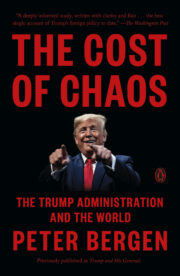
The Cost of Chaos: The Trump Administration and The World:
RECENT ARTICLES

UPCOMING EVENTS
Wednesday, March, 11, 2026
Reporting on the United States’ Long War Against Al-Qaeda, Georgetown University Library
Sunday, April, 12, 2026
2026 Global Security Forum, Doha
Monday, May, 04, 2026
“From Life Itself,” book event with author Suzy Hansen, NA/ASU online
Wednesday, September, 09, 2026
GLOBAL SUMMIT ON TERRORISM AND POLITICAL VIOLENCE, NYC
Thursday, September, 10, 2026
Denver, CELL
Friday, September, 11, 2026
Duke University
Tuesday, September, 22, 2026
Spy Museum, DC.
RECENT FILM AND TV SERIES
GHOSTS OF BEIRUT: SHOWTIME
The Fall of Osama bin Laden, National Geographic
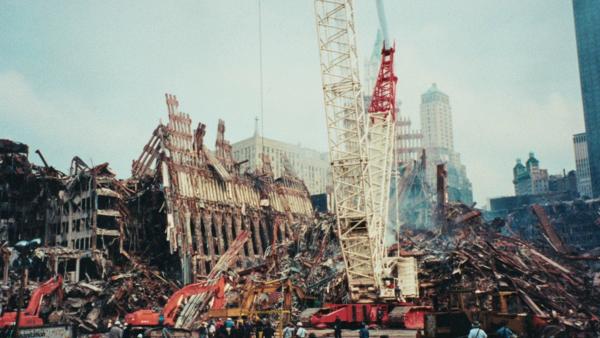
BIN LADEN'S HARD DRIVE, NATIONAL GEOGRAPHIC

