Special Operations and Modern Warfare, ASU, UT, Global SOF and NA, New America DC
For Trump’s generals, this is personal. CNN.com
For Trump’s generals, this is personal
Peter Bergen
By Peter Bergen, CNN National Security Analyst
Peter Bergen says many of the President’s top advisers have served in Afghanistan or have personal ties to the war
They know that an abrupt withdrawal would be a mistake, Bergen says
“Peter Bergen is CNN’s national security analyst, a vice president at New America and a professor of practice at Arizona State University. He is the author of “United States of Jihad: Investigating America’s Homegrown Terrorists.””
(CNN)The seriously deteriorating situation in Afghanistan — and what to do about it — is a deeply personal issue for Trump’s top national security advisers and generals.
In the months after the 9/11 attacks, Trump’s secretary of defense, retired Marine four-star General James Mattis, led the deepest assault from a ship in Marine Corps history near the key Taliban city of Kandahar in southern Afghanistan.
Trump’s National Security Adviser Lt. General H.R. McMaster served in Afghanistan, leading an anti-corruption task force there in 2010.
Trump’s top military adviser, the Chairman of the Joint Chiefs Marine Gen. Joseph F. Dunford, was the commanding general in Afghanistan in 2013.
And General John Kelly, the retired four-star Marine general who is now Trump’s chief of staff, lost a son in Afghanistan, 29-year-old Marine 1st Lt. Robert Kelly who was killed by a landmine there in 2010.
Four days after his son’s death, in a speech in St. Louis, Kelly said that the United States’ war against jihadist terrorists will go on for a very long time. “The American military has handed our ruthless enemy defeat after defeat, but it will go on for years, if not decades, before this curse has been eradicated,” he said at the time.
So when it came to developing a new strategy for Afghanistan, the generals brought a degree of commitment to the longest war in US history that their commander in chief, at least initially, did not share.
In 2013, for example, Trump tweeted, “Let’s get out of Afghanistan. Our troops are being killed by the Afghanis we train and we waste billions there. Nonsense! Rebuild the USA.”
The generals had a different view of what was at stake.
Generals Mattis, Kelly and Dunford have fought alongside each other since the 2003 invasion of Iraq. Then-Major General Mattis, then-Brigadier General Kelly and then-Colonel Dunford led the Marine force that went into Iraq in March 2003 during the initial US invasion of the country.
All of them experienced the visceral sense that US forces leaving Iraq at the end of 2011 helped pave the way for the collapse of the Iraqi army in the face of ISIS’s campaign in Iraq in 2014.
None of them want the same scenario to play out in Afghanistan, where the Taliban is at its strongest point since 9/11 and a virulent local affiliate of ISIS has established itself.
These Marine generals also know how hard-fought were the battles in the southern Afghan province of Helmand, where 349 Marines died in a campaign that began there in 2009 and ended in 2014.
Now 300 Marines are back in Helmand because the Taliban have recently regained territory the Marines had seized there several years ago. The Taliban also control or contest about a third of the Afghan population, around ten million people.
Monday at 9 p.m. ET, President Trump will make an unusual prime-time address from Fort Myer in Arlington, Virginia about what his Afghanistan and larger South Asia strategy will be.
Trump’s national security advisers and generals with deep experience in Afghanistan have advised against a complete withdrawal and against the notion of using contractors as substitutes for US soldiers.
Both these options were on the table as the Trump national security team discussed the options in Afghanistan.
Those options were being pushed, in part, by Trump’s chief strategist Stephen Bannon, who was forced out of the White House on Friday.
Bannon didn’t attend the final war cabinet meeting on Afghanistan that Trump hosted at Camp David on Friday.
A decision to use American contractors in battlefield roles would face a number of legal obstacles, not least that they would be subject to Afghan laws.
For these reasons, privatizing the Afghan war and outsourcing it to contractors or withdrawing completely were really non-starters during the war cabinet’s deliberations on Afghanistan.
Trump officials are tight-lipped about what Trump will announce on Monday night, but he is likely to endorse something close to what the National Security Council plan for Afghanistan has been for the past few months. By mid-June, Trump’s approach to the Afghan War was emerging and it was different from President Obama’s in an important respect.
Trump seemed to be committing US military forces to an open-ended deployment in Afghanistan, according to a senior US official familiar with the plans.
While Obama surged tens of thousands of additional US troops into Afghanistan, he also simultaneously announced their withdrawal date. According to the US official, the Trump administration won’t make the same mistake.
Trump on Monday night will likely also announce some form of conditionality for the expanded US presence in Afghanistan, setting benchmarks, for instance, to reduce corruption in one of the most corrupt countries in the world.
Trump may also mention Afghanistan’s mineral wealth as a “return on investment” that the United States can help to exploit.
Tapping Afghanistan’s vast mineral wealth is a challenge because of the declining security situation and Afghanistan’s rudimentary road infrastructure, but it was one of the key items that Trump and Afghan President Ashraf Ghani discussed when Ghani called Trump to congratulate him on his election to the presidency, according to a senior Afghan official.
When Trump speaks on Monday night, the additional American forces he will likely announce he is sending to Afghanistan are not going there to do anything close to “nation building.” But they are providing triage to help reinforce the Afghan army, which faces its gravest challenge yet from the Taliban.
The United States’ key strategic goal in Afghanistan is to prevent the country from being taken over by jihadist groups such as the Taliban, al-Qaeda and ISIS, allowing the country to be once again used as a launching pad for attacks against the United States and its allies, as it was on September 11, 2001.
So far, that goal has cost the lives of 2,403 American soldiers.
Trump’s top national security advisers and generals understand both the stakes and the costs of the Afghan War well, because they have been personally deeply affected by it.
Vehicle attacks have taken a horrific toll since 2014, CNN.com
Vehicle attacks have taken a horrific toll since 2014
Peter Bergen
By Peter Bergen, CNN National Security Analyst
0
Story highlights
More than 120 people have been killed in vehicle ramming attacks in the West since 2014, including Thursday’s in Barcelona, writes Peter Bergen
Terrorist groups have favored these low-tech attacks since they require no training or expertise, Bergen writes
“Peter Bergen is CNN’s national security analyst, a vice president at New America and a professor of practice at Arizona State University. He is the author of “United States of Jihad: Investigating America’s Homegrown Terrorists.””
(CNN)The attack on one of Barcelona’s historic streets Thursday is the latest in a series of vehicle ramming incidents in the West that have killed 129 people since 2014.
At least 14 people were killed and 80 injured when a van, which witnesses said was traveling at a high speed through the tourist area, mowed down people in Barcelona.
Since 2014 there have been 14 vehicle ramming attacks in the West, according to a count by New America, a nonpartisan think tank.
Like school shooters, terrorists learn from other attacks. Vehicle attacks have become a method of choice for terrorists in the past three years since they require no training or expertise and they inflict just as much terror as more conventional tactics such as bombings.
Three years ago, Abu Muhammad al-Adnani, ISIS’ spokesman, called for attacks in the West using vehicles as weapons.
The most lethal response to this call came in Nice, France on July 14, 2016. A terrorist killed 84 people when he smashed his truck into crowds celebrating Bastille Day, France’s revolutionary anniversary.
The large majority of these vehicle ramming terror attacks have been ISIS-inspired, but the tactic has also been recently adopted by terrorists motivated by other ideologies.
In June, an anti-Muslim fanatic killed one person and injured 11 others when he rammed a vehicle into a group of Muslims who were celebrating Ramadan outside a mosque in north London. According to witnesse,s the man allegedly shouted, “I want to kill all Muslims. … I did my bit.”
On Saturday, a right-wing extremist killed a woman when he rammed a car into a group of people protesting a white nationalist rally in Charlottesville, Virginia.
Vehicular attacks are not entirely new. The Yemen-based al Qaeda in the Arabian Peninsula called for such attacks in 2010, in its English-language webzine, Inspire. In 2006, Mohammed Taheri-Azar injured nine people when he drove a Jeep Cherokee into a crowd on the University of North Carolina-Chapel Hill campus. Palestinian terrorists have also made frequent use of the tactic.
But what is new is the frequency of these vehicle-based attacks.
ISIS’ official news agency, Amaq, has claimed the Barcelona attack as having been carried out by “soldiers of the Islamic State.” This is a formulation that ISIS uses when militants inspired by ISIS but not trained by the group have carried out an attack. As yet, there is no independent corroboration of this claim.
Spain has not seen a jihadist terrorist attack since the multiple bombings on Madrid’s commuter train system that killed 191 people in 2004.
Follow CNN Opinion
Spain also has been somewhat insulated from the strain of ISIS-directed and ISIS-inspired terrorism that has plagued other European countries such as France, Belgium and the United Kingdom.
That is in part because Spain has not experienced the large numbers of “foreign fighters” drawn to fight with ISIS that other European countries have. France has accounted for an estimated 1,500-plus fighters for ISIS. French authorities in July said that 271 of those ISIS fighters had returned to France.
According to a 2015 estimate by The Soufan Group, which tracks foreign fighters, the total official number of fighters from Spain who had traveled to fight with ISIS was 133, and a high end unofficial estimate was 250.
In the wake of Charlottesville and Barcelona, many will be asking how to prevent such vehicular attacks in the future. The sad truth is that, given the vast number of potential targets and the ease with which these attacks can be carried out, there isn’t much authorities can do other than to restrict traffic around high profile events and highly symbolic targets.
The key to preventing future attacks is enlisting peers and family members, who are often the first to detect radicalization and plot planning, to inform authorities of their concerns.
One Mission: How to Build a Team of Teams, New America DC
One Mission: How to Build a Team of Teams
September 15, 2017
12:15 pm – 1:45 pm
Where
New America
740 15th St NW #900
Washington, D.C. 20005
Too often, companies end up with teams stuck in their own silos, pursuing goals and metrics in isolation. In his new book, One Mission: How Leaders Build a Team of Teams, Chris L. Fussell channels his experiences, in the military as a 15-year Navy SEAL veteran and in the corporate world, into a practical guide for developing strategies to create the type of “team of teams” that General McChrystal applied against al Qaeda in Iraq and was described in their previous book Team of Teams.
Fussell is a senior fellow with the International Security program at New America. He spent 15 years as an officer in the Navy SEAL Teams, before transitioning into the private sector. Fussell is now a Partner at McChrystal Group, an advisory services and leadership development firm headquartered in Old Town, Alexandria.
During his active duty career with the SEAL Teams, Fussell deployed multiple times to Iraq, Afghanistan, and other nations in the Central Command region. From 2007-2008, he served as Aide-de-Camp to General (Ret.) Stanley A. McChrystal, then Commanding General of the Joint Special Operations Command. In addition to his latest book, Fussell coauthored Team of Teams: New Rules of Engagement for a Complex World, with General McChrystal.
Follow the conversation online with #OneMission and by following @NewAmericaISP.
Participant:
Chris Fussell, @FussellChris
Author, One Mission: How Leaders Build a Team of Teams
Senior Fellow, New America International Security program
Peter Bergen, @PeterBergenCNN
Vice President, New America
Charlottesville killing was an act of domestic terrorism, CNN.com
Charlottesville killing was an act of domestic terrorism
Peter Bergen
By Peter Bergen, CNN National Security Analyst
Updated 9:18 AM ET, Sun August 13, 2017
Story highlights
Peter Bergen: Incident shows that political violence in the US takes many forms
That includes right-wing terrorism — which should be condemned as such
Peter Bergen is a CNN National Security Analyst, a vice president at New America and the author of “United States of Jihad: Who Are America’s Homegrown Terrorists and How Do We Stop Them?” The opinions expressed in this commentary are his.
(CNN)On Saturday, a 20-year-old man from Ohio allegedly rammed his car into a group of people gathered to protest a white nationalist rally, killing a 32-year old woman and injuring 19 others. If James Alex Fields Jr., of Maumee, Ohio, indeed intended to harm the counter-protesters, then his act deserves to be branded domestic terrorism.
Political violence in the United States takes all shapes and forms and on Saturday in Charlottesville, Virginia, we saw one of its manifestations, militant right-wing terrorism.
New America, a non-partisan think tank that tracks political violence, finds that jihadist terrorists have killed 95 people in the United States since al Qaeda’s attacks on 9/11, while the attack in Charlottesville brings the number to 68 people that have been killed by far-right terrorists in the States during the same time period.
Other forms of political violence have also emerged in the past couple of years. Black nationalist terrorists have killed 8 people in the United States since 2016, while in June a terrorist motivated by extremist anti-Trump views shot at a Republican congressional baseball practice in Alexandria, Virginia, critically wounding Rep. Steve Scalise who is recovering.
In December a man shot a weapon inside a pizzeria in Washington because he believed a conspiracy theory that the pizza joint was in fact a secret front for a child sex ring run by senior Democratic Party officials. Luckily, nobody was hurt in that attack.
And jihadist terrorists continue to kill Americans. In January a security guard was killed in Denver by a terrorist who appears to have been motivated by jihadist beliefs.
These terrorist attacks by right-wing, left-wing and black nationalist terrorists remind us that terrorism is not only the preserve of those who are motivated by the ideology of Osama bin Laden and ISIS.
The attack in Charlottesville deploying a car as a weapon is a new twist for right-wing terrorists in the United States. Jihadist terrorists have used vehicles as weapons frequently, for instance, in recent months in London killing 13 in two separate incidents and in 2016 in Nice, France, killing 84, and in Berlin killing 12.
On Saturday President Donald Trump condemned the attack in Charlottesville in a general terms, but didn’t specifically call out the white nationalists who had convened the rally and who are responsible for the death and injuries that occurred there.
Trump said, “We condemn in the strongest possible terms this egregious display of hatred, bigotry and violence, on many sides. On many sides.”
In 2016 Trump opined on CNN “I think Islam hates us” and he has repeatedly condemned “radical Islamic terrorism,” but he has been noticeably silent about the actions and beliefs of the white nationalists and alt-right militants of the kind that rallied in Charlottesville on Saturday.
Indeed, since Trump took office — and before the Charlottesville incident — far-right militants have killed three people in two separate incidents in New York City and Portland, Oregon; a black nationalist terrorist also killed three and a jihadist militant killed one person, according to New America research.
The lack of acknowledgement and condemnation of militant right-wing terrorism echoes another area of silence by Trump. He has not condemned those behind the bomb that detonated at a Minneapolis suburban mosque a week ago. The perpetrators have not been identified in that case. Luckily the bomb injured no one, but so far the reaction to the attack by the usually voluble Trump has been to say nothing.
Minnesota Gov. Mark Dayton described the mosque bombing as “an act of terrorism.”
Let’s see if Trump offers the same kind of condemnation of the terrorist attack in Charlottesville.
CENS Distinguished Visitors Program, S.Rajaratnam School of International Studies, Singapore
The Internationalists: How a Radical Plan to Outlaw War Remade the World, New America DC
The Internationalists: How a Radical Plan to Outlaw War Remade the World
September 12, 2017
12:15 pm – 1:45 pm
Where
New America
740 15th St NW #900
Washington, D.C. 20005
On a summer afternoon in 1928, world leaders assembled in Paris to outlaw war. Within a year, the treaty signed that day, known as the Peace Pact, was ratified by nearly every state in the world. War, for the first time in history, had become illegal. Within a decade, the states that signed the pact were again at war, and as a result many dismissed the pact as folly.
In their new book The Internationalists: How a Radical Plan to Outlaw War Remade the World, Oona Hathaway and Scott Shapiro argue that this dismissal was mistaken, and that the pact ushered in a sustained march towards peace. While doing so, they tell the history of how the pact came to be and of the lawyers, politicians, and intellectuals whose ideas have shaped our understanding of war’s role in a just world order.
Oona Hathaway is the Gerard C. and Bernice Latrobe Smith Professor of International Law and Counselor to the Dean at the Yale Law School. She is also Professor of International Law and Area Studies at the Yale University MacMillan Center, on the faculty at the Jackson Institute for International Affairs, and Professor of the Yale University Department of Political Science. In 2014-15, she took leave from Yale Law School to serve as Special Counsel to the General Counsel for National Security Law at the U.S. Department of Defense, where she was awarded the Office of the Secretary of Defense Award for Excellence. She is, with Scott J. Shapiro, the author of The Internationalists: How a Radical Plan to Outlaw War Remade the World.
Scott J. Shapiro is the Charles F. Southmayd Professor of Law and Professor of Philosophy at Yale Law School. He joined the Yale Law faculty in July 2008 as a professor of law and philosophy. He previously taught law and philosophy at the University of Michigan and before that, was a professor of law at the Benjamin N. Cardozo School of Law. He is the author of Legality (2011) and editor (with Jules Coleman) of The Oxford Handbook of Jurisprudence and Philosophy of Law (2002).
Follow the discussion online using #Internationalists and following @NewAmericaISP.
PARTICIPANTS
Oona Hathaway, @oonahathaway
Professor of International Law, Yale Law School
Author, The Internationalists: How a Radical Plan to Outlaw War Remade the World
Scott J. Shapiro, @scottjshapiro
Professor of Law and Philosophy, Yale Law School
Author, The Internationalists: How a Radical Plan to Outlaw War Remade the World
MODERATOR
Peter Bergen, @peterbergencnn
Vice President, New America
Future of Terrorism, Arizona State, Tempe, AZ
Designed to introduce Political Thought and Leadership students and members of the community to local and international leaders from a variety of fields, the Political Thought and Leadership Dialogue Series provides lively presentations and opportunities for discussion about a range of topics.
Peter Bergen is a print and television journalist, author, documentary producer and vice president at New America where he directs the International Security and Fellows programs; a professor of practice at Arizona State University; a fellow at Fordham University’s Center on National Security and CNN’s national security analyst. He has held teaching positions at the Kennedy School of Government at Harvard University and at the School of Advanced International Studies at Johns Hopkins University.
Date:
Monday, October 30, 2017 –
5:00pm to 6:30pm
Price:
Free
Campus:
Tempe campus
Location:
Coor Hall, room 4403
Contact:
Roxane Barwick
Phone:
480-727-5436
Website:
http://cptl.asu.edu
Ticketing:
http://conta.cc/2eFxH7C
Domestic Terrorism & Mass Casualty Incident, Georgetown University
START experts to headline conference on domestic terrorism and mass casualty incidents
START experts to headline conference on domestic terrorism and mass casualty incidents
October 17, 2017Zane Moses
START experts, alongside federal, state and local authorities, will speak about the changing state of terrorism during an Insight Exchange Network conference at Georgetown University, Nov. 15-16. The conference, “Best Practices in Preparing for and Responding to Domestic Terrorism & Mass Casualty Incidents” will cover topics such as the steps in preparing for incident response, how to effectively partition state and federal resources, coping with the mental fallout resulting from incidents among other topics.
William Braniff, Kieran Quinlan and Patrick James will headline the START panel following a keynote address from Peter Bergen, a CNN national security analyst.
Law enforcement officials, terrorism analysts, homeland security professionals, community leaders and hospital coordinators are all encouraged to attend the event to learn how to change policy in response to the changing face of terrorism.
Those interested in attending can use the discount code “UMD15” for 15% off. For more information or to register click here.
Domestic Terrorism & Mass Casualty Incidents
Best Practices in Preparing and Responding
November 15-16, 2017
Georgetown University Hotel & Conference Center Washington, DC
Purchase order. Register now and pay by credit card, or call Will Adams at 870-543-2295 to inquire about group discounts or if you plan to pay by purchase order or prefer to be invoiced.
Terrorism has changed: are you changing with it? Vehicle rammings, nightclub attacks, school shooters, the Boston Marathon attack…the list goes on. How can you best prepare for this new face of terrorism and mass casualty incidents? What do you need to know—both in terms of best-practice preparation and response? Insight Exchange Network’s conference brings together federal, state and local authorities, along with industry subject matter experts, in a unique discussion aimed at keeping our country safe—don’t miss it!
*
MIT Club of Washington
Dinner and Talk
Peter Bergen
Vice President at New America
The Future of Terrorism
What we know then, now and Future Expectations.
Wednesday, September 27, 2017; 6:30 PM
Kenwood Golf & Country Club, 5601 River Rd, Bethesda, MD
The MIT Club of Washington cordially invites you to an exciting and stimulating evening with a talk by Mr. Peter Bergen on The Future of Terrorism. Peter Bergen is Vice President at New America, a Journalist, Documentary Producer, CNN National Security Analyst, and Professor of Practice at Arizona State University. Peter will focus on what we know then about terrorism, what we know now, and future expectations. He will discuss the state of the current jihadist terrorist threat to the United States; an assessment of how ISIS is doing; an examination of what the big drivers of jihadist terrorism are; a discussion of some future trends in terrorism, and, finally, what can be done to reduce the threat from jihadist terrorists? He will evaluate the architects of current terrorism, adaptive capabilities, and the application of new technologies.
Bergen produced the first television interview with Osama bin Laden in 1997. The interview, which aired on CNN, marked the first time that bin Laden declared war against the United States to a Western audience. In 2011 he published The Longest War: The Enduring Conflict between America and Al-Qaeda. The book won the Washington Institute’s $30,000 Gold Prize for the best book on the Middle East. In 2012 he published Manhunt: The Ten Year Search for Bin Laden, from 9/11 to Abbottabad. It won the Overseas Press Club award for the best book on international affairs. HBO based the film “Manhunt” on the book, which won the 2013 Emmy for best documentary.
He has a degree in Modern History from New College, Oxford. He has held teaching positions at the Kennedy School of Government at Harvard University and the School of Advanced International Studies at Johns Hopkins University. For many years he was a fellow at New York University’s Center on Law and Security. He has testified on Capitol Hill seventeen times about national security issues.
\
FEATURED BOOK
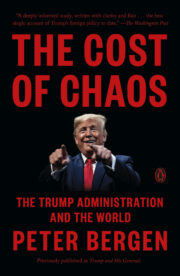
The Cost of Chaos: The Trump Administration and The World:
RECENT ARTICLES

RECENT FILM AND TV SERIES
GHOSTS OF BEIRUT: SHOWTIME
The Fall of Osama bin Laden, National Geographic
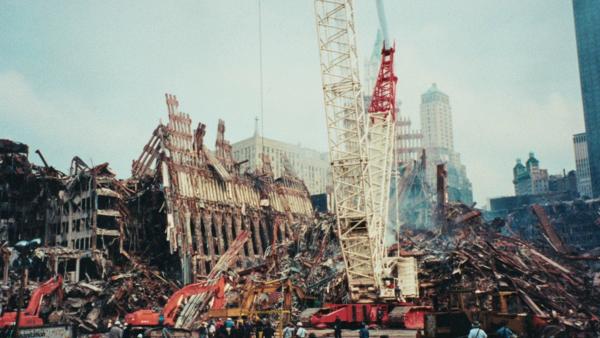
BIN LADEN'S HARD DRIVE, NATIONAL GEOGRAPHIC

