Blood Year: Terror and the Islamic State with Dave Kilcullen, New America DC

Blood Year

In June 2014, ISIS seized Mosul, the anchor of northern Iraq and home to more than two million. Can we recover from this? What does a coherent strategy look like after this disastrous year? In “Blood Year: Terror and the Islamic State,” Dr. David Kilcullen draws upon interviews with communities and combatants, work by his field research teams in Iraq and Syria, and analysis by other observers to point the way towards answers.

Arnold Air Society and Silver Wings, 69th National Conclave, Dallas TX

Arnold Air Society is composed of 2800 Air Force ROTC and United States Air Force Academy Cadets, and Silver Wings is composed of over 700 college students. 69th National Conclave will be held at the Dallas Sheraton from Saturday 26 March through Monday 28 March.
 The National Conclave is scheduled from 26-28 March 2016 at the Sheraton Dallas, located at 400 N Olive St, Dallas, TX  PHONE: (214) 922-8000.  We anticipate between 800 and 1000 attendees with the primary audience being Air Force ROTC Cadets, Air Force Academy Cadets, and affiliated college age civilians interested in supporting the United States Military, the Air Force, and service to our Nation.
  • Speaking date and time is Monday 28 March at 1100 as part of our Distinguished Speaker Series.  

Why is this war hero being investigated? CNN.com

Why is this war hero being investigated?

By Peter Bergen, CNN National Security Analyst


Updated 1:50 PM ET, Thu May 28, 2015

Lt. Col. Jason Amerine, pictured in 2001, played a key role in overthrowing the Taliban in Afghanistan.

Lt. Col. Jason Amerine, pictured in 2001, played a key role in overthrowing the Taliban in Afghanistan.

Story highlights

  • Lt. Col. Jason Amerine, who helped liberate Afghanistan, faces probe in hostage disclosure
  • Peter Bergen: It appears to be a case of a war hero being investigated for doing the right thing

Peter Bergen is CNN’s national security analyst, a vice president at New America and a professor of practice at Arizona State University. He is the author of “Manhunt: The Ten-Year Search for bin Laden — From 9/11 to Abbottabad.”

(CNN)Lt. Col. Jason Amerine, a Special Forces war hero who played an instrumental role in the overthrow of the Taliban in the months after 9/11, is under investigation over a purported unauthorized disclosure relating to a U.S. hostage held overseas that was made to U.S. Rep. Duncan Hunter’s office.

Hunter, a California Republican, has been a vocal advocate in Congress for pushing efforts to help free American hostages held by al Qaeda and the Taliban.
Peter Bergen

Peter Bergen

A plan was developed in the Pentagon by Amerine, most recently a planner on the U.S. Army staff, to secure the release of those American hostages, according to a staff member on Hunter’s committee.

The plan was to release Haji Bashir Noorzai, a prominent member of the Taliban who is in prison in the States on drug trafficking charges, in exchange for U.S. Army Sgt. Bowe Berghdal, who was held by the Taliban until last year as well as other Taliban hostages. They were: Caitlin Coleman, a U.S. citizen, and her husband, Canadian citizen Joshua Boyle, and Warren Weinstein, an American aid worker held by al Qaeda who was inadvertently killed in a CIA drone strike in January.

It’s not clear how far, if anywhere, this plan of action went.

The Washington Post reported Tuesday that the Army Criminal Investigation Command is probing what Amerine may have disclosed to members of Congress months ago. Chris Grey, a spokesman for the Criminal Investigation Command told the Post that, “As a matter of policy, we do not confirm the names of individuals who may or may not be under investigation to protect the integrity of a possible ongoing investigation, as well as the privacy rights of all involved.” He also said, “We reject any notion that Army CID initiates felony criminal investigations for any other purpose than to fairly and impartially investigate credible criminal allegations that have been discovered or brought forward.”

CNN first reported the investigation of Amerine in April.

In a Facebook post this month, Amerine made his first public comments about the investigation, writing: “I have been under criminal investigation for the last four months for whistleblowing to Congress over our completely dysfunctional system for recovering hostages. The FBI formally complained to the Army about me reporting to Congress about their failed efforts to recover Warren Weinstein, Caitlin Coleman and the child she bore in captivity…If I learned nothing in my 22 years of service I learned that we never leave people behind.”

What makes the investigation of Amerine so strange is that he is a bona fide war hero. According to research that I conducted for “The Longest War,” a history of the war on terror, in the months after the 9/11 attacks, then-Capt. Jason Amerine was the leader of the U.S. Special Forces team embedded with Hamid Karzai, the future leader of Afghanistan, in Tarin Kowt, the provincial capital of the Afghan province of Uruzgan.

Bergen: Secrets of the bin Laden treasure trove

On November 16, 2001, the people of Tarin Kowt rose up against the Taliban and chased them out. A day later Karzai headed into the town in a 20-vehicle convoy and set up shop in the governor’s mansion. Arriving around midnight, Karzai met with local Pashtun tribal leaders, who welcomed him and told him with some trepidation that there was a column of some 100 vehicles approaching from Kandahar and containing up to 500 Taliban who would reach the town by the next day intent on taking it back.

The 100-vehicle convoy sent to retake Tarin Kowt for the Taliban was Taliban leader Mullah Mohammed Omar‘s last shot at hanging on to power.

Amerine started to plan how to repel the much larger Taliban force, while his combat controller sent out an urgent warning to U.S. Navy and Air Force aircraft in the area that they would be needed shortly.

Remembering the hostages killed in the U.S. drone strike

Remembering the hostages killed in the U.S. drone strike 02:25
PLAY VIDEO

Amerine gathered as many of Karzai’s guerrillas as he could. His plan was to stake out some higher ground with those guerillas outside Tarin Kowt and call in airstrikes from there onto the fast-approaching Taliban convoy.

Around two hours after Amerine was first alerted to the approaching Taliban column, Navy F/A-18 fighters spotted a group of about 10 four-wheel drives and started bombing them. Three hours later, at 5 a.m., the larger convoy of dozens of Taliban vehicles came into view.

Heavily outnumbered, Karzai’s group of Afghan guerrillas took flight and sped back to Tarin Kowt, followed by Amerine and his Special Forces team. Back in Tarin Kowt, Amerine told Karzai, “The Taliban are coming, there are a lot of them. These (Afghan) fighters we are with don’t understand our capabilities; they kind of ran. I need to take these vehicles and get out there and keep doing what I’m doing.”

Amerine drove back outside the town at around 7 a.m. to direct deadly accurate bombing runs on the approaching Taliban convoy. Three hours later the battle was over, and what remained of the convoy was in full retreat.

Bergen: Could Warren Weinstein have been saved?

Hank Crumpton, who was running the CIA’s operation in Afghanistan, recalls that the battle was decisive because Karzai was the only man who could unify the country’s fractious ethnic factions: “Karzai was the lynchpin between north and south. The Uzbeks, the Tajiks, the Hazara, they all respected Karzai. They knew that he understood the concept of a nation-state.”

Americans detained abroad

Americans detained abroad 20 photos
EXPAND GALLERY

But the importance of the Tarin Kowt battle was not well understood at the time because the vast majority of the international media covering the war were concentrated in the north of the country and focusing on the fall of Kabul five days earlier.

Following the news of the debacle at Tarin Kowt, Mullah Omar finally abandoned Kandahar, the city he had controlled absolutely for seven years.

Karzai arrived just outside Kandahar on December 5 to begin the discussions of the terms of the Taliban surrender agreement. The following day, around 9 a.m., the Afghan leader was talking with a local tribal chief when suddenly there was an enormous bang and the doors and windows of the building he was in blew out.

A U.S. investigation later determined that the cause of the explosion was a 2,000-pound American bomb that had fallen 2 kilometers short of its intended target, instead landing on Karzai and his security detail. Three American Special Forces soldiers were killed.

Amerine, who had grown close to Karzai in the weeks he had protected him, was wounded in the leg and evacuated.

Karzai would go on, of course, to become the first democratically elected Afghan President.

President Barack Obama has ordered a review of U.S. government policies as they relate to hostages. The recent history of American hostage recoveries has mostly been one of failure. Journalists James Foley, Steve Sotloff and aid workers Kayla Mueller, Peter Kassig and Weinstein have all been killed.

Does the White House need a ‘hostage czar’?

Families of hostages have also complained about a lack of communication with them, a lack of coordination between the agencies responsible for securing the release of their family members, and even threats of prosecution if they entered into negotiations with the terrorists holding their loved ones.

The hostage review process, the final findings of which are likely to be made in coming weeks, will surely help to solve some of these problems.

Hunter released a statement in April, saying, “The only government organization seriously developing options to recover Weinstein and others in the Afghanistan/Pakistan region was within the Pentagon — led by war hero Jason Amerine.”

Since the Army is saying little, it is not exactly clear what the grounds are for its investigation of Amerine. That said, it’s strange that this officer appears to be being penalized for simply doing the right thing: coming up with novel ideas about how to return American hostages home and communicating with members of Congress who have taken an interest in the issue.


Peter Bergen: ¿Fue la muerte de Bin Laden una mentira? CNN.es

Peter Bergen: ¿Fue la muerte de Bin Laden una mentira?

fecha: 
Peter Bergen: ¿Fue la muerte de Bin Laden una mentira?

Seymour Hersh es uno de los gigantes del periodismo de investigación. Al inicio de su carrera, él dio a conocer la historia de la masacre de My Lai durante la cual cientos de civiles desarmados murieron a manos de soldados estadounidenses enVietnam en 1968.

Hersh obtendría aún más reconocimiento luego del 11 de septiembre, al dar a conocer (junto con “60 Minutes”) la historia de abusos que soldados estadounidenses cometieron contra prisioneros en la cárcel de Abu Ghraib en Iraq para The New Yorker en 2004.

Ahora surge otro informe de Hersh en el que asegura que “La hostoria de la Casa Blanca (sobre la redada llevada a cabo por los Navy SEAL de EE.UU. en 2011 en Paquistán que le dio muerte a Osama bin Laden) podría haber sido escrita porLewis Carroll”

El artículo de Hersh fue publicado en el London Review of Books, no en el New Yorker, donde ha sido un colaborador desde 1993.

Debido a la estatura de Hersh, su artículo acerca de la redada de bin Laden atrajo tanta atención el domingo cuando fue publicado inicialmente, que el sitio web delLondon Review of Books colapsó.

¿Un encubrimiento masivo?

El principal argumento de Hersh en su nuevo informe es que, a diferencia de lo que funcionarios de la administración de Obama afirmaron tras el operativo contra bin Laden, los funcionarios estadounidenses y pakistaníes tenían pleno conocimiento acerca del paradero de bin Laden en la ciudad de Abbottabad, al norte del país, cooperaron en su captura y luego acordaron un encubrimiento masivo de todo esto, lo cual involucra a funcionarios en varios niveles distintos del gobierno de ambas naciones.

Estas son las principales afirmaciones que se hacen en el artículo de Hersh, las cuales en gran medida se basan en lo que indica un único funcionario de inteligencia retirado y no identificado de Estados Unidos:

• El operativo llevado a cabo en 2011 por los Navy SEAL en el complejo deAbbottabad donde bin Laden se escondía al norte de Paquistán no fue un tiroteo en el que los miembros de la unidad SEAL ingresaron a una situación peligrosa y desconocida, sino un ardid en el que el ejército de Paquistán había tenido a bin Laden cautivo en Abbottabad durante cinco años y simplemente lo puso a disposición de los SEAL, quienes llegaron al complejo en helicóptero la noche de la redada.

• Un funcionario de la poderosa agencia de inteligencia del ejército de Pakistán, el Servicio de Inteligencia (ISI, por sus siglas en inglés), acompañó a los SEAL en la redada y les mostró el complejo de Abbottabad, y los únicos disparos que se produjeron esa noche fueron los que los SEAL dispararon para matar a bin Laden.

• Un “desertor” en la Embajada de Estados Unidos en Islambad le avisó a la CIA que bin Laden vivía en el complejo de Abbottabad, y no era cierto —a pesar de las declaraciones de varios funcionarios estadounidenses después de la redada— que la CIA había rastreado al servicio de mensajería de bin Laden hasta el complejo deAbbottabad y que había desarrollado argumentos circunstanciales en relación a que bin Laden vivía ahí.

• Arabia Saudita financiaba el mantenimiento de bin Laden en su complejo de Abbottabad.

• Un médico del ejército paquistaní obtuvo una muestra de ADN de bin Laden que demostró que estaba en Abbottabad, una prueba que fue proporcionada a Estados Unidos para que toda la supuesta incertidumbre —mencionada por funcionarios de la administración de Obama después de la redada— acerca de si bin Laden en realidad vivía en el complejo fuera mentira.

• La “mentira más descarada”, según Hersh, fue que “dos de los líderes militares de más alto rango de Pakistán —el general Ashfaq Parvez Kayani, jefe de personal del ejército, y el general Ahmed Shuja Pasha, director general del Servicio de Inteligencia de Pakistán (ISI, por sus siglas en inglés)— nunca fueron informados” de antemano sobre el operativo que Estados Unidos llevó a cabo en el complejo de bin Laden.

En resumen, según el relato de Hersh, el presidente Barack Obama y muchos de sus principales asesores mintieron sobre casi todo lo referente a lo que se considera como uno de los logros más destacados del presidente: autorizar a la redada en la que Bin Laden fue asesinado.

La evidencia

La versión de Hersh del operativo contra bin Laden es un fárrago de tonterías que va en contra de una multitud de recuentos de testigos oculares, datos inconvenientes y el simple sentido común.

Empecemos con la afirmación de que los únicos disparos que se produjeron en el complejo de Abbottabad fueron los que mataron a bin Laden. Eso ignora el hecho de que los dos SEAL que fueron parte de la misión, Matt Bissonnette, autor de “No Easy Day” y Robert O’Neill, han dicho públicamente que varias personas más murieron esa noche, entre ellas dos guardaespaldas de bin Laden, uno de sus hijos y la esposa de uno de los guardaespaldas. Su versión se complementa con muchos otros funcionarios estadounidenses que han hablado oficialmente conmigo o con otros periodistas.

Yo fui la única persona ajena en visitar el complejo de Abbottabad donde bin Laden vivía antes de que el ejército pakistaní lo demoliera. El complejo fue destrozado, quedó lleno casi por todas partes de vidrio roto, y varias áreas quedaron rociadas con agujeros de balas donde los SEALS le dispararon a miembros del séquito y la familia de bin Laden, o en un caso, intercambiaron fuego con uno de sus guardaespaldas. La evidencia en el complejo demostró que muchas balas fueron disparadas la noche de la muerte de bin Laden.

El sentido común te diría que la idea de que Arabia Saudita cubriera los gastos de bin Laden mientras vivía en Abbottabad es simplemente irrisoria. El principal objetivo de bin Laden era derrocar a la familia real saudí; como resultado de esto, su ciudadanía saudí fue revocada en 1994.

¿Por qué habrían los saudíes de pagar por el mantenimiento de su enemigo más mortal? En realidad, ¿por qué no habrían de hacer que sus aliados más cercanos, los pakistaníes, se hicieran de la vista gorda mientras enviaban a sus asesinos a Pakistán para acabar con él?

El sentido común también te diría que si los pakistaníes tenían cautivo a bin Laden y el gobierno de EE.UU. hubiera tenido conocimiento de esto, el camino más sencillo para ambos países no habría sido lanzar un operativo militar estadounidense enPakistán, sino que le entregaran a bin Laden de forma discreta a los estadounidenses.

De hecho, los pakistaníes han hecho esto en varias ocasiones con otros líderes de alQaeda, como Jálid Sheij Mohammed , el comandante de operaciones de los ataques del 11 de septiembre, quien fue puesto bajo custodia de Estados Unidostras una redada en la ciudad pakistaní de Rawalpindi en 2003. Lo mismo ocurrió conAbu Faraj al-Libi, otro líder clave de al Qaeda a quien igualmente los pakistaníes pusieron bajo custodia estadounidense dos años después.

¿Por qué ocultarlo?

El sentido común también te diría que si los funcionarios estadounidenses se hubieran enterado de que los funcionarios pakistaníes ocultaban a bin Laden ahí, no hay razón por la que los estadounidenses hubieran tenido que encubrirlo. Después de todo, en la época de la redada contra bin Laden, las relaciones entre Estados Unidos y Pakistán se encontraban en un punto bajo histórico, debido a que los pakistaníes recientemente habían encarcelado a Raymond Davis, un contratista de la CIA que había asesinado a dos pakistaníes. ¿Qué tenían los funcionarios estadounidenses que perder al decir que bin Laden estaba siendo protegido por los pakistaníes, incluso si fuera cierto?

El hecho es que los altos funcionarios pakistaníes que Hersh afirma que protegían a bin Laden estaban tan sorprendidos como el resto del mundo por el hecho de que el líder de al Qaeda vivía en Abbottabad. La noche de la redada contra bin Laden, los funcionarios estadounidenses estaban monitoreando las comunicaciones de altos funcionarios militares de Pakistán como Kayani y Pasha, y sus reacciones de desconcierto confirmaron que los pakistaníes no habían tenido ni idea de la presencia de bin Laden ahí, según varios funcionarios con los que hablé mientras me informaba para “Manhunt”, un libro acerca de la búsqueda de bin Laden.

En su artículo, Hersh señala correctamente que inmediatamente después de la redada contra bin Laden, funcionarios de la Casa Blanca hicieron inicialmente algunas afirmaciones falsas acerca del operativo —por ejemplo, que bin Laden utilizó a sus esposas como escudos humanos durante la redada— pero rápidamente fueron corregidas.

La única fuente que Hersh menciona por nombre en su artículo de 10.000 palabras es Asad Durrani, quien era el jefe del ISI durante la década de 1990, alrededor de dos décadas antes de que se llevara a cabo la redada contra bin Laden. Hersh describe a Durrani como una persona que en general respalda sus conclusiones.

Cuando le envié un correo electrónico a Durrani luego de que el artículo de Hersh fuera publicado, Durrani dijo que “no había evidencia de ningún tipo” en relación a que el ISI sabía que bin Laden se estaba ocultando en Abbottabad, pero que él aun así podía “hacer una evaluación en relación a que esto podría ser verosímil”. Esto de ninguna forma es un buen respaldo para una de las principales afirmaciones del artículo de Hersh.

Durrani añadió que él cree que “el operativo contra bin Laden no podría haberse llevado a cabo sin nuestra cooperación”. Esto pasa por alto el hecho de que los miembros de la unidad SEAL volaban en helicópteros furtivos a través de puntos ciegos en los radares de defensa de Pakistán, y la fuerza aérea pakistaní prácticamente no tenía la capacidad de volar de noche cuando ocurrió la redada. Por lo tanto, el operativo contra bin Laden se llevó a cabo de manera relativamente sencilla sin la cooperación pakistaní, según varios funcionarios estadounidenses con conocimiento sobre el operativo.

Por supuesto, todo tipo de cosas son verosímiles, pero tanto en el periodismo como al momento de escribir un artículo, uno busca evidencia, no verosimilitud.

Hersh ha tenido una carrera exitosa. Uno espera que no termine con un artículo sobre la administración de Obama y la redada contra bin Laden que parece tratarse de cómo Frank Underwood de “House of Cards” forma una alianza impura con Carrie Mathison de “Homeland” para producir una versión pakistaní de Watergate.


Secrets of the bin Laden Treasure Trove, CNN.com

Secrets of the bin Laden treasure-trove

By Peter Bergen, CNN National Security Analyst


Updated 8:19 PM ET, Wed May 20, 2015

UNDISCLOSED, AFGHANISTAN - JANUARY 1:  Recent TV grab of Saudi Arabian dissident Osama Bin Laden  aired 11 May as he answers to a journalist's questions in an undisclosed   location in Afghanistan, late March and begining of April.  Laden is a billionaire wanted by the United States and Saudi Arabia on charges of financing international terrorism.--COURTESY CNN 'S NEWS MAGAZINE IMPACT--  (Photo credit should read CNN/AFP/Getty Images)

Story highlights

  • U.S. releases unprecedented number of Osama bin Laden documents from 2011 raid
  • Documents show bin Laden’s correspondence with family and al Qaeda associates
  • Material paints complex portrait of the world’s most wanted man in years before his death

Peter Bergen is CNN’s national security analyst, a vice president at New America and a professor of practice at Arizona State University. He is the author of “Manhunt: The Ten-Year Search for bin Laden — From 9/11 to Abbottabad.”

(CNN)In his final years hiding in a compound in Pakistan, Osama bin Laden was a man who at once showed great love and interest in his own family while he coldly drew up quixotic plans for mass casualty attacks on Americans, according to documents seized by Navy SEALs the night he was killed.

On Wednesday morning, the U.S. Office of the Director of National Intelligence released an unprecedented number of documents from what U.S. officials have described as the treasure-trove picked up by the SEALs at bin Laden’s compound in Abbottabad, Pakistan, on May 2, 2011.

Peter Bergen

Peter Bergen

Totaling 103 documents, they include the largest repository of correspondence ever released between members of bin Laden’s immediate family and significant communications between bin Laden and other leaders of al Qaeda as well as al Qaeda’s communications with terrorist groups around the Muslim world.

Also released was a list of bin Laden’s massive digital collection of English-language books, think tank reports and U.S. government documents, numbering 266 in total.

To the end bin Laden remained obsessed with attacking Americans. In an undated letter he told jihadist militants in North Africa that they should stop “insisting on the formation of an Islamic state” and instead attack U.S. embassies in Sierra Leone and Togo and American oil companies. Bin Laden offered similar advice to the al Qaeda affiliate in Yemen, telling it to avoid targeting Yemeni police and military targets and instead prioritize attacks on American targets.

Much of bin Laden’s advice either didn’t make it to these groups or was simply ignored because al Qaeda affiliates in Yemen and North Africa continued to attack local targets.

Author on bin Laden's shelf: We interfere in Muslim world

Author on bin Laden’s shelf: We interfere in Muslim world 02:52
PLAY VIDEO

ISIS, of course, didn’t exist at the time bin Laden was writing. The group, which now controls a large swath of territory in the Middle East, grew out of al Qaeda in Iraq and has charted a different path, seeking to create an Islamic state and not prioritizing attacks on the United States and its citizens.

Taken together, these documents and reading materials paint a complex, nuanced portrait of the world’s most wanted man in the years before he was killed in the raid on his compound.

In the letters that bin Laden exchanged with his many sons and daughters, he emerges as a much-loved and admired father who doted on his children. And in a letter he sent to one of his wives, he even comes off as a lovelorn swain.

That’s in sharp contrast to the letters bin Laden sent to al Qaeda leaders that demanded mass casualty attacks against American targets and insisted that al Qaeda affiliates in the Middle East stop wasting their time on attacks against local government targets. “The focus should be on killing and fighting the American people,” bin Laden emphasized.


What bin Laden was reading


Bin Laden’s digital library is that of an avid reader whose tastes ran from “Obama’s Wars,” Bob Woodward’s account of how the Obama administration surged U.S. troops in Afghanistan in 2009 and 2010, to Noam Chomsky as well as someone who had a pronounced interest in how Western think tanks and academic institutions were analyzing al Qaeda.

Bin Laden was a meticulous editor, and some of the memos he wrote were revised as many as 50 times. Of the thousands of versions of documents recovered from computers and digital media that the SEALs retrieved at bin Laden’s compound, the final tally numbers several hundred documents.

The new documents show how bin Laden reacted to the events of the Arab Spring, which was roiling the Middle East in the months before his death. While bin Laden had nothing to say publicly about the momentous events in the Middle East, privately he wrote lengthy memos analyzing what was happening, pointing to the “new factor” of “the information technology revolution” that had helped spur the revolutions and characterizing them as “the most important events” in the Muslim world “in centuries.”

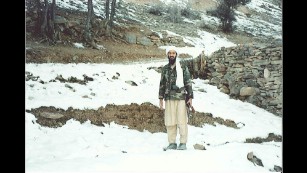
Osama bin Laden holds a Kalashnikov rifle in Tora Bora, a mountainous area of Afghanistan, in November 1996. This remarkable set of photos -- the first showing bin Laden in the remote hideout where he would seek refuge after 9/11 -- came to light only last month in the terrorism conspiracy trial of bin Laden lieutenant Khaled al-Fawwaz. Al-Fawwaz was a communications conduit for al Qaeda in London during the mid-1990s.

Osama bin Laden’s Afghan hideout 31 photos
EXPAND GALLERY

Some of the documents paint an organization that understood it was under significant pressure from U.S. counterterrorism operations. One undated document explained that CIA drone attacks “led to the killing of many jihadi cadres, leaders and others,” and noted, “(T)his is something that is concerning us and exhausting us.” Several documents mention the need to be careful with operational security and to encrypt communications and also the necessity of making trips around the Afghan-Pakistan border regions only on “cloudy days” when American drones were less effective.

Al Qaeda members knew they were short on cash, with one writing to bin Laden, “Also, there is the financial problem.”

Some of the documents have nothing to do with terrorism. One lengthy memo from bin Laden worried about the baleful effects of climate change on the Muslim world and advocated not depleting precious groundwater stocks. Sounding more like a World Bank official than the leader of a major terrorist organization, bin Laden fretted about “food security.” He also gave elaborate instructions to an aide about the most efficacious manner to store wheat.


Family concerns


Many of the documents concern bin Laden’s sprawling family, which included his four wives and 20 children. Bin Laden took a minute interest in the marriage plans of his son Khalid to the daughter of a “martyred” al Qaeda commander, and he exchanged a number of letters with the mother of the bride-to-be. Bin Laden excitedly described the impending nuptials, “which our hearts have been looking forward to.”

Bin Laden corresponded at length with his son Hamza and also with Hamza’s mother, Khairiah, who had spent around a decade in Iran under a form of house arrest following the Taliban’s fall in neighboring Afghanistan during the winter of 2001.

Hamza wrote a heartfelt letter to bin Laden in 2009 in which he recalled how he hadn’t seen his father since he was 13, eight years earlier: “My heart is sad from the long separation, yearning to meet with you. … My eyes still remember the last time I saw you when you were under the olive tree and you gave each one of us Muslim prayer beads.”

In 2010 the Iranians started releasing members of the bin Laden family who had been living in Iran. Bin Laden spent many hours writing letters to them and to his associates in al Qaeda about how best he could reunite with them.

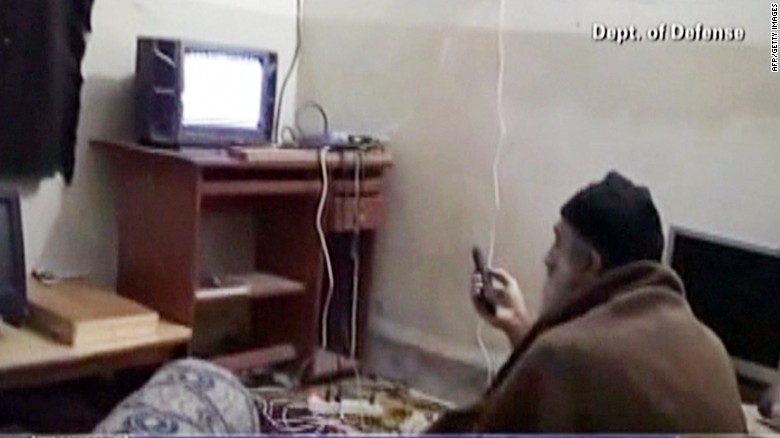
Bin Laden watches TV at his Abbottabad, Pakistan, compound in a frame grab from an undated video from the Pentagon.

Bin Laden watches TV at his Abbottabad, Pakistan, compound in a frame grab from an undated video from the Pentagon.

In a letter to his wife Khairiah, he wrote tenderly, “(H)ow long have I waited for your departure from Iran.”

Bin Laden was paranoid that the Iranians — who he said were “not to be trusted” — might insert electronic tracking devices into the belongings or even the bodies of his family as they departed Iran. He told Khairiah that if she had recently visited an “official dentist” in Iran for a filling that she would need to have the filling taken out before meeting with him as he worried a tracking device might have been inserted inside.

U.S. intelligence officials have a theory that bin Laden might have been grooming Hamza eventually to succeed him at the helm of al Qaeda because the son’s relative youth would energize al Qaeda’s base. But Hamza never made it to his father’s hiding place in Abbottabad. When the SEALs raided bin Laden’s compound, they assumed Hamza would likely be one of the adult males living there, but he wasn’t.

U.S. intelligence officials say they don’t know where Hamza, now in his late 20s, is today.


‘In case you became a martyr’


As is typical for any bureaucratic organization there was considerable discussion in the documents about which al Qaeda personnel might be suitable for promotion and also documentation of cash flows moving in and out of the organization, in amounts in the tens of thousands of euros.

There is even an al Qaeda application form that included standard questions such as what “hobbies” the applicant might have, but also less standard ones such as, “Who should we contact in case you became a martyr?”

Under pressure from bin Laden, leaders of al Qaeda in Yemen noodled with the idea that they might negotiate some kind of truce with the Yemeni government so the group could focus exclusively on attacking American targets. It’s not clear if anything came of this.

Osama bin Laden's compound

Osama bin Laden’s compound 9 photos
EXPAND GALLERY

Similarly, al Qaeda members reached out to leaders of the Pakistani Taliban who maintain contacts with Pakistan’s military intelligence service, ISI, to see if they could negotiate a similar truce with the Pakistani government. The deal would be that the Pakistanis would leave al Qaeda alone and vice versa and then al Qaeda would be able to focus on attacking American targets. However, the al Qaeda leader who was leading this effort told bin Laden, “As you know, this is just talk!” and nothing came of these discussions.

There is no evidence in the newly released documents that the Pakistanis had any idea bin Laden was living in Pakistan or indeed he was even alive.

The new documents also do nothing to substantiate investigative journalist’s Seymour Hersh’s recent well-publicized claims that the raid that killed bin Laden was not a firefight in which the SEALs went into a dangerous and unknown situation, but a setup in which Pakistan’s military had been holding bin Laden prisoner in Abbottabad for five years and simply made him available to the SEALs when they flew in helicopters to the compound on the night of the raid.

White House rejects Hersh’s ‘baseless assertions’

On the first anniversary of bin Laden’s death in May 2012, the Obama administration released a first tranche of 17 documents from the treasure-trove. Those documents also underlined how much al Qaeda feared the CIA drone campaign as well as bin Laden’s obsessive interest in attacking the United States.

Bergen: Hersh's account of bin Laden raid is nonsense

Bergen: Hersh’s account of bin Laden raid is nonsense 05:25
PLAY VIDEO

Hersh seems to believe that any documents released by the Obama administration that were discovered during the bin Laden raid have been faked by the CIA. Readers can judge for themselves by examining the English-language translations of the new documents and also the original Arabic documents here.

According to U.S. intelligence officials, in October seven U.S. intelligence agencies began the process of clearing for public release the documents that came out Wednesday.

Bergen: Was there a cover-up in bin Laden killing?


Digital library


Among the most interesting windows in to the mind of al Qaeda’s leader are the contents of his massive digital library, which was painstakingly assembled. Because of security concerns, bin Laden’s compound had no connection to the Internet so any books or reports that bin Laden had an interest in were assembled painstakingly by making PDFs of each page. They were then put on to a thumb drive and delivered to bin Laden by one of his two bodyguards, according to U.S. intelligence officials.

Strangely, one of the books in bin Laden’s digital library was a suicide prevention manual. Senior U.S. intelligence officials do not believe that bin Laden was suicidal.

Bin Laden was interested in books with a conspiratorial bent, and he had tomes about the Illuminati and the Freemasons and even, somewhat ironically, a book that asserted 9/11 was an “inside job.”

Bin Laden also collected reports by leading American counterterrorism exports such as Bruce Hoffman and Paul Pillar as well as papers about al Qaeda by West Point’s Combating Terrorism Center, RAND Corp. and the Congressional Research Service. (He even possessed congressional testimony by this author titled, “Reassessing the Evolving al Qaeda threat to the Homeland.”)

Bin Laden collected indictments from American terrorism cases that he found of interest, such as that of David Coleman Headley from Chicago, who al Qaeda had tasked to plan an attack against a Danish newspaper that had published cartoons of the Prophet Mohammed.

During the almost six years bin Laden lived in the Abbottabad compound, he had a great deal of time on his hands, which was partly consumed by reading the many holdings in his digital library and also composing the memos and letters that are now becoming public.

Bin Laden was deeply aware that as the 10th anniversary of 9/11 approached his central goal of attacking the United States again had failed. Many of the documents reference his plans for some kind of major public statement to mark the anniversary. Bin Laden was killed three months before he could deliver this statement.

A gripping glimpse into bin Laden’s decline and fall

East Carolina University – Greenville, NC


Voyages of Discovery Lecture Series: The Premier Lecture

Peter Bergen

CNN’s National Security Analyst, and Director of the National Security Studies Program at the New American Foundation in Washington, D.C.

will discuss

“Making Sense of a Troubled World”

7:30 p.m.


    Tuesday, September 29, 2015

Sponsor:             East Carolina University – Greenville, NC – Wright Auditorium

Event:                  Voyages of Discovery Lecture Series: Premiere Lecture

7:30 PM – Speech
8:30 PM – Q&A
9:00 PM – Book Signing

Wright Auditorium

This is a passport event. For more information, visit www.ecu.edu/voyages.

Tuesday, September 29 at 7:30pm to 8:30pm

Wright Auditorium
Greenville, NC 27858-4353

Event Type
Lecture/Reading, Academic, ECU Homepage

Departments
Thomas Harriot College of Arts & Sciences, Harriot College of Arts & Sciences

Target Audience
Students, Faculty, Staff, Public, Alumni

Website
http://www.ecu.edu/voyages

Contact Name
Dr. Jeffrey Johnson

Contact Phone Number
252-328-6378

Contact Email
johnsonj@ecu.edu

Subscribe

Recent Activity

No recent activity

People Going (1)

Getting Here

The Schwartz Visiting Fellow Program. Pomfret School, Pomfret CT

Pomfret School welcomes many distinguished guests to the school each year.

The Schwartz Visiting Fellow Program began in 1988, when brothers Michael L. Schwartz ’66 and Eric A. Schwartz ’69, both former trustees, awarded Pomfret a generous annual grant to begin a visiting fellowship program. The Schwartz brothers’ aim was to design a program to significantly enhance the intellectual and cultural environment of the school community by inviting a distinguished person or persons to lecture, discuss, and work with students and faculty.

The Schwartz Visiting Fellow is a prominent figure from the world of art, literature, science, or politics invited to the Pomfret campus for three days each year to share his or her unique experiences, ideas, and insights with Pomfret students. Designated as the Schwartz Fellow, this guest is selected by a different department each year.

“Homegrown: Americans Fighting for Militant Islam” University of Southern California, LA


You are cordially invited to attend a talk featuring

                              PETER BERGEN


“Homegrown: Americans Fighting for Militant Islam”


Tuesday, August 18, 2015 • 12:00 p.m.


University of Southern California

Doheny Memorial Library • Room 240

3550 Trousdale Parkway, Los Angeles, CA 90089


• Book signing to follow •


Please RSVP to http://www.usc.edu/esvp with the code “BERGEN” by AUG. 10.


One of the few Westerners to interview Osama bin Laden face-to-face, Peter Bergen is a print and television journalist, documentary producer, and the author of four books, three of which were New York Times bestsellers and three of which were named books of the year by the Washington Post. The books have been translated into twenty languages. He is the director of the national security studies program at the New America Foundation in Washington D.C.; a fellow at Fordham University’s Center on National Security and CNN’s national security analyst. He has held teaching positions at the Kennedy School of Government at Harvard University and at the School of Advanced International Studies at Johns Hopkins University.

His most recent book, a New York Times bestseller, is Manhunt: The Ten Year Search for bin Laden, from 9/11 to Abbottabad. The book is being translated into nine languages and HBO has produced a theatrical release documentary based upon it. The film, for which Bergen is the executive producer, was in the Sundance Film 2013 competition and won the Emmy award for Best Documentary. The Washington Post, named Manhunt one of the best non-fiction books of 2012 and The Guardian named it one of the key books on Islamist extremism. The Sunday Times (UK) named it the best current affairs book of 2012 and The Times (UK) named it one of the best non-fiction books of 2012. The book was awarded the Overseas Press Club Cornelius Ryan award for best non-fiction book of 2012 on international affairs.


BIOGRAPHY:  Bergen has a M.A. in Modern History from New College,Oxford University. He won an Open Scholarship when he went up to New College in 1981. Before that he attended Ampleforth. He was born in Minneapolis in 1962 and was raised in London. He is married to the documentary director/producer Tresha Mabile.


~~~

                Detailed directions and parking instructions will be sent to attendees by AUG. 13.


Established in 2004, CREATE is an interdisciplinary national research center based at the University of Southern California and funded by the U.S. Department of Homeland Security. The DHS Center of Excellence is focused on risk and economic analysis and comprises a team of experts from across the country, including partnerships with numerous universities and research institutions.

www.usc.edu/create


The Future of Afghan Women, New America DC

Contested Terrain: The Future of Afghan Women

event | May 28, 2015 


Contested Terrain: The Future of Afghan Women

Thursday, May 28, 2015

12:15 PM – 01:45 PM

1899 L Street NW, Suite 400

Washington, DC 20036

RSVP


With the U.S. withdrawing from Afghanistan and a new Afghan government having assumed power, what kind of future do Afghan women face? In her new book, Contested Terrain: Reflections with Afghan Women Leaders, Sally L. Kitch explores the crisis in contemporary Afghan women’s lives by focusing on the stories of Judge Marzia Basel and Ms. Jamila Afghani from 2005 through 2014, providing an oft-ignored perspective on the personal and professional lives of Afghanistan’s women.

Dr. Sally L. Kitch is the founding Director of the Institute for Humanities Research (IHR), Regents’ Professor of Women’s and Gender Studies, and Affiliate of the Piper Center for Creative Writing at Arizona State University. Her work focuses on feminist theory and epistemology, the intellectual history of gender and racial ideology, and the material effects of such representation on the lived realities of diverse women’s lives.

Judge Marzia Basel was sworn in as a judge in 1995, just before the Taliban eliminated all women professionals in 1996. She was the founder of the Afghan Women Judges Association in 2003, an organization later banned by Afghanistan’s Supreme Court in 2007. She then worked for several international organizations in order to advance women’s rights through instruction in both civil and Shari’ah law. In 2008, she founded the Afghanistan Progressive Law Organization to fight injustices beyond the court system. In 2011 Marzia fled Afghanistan for fear of her life as a result of her work with international organizations. She now lives in Toronto, Canada, where she is seeking permanent residency. She remains involved in a number of organizations working on Afghan issues.

Ms. Jamila Afghani is the founder of the Noor Educational and Capacity Development Organization, which promotes the rights of women and girls by working with families to support the acceptance of girls’ schooling in rural areas and with imams to instruct congregations in what the Qur’an says about women’s rights. She personally overcame many obstacles, including family members’ conservatism and a disability that affected her since early childhood. Though disruptive, her family’s emigration to Pakistan to escape the Afghan civil wars allowed Jamila to obtain a degree from Peshawar’s Jinnah College for Women and a master’s degree in international relations. Back in Afghanistan since 2002, Jamila established the Afghan Women’s Islamic Network, an NGO that aims to create a network where women with Islamic education can pool their knowledge and support one another. She was also an elected member, and the only Afghan member, of the Afghan NGO Humanitarian Country Team, which decided on the distribution of government funds and donations in emergency situations, and established her own Afghan Women’s Professional Education Institute, which she officially registered with the Ministry of Education.

New America and The McCain Institute for International Leadership at ASU are pleased to welcome Dr. Kitch, Judge Basel, and Ms. Afghani for a discussion of Dr. Kitch’s book and the future of Afghan women.

Join the conversation online using #AfgWomen and following @NatSecNAF and @McCainInstitute.

In collaboration with


Copies of Dr. Kitch’s book will be available for purchase by cash, check, or credit card. All proceeds from the book will support Afghan women’s causes.

Participants

Dr. Sally L. Kitch
Founding Director, Institute for Humanities Research
Regents’ Professor of Women’s and Gender Studies at Arizona State University
Author, Contested Terrain: Reflections with Afghan Women Leaders

Judge Marzia Basel (by video)
Founder, Afghan Women Judges Association

Ms. Jamila Afghani
Founder, Noor Educational and Capacity Development Organization
Founder, Afghan Women’s Islamic Network
Elected Member, Afghan NGO Humanitarian Country Team

Moderator: Peter Bergen
Director, International Security Program, New America

Who are ISIS’ American recruits? CNN.com

By Peter Bergen and David Sterman


Updated 12:05 PM ET, Wed May 6, 2015

Story highlights

  • Texas shooting suspect appeared to have pledged support for ISIS
  • Peter Bergen: Several dozen Americans have backed ISIS, most of them young and active on social media

Peter Bergen is CNN’s national security analyst, a vice president at New America Foundation and a professor of practice at Arizona State University. He is the author of “Manhunt: The Ten-Year Search for bin Laden — From 9/11 to Abbottabad.” David Sterman is a program associate at New America.

(CNN)Elton Simpson — one of the gunmen who opened fire Sunday at an event in Garland, Texas, that was celebrating cartoonists who had drawn pictures of the Prophet Mohammed — appears to have declared his allegiance to ISIS in a tweet before the attack. Simpson also apparently had online ties to a British ISIS recruit believed to be in Syria.

Simpson, who was shot to death by police, is far from the only American who who has been drawn to the black flags of ISIS as well as to the al Qaeda affiliate in Syria known as the Nusra Front.

There are 62 individuals in the United States that New America has identified in public records or news accounts who have tried to join militant groups in Syria such as ISIS or Nusra, or have succeeded in joining such groups, or have helped others to join such groups.

Peter Bergen

Peter Bergen

They hail from across the United States and from a wide range of ethnic groups, which underscores the difficulty that law enforcement has in tracking them. They are relatively young; some are even teenagers. Given the fact that groups like ISIS have scant roles for women outside the home, women are surprisingly well-represented. These militants are also quite active on social media. This is something of a boon for law enforcement, as many of these militants are prolific posters on publicly available social media, which it is perfectly legal for the FBI and police departments to monitor.

The 62 are residents of 19 states: Alabama, Arizona, California, Colorado, Florida, Illinois, Massachusetts, Michigan, Minnesota, Missouri, New Jersey, New York, North Carolina, Ohio, Pennsylvania, South Carolina, Texas, Virginia, and Wisconsin.


Just one thing in common


There is no single ethnic profile for these militants: They are white, African-American, Somali-American, Vietnamese-American, Bosnian-American and Arab-American, among other ethnicities and nationalities.

An unprecedented number of American women are involved in the Syrian jihad compared to other such jihads in the past. More than one-fifth of the 62 Americans involved in Syria-related militant activity are women.

Women were rarely present, if at all, among jihadists in previous “holy wars” — in Afghanistan against the Soviets in the 1980s, in Bosnia against the Serbs in the 1990s, and the initial insurgency in Iraq against the U.S.-led occupation more than a decade ago.

They’re relatively young. A quarter are teenagers — including five teenage girls, the youngest of whom is 15. New America found that the average age of individuals involved in Syrian militancy is 25.

The only profile that ties together American militants drawn to the Syrian conflict is that they are active in online jihadist circles. Fifty-three of the 62 individuals showed a pattern of often downloading and sharing jihadist propaganda and, in a smaller number of cases, carrying on conversations with militants abroad.

Militants in the United States today become radicalized after reading and interacting with propaganda online and have little or no physical interaction with other extremists.

This trend has been going on for the past several years. Maj. Nidal Hasan, for instance, who killed 13 at Fort Hood, Texas, in 2009, became radicalized largely through reading militant propaganda online. As an active officer in the U.S. military, he had, of course, little opportunity to physically meet with fellow militants.

Social media have dramatically accelerated this trend. Of the 62 individual cases that New America examined, there were no clear cases of physical recruitment by a militant operative, radical cleric or returning fighter from Syria or radicalization while in prison.

Instead, people self-recruited online or were sometimes in touch via Twitter with members of ISIS they had never met in person.

How is ISIS luring Westerners?


Suburban teenagers


A representative case is that of 19-year-old Mohammed Hamzah Khan of suburban Chicago. In the late summer of 2014, he purchased three airline tickets for flights from Chicago to Istanbul for himself and his 17-year-old sister and 16-year-old brother (who have not been named publicly because they were minors).

Khan had met someone online who had provided him with the number of a contact to call once he had landed in Istanbul who would help to get him and his siblings to the Turkish-Syrian border, and from there on to a region occupied by ISIS. Khan planned to serve in the group’s police force.

Before leaving, Khan wrote a three-page letter to his parents explaining why he was leaving Chicago to join ISIS. He told them that ISIS had established the perfect Islamic state and that he felt obligated to “migrate” there.

According to prosecutors, the three teenagers planned to meet up in Turkey with a shadowy ISIS recruiter they had met online, known as Abu Qa’qa, and travel with him, most likely to ISIS headquarters in Raqqa, Syria.

They didn’t make it. FBI agents arrested Khan and his two siblings at O’Hare Airport in October 2014.

There is no evidence that Khan planned to commit any act of terrorism in the United States or elsewhere, and he failed in his goal of reaching ISIS, but he faces up to 15 years in prison for allegedly attempting to provide “material support” to ISIS in the form of his own potential “services.” He has denied the charge.

What is ISIS’ appeal for young people?


Why?


Why would the Khan teenagers, from a comfortable, middle-class family in Chicago, be drawn to Syria and to ISIS?

In the minds of ISIS recruits, the group is doing something of cosmic importance that in their view is sanctioned by Allah: defending Sunni Muslim civilians from the terrible onslaughts of the Bashar al-Assad regime in Syria, which has not hesitated to use chemical weapons in its war against its own people.

At the same time, ISIS is creating what its recruits believe to be a perfect Islamic state, trying to restore the Caliphate that ceased to exist after the end of World War I and the collapse of the Ottoman Empire.

ISIS is also even presenting itself as the vanguard of Muslim warriors who will usher in the End of Times and the final, inevitable battle between the West and Islam, which presages the arrival of the Mahdi, the savior of Islam, and the triumph of Islam over all its enemies, including the West.

ISIS also presents itself as creating a real state with plentiful social services and a place where pious young Muslim men and women from around the Islamic world can gather and even find perfect marriage partners.

For its Western recruits, there is also something glamorous and even exciting about leaving behind their humdrum lives in the West to join ISIS.

One British foreign fighter, for example, told BBC radio: “It’s actually quite fun, better than, what’s that (video) game called, ‘Call of Duty’? It’s like that, but really, you know, 3D. You can see everything’s happening in front of you, know. It’s real, you know what I mean?.”

Who are the Americans linked to ISIS?


What is the true level of threat?


Four years into the Syrian civil war, little evidence has emerged to support the notion that returning fighters from Syria pose a great threat to the United States. To date, there has been only one deadly attack in the West by a fighter returning from Syria: the May 24, 2014, shooting at a Jewish museum in Belgium by Mehdi Nemmouche, a 29-year-old Frenchman, that killed four people.

The threat from the 62 U.S. citizens and residents who have reportedly gone to fight in Syria and Iraq, attempted to do so, or provided support to others who have traveled to the Middle East is worrisome but far from existential, because U.S. law enforcement has generally done a good job of containing it.

Of the 62 cases, we identified only 19 individuals who actually reached Syria. Thirty-one attempted to travel to Syria but were unsuccessful, and 12 provided support to others fighting in Syria.

Far from being a launchpad for attacks at home, Syria turned out to be a graveyard for several of the Americans who traveled to fight there. Of the 19 who reached Syria, eight died there.

Moner Abu-Salha of Florida, for instance, died conducting a suicide bombing in northern Syria. Douglas McAuthur McCain was killed fighting for ISIS, and a third American, Abdirahmaan Muhumed, reportedly also died fighting with ISIS.

Given the high casualty rate in Syria, stopping Americans from a quite likely death after they are lured to Syria by predatory online ISIS recruiters may be a significant justification for focusing resources on this issue, in addition to the more obvious goal of preventing an attack in the United States by a returning fighter from Syria.

How ISIS is luring so many Americans to join its ranks

Follow us on Twitter @CNNOpinion.

Join us on Facebook/CNNOpinion.

Read CNNOpinion’s Flipboard magazine.