Screening AMERICAN WAR GENERALS, Cronkite School, Arizona State, Phoenix

Cronkite Events
This is a schedule of events sponsored by the Walter Cronkite School of Journalism and Mass Communication.
For more information, contact Megan Calcote at 602.496.7845 or megan.calcote@asu.edu.
7 p.m.
“American War Generals”
Journalist Peter Bergen documents 50 years of military history, offering an unprecedented look at the U.S. Army from the Vietnam War to America’s War on Terror through exclusive interviews with top generals. (2014)
Introduced by Peter Bergen, “American War Generals” producer
First Amendment Forum
Walter Cronkite School of Journalism and Mass Communication
555 N. Central Ave.
Phoenix, AZ 85004
Screening AMERICAN WAR GENERALS, Mellon Auditorium, Washington DC
Bush’s toxic legacy in Iraq, CNN.com
Bush’s toxic legacy in Iraq
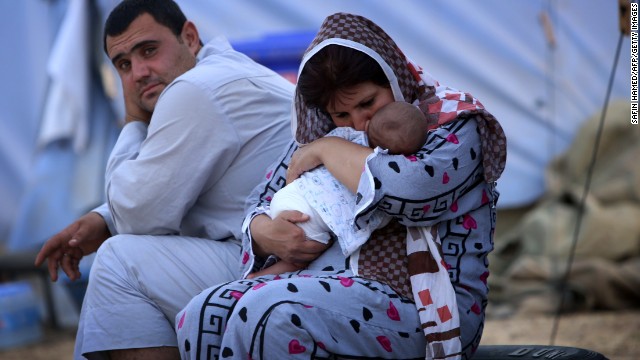 A woman cradles her baby Thursday, June 12, at a temporary camp set up in Aski Kalak, Iraq, to shelter those fleeing the violence in northern Nineveh province. More than 500,000 people fled in fear after extremist militants overran Mosul, Iraq’s second-largest city, on June 10, the International Organization for Migration said.
- When Bush administration attacked Iraq, it argued there was a Hussein-al Qaeda connection
- Peter Bergen: Exhaustive research found absolutely no evidence of a connection
- Ironically, the U.S. invasion provoked the creation of an al Qaeda arm in Iraq, Bergen says
- Bergen: U.S. military fought back against al Qaeda in Iraq, but now U.S. has departed
Editor’s note: Peter Bergen is CNN’s national security analyst, a director at the New America Foundation and the author of “”The Longest War: The Enduring Conflict between America and Al-Qaeda,” which this story draws upon.
(CNN) — ISIS, the brutal insurgent/terrorist group formerly known as al Qaeda in Iraq, has seized much of western and northern Iraq and even threatens towns not far from Baghdad.
From where did ISIS spring? One of George W. Bush’s most toxic legacies is the introduction of al Qaeda into Iraq, which is the ISIS mother ship.
If this wasn’t so tragic it would be supremely ironic, because before the U.S. invasion of Iraq in 2003, top Bush officials were insisting that there was an al Qaeda-Iraq axis of evil. Their claims that Saddam Hussein’s men were training members of al Qaeda how to make weapons of mass destruction seemed to be one of the most compelling rationales for the impending war.
After the fall of Hussein’s regime, no documents were unearthed in Iraq proving the Hussein-al Qaeda axis despite the fact that, like other totalitarian regimes, Hussein’s government kept massive and meticulous records.
The U.S. Defense Intelligence Agency had by 2006 translated 34 million pages of documents from Hussein’s Iraq and found there was nothing to substantiate a “partnership” between Hussein and al Qaeda.
Two years later the Pentagon’s own internal think tank, the Institute for Defense Analyses, concluded after examining 600,000 Hussein-era documents and several thousand hours of his regime’s audio- and videotapes that there was no “smoking gun (i.e. direct connection between Hussein’s Iraq and al Qaeda.)”
The Senate Select Committee on Intelligence concluded in 2008, as every other investigation had before, that there was no “cooperative relationship” between Hussein and al Qaeda. The committee also found that “most of the contacts cited between Iraq and al Qaeda before the war by the intelligence community and policy makers have been determined not to have occurred.”
Instead of interrupting a budding relationship between Hussein and al Qaeda, the Iraq War precipitated the arrival of al Qaeda into Iraq. Although the Bush administration tended to gloss over the fact, al Qaeda only formally established itself in Iraq a year and a half after the U.S. invasion.
On October 17, 2004, its brutal leader Abu Musab al-Zarqawi issued an online statement pledging allegiance to Osama bin Laden. Zarqawi’s pledge was fulsome: “By God, O sheikh of the Mujahideen, if you bid us plunge into the ocean, we would follow you. If you ordered it so, we would obey.”
Zarqawi’s special demonic genius was to launch Iraq down the road to civil war. In early 2004, the U.S. military intercepted a letter from Zarqawi to bin Laden in which he proposed provoking a civil war between Sunnis and Shia.
Zarqawi’s strategy was to hit the Shia so they would in turn strike the Sunnis, so precipitating a vicious circle of violence in which al Qaeda would be cast as the protector of the Sunnis against the wrath of the Shia. It was a strategy that worked all too well, provoking first sectarian conflict in Iraq and later civil war.
Al Qaeda in Iraq, or AQI, regularly attacked Shia religious processions, shrines and clerics. The tipping point in the slide toward full-blown civil war was al Qaeda’s February 2006 attack on the Golden Mosque in Samarra, which is arguably the most importantShia shrine in the world.
Three years into the Iraq War, AQI seemed all but unstoppable. A classified Marine intelligence assessment dated August 17, 2006, found that AQI had become the de facto government of the western Iraqi province of Anbar, which is strategically important because it borders Jordan, Syria and Saudi Arabia and makes up about a third of the landmass of Iraq.
In addition, AQI controlled a good chunk of the exurban belts around Baghdad, the “Triangle of Death” to the south of the capital and many of the towns north of it, up the Tigris River to the Syrian border.
Thus AQI controlled territory larger than New England and maintained an iron grip on much of the Sunni population.
In other words, the Bush administration had presided over the rise of precisely what it had said was one of the key goals of the Iraq War to destroy: a safe haven for al Qaeda in the heart of the Arab world.
By 2007, al Qaeda’s untrammeled violence and imposition of Taliban ideology on the Sunni population provoked a countrywide Sunni backlash against AQI that took the form of Sunni “Awakening” militias. Many of those militias were put on Uncle Sam’s payroll in a program known as the “Sons of Iraq”.
The combination of the Sunni militias’ on-the-ground intelligence about their onetime AQI allies and American firepower proved devastating to al Qaeda’s Iraqi franchise. And so, between 2006 and 2008, AQI shrank from an insurgent organization that controlled territory larger than the size of New England to a rump terrorist group.
But AQI did not disappear. It simply bided its time. The Syrian civil war provided a staging point over the past three years for its resurrection and transformation into the “Islamic State of Iraq and Syria,” or ISIS. And now ISIS has marched back into western and northern Iraq. Only this time there is no U.S. military to stop it.
How big a terror risk are former Guantanamo prisoners? CNN.com
How big a terror risk are former Guantanamo prisoners?
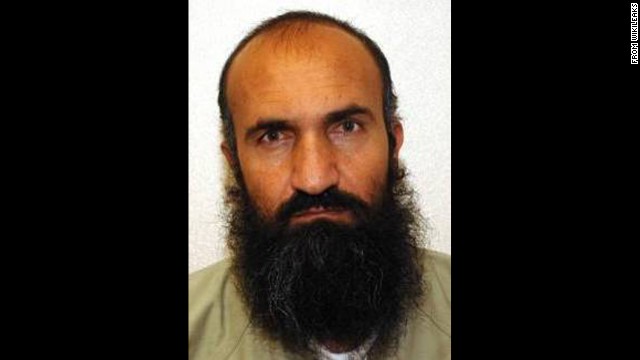 These are photos, obtained by WikiLeaks that match the names of the detainees released by the Department of Defense. The Department of Defense would neither confirm nor deny their accuracy.Khair Ulla Said Wali Khairkhwawas an early member of the Taliban in 1994 and was interior minister during the Taliban’s rule. He was arrested in Pakistan and was transferred to Guantanamo in May 2002. During questioning, Khairkhwa denied all knowledge of extremist activities.
- John McCain cites U.S. statistic that 30% of Gitmo released prisoners return to battle
- Peter Bergen: A close study of the record finds only a third of that number are recidivists
- Vast majority of recidivist Gitmo detainees were freed under the Bush administration, he says
- Bergen: Only one prisoner freed under Obama is known to have returned to the fight
Editor’s note: Peter Bergen is CNN’s national security analyst, a director at the New America Foundation and the author of “Manhunt: The Ten-Year Search for bin Laden — From 9/11 to Abbottabad.” Bailey Cahall is a policy analyst at the New America Foundation’s International Security Program.
(CNN) — Following the Taliban prisoner swap that led to the release of U.S. Army Sgt. Bowe Bergdahl, Sen. John McCain, R-Arizona, told Fox News that 30% of the detainees released from the U.S. detention facility at Guantanamo Bay “have already gone back into the fight.”
It’s a figure that has been frequently repeated in recent days, but is it true?
It depends on who is doing the counting.
According to the U.S. Office of the Director of National Intelligence, which regularly releases an unclassifiedsummary report about former detainees, as of January this year, 104 of the 614 detainees (17%) released from the prison have engaged in “terrorist activities,” while another 74 (12%) are suspected of doing so. It is impossible to assess the validity of the U.S. government’s claim, referenced by McCain, that nearly 30% of the released detainees are confirmed or suspected of engaging in terrorist activity because the government has not publicly released the names of any of these detainees for the past five years.
The U.S. government defines a “confirmed” terrorist or insurgent as based on a “preponderance” of information pointing to that conclusion, while someone in the “suspected” category is based on plausible but unverified or single source reporting to that effect.
In order to shed some light on exactly which graduates from Guantanamo have joined a militant group or engaged in some other kind of terrorist activity, the New America Foundation analyzed Pentagon reports, news stories, and other publicly available documents to create a list of former detainees who have “returned to the battlefield.” The list can be found here.
The New America list documents a much smaller number than does the U.S. government. Of the 620 former detainees who have been transferred from the prison camp, we have identified 15 former Guantanamo detainees (2.5%) who are confirmed to have engaged in terrorist or insurgent activities against the United States or its citizens, while there are 21 individuals (3.5%) who are suspected of engaging in such activities.
We also identified 18 former detainees (3%) who are confirmed or suspected of involvement in militant attacks against non-U.S. targets. Taking all three categories together, the New America list finds only a third as many Guantanamo prisoners have returned to the battlefield, compared to the U.S. government estimate.
A recent example of this is British citizen Moazzam Begg, a former Guantanamo prisoner released in 2005, who wasarrested in December on terrorism charges related to the Syrian civil war. He has denied the charges.
It’s important to note that the vast majority of individuals who are confirmed or suspected to have militant groups were released under the George W. Bush administration, a fact that is missing from much of the current commentary.
For the purposes of our study, for a former detainee to be considered “confirmed” that he had joined a militant group, there had to be a preponderance of information claiming he was directly involved in terrorist or insurgent activities. For those “suspected” of such acts, there were plausible but unverified accounts about their involvement in such activities.
While it is certainly possible there are some former detainees participating in terrorist and insurgent activities who have not been identified publicly, we are confident that our numbers are reasonably accurate because groups like al Qaeda and the Taliban are eager to trumpet the identities of released Guantanamo detainees who join their ranks, as it is a propaganda coup for them, and the media is also quick to highlight such stories.
Based on our findings, even if you combine all of the released detainees who are confirmed or suspected of taking part in any form of militant activity anywhere in the world, the total comes to 54, or 8.7%, which is much lower than the 30% being cited by the U.S. intelligence community and members of Congress.
This percentage is also much lower than the recidivism rate of criminals within the United States, which currently stands around 67.5%, according to the most recent statistics by the Bureau of Justice Statistics.
Some of the Guantanamo prisoners who were released by the Bush administration are certainly quite dangerous. Said Ali al-Shiri, who co-founded al Qaeda in the Arabian Peninsula (AQAP) in 2009, was transferred to Saudi Arabia in 2007. Shiri completed the kingdom’s rehabilitation program and promptly headed to Yemen, where he became AQAP’s deputy commander. He was killed in a U.S. drone strike last year.
Another example is Abdullah Ghulam Rasoul (who also goes by the name Mullah Zakir), who has emerged as one of the top Taliban commanders. Rasoul was also transferred from Guantanamo to Afghanistan in 2007 by the Bush administration and rejoined the Taliban shortly after the Afghan government released him from custody.
Under Obama, the U.S. State Department and U.S. Defense Department use comprehensive threat assessments to determine a detainee’s eligibility for release. This has contributed to the fact that of the 88 prisoners released under Obama, we were only able to find publicly available information about one of those who had joined a militant group: Abdul Hafiz, who was returned to Afghanistan and is accused of fighting for the Taliban and targeting Afghan aid workers. (The intelligence community claims five Obama-era releasees have joined militant groups.)
Of course the high-ranking Taliban prisoners released in the exchange for Sgt. Bergdahl are not just low-level militants and President Obama himself has admitted that they might pose some future threat. “Is there the possibility of some of them trying to return to activities that are detrimental to us? Absolutely. There’s a certain recidivism rate that takes place,” Obama said.
But these men are not being released freely into Afghan society. They have been transferred to the custody of Qatar, which is a rich, efficient police state and they have been banned from travel for a year. Assuming that ban holds, by the time they are able to travel back to Afghanistan, there will no longer be any U.S. combat presence as American combat soldiers are all pulling out at the end of December 2014. So any potential threat that those five Taliban officials might pose to American targets in Afghanistan will be much smaller by then.
Right-wing extremists strike again, CNN.com
Right-wing extremists strike again
 Police and firefighters on the scene of the shooting at a Las Vegas Walmart, on Sunday, June 8. Two gunmen shot and killed two police officers eating lunch and then killed a third person at the Walmart. The gunmen then killed themselves.
- Since 9/11, more have died in far-right violence than Islamic terrorism, Bergen says
- Bergen: Authorities should pay more attention to the threat posed by homegrown extremists
Editor’s note: Peter Bergen is CNN’s national security analyst, a director at the New America Foundation and the author of “Manhunt: The Ten-Year Search for bin Laden — From 9/11 to Abbottabad.” David Sterman is a research assistant at the New America Foundation. This is an updated version of an article originally published in April.
(CNN) — On Sunday, Jerad and Amanda Miller, a married couple, allegedly killed two police officers in an ambush at a Las Vegas pizza restaurant and then murdered another person in an adjacent Walmart. During the attack, the couple reportedly stated that their attack was part of a “revolution,” according to Second Assistant Sheriff Kevin McMahill.
The Millers appear to have been motivated by extreme far-right views. The couple left a flag at the scene of the crime with the words “Don’t Tread on Me,” a Revolutionary War symbol used by some anti-government extremists.
They also left a swastika at the scene, though McMahill cautioned to reporters, “We don’t necessary believe that they are white supremacists or associated with the Nazi movement. We believe that they equate government and law enforcement …with Nazis.”
McMahill added an assessment of the Millers’ ideological roots saying, “There is no doubt that the suspects have some apparent ideology that’s along the lines of militia and white supremacists.”
McMahill also confirmed that Jerad Miller had written on his Facebook page that he had been ejected from the Bundy Ranch, the Nevada site where armed ranchers as well some with anti-government militia ties held off federal officials at gunpoint in April. However, McMahill was not able to confirm Miller’s actual presence at the ranch. (Cliven Bundy’s son Ammon said that “state militia members” told him the Millers had been at the ranch, but were asked by a militia member to leave because of “their radical beliefs.”)
The attack in Vegas is far from the only incident of violence by the American far right. According to data collected by the New America Foundation, right-wing extremists have killed 37 people in 16 violent incidents, in the United States since the 9/11 attacks. That number is more than the 21 people killed by militants motivated by al-Qaeda’s ideology in the United States in the post-9/11 era.
Although a variety of left wing militants and environmental extremists have carried out violent attacks for political reasons against property and individuals since 9/11, none have been linked to a lethal attack
As we pointed out in this space less than two months ago, a man shot and killed a 14-year-old boy and his grandfather at the Jewish Community Center of Greater Kansas City and then drove to a nearby Jewish retirement community where he shot and killed a third person. Police arrested a suspect, Frazier Glenn Cross, who shouted “Heil Hitler” after he was taken into custody.
Cross, who also goes by Frazier Glenn Miller, is a well-known right-wing extremist who founded the Carolina Knights of the Ku Klux Klan and the White Patriot Party, according to the Southern Poverty Law Center.
A similar attack to the one that Frazier Glenn Cross is accused of in Kansas occurred in August 2012 when Wade Michael Page killed six people in a shooting at a Sikh temple in Wisconsin. Page was a member of a white supremacist band and associated with the Hammerskins, a white supremacist group. Page committed suicide during the attack.
Page is not, of course, the only right-wing extremist to have used lethal violence to achieve political ends. In 2009, for instance, Shawna Forde, Albert Gaxiola, and Jason Bush raided a house in Arizona, killing Raul Flores and his daughter Brisenia. The three attackers sought to use the burglary to finance their anti-immigration vigilante group, Minutemen American Defense. Forde and Bush were convicted and sentenced to death. Gaxiola was sentenced to life in prison.
Also in 2009, Scott Roeder murdered Dr. George Tiller, who ran an abortion clinic in Wichita, Kansas. In 2010 Roeder was convicted of first-degree murder. According to the Southern Poverty Law Center, Roeder not only had ties to the extreme anti-abortion movement, but he also had been pulled over while driving with a fake license plate bearing the markings of the Sovereign Citizens, a movement of individuals who deny that the government has authority over them.
Of course, the deadliest terrorist attack on American soil prior to 9/11 was the Oklahoma City bombing, which was masterminded by Timothy McVeigh, a man with deep ties to far-right militant circles. McVeigh killed 168 people when he bombed the Alfred P. Murrah federal building on April 19, 1995.
Despite the history of deadly violence by individuals motivated by political ideologies other than that of al Qaeda, it is jihadist violence that continues to dominate the news and the attention of policy makers. Some of this is quite understandable. After all, on 9/11 al Qaeda’s 19 terrorists killed almost 3,000 people in the space of a morning. Since then al Qaeda’s branch in Yemen tried to bring down — with a bomb secreted on a passenger — an American commercial jet flying over Detroit on Christmas Day 2009 and al Qaeda’s branch in Pakistan tried to launch bombings on the New York subway system a few months earlier. Luckily those plots didn’t succeed, but certainly if they had, the death toll would have been on a large scale.
Yet the disparity in media coverage can have serious consequences. McMahill told reporters that he had heard reports that the Millers had spoken to a neighbor about their plans adding “You know we have the ‘see something, say something’ campaign,” and urged that, “We need to hear about those times when individuals or groups of individuals are talking about going out and committing acts of violence — whether it’s against the police or anybody else in our community.”
Indeed, in a report on countering radicalization in Muslim communities, the Muslim Public Affairs Council emphasized the need to inform law enforcement when an individual is ejected from a community for being extreme.
Countering violent extremism cannot simply be a demand placed on Muslim communities to prevent jihadist violence. In the decade since 9/11 right-wing extremists have demonstrated their ability to be just as deadly as their homegrown jihadist counterparts.
Moreover, killings like the ones of the two police officers in Las Vegas on Sunday demonstrate the need to move beyond the view that the only threat of terrorism or extremist violence comes from radicalized Muslims.
A promising development to that end is that U.S. Attorney General Eric Holder announced last week that he is reconstituting a Justice Department task force on domestic terrorism, focused on anti-government plots and racial violence. The task force was originally launched after the 1995 Oklahoma City bombing.
Obama says goodbye to American hubris, CNN.com
Obama says goodbye to American hubris
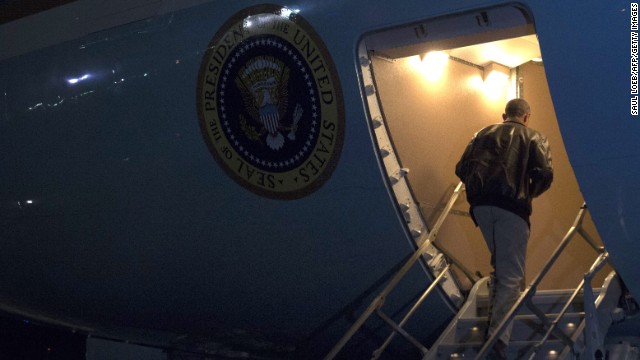 President Barack Obama boards Air Force One before departing Bagram Air Field. Obama landed Sunday, May 25, in Afghanistan for an unannounced trip to visit with U.S. forces on Memorial Day weekend. He thanked the troops for their service as the United States hands over responsibility to Afghan forces.
- President Obama outlines his version of the Kennan, Bush and Powell doctrines
- Peter Bergen says it amounts to a “do no harm” view of foreign policy
- It represents a dramatic switch from counterproductive cases of U.S. overreach, he says
- Bergen: Obama Doctrine lacks drama but may be a smart way for superpower to behave
Editor’s note: Peter Bergen is CNN’s national security analyst, a director at the New America Foundation and the author of “Manhunt: The Ten-Year Search for bin Laden — From 9/11 to Abbottabad.”
(CNN) — What is the Obama Doctrine? As the President put it Wednesday, “Just because we have the best hammer does not mean that every problem is a nail.”
The Obama Doctrine, as outlined by the President at the commencement ceremony at West Point, can be summarized as limiting the use of American power to defending the nation’s core interests and being smart enough to avoid the temptation to use such power when it embroils the country in costly mistakes such as the decision to invade Iraq.
Obama was attempting to answer a central question: What strategic doctrine should guide U.S. actions in a world where America’s long war against core al Qaeda and its Taliban allies is winding down, at the same time that Russia and China are both flexing their muscles and when a number of al Qaeda affiliates in countries such as Syria are enjoying something of a resurgence?
The President’s answer is the foreign policy equivalent of medicine’s Hippocratic oath “first do no harm.”
Without directly saying so, it amounts to a cautious but firm repudiation of the decisions made by presidents such asGeorge W. Bush and Lyndon Johnson, who ordered massive commitments of American military power against perceived enemies.
A foreign policy of judicious restraint that doesn’t sacrifice core American interests is not the sort of foreign policy that lends itself well to emotional rhetoric. But that’s exactly Obama’s point; it is American hubris and overreach since World War II in wars such as Vietnam and Iraq that cost the nation dearly in blood and treasure, while doing little to protect America’s core interests.
But the President also said that the United States reserved the right to take unilateral military action when standing up for core American interests, which he defined as “when our people are threatened, when our livelihood is at stake or when the security of our allies is in danger.”
An example of this — which, interestingly, the President didn’t cite in the speech — was the 2011 American-led intervention to topple Libyan dictator Moammar Gadhafi to prevent him killing large numbers of his own civilians, an effort that both NATO and the Arab League led.
The Obama Doctrine means more money for U.S. Special Forces. While Special Forces occupy only a tiny percentage of the American defense budget, they are the tip of the spear when it comes to partnering with countries that have some kind of al Qaeda presence and enabling local forces to go after such groups.
At West Point, Obama announced that he would go to Congress to seek a new $5 billion fund for counterterrorism training efforts in countries in North Africa and Asia, an effort that will be led by Special Forces.
This dovetails with what Adm. William McRaven, commander of U.S. Special Operations Command, has pushed for over the past year or so — a greater Special Forces presence in many countries around the world to partner with host nations and train them to fight al Qaeda affiliates or other groups aligned with al Qaeda’s ideology.
In Syria, the Obama Doctrine means working with Turkey and the Gulf countries such as Saudi Arabia to increase funding and other kinds of assistance to the more moderate elements of the Syrian opposition and also to identify extremist groups better to make sure aid is getting to the right groups.
On Iran, the Obama Doctrine means continuing negotiations with the Iranian regime to modify its nuclear program, where the President sees that “for the first time in a decade, we have a very real chance of achieving a breakthrough agreement — one that is more effective and durable than what would be achieved through the use of force.”
It also means closing the Guantanamo prison camp since, after all, the indefinite detention of prisoners doesn’t fit with American ideals. Over the past year the Obama administration has made some quiet progress on that front, releasing two Algerians and three Chinese Uyghur prisoners. A further six of the remaining 154 prisoners in Gitmo will also soon be transferred to Uruguay.
But will the Obama Doctrine be seen as the right strategy to guide American foreign policy for many years in the future? To answer that question it is worth examining what strategies have guided American foreign policy since the defeat of the Nazis almost seven decades ago.
The holy grail of American foreign policy makers is to establish a national security strategy (or doctrine) that deals with the real threats that the United States faces as they change over time. But coming up with such a strategy that actually informs effective policies is relatively rare.
Since World War II there have been two doctrines that could be described as more or less unalloyed successes.
At the dawn of the Cold War, George Kennan established the doctrine of “containment,” which attempted to block Soviet expansionism through a combination of American political and economic efforts that included the establishment of U.S.-led institutions such as NATO, the United Nations, the World Bank and the International Monetary Fund.
Sometimes containment also meant that the United States fought proxy military conflicts with the Soviets, such as the Vietnam War, where the two superpowers backed different sides in a civil war. The intent of this strategy was to contain the Soviets, and yet, at the same time, to avoid becoming embroiled in an outright war that might end with mutually assured destruction.
Containment succeeded brilliantly because ultimately the Soviet Union imploded of its own internal contradictions without a shot being fired in what could have become an Armageddon-like U.S.-Soviet nuclear war.
After the collapse of the Soviet Union, Gen. Colin Powell came to be associated with the “Powell Doctrine,” which was a response to the Vietnam War debacle. The Powell Doctrine was to go in at the beginning of a war with overwhelming forces to achieve clearly defined political objectives — and then to end the conflict without getting bogged down in a lengthy occupation.
The classic example of the Powell Doctrine in practice was the 100-hour war the United States waged against Saddam Hussein in 1991, which defeated the Iraqi army that had occupied Iraq’s neighbor Kuwait, and did so with relatively few American casualties.
Following the 9/11 attacks, came the Bush strategy of the war on terror that was the basis for the U.S.-led coalition’s successful overthrow of the Taliban in Afghanistan. But after that it also became the basis for the unnecessary and costly war against the Iraqi dictator.
As a strategy the war on terror can hardly be judged a success alongside containment or the Powell Doctrine.
So how might history judge the Obama Doctrine? The doctrine will not satisfy some of Obama’s critics, who want him to “do more” on issues such as Russia’s intervention in Ukraine. But it does dovetail neatly with where a large majority of Americans are right now.
They have no appetite for any more land wars. According to a CNN poll in December, the 13-year war in Afghanistan has becomearguably the most unpopular in American history.
What Obama did in his West Point speech was to chart a course that balances two natural, and contradictory, American national security impulses — isolationism and interventionism — and points to a hybrid approach that avoids some of the pitfalls of either of these strategic approaches.
Obama has put Pakistan drone war on hold, CNN.com
Obama has put Pakistan drone war on hold
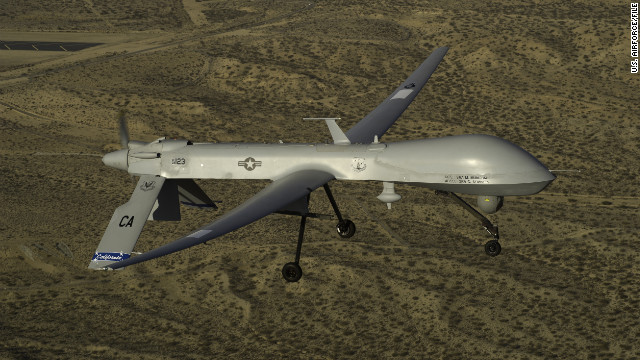 A U.S. Air Force MQ-1 Predator UAV assigned to the California Air National Guard’s 163rd Reconnaissance Wing flies near the Southern California Logistics Airport in Victorville, California, on January 7, 2012.
- A year ago, President Obama gave a key speech on the “boundless…war on terror”
- He signaled new restrictions on drones and an effort to wind down Guantanamo detention
- Peter Bergen: Obama’s changes have led to virtual suspension of drones in Pakistan
- He says drone war goes on in Yemen, small progress has been made on Guantanamo
Editor’s note: Peter Bergen is CNN’s national security analyst, a director at the New America Foundation and the author of “Manhunt: The Ten-Year Search for bin Laden — From 9/11 to Abbottabad.”Emily Schneider is a research associate at the New America Foundation.
(CNN) — A year ago, President Obama delivered a speech at the National Defense University in Washington in which he made the case that it was time to wind down the “boundless global war on terror ” and “perpetual wartime footing” that has been a feature of American life since 9/11.
Indeed, the CIA drone program in Pakistan has stopped completely since the beginning of this year. This is a noteworthy development given the fact that there have been 370 drone strikes in Pakistan over the past decade that have killed somewhere between 2,080 to 3,428 people; most of whom were suspected militants, but also a smaller number of civilians.
In his speech the President made the case that al Qaeda, which carried out the 9/11 attacks, “is on the path to defeat. Their remaining operatives spend more time thinking about their own safety than plotting against us.”
Obama outlined the remaining terrorism threat as coming from “less capable al Qaeda affiliates” who are certainly threats to American diplomatic facilities and businesses abroad, as well from “homegrown extremists,” like those who bombed the Boston Marathon a little over a year ago.
Such homegrown extremists remain capable of carrying out attacks on the scale of the Boston bombings, but such incidents are tragedies rather than national catastrophes, as 9/11 was.
In the President’s view these kinds of threats do not necessitate that the country remain on an endless war footing. And, indeed, it is long past time for the United States to transition away from a state of perpetual war now that the threat from al Qaeda to American national security has diminished significantly both because of al Qaeda’s own weaknesses and the many defensive measures the United States has taken since 9/11.
To transition away from a war footing, Obama said he would make changes in three key areas:
First by reforming the secret CIA drone program. The President promised that going forward, “There must be near-certainty that no civilians will be killed or injured” for strikes to be authorized.
Second, he said he would move to repeal the Authorization for the Use of Military Force (AUMF) that was passed by Congress just days after the 9/11 attacks. The AUMF authorized not only America’s longest war in Afghanistan, but also U.S. operations against al Qaeda and its allies in Pakistan, Yemen and Somalia.
Third, Obama said he would hasten the closing of the prison camp at Guantanamo Bay.
So what has changed in the twelve months since Obama gave that speech?
Peter Bergen, Emily Schneider
The cessation of drone strikes in Pakistan since the beginning of the year is due to a combination of the President pushing for a more calibrated use of drone strikes; running out of “high value” al Qaeda and Taliban targets in Pakistan’s tribal areas; very strong pushback from the Pakistani public and government who are opposed to the drone strikes on the grounds that they violate Pakistan’s national sovereignty; and the fact that the Pakistani government is stepping up its own military operations against militants in the Pakistani tribal region of North Waziristan, where the majority of CIA drone strikes have taken place.
Air strikes by the Pakistani air force, for instance, killed approximately 60 people on Wednesday in North Waziristan.
In Pakistan, there have also been no reported civilian casualties from CIA drone strikes during the past year, according to data collected by the New America Foundation.
In contrast, in Yemen, civilian casualties from U.S. drone strikes have remained steady over the past year. From May 2013 to May 2014, 16 civilians were killed in U.S. drone strikes, including a number of civilians in a mid-December strike that mistakenly targeted a wedding party because intelligence reports identified the vehicles as carrying al Qaeda operatives. There were also 16 civilians killed in drone strikes the previous year in Yemen.
Bergen: Drones will fill the sky
On drones, it is clear that the President’s directives to tighten up on the protocols for authorizing drone strikes have made some real differences in Pakistan both in terms of the falling numbers of civilian casualties and the cessation of drone strikes there.
But in Yemen, while the number of civilian casualties has remained constant, the number of drone strikes is actually declining. Since the president’s speech, there have been 29 drone strikes in Yemen. There were 36 strikes in the 12 months before.
Last May, Obama also said he looked forward “to engaging Congress and the American people in efforts to refine, and ultimately repeal, the AUMF’s mandate.”
Since it was this Authorization for the Use of Force that made possible the introduction of combat troops into Afghanistan 13 years ago, the natural moment to ultimately repeal the declaration is as the last of U.S. combat troops leave Afghanistan at the end of this year.
For the moment, the administration hasn’t taken up this effort, which could meet a good deal of opposition from some in the Republican party who would likely want to extend and even expand the authorization so that it could permit the use of U.S. military force against al Qaeda-aligned groups around the world.
Opinion: When will drones stop killing innocent people in Yemen?
And repealing the authorization would also raise some knotty national security and political issues given the present political paralysis and rancor in Congress.
First, U.S. Special Operations raids against al-Qaeda members and allies in Libya and Somalia in 2013 were conducted under the AUMF. How does one get congressional buy-in for a more narrow legal framework that might constrain such raids?
Second, since the drone program draws its legal validity partly from the AUMF, how would that declaration’s expiration affect the use of drones in countries such as Pakistan?
Third, what should the United States do about the 40 or so prisoners at Guantanamo Bay who are deemed “too dangerous to release,” but are not chargeable with a crime, and who would theoretically have to be released if the present authorization for the use of force expired? Without that authorization it would not be possible to treat Guantanamo detainees as prisoners of war since the war would be effectively over.
President Obama also promised to wind down the prison camp at Guantanamo Bay (GTMO). Since that speech, there have been a number of prisoners released from Guantanamo, including two Algerian prisoners who were transferred to Algeria in August, and three Chinese Uighur prisoners captured in Afghanistan who were transferred to Slovakia in December.
A recent agreement with Uruguayan President José Monica would allow a further six of the remaining 154 prisoners in Gitmo to be transferred to Uruguay.
At the same time, the Obama administration has in the past year successfully put a number of high profile militants on trial in the Southern District of New York, such as bin Laden’s son in law, Suleiman Abu Ghaith, and Abu Hamza, a London-based cleric who helped to direct the 1998 kidnapping of Western tourists in Yemen by al Qaeda-aligned militants.
Despite much hand wringing by politicians about trying prominent terrorists in the United States, those trials, which have taken place a few blocks from the newly rebuilt World Trade Center, have proceeded without incident and juries have speedily convicted the terrorists on all counts.
Given the speed and efficacy of these trials, perhaps it’s time for the Obama administration to abandon the military tribunal process at Guantanamo altogether and bring 9/11 operational planner Khalid Sheik Mohammed (KSM) to trial in Manhattan.
Such a plan was scuppered three years ago, in part, because of opposition from politicians in New York who claimed it was a public safety risk to hold KSM’s trial in Manhattan. These concerns seemed overwrought even at the time and are effectively moot at this point. KSM has spent the past eleven years in American captivity but still he has not been put on trial because he is tangled in the cumbersome and largely untested military tribunal process in Guantanamo.
To summarize: Since the President’s speech arguing for ending America’s endless war on terror, there has been a marked change in the CIA’s drone program in Pakistan, which has effectively ended. Yet there has been little real change in the similar drone program in Yemen.
Meanwhile, there has been incremental progress on emptying the prison camp at Guantanamo and real progress on using the ordinary civilian court system to convict prominent terrorists.
As yet there is no serious discussion in Congress or by the White House about what, if anything, might happen to the Authorization for the Use of Military Force (AUMF).
Given the political realities in Washington, our guess is the AUMF will simply remain in place indefinitely because any effort to replace it or end it will encounter resistance in Congress.
Al Qaeda Transformed, Carnegie, Washington
8:30 AM – 4:00 PM EST
This conference will bring together leading scholars and practitioners from the United States, Europe, and the Arab world to examine the complex dynamics underway within al-Qaeda. This will include its role in Syria, Iraq, Yemen, and North Africa, as well as European influence on the movement, and the broader political and social context within which al-Qaeda operates today.
AGENDA
8:30–9:00 a.m.
Registration
9:00–10:15 a.m.
Al-Qaeda in the Levant
- Fidaa El Itani
- Nelly Lahoud, U.S. Military Academy at West Point
- Joas Wagemakers, Radboud University Nijmegen
- Moderator: Frederic Wehrey, Carnegie Endowment for International Peace
10:15–10:30 a.m.
Break
10:30–11:45 a.m.
Al-Qaeda in North Africa
- Ismail Alexandrani, Arab Reform Initiative
- Anouar Boukhars, Carnegie Endowment for International Peace
- Frederic Wehrey, Carnegie Endowment for International Peace
- Bronwyn Bruton, Atlantic Council
- Moderator: Michele Dunne, Carnegie Endowment for International Peace
11:45 a.m.–12:00 p.m.
Break
12:00–1:00 p.m.
Luncheon Discussion: Al-Qaeda’s Curious Comeback
Bruce Hoffman, Georgetown University
1:00-1:15 p.m.
Break
1:15–2:30 p.m.
European Influences on Al-Qaeda— and Potential Blowback
- Farhad Khosrokhavar, Sciences Po
- Petter Nesser, Norwegian Defense Research Establishment
- Raffaello Pantucci, Royal United Services Institute for Defense and Security Studies
- Moderator: Sarah Chayes, Carnegie Endowment for International Peace
2:30–2:45 p.m.
Break
2:45–4:00 p.m.
Implications for Local and Western Strategies
- Nadwa Al-Dawsari, Yemeni Tribal Voices blog
- Peter Bergen, New America Foundation
- Jen Easterly, National Security Council
- Moderator: William McCants, Brookings Institution
Drones will fill the sky, CNN.com
Drones will fill the sky
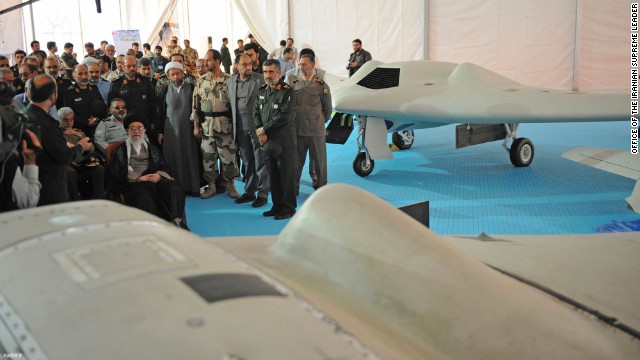 Iranian Supreme Leader Ayatollah Ali Khamenei, seated left, listens to an official during his visit to an aerospace exhibition in Tehran, Iran, on Sunday, May 11. The exhibition revealed an advanced CIA spy drone, at front, captured in 2011 by Iran, and its Iranian-made copy, at back.
- Peter Bergen says use of drones for military purposes is going to proliferate
- Drones enable warfare to be fought at lower cost without risking pilots’ lives
- They offer more precise targeting but still will kill civilians and thus will stir debate
- Bergen: Ethical and legal questions raised by the use of armed drones abound
Editor’s note: Peter Bergen is CNN’s national security analyst, a director at the New America Foundation and the author of “Manhunt: The Ten-Year Search for bin Laden — From 9/11 to Abbottabad.”
(CNN) — Drones are everywhere.
Consider that just in the past few days, a Federal Aviation Administration official revealed that in March a US Airways passenger jet nearly collided with a small-unmanned aircraft that looked similar to an F-4 Phantom jet and was flying above 2,000 feet over Florida. These details and the fact that the drone was described as “camouflaged” suggest that it was not a civilian drone.
Then Sunday the Iranians announced that they had engineered a copy of a highly sophisticated U.S. surveillance drone that they had captured in 2011. Iran’s state television showed footage of what they claimed was a replica of the American RQ-170 Sentinel drone. A photograph showed Iran’s Supreme Leader, Ayatollah Ali Khamenei, sitting next to the drone.
The same day that the Iranians showed off their new drone, Sen. Rand Paul, R-Kentucky, wrote an op-ed in The New York Times arguing against the appointment of David Barron as a federal judge. Barron was a White House lawyer who was involved in drafting the legal opinions used to justify the 2011 drone strike in Yemen that killed Anwar al-Awlaki, an American citizen who had taken a leadership role in al Qaeda.
Paul wrote, “Killing an American citizen without a trial is an extraordinary concept and deserves serious debate. I can’t imagine appointing someone to the federal bench, one level below the Supreme Court, without fully understanding that person’s views concerning the extrajudicial killing of American citizens. … I believe that all senators should have access to all of these opinions. Furthermore, the American people deserve to see redacted versions of these memos so that they can understand the Obama administration’s legal justification for this extraordinary exercise of executive power.”
Not so long ago, killing an American citizen on the other side of the world with an armed drone would have been in the realm of science fiction. Before 9/11, the United States had only a handful of experimental drones that had never been used to kill anyone. Today, there are at least 7,000 drones in the U.S. arsenal, more than 200 of which are armed drones and that have killed thousands of people.
This large American fleet of drones is a harbinger of an important trend. Armed drones will likely prove as important to the future of warfare as tanks were during World War II. We can expect to see them used not only by the United States, but also by other countries such as China and Russia that are jumping into the production of armed drones.
But armed drones raise a number of moral and political issues that are unresolved. In Pakistan, the CIA drone campaign is deeply unpopular because Pakistanis ask themselves: What gives the United States the right to invade the sovereign airspace of our nation and sometimes kill our civilians, even in the service of the laudable goal of killing al Qaeda militants?
For American readers, do a thought experiment in which armed Mexican drones were routinely killing members of drug cartels living in Texas, but they were also sometimes killing a number of ordinary Texans and you get a sense of how the average Pakistani thinks about this issue.
In Yemen, the U.S. drone campaign has also become increasingly controversial because drones continue to kill Yemeni civilians — as they did last month in a strike that targeted members of al Qaeda’s Yemeni affiliate. In thatstrike on April 19, at least nine militants were killed but so were three civilians.
Even with these issues, drones present features that make them appealing to political and military leaders. Drones are not simply pieces of artillery that happen to fly. They have four characteristics that mean they are likely to reshape warfare at a tactical level.
First, armed drones are different from any previous form of artillery because they can linger over and assess a target for many hours. That capability can quite dramatically lower the civilian casualty rates that have been typical of earlier eras of warfare.
The smallest bomb dropped by the U.S. Air Force is typically 500 pounds. Such a bomb cannot, of course, distinguish between a civilian and a combatant. A drone can do so. And it can also shoot much smaller missiles, such as the 100-pound Hellfire missile.
In that sense there is a case to be made that armed drones presage a more ethical form of warfare that kills fewer civilians. But that doesn’t mean of course that drones and the people who operate them won’t kill civilians in the future. The U.S. drone campaigns in Pakistan and Yemen have killed hundreds of civilians over the past half decade.
Second, armed drones also make it possible to wage war against particular individuals. In a sense drones are flying assassins that target particular people.
It is not an accident that the rise of drone warfare has coincided with America’s unconventional war against al Qaeda and its allies. In conventional wars, armies wearing uniforms attack each other. But in the kind of drone warfare that the United States has conducted since 9/11 outside of conventional war zones in countries such as Pakistan and Yemen, drone strikes are not directed at someone because of his status as a uniformed member of another military force, but rather because of the individual’s suspected connection to al Qaeda or an allied group.
Bergen: Target an American with drones?
Third, there is a lower threshold for the use of force when armed drones are an option. In many ways the use of armed drones is akin to the use of cyberwarfare. Both tactics greatly reduce or eliminate the number of deaths that would result from a conventional armed conflict. And whoever launches a drone attack or a cyberattack pays no costs of the kind that would typically take place on a conventional battlefield.
You can’t shoot down a drone pilot or kill a computer technician launching some kind of cyberattack thousands of miles from the intended target. For this reason, drones and cyber capabilities can make conflict more likely as the barriers to engage in either drone warfare or cyberconflict are so low. (Until, of course, the opponent has the resources to retaliate in kind.)
Fourth, drone warfare is taking place in an unprecedented information environment in which the U.S. government collects ever-vaster amounts of data. This data collection is so extensive that the National Security Agency, for instance, can record every phone call that is made in a particular country.
It is this merger of “big data” and drone technology, which is also complemented by human intelligence about suspected terrorists provided by CIA assets on the ground in places such as Pakistan’s tribal regions, that has made drone warfare against al Qaeda and its allies so effective.
The CIA drone campaign in Pakistan has killed 58 militant leaders, according to a count by the New America Foundation. Thirty-five militant leaders have also been killed in Yemen. Meanwhile, at least 339 civilians have been killed as well as at least 2,200 foot soldiers in militant groups in Pakistan and Yemen. At least 230 other people were reported killed, though it was not clear from reliable news accounts if they were militants or civilians.
Indeed, using the most conservative estimates from a database of drone attacks maintained by the New America Foundation, the Obama administration authorized the killing of more than 2,400 people in drone strikes in Pakistan and Yemen from the time it first assumed office until the end of March 2014. (Using the least conservative estimates from that database, the total number of people killed was almost 4,000.)
Put another way, using the most conservative estimates of the numbers of people killed in drone strikes by the Obama administration, they amount to three times the total number of the some 800 prisoners at the Guantanamo prison camp placed there by the Bush administration. As President Barack Obama reportedly told some of his aides, “Turns out I’m really good at killing people. Didn’t know that was going to be a strong suit of mine.”
Osama bin Laden recognized the devastation that such drone strikes were inflicting on his organization, writing a lengthy memo about the issue that was later recovered in the compound in Pakistan where he was killed three years ago.
In the October 2010 memo to a lieutenant, bin Laden advised his men to leave the Pakistani tribal regions where the drone strikes have been overwhelmingly concentrated. Bin Laden wrote, “I am leaning toward getting most of our brothers out of the area” and urged his followers to depart for the remote Afghan province of Kunar, explaining that “due to its rough terrain and many mountains, rivers, trees, it can accommodate hundreds of the brothers without them being spotted by the enemy.”
The civilian casualty rate from drone strikes has been dropping dramatically in recent years. According to New America Foundation data, the casualty rate in Pakistan for civilians and also for “unknowns” — those who were not identified in news reports definitively as either militants or civilians — was around 40% under President George W. Bush when the drone program was in its infancy. It has come down to about 7% under Obama.
Bergen: Obama’s high-stakes drone war in Yemen
In 2013 in Pakistan and Yemen, the numbers of civilians killed by drones in both countries combined was the lowest ever, in the single digits, according to the New America Foundation’s data.
This shift has been accomplished because of the combined effects of smaller munitions, improved drone flight technology, better intelligence on the ground, stricter White House guidelines regarding the use of drones, increased congressional oversight of the drone program and greater public scrutiny of the issue.
It will be many years before other countries are able to build up the capacity that the United States has to carry out lethal drone strikes. As of 2013, the United States had drone bases in countries such as Afghanistan, Djibouti and Saudi Arabia. And it isn’t as easy as some might think for other nations to arm unarmed drones.
Such weapons systems require specific electrical engineering; the wings must be reinforced for the aircraft to sustain the force of launching a missile; the drone must be equipped with fire control systems, and built-in mounting brackets are needed to attach munitions to the vehicle.
But even with these inherent limitations, the drone industry thrives, and more companies and nations continue to jump on board the drone bandwagon. And the U.S. aggressive and secretive drone campaign against al Qaeda and its affiliates is setting a powerful international precedent about the use of armed drones.
It is these kinds of drone strikes that are controversial since the use of armed drones in a conventional war is not much different, legally, than a manned aircraft that drops bombs or fires missiles.
There has been virtually no substantive public discussion about what an international legal framework governing such drone attacks should be among policymakers at the international level. It’s long past due for that conversation to happen.
Follow us on Twitter @CNNOpinion.
What’s at stake in war against girls’ kidnappers? CNN.com
What’s at stake in war against girls’ kidnappers?
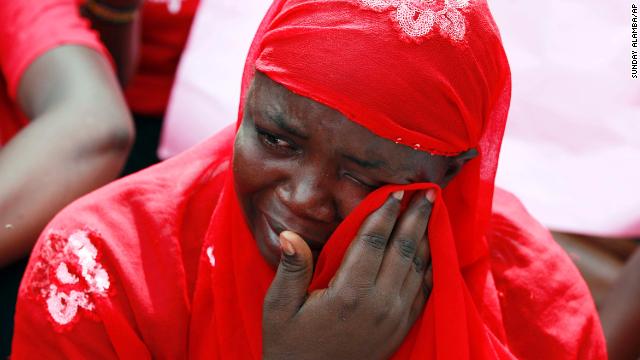 A woman attends a demonstration Tuesday, May 6, that called for the Nigerian government to rescue more than 200 schoolgirls who were kidnapped last month in Chibok, Nigeria. The girls were taken by the Islamist militant group Boko Haram, which means “Western education is sin.”
- Boko Haram leader says it has kidnapped more than 200 girls in Nigeria
- Peter Bergen: Nigeria is just about to host a world economic conference
- He says the terror group’s actions jeopardize Africa’s largest economy
- Bergen: Boko Haram hasn’t formalized ties to al Qaeda, but it could threaten Westerners
Peter Bergen is CNN’s national security analyst, a director at the New America Foundation and the author of “Manhunt: The Ten-Year Search for bin Laden — From 9/11 to Abbottabad.” Bailey Cahall is a policy analyst at the New America Foundation’s International Security Program. CNN anchor Isha Sesay will be live from Abuja on CNN International, Monday to Thursday at 5pm, 7pm, 8.30pm and 9pm CET.
(CNN) — Befitting its status as a fast-growing oil exporter, for Nigeria this week was to be a coming out party of sorts, as it hosts the 24th World Economic Forum on Africa. More than a thousand academic, business, civil society and political leaders are supposed to gather in Abuja, Nigeria’s capital city, beginning on Wednesday, to discuss “inclusive growth and job creation.”
Conflicting with this image of an emerging regional economic powerhouse, just two days before the start of the World Economic Forum meeting, Nigeria is in the international headlines for all the wrong reasons: Abubakar Shekau, the leader of Boko Haram, a militant Islamist organization, released a video on Monday claiming responsibility for kidnapping more than 270 schoolgirls in northern Nigeria last month.
The Boko Haram leader explained that the girls should not be attending school and should instead get married. He also threatened to sell the girls in the marketplace because, he said while laughing, “Allah says I should sell. He commands me to sell. I will sell women.”
That statement, coming the day after Nigerian President Goodluck Jonathan held a nationally televised “media chat” in which he vowed to rescue the girls, highlights Boko Haram’s growing power in the country, as well as the government’s relative inability to stop the group’s attacks.
If Boko Haram’s growing insurgency isn’t halted in Nigeria, it threatens to jeopardize the largest economy in Africa and the some $100 billion in oil revenue the country generates every year.
Boko Haram, whose name means “Western education is forbidden,” has been at war with the Nigerian state for years.
Founded in 2002 by Mohammed Yusuf, a member of the short-lived “Nigerian Taliban,” it is predominantly focused on attacking the Nigerian government and implementing Taliban-style Sharia law. Yusuf was killed in 2009 while he was in police custody.
There is no doubt that Boko Haram is a growing threat to Nigerians, but to what extent is it also a threat to Western interests? So far not much, although that could change. In the 12 years since its creation, Boko Haram has attacked an international target only once, when it bombed the United Nations office in the Nigerian capital Abuja in August 2011.
A year earlier, Shekau, the Boko Haram leader, had released a statement expressing solidarity with al Qaeda and threatening the United States, and Osama bin Laden was reportedly in direct contact with the group’s leaders. However, al Qaeda has never formalized any kind of partnership with Boko Haram.
That said, the group has received some funding from the North African al Qaeda affiliate, al Qaeda in the Islamic Maghreb, or AQIM; the exact numbers are unknown, but it is estimated that AQIM has accumulated $90 million, much of it from kidnappings.
6 reasons why the world should demand action
The United States is sufficiently worried about anti-Western terrorism in Nigeria that on Friday the State Department released a warning to Americans traveling in and to Nigeria that “groups associated with terrorism” may be planning an attack on a Sheraton hotel in Lagos, the country’s commercial center.
Though Lagos has never been attacked by Boko Haram, recent bombings in Abuja — the first in two years — show that militants are increasingly turning to targets outside their home base in Nigeria’s northern territories.
To combat the growing threat of Boko Haram, the President placed the northern states of Adamawa, Borno and Yobe under a six-month state of emergency in May 2013; the state of emergency was extended for six more months in November. But despite the heightened presence of security forces in those states, the Boko Haram insurgency has worsened.
Amnesty International reported on Saturday that more than 1,500 people were killed because of fighting between Islamist militant groups and the government in the first three months of 2014, a total greater than in all of 2013.
Continuing this trend, 19 people were killed and more than 60 were injured in a car bombing in an Abuja suburb on Thursday. (No group has claimed responsibility for that bombing, but it occurred in the same area as a Boko Haram attack that killed at least 70 people on April 14.)
Initially, Jonathan downplayed the Boko Haram threat, calling the situation “temporary” and arguing that the Nigerian security forces were winning the battle against the militants. But after international criticism and domestic outrage, Jonathan has called for an investigation into the mass kidnappings of the girls in April and has said he is open to receiving foreign assistance.
Boko Haram: The essence of terror
Some of this assistance will be coming from the United States, with a U.S. official telling CNN that: “You are going to see a focus on this in all three channels of government: diplomatic, intelligence and military.”
Adding to the growing frustration within Nigeria over the abductions are reports that Patience Jonathan, Nigeria’s first lady, bizarrely ordered the arrest of two of the leaders of the protests that had erupted after the kidnappings of the girls in April, and had even denied the kidnappings had taken place. Patience Jonathan’s office has denied the reports, but she was quoted by the News Agency of Nigeria as saying, “You are playing games. Don’t use schoolchildren and women for demonstrations again.”
FEATURED BOOK

All the Presidents’ Wars:
RECENT ARTICLES

RECENT FILM AND TV SERIES
GHOSTS OF BEIRUT: SHOWTIME
The Fall of Osama bin Laden, National Geographic

BIN LADEN'S HARD DRIVE, NATIONAL GEOGRAPHIC

