Hyping the terror threat? CNN.com
Hyping the terror threat?
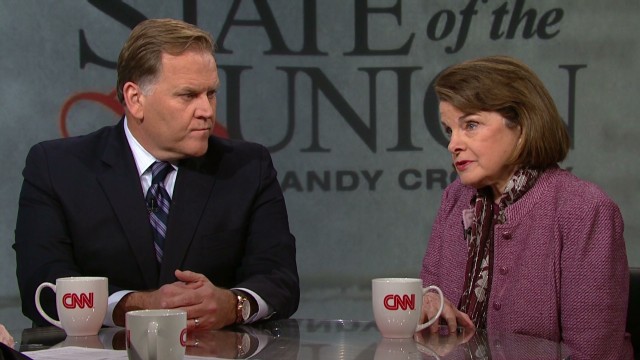
Feinstein: ‘Terror is up worldwide’
- Heads of intelligence committees tell CNN U.S. is no safer than in 2011
- Peter Bergen: Evidence suggests that fewer plots are being directed against the U.S.
- There’s little sign of Americans being trained by jihadists overseas, he says
- Bergen: The committee chiefs are correct about stepped up jihadist activity in Mideast
Editor’s note: Peter Bergen is CNN’s national security analyst, a director at the New America Foundation and the author of“Manhunt: The Ten-Year Search for bin Laden — From 9/11 to Abbottabad.”
(CNN) — On Sunday’s CNN “State of the Union” show, anchorCandy Crowley asked Sen. Dianne Feinstein (D- California), the head of the Senate Intelligence Committee, and her counterpart in the House, Rep. Mike Rogers (R-Michigan), a simple question: “Are we safer now than we were a year ago, two years ago, in general?”
Feinstein’s’ answer was unambiguous, “I don’t think so. I think terror is up worldwide. Statistics indicate that. The fatalities are way up. … There are more groups than ever, and there is huge malevolence out there.”
Crowley seemed surprised by this response: “I have to say, that is not the answer I expected. I expected to hear, oh, we’re safer.”
Rogers backed up Feinstein’s gloomy assessment, saying, “Oh, I absolutely agree that we’re not safer today.”
Both Feinstein and Rogers are able public servants who, as the heads of the two U.S. intelligence oversight committees, are paid to worry about the collective safety of Americans, and they are two of the most prominent defenders of the NSA’s controversial surveillance programs, which they defend as necessary for American security.
But is there any real reason to think that Americans are no safer than was the case a couple of years back? Not according to a study by the New America Foundation of every militant indicted in the United States who is affiliated with al Qaeda or with a like-minded group or is motivated by al Qaeda’s ideology.
In fact, the total number of such indicted extremists has declined substantially from 33 in 2010 to nine in 2013. And the number of individuals indicted for plotting attacks within the United States, as opposed to being indicted for traveling to join a terrorist group overseas or for sending money to a foreign terrorist group, also declined from 12 in 2011 to only three in 2013.
Of course, a declining number of indictments doesn’t mean that the militant threat has disappeared. One of the militants indicted in 2013 was Dzhokhar Tsarnaev, who is one of the brothers alleged to be responsible for the Boston Marathon bombings in April. But a sharply declining number of indictments does suggest that fewer and fewer militants are targeting the United States.
Recent attack plots in the United States also do not show signs of direction from foreign terrorist organizations such as al Qaeda, but instead are conducted by individuals who are influenced by the ideology of violent jihad, usually because of what they read or watch on the Internet.
None of the 21 homegrown extremists known to have been involved in plots against the United States between 2011 and 2013 received training abroad from a terrorist organization — the kind of training that can turn an angry, young man into a deadly, well-trained, angry, young man.
Of these extremists, only Tamerlan Tsarnaev, one of the alleged Boston bombers, is known to have had any contact with militants overseas, but it is unclear to what extent, if any, these contactsplayed in the Boston Marathon bombings.
In short, the data on al-Qaeda-linked or -influenced militants indicted in the United States suggests that the threat of terrorism has actually markedly declined over the past couple of years.
Where Feinstein and Rogers were on much firmer ground in their interview with Crowley was when they pointed to the resurgence of a number of al Qaeda groups in the Middle East.
Al Qaeda’s affiliates in Syria control much of the north of the country and are the most effective forces fighting the regime of Bashar al-Assad.
In neighboring Iraq, al Qaeda has enjoyed a renaissance of late, which partly accounts for the fact that the violence in Iraq today is as bad as it was in 2008.
The Syrian war is certainly a magnet for militants from across the Muslim world, including hundreds from Europe, and European governments are rightly concerned that returning veterans of the Syrian conflict could foment terrorism in Europe.
But, at least for the moment, these al Qaeda groups in Syria and Iraq are completely focused on overthrowing the Assad regime or attacking what they regard as the Shia-dominated government of Iraq. And, at least so far, these groups have shown no ability to attack in Europe, let alone in the United States.
Blinking Red: Crisis and Compromise in American Intelligence After 9/11, New America, Washington DC
Blinking Red: Crisis and Compromise in American Intelligence After 9/11

A former senior White Office and Congressional official, Michael Allen provides readers of his new book, BLINKING RED: Crisis and Compromise in American Intelligence After 9/11, with an insider’s account of the complete restructuring of America’s intelligence community that occurred at the beginning of the 21st Century. In particular, he focuses on the creation of the Director of National Intelligence, and internecine battles and trench warfare that were behind this dramatic shift in how the United States gathers and uses intelligence to protect its citizens from further large-scale attacks.Based on interviews with President George W. Bush, Vice President Dick Cheney, CIA executives, Congressional leaders, and other senior government officials, as well as Allen’s own research and recollections, the book is a study of the complex and opaque machinations of the American political system that produced such dramatic changes to the country’s national security policies.
The New America Foundation is pleased to welcome Mr. Allen for a discussion about the findings in his book and why this is an experiment in bureaucratic reorganization whose effectiveness remains in question.
Copies of the book will be available for purchase by cash, check, or credit card.
Join the conversation online using #BlinkingRed and following @NatSecNAF. If you are unable to join us in person, please tune in to our live webcast of the event. No signup is required to view the streaming video.
PARTICIPANTS
GOLIATH: Life and Loathing in Greater Israel, New America, Washington DC
GOLIATH: Life and Loathing in Greater Israel

In his new book, GOLIATH: Life and Loathing in Greater Israel, award-winning journalist and New York Times bestselling author Max Blumenthal takes readers on an eye-opening journey through the badlands and high roads of Israel-Palestine. Based on four years of research and on-the-ground reporting, the book is an unflinching, unprecedented work of journalism which depicts a startling portrait of Israeli society under siege from increasingly authoritarian politics.
GOLIATH illuminates the momentous political and social transitions occurring in greater Israel, with a particular focus on the effects of these changes on the people themselves — both Jews and Palestinians. Blumenthal charts the progression of Israel’s current crisis through the 2012 Israeli national elections, and against the historical backdrop of the cataclysmic events of 1948 that haunt the Holy Land to this day.
The New America Foundation is pleased to welcome Mr. Blumenthal for a discussion about his book and what his findings mean for the potential of peace in one of the world’s most contested regions.
Copies of the book will be available for purchase by cash, check, or credit card.
Join the conversation online using #GOLIATH and following @NatSecNAF. If you are unable to join us in person, please tune in to our live webcast of the event. No signup is required to view the streaming video.
PARTICIPANTS
Author, GOLIATH: Life and Loathing in Greater Israel
Peter Bergen
Director, National Security Program
Rapping for al Qaeda in Syria, CNN.com
Rapping for al Qaeda in Syria
 A rebel fighter fires his weapon as he stands amidst rubble and debris during clashes with Syrian government forces in Deir Ezzor, Syria on November 11. More than 100,000 people have been killed, according to the United Nations, and millions uprooted from their homes and tens of thousands trapped by the relentless fighting since 2011. Click through to view the most compelling images taken since the start of the
- Germany’s Deso Dogg converted to Islam, taped propaganda for al Qaeda
- Peter Bergen: Jihadists have shifted focus from Afghanistan-Pakistan to Syria
- He says the influx of foreign fighters into Syria worries terrorism experts
- Bergen: It’s feared they could learn terror techniques they will take home and use
Editor’s note: Peter Bergen is CNN’s national security analyst, a director at the New America Foundation and the author of“Manhunt: The Ten-Year Search for bin Laden — From 9/11 to Abbottabad.” Tim Maurer is a policy analyst at New America.
(CNN) — In August, al Qaeda’s propaganda arm released a videostarring the German rapper Deso Dogg.
Wearing combat fatigues and standing next to a waterfall in Syria, Deso Dogg raps in German calling on others to join the jihad and “to make an effort for Paradise.”
Deso Dogg, whose real name is Denis Cuspert, is one of several dozen German citizens who have fought in Syria.
Their move to Syria marks an important shift in the focus of global jihadists. Videos by German militants training with groups associated with al Qaeda during 2009 and 2010 were invariably taped in the Afghanistan-Pakistan border region.
That region now is largely shunned by foreign militants partly because of effective CIA drones strikes and partly because Syria is now the destination choice for jihadists from around the world.
Deso Dogg is one of the many thousands of foreign fighters who have been drawn to the jihad in Syria against the regime of Bashar al-Assad over the past three years.
This group includes an estimated 800 to 900 from Europe, mostly from Germany, the United Kingdom, France, the Netherlands and Belgium. A handful of Americans have also fought in Syria.
The concern, of course, is that these militants will swap business cards and will acquire arms training and bomb-making skills and will return to Western countries and carry out acts of terrorism.
This is what happened after the war in Afghanistan during the 1980s. Arab veterans of those wars formed the heart of al Qaeda and affiliated groups. Osama bin Laden fought in the Afghan War against the Soviets and then founded al Qaeda, which subsequently, of course, launched the 9/11 attacks. The failure to pay adequate attention to the so-called “Afghan Arabs” such as bin Laden proved an expensive one for the United Sates and her allies.
Could Syria be a new Afghanistan? Maybe.
Last month, for instance, British authorities arrested militants who were allegedly planning a terrorist attack. Two British officials who work on counterterrorism issues told us that that the militants had traveled to Syria.

The 37-year-old Deso Dogg was born in Berlin. His mother is German and his father from the West African nation of Ghana. As a teenager, he became politicized during the first Gulf War, joining anti-American demonstrations in Berlin. “We marched, shouted and burned the American flag,” Cuspert recalled.
Cuspert joined Berlin street gangs and became a popular artist in the German gangsta-rap scene, known by his nom de rap “Deso Dogg” and touring with other rappers such as DMX.
After surviving a car accident, he started questioning his lifestyle and turned to Islam for answers. In 2010, he ended his career as a rapper. Deso Dogg changed his name again to “Abu Talha al-Almani” and his rap songs became nasheeds, Islamic devotional songs.
Cuspert’s nasheeds were posted on jihadist websites and became popular among al Qaeda supporters.
The ex-rapper went on to become one of the key figures in the militant Millatu-Ibrahim group in Germany.
The group was banned by the German government last year and several of its members, including Cuspert, moved to Egypt to avoidpossible arrest by German authorities.
Cuspert’s whereabouts remained unclear for many months until the video was released in August showing him to be in Syria andrapping about the duty to “go into battle.”
Some 6,000 to 10,000 foreign fighters from more than 80 countries are believed to have traveled to Syria since the beginning of the conflict to join the rebels who aim to topple al-Assad’s regime.
Close to 800 of those foreigners are from Saudi Arabia. Tunisia and Libya are the next highest contributors, according to residents and analysts, but Chechnya, Kuwait, Jordan, Iraq and the United Arab Emirates have also seen citizens join the rebel forces in Syria.
Not all of these fighters have joined al-Qaeda linked groups in Syria, but it is likely that many of them have done so because they are generally Sunni militants who are drawn to the conflict for religious reasons.
Canadian news reports estimate the number of Canadian citizens fighting in Syria range from a few dozen to as many as 100. An American filmmaker, Bilal Abdul Kareen, who lived with an Islamist group in Syria for a year said he met with 20 to 30 Canadians.
Experts say the number of Americans fighting in Syria is likely less than 10. Eric Harroun, a former U.S. solider, was charged this year with conspiring to use a rocket-propelled grenade in Syria, and he admitted to fighting with the al Qaeda affiliate group, al-Nusra.
Nicole Mansfield of Flint, Michigan, was killed in May by Syrian government forces who claimed she was fighting with an al Qaeda linked insurgent group.
How to prevent the foreign fighters in Syria fomenting acts of terrorism around the world?
The United States and its allies should make a careful effort to find out the identities of the foreign fighters who have joined the jihadist groups fighting in Syria. And the U.S. should make clear to countries such as Saudi Arabia, which is supplying hundreds of Saudi fighters in Syria, that encouraging this kind of militancy could create a “blowback” problem in the Middle East in the form of terrorism directed at Arab regimes.
As for the former Deso Dogg, in September a jihadi forum released a statement saying that the German ex-rapper had been woundedby an air strike in Syria.
Follow us on Twitter @CNNOpinion.
Foreign Policy Challenges in Obama’s Second Term, New America, Washington DC
Foreign Policy Challenges in Obama’s Second Term
On Tuesday, November 26, the New America Foundation, the American Enterprise Institute, and the Center for a New American Security will host an in-depth discussion on the foreign policy challenges faced by the Obama administration in its second term. With a politically turbulent Middle East, a financially teetering EU, and an increasingly technologically competitive Asia-Pacific region, Obama and his administration will face critical foreign policy decisions in the second half of his final term.
This event continues a unique collaboration among these institutions in the presidential campaign season, “Election 2012: The National Security Agenda.” Past conversations covered the U.S. role in the world, policy in East Asia, and the national security budget.
New America Foundation
4th Floor Conference Room
1899 L Street NW, Washington, DC.
Tuesday, November 26, 2013
12:15-1:45 p.m.
Registration and lunch will begin at 12:00 p.m.
Featured Speakers:
Ambassador Dennis Ross
Counselor, Washington Institute for Near East Policy
Former Special Assistant to President Obama
Former National Security Council senior director for the Central Region
Former Special Advisor to Secretary of State Hillary Rodham Clinton
Anne-Marie Slaughter
President and CEO, New America Foundation
Former Director of Policy Planning, U.S. Department of State
Robert Kaplan
Chief Geopolitical Analyst, Stratfor
Senior Fellow, Center for a New American Security
Moderators:
Richard Fontaine
Center for a New American Security
Thomas Donnelly
American Enterprise Institute
Peter Bergen
New America Foundation
About the Series:
The demands for U.S. leadership are substantial–particularly in the dynamic Middle East and Asia-Pacific–yet fiscal challenges are forcing reductions in defense spending, sparking new thinking about American engagement with the world. In his final years in office, Obama and his administration will be faced will difficult and pressing foreign policy issues across a wide range of topics and geographic regions. This event is the eighth in a series of campaign-season seminars on the critical issues of U.S. foreign and defense policy, hosted by AEI, the Center for a New American Security and the New America Foundation.
Afghanistan: A Distant War, New America Washington DC
Afghanistan: A Distant War
Renowned photojournalist Robert Nickelsberg has been publishing photographs from Afghanistan since 1988, when he accompanied a group of mujahideen fighters across the border from Pakistan. The remarkable images he has captured bring into focus the day-to-day consequences of war, poverty, oppression, and political turmoil in Afghanistan – a country few people once thought about, but one that now evokes the deepest of emotions.
In his new book, Afghanistan: A Distant War, Nickelsberg’s stunning photographs are accompanied by insightful texts from experts on Afghanistan and the Taliban, as well as his own extensive commentary. Timely and important, the book serves as a reminder that Afghanistan and the rest of the world remain inextricably linked, no matter how much we long to separate ourselves from distant realities.
The New America Foundation is pleased to welcome Mr. Nickelsberg for a discussion about the book as he shares some of his favorite photographs and the stories behind them.
PARTICIPANTS
Robert Nickelsberg
Photographer, Afghanistan: A Distant War
Peter Bergen
Director, National Security Program
Did Obama keep his drone promises? CNN.com
Did Obama keep his drone promises?
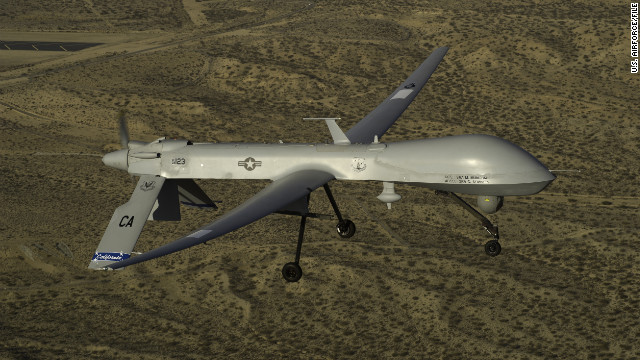 A U.S. Air Force MQ-1 Predator UAV assigned to the California Air National Guard’s 163rd Reconnaissance Wing flies near the Southern California Logistics Airport in Victorville, California, on January 7, 2012.
- President Obama spoke six months ago of changes to the U.S. drone war programs
- Peter Bergen says strikes have decreased, but there are still civilian casualties
- He says a board should be created to review drone strikes afterward
- Bergen: U.S. needs to fix its drone program and work with other nations on standards
Editor’s note: Peter Bergen is CNN’s national security analyst, a director at the New America Foundation and the author of “Manhunt: The Ten-Year Search for bin Laden — From 9/11 to Abbottabad.” Jennifer Rowland is a graduate student at Harvard University’s Kennedy School.
(CNN) — On May 23, President Barack Obama gave a major speech at the National Defense University in Washington stating his intention to recalibrate his counterterrorism strategy, which is now largely defined by a covert CIA drone program that has come under increased public and congressional scrutiny over the past couple of years.
The speech did little to illuminate details of the CIA drone program of the future, and the President was careful to emphasize that the United States would continue to reserve the right to use force “against terrorists who pose a continuing and imminent threat to the American people.” But the overarching theme of Obama’s remarks was one of increasing restraint in U.S. national security policy.
Obama also said: “Before any strike is taken, there must be near-certainty that no civilians will be killed or injured — the highest standard we can set.”
So has anything changed in the past five months?
A study of drone strike activity since May 23, tabulated by the New America Foundation from news reports, provides some answers. The Obama administration has cut the number of CIA drone strikes considerably in Pakistan and has slightly slowed the number of strikes in Yemen.
At the same time, the targets of the drone strikes have increasingly tended to be the leaders of al Qaeda or affiliated groups rather than mere foot soldiers. Nevertheless, the drone program continues to involve a number of civilian casualties and not enough has been done to make it as transparent and legally sustainable as the President has promised.
There were just 10 drone strikes in Pakistan during the past five months; an average of one strike every 15 days. In the year before Obama’s speech, drone strikes happened every eight days.
The average death toll of the most recent strikes in Pakistan is about six, which is about the same as the average death toll over the year before Obama’s May speech, indicating that changes to the program have not included restricting the sizes of those groups of suspected militants that are being targeted.
According to media reports, four top militant leaders were killed in strikes in Pakistan and Yemen since the May speech, which is a much higher rate of “high-value” targeting than was seen previously. Just seven militant leaders were reported killed in the 44 strikes that took place during the year before Obama’s keynote speech on terrorism.
The pace of drone strikes fell in Yemen after Obama’s speech, too, but not as sharply as it did in Pakistan. Since May 23, there have been 12 strikes in Yemen; an average of about one strike every 13 days. Over the previous year, a strike occurred about once every 10 days.
As in Pakistan, the size of the groups targeted in Yemen has remained about the same after Obama’s speech. The average death toll resulting from those 12 strikes was 4.5, while the average death toll over the year prior was about six.
Starting in 2009, the civilian casualty rate from drone strikes has been on a markedly downward trajectory in Pakistan.
That trend has continued into 2013, during which no civilians have been confirmed killed in Pakistan, according to the New America Foundation study. Similarly, the Bureau of Investigative Journalism, a London-based organization that tracks drone strikes, also found no civilian casualties in Pakistan so far this year.
But a 10-year-old boy was killed in a drone strike in the Yemeni province of Al Jawf on June 9, and two civilians were reported killed in Yemen on August 8.
Reports on CIA drones released Tuesday by Amnesty International and Human Rights Watch highlight some of the civilian casualties that have been caused by drone strikes in Pakistan and Yemen over the past several years.
The Amnesty International report recounts a strike in October 2012, in which a 68-year-old woman, Mamana Bibi, was killed by a drone as she picked vegetables with her grandchildren, a number of whom were injured in the attack. The report observed “Amnesty International is seriously concerned that these and other strikes have resulted in unlawful killings that may constitute extrajudicial executions or war crimes.”
But even these on-the-ground investigations cannot bring to light the full extent or impact of the U.S. drone campaign. Only greater transparency on the part of the government can do that. As U.S. Supreme Court Justice Louis Brandeis observed a century ago, “Sunlight is the best disinfectant.”
How to proceed then?
Perhaps the most practical idea to make the drone program as accountable as possible is to set up a U.S. government body that is independent of the CIA and the Pentagon and that would conduct an after-action review of drone strikes to ensure that the victims of the strikes were not civilians and did indeed pose some kind of threat to the United States.
It is human nature that if you know someone is grading your homework, you are likely to be more careful about how you perform.
The creation of such an independent body would also allow the payment of compensation to any civilian victims of CIA drone strikes, a system that already exists in the U.S. military, which has a mechanism in place to compensate the civilian victims of its drone strikes in conventional war zones such as Afghanistan.
Such a move would ensure that the families of injured children — such as those identified in the Amnesty International report released on Tuesday — could afford medical care without having to sell their land or other property.
And more broadly, it’s a fact that international law often lags behind advances in the conduct of warfare. It took, for instance, until 1925 to ban the use of chemical weapons, despite their widespread use a decade earlier.
Similarly, the law today has hardly kept up with what drones allow the U.S. to do, such as assassinate individuals a world away by remote control.
One could imagine some future Geneva Convention-like protocol that would govern the world’s use of drones. On the left, such a development might be unpopular, as it would seem to codify the use of drones and the rights of states to attack terrorist groups outside of their borders. On the right, this could also be controversial, as it might seem to constrain American power.
However, the fact is that the U.S. government needs to do some hard thinking about this issue as the monopoly that the United States, Britain and Israel have had on armed drones has evaporated.
Early this year, the China disclosed that it had planned to assassinate a notorious drug lord hiding in a remote mountainous part of Southeast Asia with an armed drone but opted to capture him instead.
Just as the U.S. government justifies its CIA drone strikes in Pakistan and Yemen with the argument that it is at war with terrorists such as al Qaeda and its affiliates, one could imagine that China might strike Chinese Uighur separatists in exile in Afghanistan with drones under the same rubric, or that Iran — which claims to have armed drones — might attack Iranian Baluchi nationalists along its border with Pakistan.
The United States, which has long been the guarantor of international order, should make its drone program as transparent and accountable as feasible and also start doing the hard work of creating some kind of international consensus about the future use of armed drones.
Follow us on Twitter @CNNOpinion.
Syrian war’s brutality isn’t going away, CNN.com
Syrian war’s brutality isn’t going away
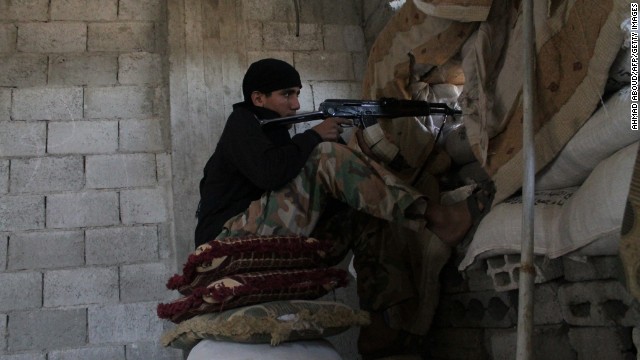 An opposition fighter from the Al-Ikhlas brigade guards a post in Deir Ezzor, Syria, on Wednesday, October 9. More than 100,000 people reportedly have been killed in Syria since a popular uprising spiraled into a civil war in 2011. Click through to view the most compelling images taken since the start of the conflict:
- A video purportedly shot in Syria shows gruesome executions
- Peter Bergen: Atrocities in Syria continue, and appear to involve both sides
- He cites a Human Rights Watch report documenting a massacre on Aug. 4
- Bergen: As the world’s attention wanders, as many as 120,000 have died in Syria
Editor’s note: Peter Bergen is CNN’s national security analyst, a director at the New America Foundation and the author of“Manhunt: The Ten-Year Search for bin Laden — From 9/11 to Abbottabad.” Jennifer Rowland is a graduate student at Harvard University’s Kennedy School.
(CNN) — A gruesome snuff video that has garnered more than 180,000 views on YouTube underlines just how grim the Syrian conflict has become.
This video appears to document one of the worst kinds of war crimes: The summary executions of wounded men. (Warning: The scenes are extremely graphic.)
Several paramilitaries in battle fatigues armed with automatic weapons — some speaking Arabic in distinctive Lebanese accents — pull wounded men out of the back of a van and drop them on to the ground, then shoot them in their heads at point-blank range.
As they shoot their victims, some of the paramilitaries seem almost giddy with excitement.
A man who appears to be their commander admonishes his men, “Come on guys, we are here to carry out our duties not to seek revenge on our own. This is unacceptable.”
One of the paramilitaries smilingly replies, “But we are killing them in God’s cause, only in God’s cause.”
The wounded men lying on the ground awaiting their deaths repeat religious phrases that are commonly said just before death. They all appear to be civilians.
There has been much analysis of the al Qaeda-aligned groups in Syria fighting the Assad regime that have recruited thousands of foreign fighters from around the Arab world and a smaller number from the West, but there has been far less discussion of the Shiite militias in Syria that have recruited foreign fighters from Iraq as well as from Lebanese Hezbollah, all of whom are fighting to support Syrian President Bashar al-Assad.
Barak Barfi, an American journalist who is a fellow at the New America Foundation and who has reported inside Syria for many months, says that one of the executioners in the videotape is wearing a distinctive yellow armband that Hezbollah fighters wear. Barfi says, “This appears to be a Hezbollah video, though we cannot conclude this with high confidence.”
Similarly, Augustus Richard Norton, professor of international relations at Boston University and the author of an authoritative study of Hezbollah, says, “The only identifying marks on the uniforms are yellow ribbons, which, in theory, would identify them as Hezbollahis.”
Randa Slim, also a fellow at the New America Foundation and a scholar at the Middle East Institute who is writing a book about Hezbollah, says that based on the accents of the Arabic-speaking executioners the video shows Syrians as well as fighters from Iraq and Lebanon.
Slim cautions, however, that the paramilitaries conducting the executions could well be members of an Alawite militia made up mostly of Syrians who have been trained by Hezbollah, but that are not part of Hezbollah itself.
Phillip Smyth, a researcher at the University of Maryland who specializes in Shiite militias operating in Syria, says that the fighters are likely from Hezbollah as they speak in a Lebanese accent and when they perform the executions they mention a religious edict handed down by a key Hezbollah religious guide.
Oubai Shahbandar is a Syrian-American who worked at the Pentagon for much of the past decade as a Middle East analyst, including a stint on General David Petraeus’ staff during the Iraq War, and is now a vice president at the Syrian Support Group, which supports “moderate elements of Syria’s armed opposition.”
Shahbandar has been tracking Hezbollah since 2007 and he asserts that the executioners in the video are definitely from Hezbollah and that the video itself was shot in Homs province in western Syria.
An analysis done by CNN’s International desk confirms that the dialect spoken by the executioners in the videotape is Lebanese Arabic and they can be heard shouting “Fi Sabil Allah,” an Arabic phrase that means “in God’s cause,” an expression commonly used by Hezbollah fighters on the battlefield. The international desk’s analysis points out that the yellow and green ribbons tied to the fighters’ uniforms appear to mark them as Hezbollah fighters.
As is now well known, many of the players in the Syrian conflict, including most prominently the Assad regime itself, have committed war crimes against civilians.
On Friday, Human Rights Watch released a report documenting a massacre on August 4 that was perpetrated by two al Qaeda-aligned Sunni militant groups, the Islamic State of Iraq and Sham and Jabhat al-Nusra.
The massacre took place in the coastal region of Latakia in a number of Alawite villages supportive of the Assad regime. According to the report “Eight survivors and witnesses described how opposition forces executed residents and opened fire on civilians, sometimes killing or attempting to kill entire families who were either in their homes unarmed or fleeing from the attack, and at other times killing adult male family members, and holding the female relatives and children hostage. ”
Human Rights Watch collected the names of 190 civilians who were killed in these attacks, including 57 women and at least 18 children and 14 elderly men.
While the world in the past few weeks has been distracted by the U.S. government shutdown and the brutal attack on the mall in Kenya by an al Qaeda affiliate that left at least 67 dead, the Syrian war has ground on.
It is a war that has now claimed as many as 120,000 lives.
Four of those deaths are documented in the appalling videotape of the Shiite paramilitaries gleefully executing wounded men who appear to be civilians. And the deaths of 190 civilians killed by Sunni militias in August are documented in great detail in the Human Rights Watch report that was released Friday.
Just when you thought the Syrian civil war couldn’t get any worse, it does.
Follow us on Twitter @CNNOpinion.
Join us on Facebook/CNNOpinion.
Treasury’s War: The Unleashing of a New Era of Financial Warfare, New America, Washington
|
Treasury’s War: The Unleashing of a New Era of Financial Warfare
Over the past decade, America has quietly and successfully waged a new kind of war against the financial networks of terrorist groups, rogue regimes, proliferators, and criminal syndicates. A small group of officials at the U.S. Department of the Treasury dedicated themselves to leveraging financial power and influence globally to undermine America’s enemies. The result was a dramatic redefinition of financial warfare and the role of the Treasury department — one that utilized all of Treasury’s power, influence, and relationships to dismantle illicit financial networks, stop terrorism, and influence geopolitics.
In his new book, Treasury’s War: The Unleashing of a New Era of Financial Warfare, Juan Zarate –a former senior Treasury and White House official — gives readers an insider’s view of how these tactics were developed and forecasts their future impact on our security and safety. Zarate warns that other nations and organizations are beginning to learn these tactics, and that “the financial wars are coming.”
The New America Foundation is pleased to welcome Mr. Zarate for a discussion on Treasury’s War and how the United States can redesign its national economic security policy to better prepare for future financial battles.
Copies of Zarate’s book will be available for purchase at the event.
Featured Speakers
Juan Zarate Author, Treasury’s War: The Unleashing of a New Era of Financial Warfare
Director, National Security Studies Program, New America Foundation
To RSVP for the event, click on the red button or go to the event page: For questions, contact Faith Smith at New America at (202) 596-3393 orsmithf@newamerica.net
|
Good thing U.S. terrorist hunters weren’t furloughed, CNN.com
Good thing U.S. terrorist hunters weren’t furloughed
- Peter Bergen: After ‘Blackhawk Down’ disaster, U.S. stopped relying on special forces
- He says 9/11 led to renewed interest in using SEALs, other special forces
- Bergen: Weekend’s operations show Obama’s continued support for special forces
- 2009 rescue of U.S. merchant captain from pirates impressed Obama, he says
Editor’s note: Peter Bergen is CNN’s national security analyst and the author of “Manhunt, the Ten-Year Search for bin Laden from 9/11 to Abbottabad”, from which this article is, in part, adapted.
(CNN) — On the sweltering evening of April 12, 2009, as dusk deepened over the Indian Ocean, several hundred miles off the coast of Somalia, three shots rang out. All the bullets found their targets — three Somali pirates in a small lifeboat bobbing on the darkening sea.
For the past five days the pirates had taken hostage Richard Phillips, the American captain of the Maersk Alabama container ship.
President Barack Obama had authorized the use of deadly force if Phillips’ life was in danger.
Unbeknownst to the pirates, days earlier a contingent from SEAL Team 6 had parachuted at night into the ocean near the USS Bainbridge warship, which was shadowing the pirates in their boat. The SEALs had taken up position on the fantail of the Bainbridge and were carefully monitoring Phillips while he was in the custody of the pirates.
One of the pirates had just pointed his AK-47 at the American captain as if he were going to shoot him. That’s when the SEAL team commander on the Bainbridge ordered his men to take out the pirates.
Three U.S. Navy SEAL sharpshooters fired simultaneously at the pirates from a distance of 30 yards in heaving seas at nightfall,killing them all.
Obama called Vice Adm. William “Bill” McRaven, the leader of Joint Special Operations Command and of the mission to rescue Phillips, to tell him, “Great job.”
In the eyes of Hollywood at least, the American public can’t get enough of these kinds of operations. “Captain Phillips,” a movie starring Tom Hanks playing the rescued sea captain, will be in theaters on Friday.
The flawless rescue of Philips was the first time that Obama, only three months into his new job, was personally exposed to the capabilities of America’s “Quiet Professionals,” as they sometimes refer to themselves.
They are the secretive counterterrorism units of special operations, made up of units including the Navy’s SEAL Team 6 and the Army’s Delta Force, whose well-oiled skills Obama has come to rely upon increasingly with every passing year of his presidency.
African raids
This was underlined over the weekend in Africa when operators from Delta and SEAL Team 6 carried out raids in Libya and Somalia— more than 2,000 miles apart — targeting a longtime member of al Qaeda in the Libyan capital, Tripoli, and the leaders of one al Qaeda’s affiliated groups in the Somali port of Barawe.
In Tripoli, Delta operators seized Abu Anas al-Libi, who is wanted for his alleged role performing surveillance on the U.S. embassy in Nairobi, Kenya, which was destroyed by an al Qaeda truck bomb in 1998, while in Barawe SEAL Team 6 operators went ashore to attack a house frequented by commanders of Al Shabaab, the group that launched the attack on the mall in Nairobi two weeks ago where at least 67 people were killed.
The Delta raid in Tripoli went off flawlessly, but the SEALs encountered heavy resistance in Barawe and the SEAL team retreated. Details of what exactly happened during the Somali operation are still murky.
The two raids over the weekend show that President Obama remains very comfortable deploying special operations forces in countries the United States is not at war with as a means to combat terrorist groups, just as he is comfortable with the use of CIA drones for the same purpose in countries such as Pakistan and Yemen.
For the White House, part of the appeal of special operations and drones is that they do not, of course, consume anything like the blood and treasure that are expended on conventional military operations such as the wars in Iraq and Afghanistan.
Indeed, the SEALS have had considerable experience working in and around Somalia in recent years. Six months after the rescue of Phillips, Obama’s national security team authorized a mission to take out Saleh Ali Saleh Nabhan, a leader of al Qaeda in Africa.
Nabhan was killed by SEAL Team 6 in a helicopter raid on September 14, 2009, as he was driving south of the Somali capital, Mogadishu. The SEALs landed briefly to take Nabhan’s body, and after they had confirmed his identity through DNA samples, he was buried at sea.
Home of the SEALs
It is quite challenging to enter the SEALs, but an even greater challenge is to be selected for the SEAL’s premier counterterrorism force, the innocuously named Naval Special Warfare Development Group based at Dam Neck, Virginia, near the bustling resort town of Virginia Beach.
It’s known inside the military as “DevGru” and more popularly as “SEAL Team 6” and is an elite within the SEAL elite.
The men of DevGru, around 250 in total, are battle-hardened and are usually in their mid-30s.
DevGru is divided into squadrons that are named by color: Red, Blue and Gold are the assault squadrons, Grey handles vehicles and boats, and Black is the sniper team. These squadrons scout other SEAL teams, which number around 2,000 men, for those with the particular skills they need.
DevGru’s base at Dam Neck does not announce itself. Behind the high wire fence that seals the SEALs off from the rest of the world is a large dog pound where the highly trained dogs that accompany the men on their missions live. There is a giant wall to sharpen climbing skills and a hangar full of exceptionally fast boats. Other hangars house experimental Mad Max-like dune buggies suitable for driving in the deserts of the Middle East and weapons rooms loaded with exotic firearms.
‘Somalia-ized’
SEAL Team 6’s greatest coup, of course, was the 2011 operation in Abbottabad, Pakistan, in which Osama bin Laden was killed.
However, SEAL Team 6’s integral role in the war against al Qaeda and its allies would not have been easy to predict before the 9/11 attacks.
Just recall the debacle that has come to be known as “Blackhawk Down.” In Mogadishu, Somalia, in early October 1993 a daytime helicopter assault — by pilots of the Special Operations Air Regiment and elements of SEAL Team 6, Delta Force and the 75th Rangers — to snatch Somali clan leaders who were attacking U.S. troops stationed in Somalia turned into a fiasco in which two Blackhawk helicopters were shot down by rocket propelled grenades. Eighteen American servicemen died.
Scarred by Mogadishu, the Pentagon was resistant to using SEAL Team 6 and Delta to take on al Qaeda in Afghanistan once the terrorist group had rebased itself there in 1996.
Yet after the 9/11 attacks, then-Secretary of Defense Donald Rumsfeld was deeply frustrated that the first American boots on the ground in Afghanistan were from the CIA and not the highly trained counterterrorism units of SEAL Team 6 and Delta Force.
On October 17, 2001, ten days after the U.S. campaign against the Taliban had started, Rumsfeld wrote a secret memo to Gen. Richard Myers, then-chairman of the Joint Chiefs of Staff, expressing his irritation: “Does the fact that the Defense Department can’t do anything on the ground in Afghanistan until CIA people go in first to prepare the way suggest that the Defense Department is lacking a capability we need? Specifically, given the nature of our world, isn’t it conceivable that the Department (of Defense) ought not to be in a position of near total dependence on CIA in situations such as this?”
Officials working for Rumsfeld commissioned Richard Shultz, an historian on special forces, to find out why special operations units were not deployed to hit al-Qaeda before the attacks on New York and Washington. After all, fighting terrorists was why these units were founded in the first place. Schultz concluded that in the years before 9/11 the senior officers at the Pentagon had become “Somalia-ized.”
Then-special operations boss Gen. Peter Schoomaker recalled, “Special operations were never given the mission. It was very, very frustrating. It was like having a brand-new Ferrari in the garage and nobody wants to race it because you might dent the fender.”
The attacks on the World Trade Center and Pentagon allowed Rumsfeld to push special operations to the center of the “Global War on Terrorism.” And on September 6, 2003, Rumsfeld signed an order known as an “EXORD” that empowered Joint Special Operations Command to hunt al-Qaeda in as many as 15 countries.
Military’s own army
In the decade after 9/11, JSOC became a small army within the military with its own drones, its own air force (known as the Confederate Air Force) and its own intelligence operations.
The rise of JSOC was inextricably linked to the vision of Maj. Gen. Stanley McChrystal, a brilliant workaholic from a military family who was beloved by his men; during the Iraq War he who would go out with them on missions to capture/kill insurgents.
It was McChrystal who took the special operations Ferrari out of the garage and drove it to become a killing machine of unprecedented agility and ferocity.
JSOC went from mounting half a dozen operations a month in Iraq in the spring of 2004 to 300 a month by the summer of 2006.
It was McChrystal’s five-year command of JSOC between 2003 and 2008 that helped turn its core components of SEAL Team 6 and Delta into what is arguably the most agile and deadly force in history.
One of the key officers under McChrystal was Bill McRaven, who took over command from McChrystal as head of JSOC when McChrystal went to take a senior job at the Pentagon.
McRaven is a strapping, dark-haired, blue-eyed Texan in his mid-50s. In conversation as he chugs a Rip It — a heavily caffeinated beverage popular with American soldiers in Afghanistan — he speaks in well thought-out paragraphs, but he also peppers his speech with the occasional “doggone,” as well as other, more robust swear words.
A battle-hardened colleague says McRaven reminds him of the comic book superhero Captain America, while another says he “is reputed to be the smartest SEAL that ever lived. He is physically tough, compassionate and can drive a knife through your ribs in a nanosecond.” Even as a three-star admiral, about once a month in Afghanistan, McRaven went out with his teams on snatch-and-grab missions.
It was McRaven who planned the bin Laden raid down to the last details. Now he commands Special Operations Command, or SOCOM, which oversees special operations by the Navy, Army, Air Force and Marines.
According to its mission statement, SOCOM’s job is to “synchronize planning of global operations against terrorist networks”.
A sign of where the Obama administration is placing its bets about what it believes to be the future of warfare is that while there are major cuts planned for all four of the armed services, SOCOM is one of the few places in the military whose budget is actually growing.
FEATURED BOOK

All the Presidents’ Wars:
RECENT ARTICLES

UPCOMING EVENTS
Tuesday, December, 08, 2026
USC DC, All the Presidents’ Wars, book event
Tuesday, January, 12, 2027
NY Historical, All the Presidents’ Wars: 25 Years of America’s War on Terror Featuring: Peter Bergen, David M. Rubenstein (moderator), NYC
Wednesday, February, 10, 2027
Metropolitan Club, DC, All the Presidents’ Wars event
RECENT FILM AND TV SERIES
GHOSTS OF BEIRUT: SHOWTIME
The Fall of Osama bin Laden, National Geographic

BIN LADEN'S HARD DRIVE, NATIONAL GEOGRAPHIC

