Jihadists focus on prison breaks, CNN.com
Jihadists focus on prison breaks

Taliban claims responsibility for raid
- A Taliban commander leads prison attack in Pakistan, freeing 250 inmates
- Peter Bergen: Jihadists have conducted jailbreaks in Middle East and South Asia for years
- Bergen: Huge numbers are freed to join militants’ ranks and score propaganda coups
- U.S. needs to help make prisons vulnerable to attacks much more secure, he says
Editor’s note: Peter Bergen is CNN’s national security analyst, a director at the New America Foundation and the author of “Manhunt: The Ten-Year Search for bin Laden — From 9/11 to Abbottabad.” Bailey Cahall is a research associate at the New America Foundation.
(CNN) — In an attack orchestrated by a Pakistani Taliban commander, around 250 prisoners, most of them militants, were freed this week at the central prison in Dera Ismail Khan in northwestern Pakistan.
The commander, Ahmed Rashid, had been freed a year earlier, this time at the central jail in Bannu, where 150 Taliban fighters stormed the facility and released nearly 400 prisoners — Pakistan’s largest jailbreak.
Both prison breaks happened in the stronghold of the Pakistani Taliban, Khyber Pakhtunkhwa province, which borders North and South Waziristan, and both were conducted with a high degree of sophistication.

This week’s attack unfolded in multiple stages, beginning with cutting the prison’s electricity, detonating bombs that had been planted around the facility to breach its external wall, and ambushing the security forces that rushed to the scene.
Once the militants overwhelmed the guards, they used loudspeakers to contact and locate specific prisoners, freeing them from their cells with hand grenades. At least 13 people died in the attack. Pakistani authorities launched a search operation for the missing prisoners, but few have been recaptured. The others have simply melted away into the mountains.

Jihadist militants have been breaking people out of prison across the Middle East and South Asia for years, some with significant consequences for the United States and its allies.
A 2006 prison break in the Yemeni capital, Sanaa, led to the creation of al Qaeda in the Arabian Peninsula, one of al Qaeda’s most virulent affiliates, the one that recruited the “underwear bomber” who nearly brought down Northwest Airlines Flight 253 over Detroit on Christmas Day 2009.
During the 2006 prison break, 23 inmates escaped through a 460-foot tunnel into a nearby mosque. Two of the escapees went on to become the leader and deputy leader of al Qaeda in the Arabian Peninsula.
In 2008 and again in 2011, the Afghan Taliban led attacks on the Sarposa prison in Kandahar in southern Afghanistan that freed an astounding number of militants, around 1,700.
Like the prison attacks by the Taliban in Pakistan, the Kandahar plots showed sophisticated planning. In the aftermath of the 2011 breach, Afghan officials discovered an intricate network of tunnels under the jail, equipped with electrical and ventilation systems.
But perhaps no group has made prison breaks an organizational focus more than al Qaeda in Iraq. On July 21, 2012, Abu Bakr al-Baghdadi, al Qaeda in Iraq’s leader, announced the “Breaking the Walls” campaign, a yearlong effort to release his group’s prisoners.
 Taliban pens letter to Malala
 Are the Taliban in Syria?
According to a count by the Institute for the Study of War, since al-Baghdadi’s announcement, al Qaeda in Iraq has conducted assaults on seven major prisons.
Earlier this month, hundreds of prisoners, including senior members of al Qaeda, escaped from Iraq’s Abu Ghraib jail on the outskirts of Baghdad following a military-style assault on the prison. Al Qaeda’s Iraqi affiliate claimed responsibility for that attack.
Elsewhere in the Middle East, a prison riot and an attack launched from outside Al-Kuifiya prison in Benghazi, Libya, freed more than 1,000 inmates Saturday.
Although it doesn’t appear that groups such as the Taliban and al Qaeda are coordinating strategies in freeing their fellow militants, it is likely that they are inspiring each other with every successful, and well-publicized, prison break.
The attacks are generally well-organized and often free significant numbers of inmates, refreshing the militant groups’ ranks, and each successful prison break is a propaganda coup.
Insiders assist in varying degrees in these different prison breaks, but the militants are also exploiting the countries’ inadequate correctional systems. Many of these prison facilities where convicts have escaped en masse were meant to house criminals, not terrorists, and they often lack the fortification needed to fend off armed assaults.
Security concerns regarding prison facilities are part of the reason that 86 Guantanamo Bay detainees who were cleared for transfer into the custody of their home countries three years ago still remain in jail at Guantanamo.
Fifty-six of those men are from Yemen, which has a notoriously porous prison system. The recent prison breaks in Pakistan, Iraq and Libya are reminders that the United States needs to do more to strengthen high security prisons in countries such as Yemen if there is any hope that prisoners who are cleared for transfer — but have been languishing at Guantanamo for many years — are ever to return home.
Follow us on Twitter @CNNOpinion.
Join us on Facebook/CNNOpinion.
Al Qaeda’s kinder, gentler image makeover, CNN.com
Al Qaeda’s kinder, gentler image makeover
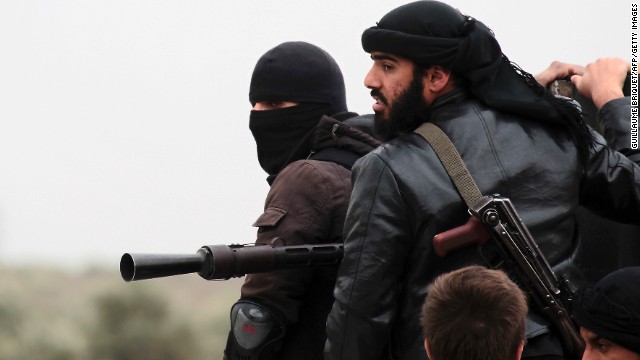
- Writers: Al Qaeda posting feel-good videos, holding ice cream eating contests, tugs of war
- They say al Qaeda and affiliates want to win “hearts and minds,” but the groups have failed
- Writers: Al Qaeda fighters in Syria try sugar and spice tack, but in Iraq they kill civilians
- New image will not win over people appalled by murder in the name of Islam, they say
Editor’s note: Peter Bergen is CNN’s national security analyst, a director at the New America Foundation and the author of “Manhunt: The Ten-Year Search for bin Laden — From 9/11 to Abbottabad.” Jennifer Rowland is a program associate at the New America Foundation.
(CNN) — An al Qaeda-produced video posted on a website in early July opens with uplifting images of smiling Syrian children and jovial old men listening to speeches delivered by al Qaeda militants.
The video seems startlingly out of place on a website usually devoted to serious young men learning to fire machine guns, bloodshed and graphic images of civilian casualties purportedly caused by U.S. forces in Iraq and Afghanistan.
Instead, the video, featured on a site aligned with al Qaeda, shows a Jordanian member of al Qaeda’s affiliate in Syria insisting that his group’s poor image is just a myth propagated by Western media. He says: “The international channels try to twist the picture and portray the mujahedeen as bloodthirsty, as distanced from the people — that they reject the people and don’t love them.” As the Jordanian militant speaks, young Syrian boys crowd around him.
Al Qaeda-affiliated fighters have set up “Advocacy Tents” in Syria’s largest city, Aleppo, where the jihadists can “educate the people on our point of view.”
In another apparent attempt to soften its image, al Qaeda members in Syria held something akin to a town fair. Another al Qaeda video produced in Syria surfaced online in July, this one showing an al Qaeda-organized ice cream-eating contest in Aleppo.
Around the same time, an Arabic-language news outlet, Aleppo News, published a video of a tug-of-war between members of the two al Qaeda-affiliated rebel groups fighting in Syria. In the video, crowds of young boys and older men cheer on the members of al Qaeda.
Al Qaeda and its regional franchises understand they need to try to win the “heart and minds” of the local population; something they have generally failed to do in the past and something that the leaders of these groups have come to understand is a major problem.
In documents recovered in Osama bin Laden’s compound in Abbottabad, Pakistan, bin Laden and his top advisers privately criticized the brutal tactics of al Qaeda in Iraq, which had provoked a tribal uprising known as “the Sunni Awakening” that almost destroyed al Qaeda’s Iraqi affiliate in 2006 and 2007.
Now, al Qaeda in Iraq and in neighboring Syria are experiencing a revival, a revival at least somewhat fueled by al Qaeda learning from some of the mistakes it made during the previous decade in Iraq.
This is significant because al Qaeda’s Syrian affiliate, al Nusra, is widely considered to be the most effective rebel force fighting the Assad regime, and the group pledged allegiance to the leader of al Qaeda, Ayman al-Zawahiri, in April.
But videos of al Qaeda militants playing tug-of-war or joking with members of the local community are hardly signs of moderation.
Al Qaeda’s Syrian branch releases lengthy and passionate sermons dedicated to denouncing Shi’a Muslims as apostates who should be killed.
And although some al Qaeda fighters in Syria might be engaging the public with ice cream, games and conversation, their colleagues in neighboring Iraq continue to launch bloody attacks on civilians.
On Monday, at least 50 people were killed in 15 separate car bomb attacks in Baghdad. Many of those bombings are believed be the work of al Qaeda’s Iraqi affiliate.
In all likelihood, al Qaeda and its allied groups are doing too little, too late, in their quest to win the public’s hearts and minds.
The group’s senior leaders recognized the dangers of killing too many Muslim civilians as far back as 2005, when Zawahiri reprimanded the founder of al Qaeda in Iraq, Abu Musab al-Zarqawi, for alienating the Iraqi people with indiscriminate violence.
And the majority of Muslims around the world reject violence in the name of Islam, particularly in the form of suicide bombings. This is unsurprising, given that al Qaeda’s violence has primarily claimed Muslim lives.
It will take a lot more than ice cream socials to undo that damage.
New view of drone death toll, CNN.com
New view of drone death toll
By Peter Bergen and Jennifer Rowland
updated 3:33 PM EDT, Fri July 26, 2013
Obama defends drone program
STORY HIGHLIGHTS
U.S. drone program is especially controversial in Pakistan
Peter Bergen: A leaked report suggests fewer civilian drone deaths than previously reported
Pakistan’s new prime minister opposes drone program, cites issue of sovereignty
Bergen: Having reliable estimates on drone deaths is important
Editor’s note: Peter Bergen is CNN’s national security analyst, a director at the New America Foundation and the author of “Manhunt: The Ten-Year Search for bin Laden — From 9/11 to Abbottabad.” Jennifer Rowland is a program associate at the New America Foundation.
(CNN) — The debate over the number of civilian casualties caused by CIA drone strikes in Pakistan is perhaps the most contentious issue in the often fraught U.S.-Pakistan relationship.
On one side are US officials who assert that the strikes kill few, if any, Pakistani civilians. In June 2011, President Barack Obama’s then-counterterrorism adviser John Brennan claimed improbably during a speech at the Johns Hopkins School for Advanced International Studies “there hasn’t been a single collateral death because of the exceptional proficiency, precision of the capabilities that we’ve been able to develop.”
Two months later, U.S. officials speaking on condition of anonymity told the New York Times that around 50 civilians had been killed in drone strikes in Pakistan since the 9/11 attacks.
On the other side of the debate are Pakistani officials such as the country’s powerful Interior Minister Rehman Malik, who asserted in 2012 that 80% of the people killed in drone strikes were civilians. Earlier this year, before he stepped down as Interior Minister, Malik told Pakistani reporters that the strikes had killed mostly women and children.
Similarly, Maulana Sami ul-Haq, leader of the Pakistani Islamist party Jamiat Ulama-i-Islam (JUI-S), told crowds at a 2011 conference in Lahore that drones kill “dozens of innocent people daily.”
Now comes a leaked Pakistani government document that helps to shed light on some of the facts surrounding this debate. According to the internal Pakistani report, civilian casualties from drone strikes are much lower than has often been claimed in Pakistan, but they are also much higher than the U.S. government has asserted.
The Pakistani government confirmed 10 civilian deaths in CIA drone strikes in 2009, according to the leaked official document obtained this week by the Bureau of Investigative Journalism, a London-based organization that tracks the strikes.
The report also found that from 2006 through October 24, 2009, civilians made up a minority of those killed in drone strikes: 147 civilians in a total death toll of 742, or about 20%.
That number is somewhat lower than the estimates of Western nongovernmental organizations that track the strikes. The New America Foundation estimates that up to 207 civilians were killed from 2006 to October 24, 2009, along with up to 198 people who were not identified in reliable media reports to be either civilians or militants.
Oddly, the leaked Pakistani report left out four strikes that occurred in 2007. It also missed nine strikes from 2008 and 2009, in which between eight and 10 civilians were reported killed, according to the New America Foundation’s tally.
The leaked report is a welcome sign that the Pakistani government is making a concerted effort to confirm the identities of those who have been killed in U.S. drone strikes in the country’s remote tribal regions that border with Afghanistan.
Pakistani authorities have long denounced the strikes, out of concern that civilian deaths caused by drone strikes inflame the local population, bolster militant groups and violate Pakistan’s sovereignty.
The civilian casualty rate has declined steadily over the life of the CIA drone program as both technology and intelligence-gathering have improved. One civilian — a 10-year-old boy — has been confirmed killed so far in 2013, according to reliable media reports. In 2012, five civilians were confirmed killed, representing 2% of the total deaths.
As the civilian casualty rate has fallen, Pakistani officials who oppose the drone strikes have turned more frequently to the argument that they violate Pakistan’s sovereignty, regardless of whom they kill.
Pakistan’s new Prime Minister, Nawaz Sharif, told parliament in June that “We respect the sovereignty of others and they should respect our sovereignty and independence. This campaign must come to an end.” As Sharif wrangles with the United States over the future of the drone program, a complete and authoritative official Pakistani tally of civilian deaths caused by drones would be a useful tool for those discussions.
The leaked Pakistani report is a step in the right direction.
Al Qaeda in Yemen: On the ropes, CNN.com
Al Qaeda in Yemen: On the ropes

- Al Qaeda affiliate in Yemen confirms death of a key leader
- Peter Bergen says it amounts to a concession that the group is in deep trouble
- Militants in Yemen were riding high in 2011, but drone campaign has set them back, he says
- Bergen: Al Qaeda in the Arabian Peninsula is struggling to survive
Editor’s note: Peter Bergen is CNN’s national security analyst, a director at the New America Foundation and the author of “Manhunt: The Ten-Year Search for bin Laden — From 9/11 to Abbottabad.” Jennifer Rowland is a program associate at the New America Foundation.
(CNN) — On Wednesday, al Qaeda’s virulent Yemeni affiliate which is known as al Qaeda in the Arabian Peninsula (AQAP) confirmed the death of the group’s deputy leader and co-founder, Saeed al-Shihri, in a video message posted to jihadist websites.
It was a confirmation of what was long suspected: that Shihri was killed in a U.S. drone strike several months ago. And it also amounted to a concession that the al Qaeda affiliate is under an enormous amount of pressure.
In the past three years more than 30 al Qaeda leaders and other senior operatives in Yemen have been killed by U.S. drone strikes, according to a count by the New America Foundation.
The militants killed by those drone strikes included Anwar al-Awlaki, the fiery Yemeni-American preacher who served as a key ideologue for the group and has been an inspiration for a wide range of militants living in the West, including the Tsarnaev brothers who are accused of bombing the Boston Marathon in April.
Not all of the drone strikes in Yemen have found their targets. New America Foundation’s review of reliable media reporting of those strikes found that somewhere between 38 and 71 of the casualties were civilians, which included Awlaki’s 16-year-old son.
A Yemeni tribal leader close to AQAP says the drone strikes have sown mistrust within the group, where there is “a feeling that the Americans have infiltrated its ranks, especially with the killing of several of its leaders.”
Al-Shihri, a Saudi who spent six years at the Guantanamo Bay detention facility, was first reported killed in January. The Yemeni government quickly confirmed Shihri’s death, but until now AQAP had denied it.
AQAP’s video message confirming Shihri’s death was delivered by Ibrahim al-Rubaish, another Saudi who was also formerly held at Guantanamo Bay.
In the 11½-minute video, which we have reviewed, Rubaish gushes about Shihri’s devotion to al Qaeda’s cause. Rubaish says Shihri was “searching for martyrdom,” trumpeting his combat against U.S. forces in Afghanistan where he suffered serious injuries to his hands and legs, and lost an eye.
Shihri was released from Guantanamo in November 2007, and entered a Saudi rehabilitation program and was then released. Rubaish says Shihri subsequently planned an attack on the U.S. Embassy in the Yemeni capital, Sanaa, which killed 10 Yemeni policemen and civilians.
But Shihri grew complacent. “Lax security measures during his telephone calls enabled the enemy to identify and kill him,” Rubaish declared in his eulogy.
Shihri’s death in the U.S. drone strike is part of larger story of AQAP decline over the past two years. In 2011, AQAP had gained significant territory in Yemen as it exploited the popular uprising against longtime Yemeni president Ali Abdullah Saleh. Its core membership grew from approximately 300 members in 2009 to around 1,000 three years later, according to Gregory Johnsen, the author of the authoritative book “The Last Refuge: Yemen, al-Qaeda, and America’s War in Arabia”.
But the jihadist group lost all of these gains within about a year. An offensive by the Yemeni army that was supported by U.S. intelligence last year pushed AQAP out of the central Yemeni province of Abyan, forcing AQAP’s fighters to flee to the remote desert province of Hadramaut.
The group has since been reduced to carrying out much smaller attacks; nothing compared to the massive suicide bombing it was able to conduct in the heart of the Yemeni capital in May 2012, which killed upwards of 100 soldiers as they rehearsed for a military parade.
And despite its focus on attacking U.S. targets, AQAP has not tried to attack one since its October 2010 attempt to plant bombs hidden in printer cartridges on cargo planes destined for the United States. (Last year AQAP plotted to send an operative with explosives in his underwear aboard a plane bound for the United States, but that operative was actually secretly working for the British and Saudi intelligence services, so the plot was never a real threat.)
Despite all the losses AQAP has suffered its capable chief bomb maker, Ibrahim al-Asiri, remains at large. Al-Asiri was the brains behind AQAP’s failed “underwear bomb” attempt to bring down a Detroit-bound U.S. airliner on Christmas Day 2009.
AQAP’s overall leader, Nasser al-Wuhayshi also remains at large, Wuhayshi is AQAP’s founder and his continued survival is surely important for the organization.
AQAP could regenerate, particularly if Yemen sees more upheaval, but for now, the group is on the run from the Yemeni army and U.S. drone strikes, fearful of spies in its midst, is unable to launch large-scale attacks, and boasts a dwindling cadre of leaders. AQAP, in short, is struggling to survive.
From Benghazi to Boston: The state of the jihad, CNN.com
From Benghazi to Boston: The state of the jihad
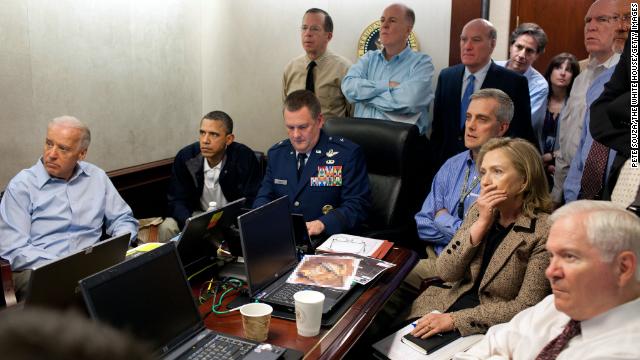 Vice President Joe Biden, left, President Barack Obama, and Secretary of State Hillary Clinton, second from right, watch the mission to capture Osama bin Laden from the Situation Room in the White House on May 1, 2011. Click through to see reactions from around the world following the death of the al Qaeda leader.
- Peter Bergen: Benghazi and Boston don’t alter reality about jihad
- He says al Qaeda central is in trouble and that it offers no solutions to regional problems
- Bergen says some affiliates of al Qaeda show life but don’t pose major threat yet to West
Editor’s note: This is one in a series of stories and opinion pieces previewing the upcoming Aspen Security Forum. Security Clearance is a media sponsor of the event, which is taking place from July 17 to 20 in Aspen, Colorado. Peter Bergen is CNN’s national security analyst and the author of “Manhunt: The Ten-Year Search for bin Laden, from 9/11 to Abbottabad.”
(CNN) — Every July in the lush, green mountains of Aspen, Colorado, many of the top present and former U.S. national security officials and other experts gather to discuss how the war against al Qaeda and its allies is going.
Ahead of last year’s Aspen conference, I wrote a piece for CNN provocatively titled “Time to declare victory: Al Qaeda is defeated.” And I then spoke on a panel at Aspen where I tried to make the case for this position.
I’m not sure too many of the folks in Aspen were convinced. (If they had been, it would hardly seem necessary to travel back to Aspen again this year!)
Since last year’s Aspen conference, a group of men only very loosely aligned with al Qaeda attacked the U.S. Consulate in Benghazi, Libya, killing four U.S. diplomats and CIA contractors.
And in April, the Tsarnaev brothers whose family originated in the Caucasus — one an American citizen and the other a US resident — were accused of detonating pressure-cooker bombs in Boston that were based on a design that al Qaeda’s Yemeni affiliate had widely distributed on the Internet.
The bombing killed three and wounded more than 250 and brought ordinary life to a screeching halt in one of the nation’s largest cities.
Certainly the attacks in Libya and Boston were victories for “Binladenism,” the ideological movement that al Qaeda has spawned.
Indeed, the New Mexico-born cleric Anwar Awlaki who was a leader of al-Qaeda’s Yemeni affiliate before he was killed in a US drone strike in 2011, was influential not only on the Tsarnaev brothers who possessed some of his writings but also on 22 other US-based jihadist extremists, according to a count by the New America Foundation.
However, the attacks in Libya and Boston don’t really change the prognosis that al Qaeda, the organization that attacked the U.S. on 9/11, is going the way of the VHS tape.
Al Qaeda itself hasn’t carried out a successful attack in the West since the suicide bombings in London in 2005 that killed 52. And the terrorist group hasn’t carried out an attack in the United States since 9/11. Nor have any of its affiliated groups.
The killings of several high-level al Qaeda militants — foremost among them the organization’s founder and leader, Osama bin Laden, during a Navy SEAL raid on his compound in May 2011 — have dealt a serious blow to al Qaeda’s core leadership.
A few months after bin Laden’s death, a U.S. drone strike killed Atiyah Abdul Rahman, who had become al Qaeda’s No. 2 commander after Ayman al-Zawahiri had assumed bin Laden’s leadership role.
Rahman was one of 30 leaders of al Qaeda in Pakistan who have been killed in CIA drone strikes over the past five years, according to a count by the New America Foundation.
Al Qaeda “Central,” in short, remains on life support.
A second chance with the Arab Spring
However, the unrest that swept the Arab world in the wake of the 2011 Arab Spring has provided jihadist extremist groups with more room to operate and injected large amounts of arms into the region.
Al Qaeda affiliates subsequently gained significant footholds in Libya, Syria, Yemen and Mali. But the bulk of jihadist violence in those countries is focused on purely domestic targets. And in countries such as Mali and Yemen, jihadist militants have overplayed their hands and have suffered real reverses in the past year or so.
As a result, the attacks by al Qaeda-aligned groups on the U.S. Consulate in Benghazi in September and on the BP gas facility in Algeria, at the beginning of this year represent the current state of jihadist anti-Western capabilities abroad.
Worldwide, al Qaeda affiliates and allied groups aren’t a major threat to the West:
— Al-Qaeda in the Arabian Peninsula remains a real threat to Yemen, but despite its strong interest in U.S. targets, the group has not attempted any serious anti-American attack since its failed October 2010 plot to plant bombs hidden in printer cartridges on cargo planes destined for the United States. However, AQAP’s capable chief bomb maker, Ibrahim al-Asiri, remains at large.
— A long-term safe haven for the al Qaeda affiliate in Syria known as Jabhat al-Nusra, ( “the Victory Front”) could create an organization with the capability to attack the West. For the moment, the group, which is widely regarded as the most effective fighting force in Syria, is focused on overthrowing the regime of Bashar al-Assad, a project that may take years to achieve.
That said, this group is gaining substantial territory in Syria; is attracting thousands of foreign fighters, including hundreds from the West; and might eventually turn its attention to Western targets.
— Al Qaeda in Iraq has also become deeply involved in the civil war in Syria. It has also successfully leveraged a growing sectarian divide in Iraq to garner support from the Sunni community and is, once again, a real threat to the stability of Iraq.
— Al-Qaeda in the Islamic Maghreb and its splinter groups have little ability to target the West but still pose a threat to Western interests in their areas of operation. AQIM and its splinter groups remain active in parts of Algeria, where they attacked the BP gas facility in early 2013, and northern Mali, where they launched an offensive against the government alongside separatist Tuareg rebels in 2012. However, AQIM and its splinter groups were pushed out of major Malian cities by a French military intervention earlier this year
— In the past two years, the Somali al Qaeda affiliate, Al-Shabaab, has lost substantial territory and influence in Somalia. While Al-Shabaab remains a potential threat to Western targets because of the group’s influence among the Somali diaspora in the West, recent battlefield defeats have forced the group to focus internally.
Al-Shabaab has never conducted a successful attack in the West and has not conducted a mass-casualty attack outside of Somalia since it carried out bombings in Kampala, Uganda, in 2010.
— Islamist militant groups remain a threat to stability in Libya in the post-Moammar Gadhafi era. Ansar al-Sharia’s loose network of Islamist militants have conducted attacks and gained some legitimacy among the local populace in Benghazi. Ansar al-Sharia is not, however, organizationally or operationally linked to al Qaeda, and it operates only within Libya.
— The Pakistani Taliban, also known as Tehrik-i-Taliban Pakistan, is largely a threat to Pakistan, Afghanistan, NATO soldiers and Western interests in the Afghanistan-Pakistan region. It has attempted only two attacks outside the region. TTP has not conducted an attack on American soil since it directed Faisal Shahzad to carry out a car bombing that proved unsuccessful on May 1, 2010, in Times Square.
— The Afghan Taliban continue to lead a potent insurgency in Afghanistan, launching persistent attacks against U.S. forces, as well as military, diplomatic, and aid facilities. They remain in control of significant swaths of land in rural Afghanistan, and will continue to threaten Afghan stability after the NATO combat mission ends in December 2014. However, they have shown no interest in mounting an attack against the U.S. homeland.
— The Pakistan-based Lashkar-e-Taiba has not conducted a mass-casualty attack outside of the Afghanistan-Pakistan region since its lethal rampage in Mumbai in 2008. Similarly, the Islamic Movement of Uzbekistan and the Islamic Jihad Union have not showed an interest in or ability to engage in international terrorism since an IJU-linked terrorism cell was broken up in Sauerland, Germany, in 2007.
— Because of continued government crackdowns throughout Southeast Asia, the once-virulent threat posed by the al Qaeda aligned regional terrorist group Jemaah Islamiyah has decreased significantly over the past few years.
Terror groups have local preoccupations
Given the weaknesses and the local preoccupations of the terrorist groups described in this story, many U.S. counterterrorism officials believe the chances of a large-scale, catastrophic terrorist attack in the United States by al Qaeda or an al Qaeda-affiliated or inspired organization are quite small.
Also, the long-term prognosis for most of these terrorist groups is poor because they have all tended to kill many Muslim civilians, and they offer no political or economic ideas to cure the real problems of much of the Islamic world.
However, continued unrest throughout the greater Middle East, especially the current turmoil in Egypt, the rising tensions across the region between Sunnis and Shia, the continuing Syrian civil war and the uncertain future of Afghanistan after U.S. and NATO combat troops are withdrawn in December 2014 are all potential wild cards that could create an environment that gives al Qaeda and allied groups opportunities to resuscitate themselves.
And at home, the Boston Marathon bombings remind us that the United States still faces a threat from disaffected individuals inspired by al Qaeda’s ideology and who often radicalize in the online world.
Although they are difficult to detect, these individuals are also quite unlikely to be capable of perpetrating an attack even remotely on the scale of 9/11.
Abandon Afghanistan? A dumb idea, CNN.com
Abandon Afghanistan? A dumb idea
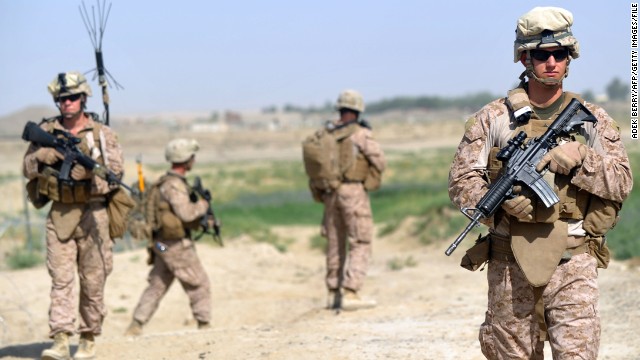
- White House mulling withdrawing all U.S. troops from Afghanistan, official said
- Peter Bergen said the idea would be dangerous and send the wrong message
- He says U.S. abandoned Afghanistan before and the Taliban stepped into vacuum
- Bergen: U.S. should follow model it set in South Korea at end of Korean War
Editor’s note: Peter Bergen is CNN’s national security analyst and the author of “Manhunt: The Ten-Year Search for bin Laden, from 9/11 to Abbottabad.” A version of this article appeared in January.
(CNN) — President Barack Obama is seriously contemplating withdrawing all U.S. troops from Afghanistan sometime in 2014, a senior administration official told CNN’s Jessica Yellin.
The Obama administration had been considering leaving a force of at least several thousand soldiers to act as trainers and to hunt leaders of the Taliban and other militant groups after the long-scheduled withdrawal of all combat troops in December 2014.
But Obama has grown increasingly frustrated in his dealings with Afghan President Hamid Karzai, who last month cut off negotiations about the size of the post-2014 American military force. Karzai objected to the United States beginning formal direct discussions with the Taliban about peace; he regarded this move as happening behind his back and a betrayal.
Let’s stipulate that Karzai can be a frustrating leader to deal with and that he can even be quite mercurial on occasions. That said, the Obama administration shouldn’t be making important strategic decisions merely on the basis of whether or not its leaders like dealing with another country’s leader.
Further, Karzai will be gone in April 2014, when the next Afghan presidential election will take place; in only nine months, the Obama administration won’t have to deal with him at all.
In any case, zeroing out U.S. troop levels in the post-2014 Afghanistan is a bad idea on its face — and even raising this concept publicly is maladroit strategic messaging to Afghanistan and the region writ large.
Why so? Afghans well remember something that most Americans have forgotten.
After the Soviet Union withdrew from Afghanistan, something that was accomplished at the cost of more than a million Afghan lives and billions of dollars of U.S. aid, the United States closed its embassy in Afghanistan in 1989 during the George H.W. Bush administration and then zeroed out aid to one of the poorest countries in the world under the Clinton administration. It essentially turned its back on Afghans once they had served their purpose of dealing a deathblow to the Soviets.
As a result, the United States had virtually no understanding of the subsequent vacuum in Afghanistan into which eventually stepped the Taliban, who rose to power in the mid-1990s. The Taliban granted shelter to Osama bin Laden and his al Qaeda organization from 1996 onward.
After the overthrow of the Taliban, a form of this mistake was made again by the George W. Bush administration, which had an ideological disdain for nation building and was distracted by the Iraq War, so that in the first years after the fall of the Taliban, only a few thousand U.S. soldiers were stationed in Afghanistan.
The relatively small number of American boots on the ground in Afghanistan helped to create a vacuum of security in the country, which the Taliban would deftly exploit, so that by 2007, they once again posed a significant military threat in Afghanistan.
In 2009, Obama ordered a surge of 30,000 troops into Afghanistan to blunt the Taliban’s gathering momentum, which it has certainly accomplished.
But when Obama announced the new troops of the Afghan surge, most media accounts of the speech seized on the fact that the president also said that some of those troops would be coming home in July 2011.
This had the unintended effect of signaling to the Taliban that the U.S. was pulling out of Afghanistan reasonably soon and fit into the longstanding narrative that many Afghans have that the United States will abandon them again.
Similarly, the current public discussion of zero U.S. troop presence in Afghanistan after 2014 will encourage those hardliner elements of the Taliban who have no interest in a negotiated settlement and believe they can simply wait the Americans out.
It also discourages the many millions of Afghans who see a longtime U.S. presence as the best guarantor that the Taliban won’t come back in any meaningful way and also an important element in dissuading powerful neighbors such as Pakistan from interference in Afghanistan’s internal affairs.
Read related: Afghanistan vet finds a new way to serve
Instead of publicly discussing the zero option on troops in Afghanistan after 2014, a much smarter American messaging strategy for the country and the region would be to emphasize that the Strategic Partnership Agreement that the United States has already negotiated with Afghanistan last year guarantees that the United States will have some form of partnership with the Afghans until 2024.
In this messaging strategy, the point should be made that the exact size of the American troop presence after 2014 is less important than the fact that U.S. soldiers will stay in the country for many years, with Afghan consent, as a guarantor of Afghanistan’s stability.
The United States continues to station thousands of troops in South Korea more than five decades after the end of the Korean War. Under this American security umbrella, South Korea has gone from being one of the poorest countries in the world to one of the richest.
It is this kind of model that most Afghans want and the United States needs to provide so Afghanistan doesn’t revert to the kind of chaos that beset it in the mid-1990s and from which the Taliban first emerged.
Bin Laden’s life on the run, CNN.com
By Peter Bergen, CNN National Security Analyst
Editor’s note: Peter Bergen is CNN’s national security analyst, a director at the New America Foundation, and author of Manhunt: The Ten-Year Search for bin Laden from 9/11 to Abbottabad.
(CNN) — On Monday, Pakistan’s long-awaited report into the death of Osama bin Laden in the city of Abbottabad two years ago was leaked in full to Al Jazeera.
The independent Abbottabad Commission was established by Pakistan’s parliament to investigate what for many Pakistanis was an embarrassing double national humiliation. First, that bin Laden lived in Pakistan for nine years undetected before he was killed. Second, that the U.S. conducted a military operation inside Pakistan that, from the moment that four U.S. helicopters penetrated Pakistan’s airspace, lasted for more than three hours without detection by the Pakistani military.
In more than 300 pages, the report paints an intimate picture of the final days and years of the leader of al Qaeda and is also a devastating indictment of what it describes as the incompetence of many institutions of the Pakistani state.
The night of the raid
The report describes the “fateful night” of May 2, 2011, when bin Laden was killed by a U.S. Navy SEAL team and begins with a flourish out of a Harlequin romance: “Today was Amal’s turn for the Shaikh [bin Laden] to be with her. She was the youngest of his wives.”
The report goes on to describe in almost minute-by-minute detail the SEAL raid on the bin Laden compound in Abbottabad, which, it estimates, took between 36 and 38 minutes.
Bin Laden and Amal were sleeping in their top floor bedroom with their 3-year-old son Hussain when they were startled awake by a noise that sounded like a “a storm,” the report recounts.
Amal reached to turn on the light in the bedroom but bin Laden told her: “No!”
Soon bin Laden and his young wife were joined by two of bin Laden’s adult daughters. Together they quickly recited verses of the Koran and bin Laden informed them that American helicopters had arrived. He ordered his children to leave his bedroom.
Suddenly, an American soldier appeared in the room. Amal saw a red beam of light from the laser of the soldier’s gun but she heard no sounds, as the weapon had a silencer. Amal rushed the soldier who shot her “in the knee,” the report says.
“Bin Laden and Amal were sleeping in their top floor bedroom with their three year old son Hussain when they were startled awake by a noise that sounded like a “a storm”… Amal reached to turn on the light in the bedroom but bin Laden told her: ‘No!'”
A shot from the U.S .soldier hit bin Laden in the head and he died at around 12:50 a.m. on May 2, 2011, according to the report.
The report — by four retired senior Pakistani military, diplomatic, police and judicial officials — is based on 201 interviews of government officials and other witnesses.
An obsession with security
Bin Laden went to great lengths to avoid detection, according to the report’s description. When he left his three-story residence to tour his Abbottabad compound, he wore a cowboy hat that prevented prying eyes or satellites from recognizing him.
Bin Laden’s two bodyguards also practiced careful operational security, making phone calls from public call booths in cities at least an hour’s drive from the Abbottabad compound, where they lived with al Qaeda’s leader.
When one of the bodyguard’s young daughters saw a picture of bin Laden on a television program and recognized him to be the tall Arab man who was living on the Abbottabad compound, the report says, the bodyguard banned any further TV watching and any subsequent contact between his family and the bin Laden family.
After the arrest of 9/11 operational commander Khalid Sheik Mohammed in Pakistan in March 2003, bin Laden decided to stop meeting with any al Qaeda members in person, with the exception of his two bodyguards.
During bin Laden’s nine years on the run, his wife Amal gave birth to four children in Pakistan. To avoid any troublesome questions, when Amal gave birth in a hospital the nurses and doctors were informed that she was “deaf and dumb.”
The bin Laden bodyguards installed four separate gas and electricity meters at the Abbottabad compound to ensure that there wasn’t ever a suspiciously large gas or electricity bill betraying the presence of the 16 members of the bin Laden family.
Despite bin Laden complaints of pains in his heart or kidney he never saw a doctor, preferring to treat these ailments with “traditional Arab medicine,” the report says.
When bin Laden traveled around Pakistan, which he did relatively frequently in the early years of his life on the run, he shaved off his distinctive beard.
The Family Man
The report shows bin Laden to be an involved father and grandfather to the dozen or so of his children and grandchildren who were living at the Abbottabad compound. He supervised their playtime, which included cultivating vegetable plots and he handed out “prizes for best performance.”
Bin Laden was also strict when it came to his Islamic beliefs. In the bin Laden family, girls were completely separated from males at the unusually early age of three. And even when men appeared on TV, the bin Laden women would leave the room.
For the scion of one of the richest families in the Middle East, bin Laden certainly was careful with money. He had only a few changes of clothes and was paying the two bodyguards who were his only connection to the outside world around $100 a month each, according to the report.
The CIA
The Abbottabad commission also examined the recruitment of Pakistani doctor Shakeel Afridi, who, according to the commissioners, was paid 10 million rupees by the CIA — around $100,000 — to mount a hepatitis-B vaccination program in Abbottabad. The aim was to confirm the presence of bin Laden at his suspected hideout by extracting blood samples from his children. The CIA hoped to compare that DNA to DNA the U.S. government had already obtained from other members of the bin Laden family.
Afridi met with CIA officials on a number of occasions, including with two female operatives named “Kate” and “Sue,” who posed as officials with the U.S. Agency for International Development. Dr. Afridi’s CIA handlers provided him with a satellite radio so they could stay in touch with him and easily track him.
Two weeks before bin Laden was killed, Dr. Afridi arrived outside the bin Laden compound. He called one of bin Laden’s bodyguards on the phone seeking entry, but the bodyguard told him there that no one was at home. The CIA plans to extract blood samples from the bin Laden kids never panned out.
Afridi is now serving a 33-year prison term in Pakistan for what the independent report characterizes as the “trumped-up charges” of providing support to the Taliban.
Pakistani government failures
The report found that the at the time of the raid on bin Laden’s compound, the Pakistani Air Force was focused on its traditional Indian enemy on its eastern border and its radar systems were in “peacetime mode” on its western border with Afghanistan. This helped explain how the U.S. was able to insert four helicopters into Pakistan without detection.
When the Pakistani Air Force finally scrambled jets to intercept the American helicopters they were long gone from Abbottabad.
The report faults local officials in Abbottabad for their “collective incompetence and negligence” for not paying more attention to the mysterious compound where bin Laden was hiding out. And it faults Pakistan’s intelligence agencies for not mounting any kind of serious effort to discover if bin Laden was living in Pakistan. The report also lambastes the same intelligence agencies for not detecting the “nationwide CIA network” in Pakistan.
On two occasions the report makes reference to bin Laden’s “diary” which was recovered at the Abbottabad compound. Hopefully, the U.S. or Pakistani government will at some point make public the contents of that diary, which will doubtless provide important new insights about the life and thinking of al-Qaeda’s founder.
Falling under the spell of a slain terrorist, CNN.com
Falling under the spell of a slain terrorist
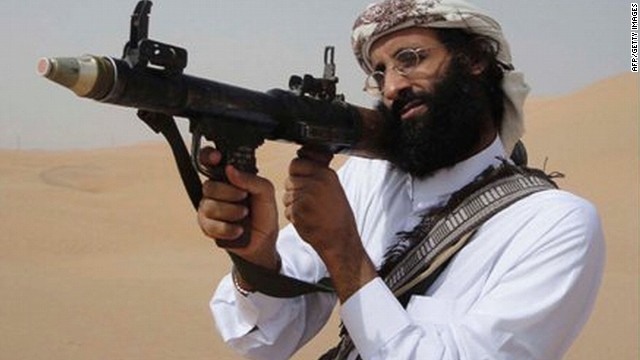
- Anwar al-Awlaki was killed by a U.S. drone strike in 2011, but continues to influence jihadists
- Peter Bergen notes that the cleric’s influence was clear in Boston Marathon indictment
- Other terrorism cases in the U.S. bear imprint of Awlaki’s statements, Bergen says
- Bergen: Will others sympathetic to al Qaeda continue to spread his teachings?
Editor’s note: Peter Bergen is CNN’s national security analyst and a director at the New America Foundation. David Sterman is a graduate student at Georgetown University’s National Security Studies Program.
(CNN) — The U.S. drone strike that killed Anwar al-Awlaki, an American cleric who was born in New Mexico and who would go on to become an al-Qaeda leader in Yemen, did not silence his siren call to jihad.
That fact was underlined Thursday by the indictment against Dzhokhar Tsarnaev, who together with his brother, Tamerlan, allegedly carried out the deadly Boston Marathon bombing on April 15.
Some time before the Boston bombings, Dzhokhar downloaded a digital copy of a book for which Awlaki, who died in 2011, had written the foreword. The book directed Muslims not to give allegiance to countries such as the United States that have invaded Muslim lands.
Four days after the Boston bombings, surrounded by police and fearing death while hiding in a boat in Watertown, Massachusetts, Dzhokhar wrote messages that seemed to echo Awlaki’s ideas such as “The U.S. government is killing our innocent civilians” and “We Muslims are one body; you hurt one, you hurt us all.”
The Tsernaevs are only the tip of Awlaki’s influence on American militants.
According to a count by the New America Foundation, 24 “homegrown” violent jihadist extremists in the United States who have been indicted or convicted of terrorism or have been killed while engaged in violent jihad since 2001 read Awlaki’s propaganda or maintained contact with him.
 Tsarnaev indicted on 30 counts
This accounts for around one in five of all jihadist extremists indicted, convicted or killed since Awlaki’s influence was cited for the first time in court documents in 2007, when his name turned up among the literature being read by members of a plot to attack the Ft. Dix military base in southern New Jersey.
From the grave, terrorist inspires a new generation
Awlaki first came to the attention of the FBI while he was living in San Diego where he had come into contact with two of the 9/11 hijackers in 2000. The FBI investigated those connections but was unable to discover if Awlaki had any nefarious connections to the hijackers.
Awlaki was working as an imam in Virginia in 2002. He then traveled to the United Kingdom and then to Yemen where his family was from.
In 2007, after a spell in a Yemeni jail that he blamed on the United States, Awlaki became more radicalized and he adopted an increasingly strident anti-American tone in his sermons, which were widely distributed on the Internet.
Soon Awlaki joined up with al Qaeda in the Arabian Peninsula.
His role at first was as a spiritual adviser. But he became more involved in operations over time. For instance, he played a central role in the recruitment of the Nigerian “underwear bomber” Umar Farouk Abdulmutallab, who tried to blow up Northwest Flight 253 over Detroit on Christmas Day 2009, court documents showed.
Since Awlaki’s death in the 2011 drone strike, other militants have continued to be influenced by Awlaki’s propaganda.
Quazi Nafis, a 21-year old Bangladeshi on a student visa, was arrested in 2012 for plotting to bomb the New York Federal Reserve. Nafis told a government informant that Awlaki’s ideas had influenced him.
In December 2012, Randy Wilson and Mohammad Abukhdair were arrested in Georgia while attempting to travel to fight for al Shabaab, the al Qaeda affiliate in Somalia. According to the indictment Abukhdair provided an informant with compact discs containing lectures by Awlaki, and Wilson watched Awlaki’s videos.
It is not surprising that Awlaki’s influence has not disappeared following his death.
Awlaki’s role in the radicalization of homegrown extremists was not primarily that of directing and facilitating operations. Only four U.S.-based extremists maintained contact with Awlaki rather than simply reading or watching his propaganda, according to the New America Foundation count.
Authorities say Army Maj. Nidal Malik Hasan, accused of murder in the 2009 Fort Hood, Texas, shooting spree that killed 13 people, communicated with Awlaki by e-mail prior to the attack. He also followed Awlaki’s publications very closely.
However, a commission conducted after the attack to review the FBI’s failure to prevent the shooting found no evidence that Awlaki directed Hasan’s attack.
Awlaki also is said to have played an important role in the radicalization of Zachary Chesser, a Virginia resident who planned to join al Shabaab.
According to a report by the Senate Committee on Homeland Security, Chesser rapidly radicalized after his conversion to Islam in the summer of 2008 and was heavily influenced by Awlaki. Chesser began to post his writings on Awlaki’s blog and began an e-mail correspondence with him, authorities have said.
Chesser decided to join al Shabaab’s struggle in Somalia because of Awlaki’s teachings on jihad, according to the congressional report. Chesser was arrested as he was about to fly to Africa from New York City in July 2010.
Looking to the future, the role of Awlaki’s propaganda as a driver of homegrown extremism will largely be determined by whether the materials he produced before he died remain relevant and easily available on the many websites that distribute his lectures.
The Boston bombings remind us that at least as of now, Awlaki continues to exert his influence even from beyond the grave.
Obama’s goal in Africa: Counter China, CNN.com
Obama’s goal in Africa: Counter China
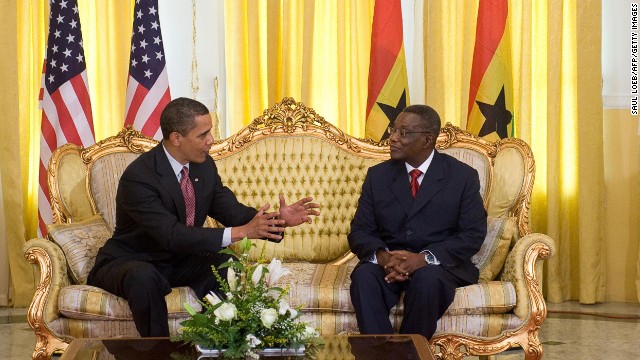 President Barack Obama speaks with Ghanaian President John Atta-Mills at Osu Castle, the government headquarters and a former slave trading fort, in Accra, Ghana, on July 11, 2009.
- President Obama is visiting Africa after years of little U.S. engagement with continent
- Peter Bergen: China took advantage of the opportunity to vastly expand trade
- He says Obama is seeking to counter China, show that U.S. is open for business
- Some African economies are growing very fast, and there are forecasts for more growth
Editor’s note: Peter Bergen is CNN’s national security analyst and a director at the New America Foundation.
(CNN) — There is a one-word subtext to President Obama’s trip to Africa: China.
After 9/11, the United States became embroiled in more than a decade of wars in Asia and the Middle East. As a result, U.S. engagement in Latin America and Africa largely atrophied.
Meanwhile, China saw an opportunity. China has now displaced the United States as the largest trading partners of two key Latin American countries, Brazil and Chile.
China’s economic rise is particularly marked in Africa; it quietly surpassed the United States as the continent’s largest trading partner four years ago.
Sino-African trade is now estimated to be $200 billion a year and is expected to rise to $325 billion in the next two years.
While the conventional view has long been that Africa is largely a motley collection of economic basket cases, in fact, according to the most recent IMF figures, five out of 10 of the world’s fastest-growing economies are in Africa.
Indeed, South Sudan, Libya and Sierre Leone are the globe’s top three economic hot spots with projected 2013 growth rates of 32%, 20% and 17% respectively.
As if to underline the importance that the Chinese see in Africa, within two weeks of assuming office in March 2013, the new Chinese president Xi Jinping visited two of the three African countries Obama will be visiting on his African trip, Tanzania and South Africa.
China is the largest trading partner for both of those nations.
Read this: Obama ‘plays catch up’ in Africa
Seemingly as a result of its substantial investments and trade in Africa, China is well liked on the continent. A 2007 Pew Research Center survey found 92% of respondents held favorable views of China in the Ivory Coast and Mali, and between 67% and 81% held favorable views in Kenya, Senegal, Ghana, Nigeria, Tanzania and Ethiopia.
Pew noted that these favorable views of China come at the expense of the United States: “China’s influence is almost universally viewed as having a more beneficial impact on African countries than does that of the United States.”
In other words, the United States has considerable catch up to play in Africa.
In 2012 then-Secretary of State Hillary Clinton toured Africa and made what many assumed to be a not-so-thinly veiled swipe at China, which is heavily involved in African mineral and oil extraction: “The days of having outsiders come and extract the wealth of Africa for themselves, leaving nothing or very little behind, should be over…”
Obama is likely to avoid any criticism of China but he has chosen to visit Senegal, Tanzania and South Africa, countries that are all relatively functional democracies, and he is likely to dwell on the issues of good governance and respect for human rights in his public remarks, which will serve to subtly remind Africans that these are issues that the United States puts more value on than does China.
But the real message Obama will be signaling is that America is open for business with Africa. In Tanzania, the president will have a closed meeting with some two-dozen leading American and African CEOs. And, according to Jennifer Cooke, an expert on Africa at the Center for Strategic and International Studies in Washington, “some 500 business leaders will join the president at various points in his trip to assess the opportunities for themselves.”
Perhaps they may conclude, as the World Bank did last year, that “Africa could be on the brink of an economic takeoff, much like China was 30 years ago, and India 20 years ago.”
And if that happens, the United States, of course, would want to be part of this story.
“Jihadist Terrorism at Home and Abroad: A Threat Assessment,” CREATE lecture at USC, Los Angeles
Event Detail
CREATE Distinguished Speaker Series with Peter Bergen
Jihadist Terrorism at Home and Abroad: A Threat Assessment
July 30, 2013
12:30pm to 2:30pm
University Park Campus
Ronald Tutor Campus Center (TCC)
Ballroom
Cost: FREE with RSVP. Please RSVP by July 23 at www.usc.edu/esvp (Use Code: BERGEN)
Peter Bergen will examine the capabilities and intentions of al-Qaeda and its affiliates around the world and also assess the extent of the threat from “homegrown” extremists motivated by al-Qaeda’s ideology of violent jihad.
Biography: Peter Bergen is a print and television journalist, documentary producer, think tank director, and the author of four books, three of which were New York Times bestsellers and three of which were named among the non-fiction books of the year by the Washington Post. The books have been translated into twenty languages. He is the director of the national security studies program at the New America Foundation in Washington D.C.; a fellow at Fordham University’s Center on National Security and CNN’s national security analyst. He has held teaching positions at the Kennedy School of Government at Harvard University and at the School of Advanced International Studies at Johns Hopkins University where he taught graduate students courses in his areas of expertise: Al-Qaeda and allied groups and U.S. national security.
Contact: gribben@usc.edu
FEATURED BOOK

All the Presidents’ Wars:
RECENT ARTICLES

UPCOMING EVENTS
Tuesday, December, 08, 2026
USC DC, All the Presidents’ Wars, book event
Tuesday, January, 12, 2027
NY Historical, All the Presidents’ Wars: 25 Years of America’s War on Terror Featuring: Peter Bergen, David M. Rubenstein (moderator), NYC
Wednesday, February, 10, 2027
Metropolitan Club, DC, All the Presidents’ Wars event
RECENT FILM AND TV SERIES
GHOSTS OF BEIRUT: SHOWTIME
The Fall of Osama bin Laden, National Geographic

BIN LADEN'S HARD DRIVE, NATIONAL GEOGRAPHIC

