The Forum is an annual summer gathering at our signature “Aspen Meadows” campus in Colorado of top-level present and former government officials from all relevant homeland security/counterterrorism agencies (the White House; Departments of Homeland Security, Defense, State, Justice, and Treasury; the intelligence community; and Congress); industry leaders (large and small homeland security/counterterrorism-related companies, as well as private equity investors, merchant and investment bankers, venture capitalists, and other financiers); leading thinkers (in other think tanks and academe); nationally noted print and broadcast journalists; and concerned citizens. During three days of in-depth conversation, participants explore various aspects of aviation security; maritime security; border security; mass transit security; critical infrastructure protection; “soft targets” security; cyber-security; intelligence; counterterrorism strategy; terrorism finance; and more.
Drones decimating Taliban in Pakistan, CNN

Drones decimating Taliban in Pakistan
- Peter Bergen, Jennifer Rowland: Administration quietly targeting militants in Pakistan with drones
- They say attacks spiked on Obama’s watch, from one every 40 days, to one every 4 days
- They say since 2004 1,562 to 2,377 suspected militants killed; but program decried in Pakistan
- Writers: Program seems effective, but anger over it may fuel terrorism
Editor’s note: Peter Bergen, CNN’s national security analyst, is a director at the New America Foundation and the author of the new book, “Manhunt: The Ten-Year Search for Bin Laden — From 9/11 to Abbottabad.” Jennifer Rowland is a program associate at the New America Foundation, a Washington-based think tank which seeks innovative solutions across the ideological spectrum.
(CNN) — On Sunday a missile launched from a U.S. drone struck a house in Pakistan’s remote tribal agency of North Waziristan, killing eight suspected militants, most of whom were loyal to the Pakistani Taliban commander, Hafiz Gul Bahadur. Bahadur has reportedly overseen multiple attacks against NATO troops in Afghanistan.
While the CIA drone war against al Qaeda in Pakistan is well known and is even, on occasion, publicly acknowledged by senior Obama administration officials, the strike against Bahadur’s fighters is part of a lesser-known campaign to target Pakistani militants, who are less able to pose a threat to the U.S. homeland. This represents an expansion of the drone program that was overseen by President Barack Obama’s administration.
In 2004 President George W. Bush authorized for the first time the covert lethal use of drones inside Pakistani territory. During his tenure, there were 45 drone strikes in Pakistan’s Federally Administered Tribal Areas (FATA), according to data compiled by the New America Foundation.
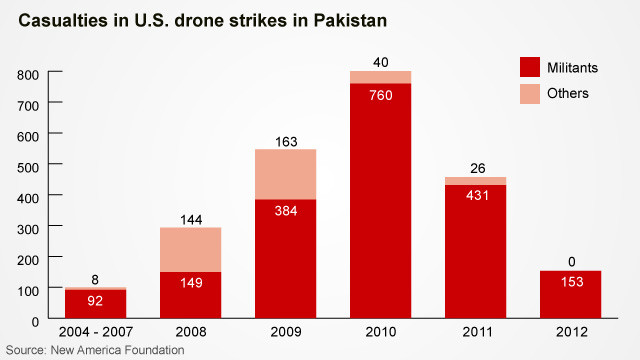
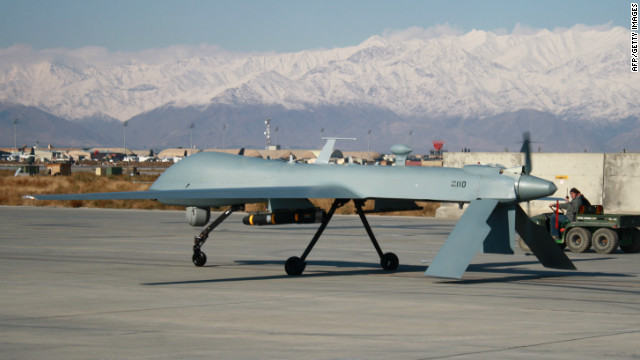
But when President Obama took office in January 2009, the program ramped up quickly, accelerating from an average of one strike every 40 days to one every four days by mid-2011.
The New America Foundation maintains a database of every reported drone strike in Pakistan’s tribal regions since 2004. We monitor reports about the strikes from reliable Western and Pakistani news sources, such as The New York Times, The Associated Press, CNN, Reuters, Express Tribune, Dawn, and Geo TV.
All told, the 307 drone strikes launched by the United States in Pakistan between June 2004 and June 2012 have killed an estimated 1,562 to 2,377 suspected militants, according to news accounts.
Of those strikes, 70% have struck North Waziristan, home to factions of the Pakistani Taliban and the Haqqani Network, which has often launched operations in Kabul against civilian targets.
Over a third of these strikes have reportedly targeted members of the Taliban, with at least 10 of the strikes killing senior Taliban commanders, as well as hundreds of lower-level fighters.
The United States’ aggressive drone campaign in Pakistan slowed considerably in 2011. There were 70 drone strikes in the tribal regions that year, down from 118 in 2010, which saw the peak number of strikes since the program began.
According to our data, 6% of the fatalities resulting from drone strikes in 2011 were civilians, up 1 percentage point from the figure in 2010. Over the life of the program we estimate that the civilian casualty rate is 16%.
Clearly, as the years have progressed, the drone strikes have become more precise and discriminating. In March 2011, Pakistani Maj. Gen. Ghayur Mehmood acknowledged this when he said “the number of innocent people being killed is relatively low” and that “most of the targets are hard-core militants,” the first such public acknowledgment by a senior Pakistani military officer.
Similarly, President Obama made his first public comments about the covert drone program, when he told participants of a Google+ “hangout” on January 30, 2012, that the United States only conducts “very precise precision strikes against al Qaeda and their affiliates, and we’re very careful in terms of how it’s been applied.”
Even if it is the case that there are relatively few civilians killed in the strikes, the drone program is quite unpopular in Pakistan. During the summer of 2010 the New America Foundation sponsored one of the few public opinion polls ever to be conducted in Pakistan’s Federally Administered Tribal Areas and found that almost 90% of the respondents opposed U.S. military operations in the region.
The wider Pakistani public shares this sentiment: A June 2012 Pew Research Center poll found that about three quarters of Pakistanis consider the drone campaign to be unnecessary.
Opinion: Obama ramps up covert war in Yemen
Even so, the strikes may have contributed to a relative decrease in violence across Pakistan. There were 41 suicide attacks in Pakistan in 2011, down from 49 in 2010 and a record high of 87 in 2009. The 118 drone strikes carried out in 2010 coincided with an almost 50% drop in suicide attacks across Pakistan, according to the Pak Institute for Peace Studies, which monitors Pakistani militant groups.
(Another factor in the reduction in terrorism in Pakistan surely was the Pakistani military’s own operations against the Taliban, particularly its 2009 campaigns in Swat and South Waziristan. Some 1,600 Taliban fighters were killed during “Operation Rah-e-Rast” in Swat while hundreds more surrendered to the government.)
Evidence of the drone strikes’ impact can be found in the description provided by David Rohde, the former New York Times reporter held by the Taliban Haqqani Network for months in 2009, who called the drones “a terrifying presence” in South Waziristan.
Key militant commanders reportedly started sleeping outside under trees to avoid being targeted, while Taliban militants regularly executed suspected “spies” in Waziristan accused of providing information to the United States, suggesting they feared betrayal from within.
Last month, a top Taliban commander in South Waziristan halted all polio eradication efforts in the area for fear that the health workers were, in fact, U.S. spies in disguise assisting the CIA drone program.
The CIA drone attacks in Pakistan have undoubtedly hindered some of the Taliban’s operations, killed hundreds of their low-level fighters, and a number of their top commanders. But they have also slowed considerably since their peak in 2010, and have come under harsher scrutiny both in Pakistan and the West, rendering the program’s future in the region uncertain.
The CIA strikes may also be fueling terrorism. Faisal Shahzad, an American citizen of Pakistan descent trained by the Pakistan Taliban, tried to detonate a car bomb in Times Square on May 1, 2010. The plot failed, but Shahzad subsequently claimed that the drone program had fueled his anger against the United States.
*
Here is a list of the Taliban leaders who have been killed in the CIA drone campaign, according to data compiled by the New America Foundation from reliable news reports :
June 18, 2004: Nek Mohammad, Taliban leader
August 13, 2008: Abdul Rehman, Taliban commander in South Waziristan
October 26, 2008: Mohammad Omar, close associate of Nek Mohammad
August 5, 2009: Baitullah Mehsud, overall leader of the Pakistani Taliban
December 31, 2009: Haji Omar, a key Taliban commander in North Waziristan
January 2010 (exact date unknown): Mahmud Mahdi Zeidan, Jordanian Taliban commander
February 24, 2010: Mohammad Qari Zafar, Taliban commander wanted in connection with a bombing in Karachi in 2006
December 17, 2010: Ibne Amin, Taliban commander in Swat
October 27, 2011: Khan Mohammad, Deputy of Taliban commander Maulvi Nazir
March 13, 2012: Shamsullah and Amir Hamza Toji Khel, two of Maulvi Nazir’s senior commanders
Women’s National Democratic Club, Washington, “Manhunt: The Search for Bin Laden”

Columbia University: The Future of Religious Violence
Summer Fervor 2012
Each summer, the Hertog Global Strategy Initiative brings renowned experts and policy makers to Columbia University to deliver weekly public lectures and work with students in the program. The lectures will take place every Thursday evening between May 31-August 2 from 6:00-7:30 p.m. All lectures will be held in the Kellogg Center on 15th floor of the International Affairs Building (Room 1501).
me › Events
Peter Bergen Lecture
Thursday, August 2, 2012 – 6:00pm – 7:30pm
Columbia University Morningside Campus International Affairs Building, Room 1501 (Kellogg Center)
As part of a public lecture series on The History and Future of Religious Violence and Apocalyptic Movements,
The Hertog Global Strategy Initiative Presents:
Peter Bergen
Director of the National Security Studies Program, New America Foundation; Research Fellow, Center on Law and Security, New York University; National security analyst, CNN
Thursday, August 2 at 6 p.m.
15th Floor, International Affairs Building
Columbia University
This event is free and open to the public. For more information and a full schedule of events, visit http://globalstrategy.columbia.edu.
Further information on our speaker:
Peter Bergen is a print and television journalist, and the author of Holy War, Inc.: Inside the Secret World of Osama bin Laden ( 2001), which has been translated into 18 languages and The Osama bin Laden I Know: An Oral History of Al Qaeda’s Leader (2006). Both books were named among the best non-fiction books of the year by The Washington Post, and documentaries based on the books were nominated for Emmys in 2002 and 2007. His most recent book is The Longest War: The Enduring Conflict between America and Al-Qaeda (2011). New York Times book reviewer Michiko Kakutani writes, “For readers interested in a highly informed, wide-angled, single-volume briefing on the war on terror so far, ‘The Longest War’ is clearly that essential book.” Tom Ricks, also writing in the Times, described the book as “stunning.” Holy War, Inc. and The Longest War were both New York Times bestsellers. Mr. Bergen is CNN’s national security analyst and a fellow at New York University’s Center on Law & Security. He has written for many publications including The New York Times, The Washington Post, Vanity Fair, Los Angeles Times, The Wall Street Journal, International Herald Tribune, The Atlantic, Foreign Affairs, Rolling Stone, The National Interest, TIME, Newsweek, Washington Monthly, The Nation, Mother Jones, Washington Times, The Times (UK), The Daily Telegraph (UK), and The Guardian (UK). He is a contributing editor at The New Republic and has worked as a correspondent for National Geographic television, Discovery and CNN. In 2008 he was an adjunct lecturer at the Kennedy School of Government at Harvard University and he worked as an adjunct professor at the School of Advanced International Studies at Johns Hopkins University for several years. He has testified on Capitol Hill on a number of occasions. Mr. Bergen holds a M.A in modern history from New College, Oxford University. As director of New America’s National Security Studies Program, Mr. Bergen leads the Found!ation’s analysis of terrorism, counterinsurgency, South Asia’s! geopolitics and other national security concerns. Mr. Bergen’s personal Web site can be accessed at: www.peterbergen.com
The US and the Middle East, New America Foundation, Washington
The U.S. and the Greater Middle East
This event has been moved to the Constitution Ballroom Grand Hyatt Washington. Event registration is now closed. You can view the live event webcast on this page.
On Tuesday, July 17, join the New America Foundation, the American Enterprise Institute, and the Center for a New American Security for an in-depth discussion of the opportunities and challenges posed to the United States by events in the Greater Middle East. Panelists will discuss electoral transitions following the Arab Spring, the changing role of Turkey, and Iran’s regional and international profile. Ambassador Dennis Ross will provide introductory remarks.
Senior National Security Studies Fellow, New America Foundation
Aspen Security Forum, Aspen
About ASF 2012
- To answer critical questions about homeland security and counterterrorism, the Aspen Institute’s Homeland Security Program, in partnership with The New York Times and CNN’s Security Clearance website, presents the third annual Aspen Security Forum. The Forum starts on Wednesday, July 25 at 6:00 PM and ends on Saturday, July 28, 2012 at 7:30 PM.
2012 Speakers
 |
 |
 |
|
|
Supreme Allied Commander, Europe;
Commander, U.S. European Command
|
Adm. William H. McRaven |
Gen. Keith B. Alexander |
|
 |
 |
 |
|
| John S. Pistole TSA Administrator |
Matthew Olsen Director National Counterterrorism Center |
Sean M. Joyce Deputy Director FBI |
|
 |
 |
 |
|
| Jane Holl Lute Deputy Secretary Department of Homeland Security |
Lt. Gen. Douglas E. Lute Special Assistant to the President and Senior Coordinator for Afghanistan and Pakistan |
David S. Cohen U.S. Treasury Under Secretary Terrorism and Financial Intelligence |
|
 |
 |
 |
|
| Paul N. Stockton Assistant Secretary Department of Homeland Security |
Lisa Monaco Assistant Attorney General for National Security National Security Division U.S. Department of Justice |
Gen. Michael Hayden Former Director Central Intelligence Agency; National Security Agency |
|
 |
 |
 |
|
| Michael A. Sheehan Assistant Secretary for Special Operations and Low-Intensity Conflicts Department of Defense |
Harold H. Koh Legal Adviser Department of State |
John E. McLaughlin Former Deputy & Acting Director Central Intelligence Agency |
|
 |
 |
 |
|
| John D. Negroponte Former Deputy Secretary of State; Former Director of National Intelligence |
Adm. Dennis C. Blair Former Director National Intelligence |
Michael Chertoff Former Secretary Department of Homeland Security |
|
 |
 |
 |
|
| William H. Webster Chairman Homeland Security Advisory Committee |
Charles E. Allen Former Under Secretary for Intelligence and Analysis Department of Homeland Security |
Michael Leiter Former Director National Counterterrorism Center |
|
 |
 |
 |
|
| Juan Carlos Zarate Former Deputy Assistant to the President and Deputy National Security Advisor for Combating Terrorism |
Jane Harman Former Representative 36th Congressional District of California; President, CEO, & Chair Woodrow Wilson International Center for Scholars |
Philip Mudd Former Deputy Director of National Security, Federal Bureau of Investigation; Former Deputy Director, Counterterrorist Center, Central Intelligence Agency; Senior Research Fellow, Counterterrorism Strategy Initiative, New America Foundation |
|
 |
 |
 |
|
| Zalmay M. Khalilzad Former Ambassador to the United Nations; Iraq; Afghanistan |
Scholar at AEI; Former President of the World Bank; Former Deputy Secretary of Defense
|
James M. Loy Senior Counselor, The Cohen Group; Former Deputy & Acting Secretary, DHS; Former Administrator, TSA |
|
 |
 |
 |
|
| Frances F. Townsend Former White House Homeland Security Advisor |
R. James Woolsey, Jr.
Former Director Central Intelligence Agency; Chairman, Foundation for the Defense of Democracies |
Cofer Black Former Director Counterterrorist Center Central Intelligence Agency |
|
 |
 |
 |
|
|
Karl W. Eikenberry |
|
Christopher R. Hill Former U.S. Ambassador to Iraq |
|
 |
 |
 |
|
| Hank Crumpton Chairman & CEO Crumpton Group LLC |
|
Coordinator |
|
 |
 |
 |
|
| Ali Soufan CEO, Soufan Group; Author, “The Black Banners: The Inside Story of 9/11 and the War Against al Qaeda” |
Richard Ben-Veniste Former 9/11 Commissioner; Partner, Mayer Brown, LLP |
||
 |
 |
 |
|
| Jabir Habeb Jabir Ambassador of the Republic of Iraq to the United States |
Eklil Hakimi Ambassador of Afghanistan to the United States |
John D. Harris II President Raytheon Technical Services Company, LLC |
|
 |
 |
 |
|
|
|
Alberto J. Mora Former General Counsel of the Navy |
Christopher Ahlberg CEO & Co-founder Recorded Future |
|
 |
 |
 |
|
| Maurice Sonnenberg Senior International Advisor JPMorgan Chase & Co. |
Paula Broadwell Author of “All In: The Education of General David Petraeus” |
Michael Isikoff Investigative Journalist NBC News |
|
 |
 |
 |
|
| Josh Meyer Author of “The Hunt for KSM”; Director Education & Outreach Northwestern University |
Roger A. Krone President, Network and Space Systems The Boeing Company |
Kevin P. DeSanto Managing Director KippsDeSanto & Co. |
|
 |
 |
 |
|
| Timothy Williams Director INTERPOL Washington |
Brad Brekke Vice President, Assets Protection Target Corporation |
Rajiv Chandrasekaran National Editor The Washington Post |
|
 |
 |
 |
|
| Devin Talbott Managing Partner Enlightenment Capital |
Kenneth Wainstein former Assistant to the President for Homeland Security and Counterterrorism; former Assistant Attorney General for National Security |
Brad Buswell CEO & President Morpho Detection, Inc. |
|
 |
 |
 |
|
| Abderrahim Foukara Washington, DC Bureau Chief Al Jazeera |
Colin Kahl Former Adviser, The Obama Administration Senior Fellow, Center for a New American Security |
Karen Betts Counselor, Foreign and Security Policy Group British Embassy |
|
 |
 |
 |
|
| Bart Johnson Executive Director International Association of Chiefs of Police |
Michael Steed Chairman, Founder, and Managing Partner Paladin Capital Group |
Alex Cary Executive Producer Showtime’s “Homeland” |
|
 |
 |
 |
|
| Christopher Kojm Chairman, National Intelligence Council, Office of the Director of National Intelligence |
Thomas Sass HFR Group, LLC |
Thomas Grumbly Vice President, Civil Government Programs, Washington Operations, Lockheed Martin |
|
 |
|||
| Mitch Silber Director, Intelligence Analysis, NYPD Intelligence Division |
Time to declare victory: al Qaeda is defeated CNN
Time to declare victory: al Qaeda is defeated
EDITOR’S NOTE: This is the first in a series of opinion articles about national security by participants in the upcoming Aspen Security Forum. Security Clearance is a media sponsor of the event which is taking place from July 25-28 in Aspen, Colorado.
By Peter Bergen, CNN National Security Analyst
To end World War II, Franklin D. Roosevelt, Winston Churchill and Joseph Stalin demanded an unconditional surrender from the Nazis. But there will be no such surrender from al Qaeda. The group is not a state that is capable of entering into such an agreement, even if it wanted to do so, which seems highly unlikely.
So we are left with a choice: We can continue fighting al Qaeda indefinitely and remain in a permanent state of quasi-war, as has already been the case for more than a decade now.
Or we can declare victory against the group and move on to focus on the essential challenges now facing America, notably the country’s sputtering economy, but also containing a rising China, managing the rogue regime in North Korea, continuing to delay Iran’s acquisition of nuclear weapons, and – to the extent feasible – helping to direct the maturation of the Arab Spring.
The case for declaring victory over al Qaeda takes two forms. First, there are al Qaeda’s own myriad weaknesses that make the group’s offensive capabilities rather puny. Second, there is the vast increase in the capacity of the U.S. national security industrial complex since 9/11, which makes America’s defenses quite strong.
Consider some of al Qaeda’s obvious weaknesses:
– According to reliable press reports, CIA drones have killed 28 al Qaeda leaders in Pakistan and Yemen since U.S. President Barack Obama took office. During the George W. Bush administration, roughly a dozen leaders of the group were also killed in drone strikes.
– As a result, al Qaeda has one senior leader left, Ayman al-Zawahiri, a black hole of charisma who took over the group after the death of Osama bin Laden. He inherited the Blockbuster Video of global jihad and has done nothing to resuscitate it. (Saif al-Adel, an Egyptian military commander of the group, who might make a more effective leader of al Qaeda, seems to have gone to ground.)
– Al Qaeda hasn’t conducted a successful attack in the West since the bombings on London’s transportation system seven years ago that killed 52 commuters. And the terrorist group, of course, hasn’t carried out an attack in the States since 9/11.
– Even terrorists influenced by al Qaeda-like ideas have only killed 17 people in the United States since 9/11. About the same number of Americans are killed every year by dogs. In other words, in the United States during the past decade, dogs have been around ten times more deadly than jihadist terrorists.
– Polling data from across the Muslim world in countries such as Egypt, Jordan, Pakistan, and Turkey indicate that support for al Qaeda has plummeted.
– Al Qaeda played no role in the Arab Spring and hasn’t been able to exploit in any meaningful way the most significant development in the Middle East since the collapse of the Ottoman Empire.
– Bin Laden’s death was greeted by only minor protests in the Muslim world.
At the same time that al Qaeda has weakened considerably, the United States has built up formidable defenses against the terrorist group and its allies.
– On 9/11, there were 16 people on the “no fly” list. Now there are more than 20,000.
– In 2001, there were just a handful of Joint Terrorism Task Forces (JTTF), “fusion centers” where multiple law enforcement agencies work together to chase down leads to build terrorism cases. Now there are more than one hundred JTTFs across the country.
– A decade ago, the National Counterterrorism Center, Transportation Security Administration (TSA) and the Department of Homeland Security(DHS) didn’t exist. All of these new institutions make it much harder for terrorists to operate in the United States.
– Before 9/11, Special Operations Forces were rarely deployed against al Qaeda and allied groups. Now they perform some dozen operations every day in Afghanistan, as well as many other missions in countries such as Yemen and Somalia.
– At the beginning of the 21st century, the American public didn’t comprehend the threat posed by jihadist terrorists. That changed dramatically after the attacks on New York and Washington. In December 2001, it was passengers on his planewho disabled the “shoe bomber,” Richard Reid. Similarly, eight years later it was his fellow passengers who tackled Umar Farouk Abdulmutallab, the “underwear bomber.” And the following year it was a street vendor who spotted a suspicious SUV parked in Times Square that contained a bomb.
– Before 9/11 the CIA and the FBI barely communicated about their respective investigations of terrorist groups. Now they work together quite closely.
Some may counter that while “al Qaeda central” is indeed on the ropes in Pakistan, regional affiliates of al Qaeda in countries such as Yemen andSomalia continue to pose a real threat, as do terrorist groups inspired by bin Laden’s ideas, such as Boko Haram in Nigeria and Lashkar-e-Taiba in Pakistan.
Certainly, since 2009 the Yemen-based al Qaeda in the Arabian Peninsula (AQAP) has attempted to bring down American airliners and cargo planes flying to the United States with hard-to-detect bombs, but those plots all failed, and once the talented bomb-maker behind them is captured or killed the threat to the United States from AQAP will likely recede.
Meanwhile, al Qaeda’s Somali affiliate has never targeted the United States, nor has Boko Haram or Lashkar-e-Taiba. (Lashkar did attack an American-Jewish community center in Mumbai in 2008, but since then it has not attacked a U.S. target anywhere.)
It is hard for any American politician to say definitively that al Qaeda is defeatedbecause the political costs of a subsequent, even relatively small, successful attack against the United States attributable to al Qaeda or an allied group would be very high. And since 9/11, both al Qaeda and the Pakistani Taliban have tried to launch attacks in Manhattan that could have killed dozens if they hadn’t been averted.
Nonetheless, the Obama administration is going about as far as it can go to underline the fact that the threat from al Qaeda is essentially over. A year ago, Secretary of Defense Leon Panetta predicted: “We’re within reach of strategicallydefeating al Qaeda.” And on the first anniversary of bin Laden’s death, Obama similarly observed: “The goal that I set – to defeat al Qaeda and deny it a chance to rebuild – is now within our reach.”
To win World War II, Roosevelt, Churchill and Stalin did not feel it necessary to kill every Nazi. We should not impose a higher standard in the battle against al Qaeda.
John Adams Institute, Amsterdam, the Netherlands
 Peter Bergen
Manhunt

The gripping account of the decade-long hunt for the world’s most wanted man. It was only a week before 9/11 that Peter Bergen turned in the manuscript of Holy War, Inc., the story of Osama bin Laden–whom Bergen had once interviewed in a mud hut in Afghanistan– and his declaration of war on America. The book became a New York Times bestseller and the essential portrait of the most formidable terrorist enterprise of our time. Now, in Manhunt, Bergen picks up the thread with this taut yet panoramic account of the pursuit and killing of bin Laden.
Moderator: Chris Kijne
In cooperation with The House of Books
Moderator:Chris Kijne
When:11 September 2012, 8pm
Where: West Indisch Huis – Herenmarkt 99 Amsterdam
Admission: Members €11,00 Non members €18,50 Students/seniors €10,00
Links
Website Peter Bergen
Obama leak ‘scandal’ is wildly overblown
Obama leak ‘scandal’ is wildly overblown
- Mitt Romney, others have called for special prosecutor on national security leaks
- Peter Bergen: Most of the info about drones, Stuxnet were known by adversaries
- He says argument that the leaks put U.S. interests and people in jeopardy doesn’t hold up
- Bergen: Public discussion of the implications of drones, computer wars is beneficial
Editor’s note: Peter Bergen, CNN’s national security analyst, is a director at the New America Foundation and the author of the new book, “Manhunt: The Ten-Year Search for Bin Laden — From 9/11 to Abbottabad.”
(CNN) — On Monday, Republican presidential candidate Mitt Romney called for the appointment of a special prosecutor to investigate a series of recent leaks that critics charge are designed to bolster the national security credentials of the Obama administration.
Investigations by special prosecutors can take on a life of their own.
Recall that the investigation of the Whitewater real estate deal in Arkansas — in which Bill and Hillary Clinton actually lost money — morphed into the scandal of the Monica Lewinsky affair.
During the George W. Bush administration, Scooter Libby, a top aide to Vice President Dick Cheney, was convicted not of leaking the name of CIA officer Valerie Plame but of making false statements to the FBI during its investigation of the leak and also perjuring himself.
The recent leaks involve stories in The New York Times, Newsweek and the Associated Press that range from the hitherto undisclosed role of the United States in cyberattacks on Iran’s nuclear facilities to details about the president’s decision-making surrounding the selection of the targets of the CIA drone program in Pakistan and Yemen and the penetration by a spy of al Qaeda’s Yemeni affiliate.
Earlier this month, Attorney General Eric Holder appointed two senior Department of Justice prosecutors to investigate the leaks, and the FBI is also investigating the matter.
Have those leaks, as Romney claimed on Monday, “put American interests and our people in jeopardy”?
It is not only Republicans making these charges. Well-regarded Democratic Sen. Dianne Feinstein, who heads the powerful Senate Select Committee on Intelligence, told CNN’s Wolf Blitzer: “I think what we’re seeing, Wolf, is an avalanche of leaks, and it is very, very disturbing. It’s dismayed our allies. It puts American lives in jeopardy. It puts our nation’s security in jeopardy.”
The story that sparked these claims was David Sanger’s piece in The New York Times earlier this month about the U.S. role in cyberattacks against Iran’s key nuclear enrichment plant at Natanz, revelations that also appear in Sanger’s fascinating new book, “Confront and Conceal.”
Sanger goes into rich detail about how computer viruses were introduced into the Natanz plant and how they then took over the controls of the finely calibrated centrifuges that the Iranians use to enrich their uranium, causing the centrifuges to spin wildly out of control.
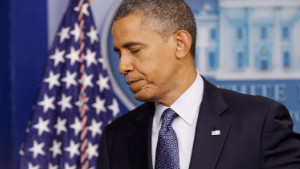 Obama: White House leaks ‘offensive’
 McCain wants info on leaked info in book
 Rep. King blames Oval Office for leaks
 FBI investigates possible leaks
But did this really hurt U.S. national security? After all, the Iranians know that their problems with the centrifuges at Natanz are caused by cyberattacks and have publicly said so for the past two years. On November 29, 2010, Iranian President Mahmoud Ahmadinejad told reporters in Tehran, “They succeeded in creating problems for a limited number of our centrifuges with the software they had installed in electronic parts.”
Computer experts around the world who examined the Stuxnet virus, the first computer virus that was introduced into the Iranian nuclear program, concluded two years ago that this was a virus that was so complex that it could only have been generated by a state, and the only two states with the technical know-how and motive to write the code for such a virus were Israel and the United States.
Last year, German computer security expert Ralph Langner, who had discovered the Stuxnet virus when it had first broken out of the Natanz plant, told a conference in California, “My opinion is that the Mossad is involved. … But, the leading source is not Israel. … There is only one leading source, and that is the United States.”
Sanger’s reporting about the cyberattacks on Iran revealed that the code name for the series of computer viruses unleashed on Iran’s nuclear program is “Olympic Games” and also laid out some of the modus operandi of the viruses themselves, but since much of this was generally known by the Iranian regime, it is unlikely U.S. national security was really harmed by the disclosures.
In fact, open discussion of the cyberattacks against Iran is in the public interest because three questions about the attacks quickly present themselves:
— What are the downsides of cyberattacks in a world that is so interconnected by the Internet?
— Since it is the Pentagon’s official position that a serious cyberattack against the United States is a form of warfare, is the U.S. therefore already at war with Iran?
— When does a covert action against an American enemy rise to a form of warfare that it merits a broader public discussion?
According to Sanger, his sources about Olympic Games included “current and former American, European and Israeli officials involved in the program, as well as a range of outside experts.”
So it is fair to assume that Sanger’s reporting was hardly dependent on a particular Obama administration official (or officials) but rather, as all good reporters do, Sanger put together a myriad of sources to arrive at the composite picture of Olympic Games that he paints for his readers.
It is therefore quite unlikely that prosecutors will find particular officials behind the leaking but rather that Obama officials gave Sanger some small fragments of the Olympic Games story that he was then also able to piece together with the help of his Israeli and European sources, as well as experts on cybersecurity.
Another story that has critics of the Obama administration steamed is that it has allowed to become public that the president personally approves “kill lists” for CIA drone strikes in Pakistan and Yemen, a story reported both by Jo Becker and Scott Shane in The New York Times and by Daniel Klaidman in Newsweek and in his excellent new book about Obama’s counterterrorism policies, “Kill or Capture.”
No such criticism attended the Bush administration’s decision to turn over to Bob Woodward the highly classified notes from “50 National Security Council and other meetings” that became the basis for Woodward’s hagiographic book, “Bush at War,” about the campaign to overthrow the Taliban during the fall of 2001.
There is nothing of substance to the criticism that discussion of the “kill lists” endangers national security.
After all, drone attacks are an entirely public form of supposedly secret warfare. A drone strike — when a bomb or missile appears out of nowhere and incinerates some people in Pakistan’s tribal areas or in Yemen — is a public event. And it’s a form of warfare that is, of course, well known to al Qaeda. The documents recovered at Osama bin Laden’s Abbottabad compound in Pakistan demonstrate how worried al Qaeda’s leaders were about the CIA drone strikes.
Incidentally, the president’s being involved in making these life-or-death decisions about the fates of many hundreds of people in any given year is desirable. Is it a preferable alternative that he shouldn’t be involved at all?
Also, discussion of the drone program is in the public interest as it’s a form of warfare that is unlikely to remain an American monopoly for much longer.
After all, the U.S. has only had the ability to arm its own drones for the past decade, and many other countries now possess unarmed drones of their own. It won’t be long before the Russians and the Chinese will be arming their own drones and precedents created by the Obama administration will surely be invoked by them.
The one story that may be genuinely troubling from a national security perspective is the one written by the deeply sourced Adam Goldman and Matt Apuzzo at the AP, who made public in May that a plot to destory a U.S. bound airliners using a souped-up new version of an “underwear bomb” developed by al Qaeda’s Yemeni branch had had been thwarted by the CIA.
As this story got into “sources and methods” that might affect the future ability of the CIA or of “liaison services” working with the agency to penetrate al Qaeda in Yemen again, the precise source of this leak seems to be the most legitimate avenue of inquiry for the Justice Department and the FBI.
Finally, is there any merit to the notion that the Obama administration is spilling secrets to burnish its national security record? To help answer that question, let’s quickly recall some of that record:
— In the first two years of his presidency, Obama quintupled the number of CIA drone strikes in Pakistan, as a result more or less destroying al Qaeda there.
— Obama has conducted around 40 drone strikes and airstrikes in Yemen, compared with the Bush administration’s single drone strike there.
— One of those Obama drone strikes killed the New Mexico-born cleric Anwar al-Awlaki, which appears to be the first time an American president has authorized the assassination of a U.S. citizen.
— According to reliable news reports of drone strikes in Pakistan and Yemen, Obama has authorized strikes that led to the killing of at least 1,900 people, most of whom were militants but around 5% of whom were civilians. (The toll of 1,900 is more than double the total number of detainees who have passed through Guantanamo).
— And, of course, Obama ordered the raid that killed bin Laden, a decision that was made against the advice of two of his most senior advisers, Secretary of Defense Robert Gates, who had served every president going back to Richard Nixon, and Vice President Joe Biden, who was elected to the Senate when Obama was 11.
This does not seem to be the record of a president who needs to bolster his national security credentials, something that seems to be well-understood by the American public.
In a variety of recent polls, Obama and Romney are now running neck and neck, but a poll released this month by Fox News shows that Obama beats Romney by 11 points on foreign policy issues and by 13 points on terrorism.
The irony of all the ruckus about the recent leaks is that the Obama administration, which came to power promising more government transparency, has been the most aggressive administration in U.S. history in its prosecution of alleged leaks to the press. It has invoked in six cases the rarely used 1917 Espionage Act to go after Americans not working for foreign intelligence services but who have leaked to the media.
By and large, the leaks are a Washington pseudoscandal that hasn’t really harmed national security but have instead helped to foster a legitimate debate about the future of drone warfare and of cyberattacks that promise to transform warfare as much as fast-moving tanks changed the face of war in the mid-20th century.
MANHUNT: The Ten-Year Search for Bin Laden
MANHUNT:
The Ten-Year Search for Bin Laden
Friday, June 22, 2012
12:15 p.m. – 1:45 p.m.
New America Foundation
1899 L St NW, Suite 400
Washington, DC 20036
Roughly a decade after Sept. 11, 2001, Americans celebrated the news that the mastermind behind the terrorist attacks had been found and killed during a raid on his home in Pakistan. Now, one year after Osama bin Laden’s death, Peter Bergen describes the raid with riveting detail in his fourth book on bin Laden, MANHUNT: The Ten-Year Search for Bin Laden from 9/11 to Abbottabad.
But the killing of bin Laden is only one element of a decade-long story – Where did he hide after the 9/11 attacks, and how did he evade capture? How did the SEALs prepare for Operation Neptune Spear? Why did President Obama decide to proceed with the raid despite the recommendations of two of his top three advisors that he not do so?
Come hear Peter Bergen discuss bin Laden’s life and eventual death, as well as America’s decade-long hunt to bring him to justice.
Featured Speaker
Peter Bergen
Director, National Security Studies Program
New America Foundation
To RSVP for the event, click on the red button or go to the event page:
http://newamerica.net/events/2012/ten-year-search
For questions, contact Stephanie Gunter at New America at (202) 596-3367 or gunter@newamerica.net.
www.NewAmerica.net
Obama ramps up covert war in Yemen
Obama ramps up covert war in Yemen

- U.S. drone attacks in Yemen haven’t received as much attention as in Pakistan
- Dozens of airstrikes have killed hundreds, mostly AQAP terrorists, the authors say
- In April, White House approved policy for even more aggressive campaign of drone strikes
- A Yemen expert says the strikes haven’t dented AQAP’s overall strength
Editor’s note: Peter Bergen, CNN’s national security analyst, is a director at the New America Foundation and the author of the new book, “Manhunt: The Ten-Year Search for Bin Laden — From 9/11 to Abbottabad.” Jennifer Rowland is a program associate at the New America Foundation, a Washington-based think tank which seeks innovative solutions across the ideological spectrum.
(CNN) — President Obama is celebrated and criticized for greatly accelerating the number of CIA drone attacks in Pakistan, but the similar covert war that he has launched in Yemen has received considerably less attention.
The Obama administration has launched an estimated 28 drone strikes and 13 air strikes in Yemen, according to data compiled by the New America Foundation from reliable news reports. By contrast, the administration of George W. Bush only launched one drone attack in Yemen. (The data was gathered from media outlets that include the Associated Press, Reuters, CNN and the Yemen Post.)
On April 25, the White House approved a new policy inaugurating a more aggressive campaign of drone strikes in Yemen allowing so-called “signature” strikes. These are strikes on individuals whose patterns of behavior signal the presumed presence of an important militant or of a plot against the United States, even if the targeted individual’s identity is unknown.
Previously, the administration only allowed the U.S. Joint Special Operations Command (JSOC) and the CIA to launch drone attacks in Yemen against top-level militants whose names appeared on secret JSOC and CIA target lists and whose locations could be confirmed.
These broadened rules of engagement will likely result in the further acceleration of U.S. intelligence and military operations in Yemen, a chaotic, weak state embroiled in several overlapping civil wars.
As of June 6, drone strikes and airstrikes had killed an estimated 531 to 779 people in Yemen, 509 to 713 of whom were identified in media reports as militants, according to the New America Foundation’s data. Of these deaths, 99% occurred during Obama’s presidency.

The civilian casualty rate from these strikes is estimated to be between 4% and 8.5%, roughly comparable with the civilian casualty rate from the U.S. drone program in Pakistan, which averaged 5.5% in 2011, according to New America Foundation data. The CIA inaugurated the lethal drone program in Yemen on November 3, 2002, with a Hellfire missile launched from a Predator drone at a vehicle in the province of Maarib, about 100 miles east of the capital city of Sanaa.
The attack killed al Qaeda’s top operative in Yemen, Qaed Salim Sinan al-Harethi, who was also a suspect in the 2000 bombing of the USS Cole off the Yemeni coast. With al-Harethi in that car were five other militants, all of whom were killed, including U.S. citizen Kamal Derwish. His was the first reported American death to result from the CIA’s drone campaign.
After the 2002 U.S. drone strike, there was no reported U.S. airstrikes or drone attacks in Yemen until December 2009, when a sustained campaign of attacks began.
That change came about because al Qaeda’s Yemen-based affiliate, al Qaeda in the Arabian Peninsula (AQAP), has over the past three years attempted a number of terrorist attacks against the United States, launching it from relative obscurity to the top of the U.S. government’s list of national security threats.
 Suicide blast kills 100+ troops in Yemen
 Aid groups call for urgent help in Yemen
In a statement posted on jihadist websites in December 28, 2009, AQAP claimed responsibility for the attempted “underwear bomb” attack on a Detroit-bound passenger airliner three days earlier. And in November 2010, the group claimed responsibility for a plot to send two packages containing bombs hidden in printer cartridges to two Chicago synagogues. The packages were discovered in the United Kingdom and Dubai after Saudi officials provided a tip about the plot.
In July 2011, Secretary of Defense Leon Panetta said the United States was “within reach of strategically defeating al Qaeda,” and that he believed of all al Qaeda affiliates, AQAP posed the greatest threat to the U.S. homeland.
Al Qaeda in Yemen advertises for Western recruits
Counting drone attacks and airstrikes in Yemen is complicated because it has often been unclear whether attacks were launched from drones or from fighter jets, and villagers regularly provide conflicting accounts of the kinds of aircraft used in these attacks.
To make data collection on these strikes even more difficult, diplomatic cables released by the transparency watchdog site WikiLeaks revealed that the Yemeni government has sometimes taken credit for airstrikes that were in fact being carried out by the United States.
According to one cable, then-Yemeni President Ali Abdullah Saleh told then-Gen. David Petraeus in January 2010, “We’ll continue saying the bombs are ours, not yours,” after which Deputy Prime Minister Rashad al-Alimi joked that he had just “lied” to the Yemeni Parliament about the American role in such strikes.
During the Obama administration, U.S. drones have killed at least 16 key al Qaeda militants in Yemen, including the Yemeni-American cleric Anwar al-Awlaki on September 30, 2011, and Fahd al-Quso who was suspected of involvement in the 2000 bombing of the USS Cole.
While the covert drone war is claiming a fast-rising toll, it’s not clear it is significantly weakening AQAP. Gregory D. Johnsen, a leading expert on Yemen at Princeton University, points out that al Qaeda’s Yemeni affiliate has grown in size during the past three years from around 200 to 300 militants to more than 1,000 fighters and “controls significant portions of territory in southern Yemen. In parts of Abyan and Shabwa provinces, the organization controls towns in which it has established its own police departments and court systems. It is providing water, electricity and services to these towns. In short, AQAP now sees itself as the de facto government in the areas under its control.”
Since the longtime Yemeni strongman Saleh stepped down in February, the American drone strikes and airstrikes have increased. In just three months, the United States launched an estimated 20 strikes. By comparison, there were just 18 attacks in the previous two years. Johnsen asks: “What happens if this ‘missile surge’ doesn’t work? What happens next? Does the U.S. fire more and more missiles in the hopes that it will reach a tipping point?”
Given the Obama administration’s embrace of drone strikes, the answer to that question seems likely to be: Yes.
________
Here is a list of the key al Qaeda militants who have been killed in U.S. drone attacks in Yemen during the Obama administration, according to data compiled by the New America Foundation from reliable news reports:
— January 15, 2010: Qassem al-Raymi, top military chief for al Qaeda in the Arabian Peninsula.
— January 15, 2010: Ayed Al Shabwani, the chief of AQAP’s operations in Maarib province.
— January 15, 2010: Ammar al-Waeli, who was accused of involvement in a July 2007 suicide bombing that killed eight Spanish tourists and two Yemenis
— January 15, 2010: Abu Ayman, an Egyptian militant who is believed to have spent time in Afghanistan.
— March 14, 2010: Jamil Nasser Abdullah al-Ambari, believed to be the leader of al Qaeda in southern Abyan province.
— July 14, 2011: Hadi Mohammad Ali, militant commander in Abyan province.
— August 1, 2011: Naser al-Shadadi, leading al Qaeda militant.
— September 30, 2011: Anwar al-Awlaki, radical Yemeni-American cleric.
— September 30, 2011: Samir Khan, founder of AQAP’s English-language magazine Inspire
— October 14, 2011: Ibrahim al-Bana, AQAP’s media chief.
— December 23, 2011: Abdulrahman al-Wuhayshi, brother of AQAP leader Nasser al-Wuhayshi.
— March 9, 2012: Abdulwahhab al-Homaiqani, local AQAP leader in Bayda province.
— March 13, 2012: Nasser al-Zafari, local AQAP leader in Bayda province.
— April 22, 2012: Mohammed al-Umda, fourth most-wanted al Qaeda militant in Yemen, who was convicted in 2005 of an attack on the Limburg oil tanker in 2002.
— May 6, 2012: Fahd al-Quso, who was on the FBI’s most-wanted list for his role in the 2000 bombing of the USS Cole.
— May 10, 2012: “Jallad,” who was in charge of armaments for AQAP fighters.
FEATURED BOOK

All the Presidents’ Wars:
RECENT ARTICLES

UPCOMING EVENTS
Tuesday, December, 08, 2026
USC DC, All the Presidents’ Wars, book event
Tuesday, January, 12, 2027
NY Historical, All the Presidents’ Wars: 25 Years of America’s War on Terror Featuring: Peter Bergen, David M. Rubenstein (moderator), NYC
Wednesday, February, 10, 2027
Metropolitan Club, DC, All the Presidents’ Wars event
RECENT FILM AND TV SERIES
GHOSTS OF BEIRUT: SHOWTIME
The Fall of Osama bin Laden, National Geographic

BIN LADEN'S HARD DRIVE, NATIONAL GEOGRAPHIC

