The event Colin Powell long regretted, CNN.com
Opinion by Peter Bergen, CNN National Security Analyst
Updated 8:58 AM ET, Tue October 19, 2021
Peter Bergen is CNN’s national security analyst, a vice president at New America and a professor of practice at Arizona State University. He is the author of “The Longest War: The Enduring Conflict Between the United States and al-Qaeda,” from which this piece is adapted. The opinions expressed here are his own.
(CNN)Much to his later regret, then-Secretary of State Colin Powell became the centerpiece of the George W. Bush administration’s case for going to war in Iraq. That fact was noted in the obituaries and opinion pieces published after Powell’s death Monday at the age of 84. But the events of that era deserve closer examination.
Powell’s presentation to the UN Security Council on February 5, 2003, six weeks before the American invasion of Iraq, laid out the case Bush wanted to make. But the case fell apart following the American occupation of Iraq, which revealed that Iraqi dictator Saddam Hussein didn’t have an active weapons of destruction program, nor was Hussein allied to al Qaeda — as Powell had asserted at the UN.
A hero of the first Gulf War, Powell was a widely admired figure in the Bush administration and had considerably more credibility than other senior officials when it came to Iraq. A Gallup poll before his UN speech found that Powell was trusted on US-Iraq policy by 63% of Americans versus only 24% who trusted Bush on the issue.
Recognizing this, Bush asked Powell to make the case to the UN about the necessity of the Iraq War.
Powell was more skeptical about the decision to invade Iraq than other Cabinet officials such as Vice President Dick Cheney. “If you break it, you own it,” Powell told Bush in August 2002, according to Robert Draper’s authoritative account of the run-up to the invasion of Iraq, “To Start a War.”
Cheney’s office pressed for the most expansive case for the purported connections between Iraq’s leader Saddam Hussein and al Qaeda in Powell’s UN speech, which was supposed to be a replay of the kind of definitive presentation that Adlai Stevenson, the US ambassador to the United Nations, had given in 1962 at the height of the Cuban missile crisis. In that speech, Stevenson had used aerial photographs to successfully convince the world that the Soviets had installed nuclear missiles in Cuba.
Al Qaeda was responsible for the deadliest attack ever on American soil — the 9/11 hijackings that killed nearly 3,000 people, brought down the twin towers of New York’s World Trade Center and damaged the Pentagon. Connecting Hussein to the terrorists who engineered 9/11 was key to establishing a reason to go to war against Iraq.
Powell’s deputy, Richard Armitage, remembered that the vice president’s office wrote up a submission for his boss to deliver to the UN that included “every kitchen sink that you could imagine,” including the notion that the lead 9/11 hijacker, Mohamed Atta, had met in Prague with an Iraqi intelligence agent before 9/11.
But, a month earlier, a CIA report titled “Iraq Support for Terrorism” had already concluded that “we are increasingly skeptical that Atta traveled to Prague in 2001 or met with the (Iraqi official).”
Deputy CIA Director John McLaughlin recalls that the White House material about the putative al Qaeda-Iraq connections had not been cleared by the CIA. McLaughlin told Powell and his staff, “This is not our draft. There’s all sorts of garbage in here.”
Despite the good-faith efforts to exclude questionable material about Hussein’s connections to al Qaeda in Powell’s speech, much that remained in the final text would later be discounted following the occupation of Iraq.
In hindsight, Powell did his job too well. His presentation was a bravura performance that seemed to establish beyond a doubt that Hussein was actively concealing an ongoing weapons of mass destruction program and was in league with al Qaeda. Powell asserted that “Saddam Hussein and his regime are concealing their efforts to produce more weapons of mass destruction,” and he pointed to a “sinister nexus between Iraq and the al Qaeda terrorist network.”
At one point, to show the dangers WMD can pose, the secretary of state dramatically brandished a small vial of a white powder of supposed anthrax saying “about this amount … shut down the US Senate in the fall of 2001.”
As Powell gave his speech, sitting directly behind him was CIA Director George Tenet, giving a visual imprimatur to what Powell was saying.
One section of Powell’s UN speech tried to make the case for an emerging alliance between Saddam and al Qaeda. “Iraq today harbors a deadly terrorist network headed by Abu Musab al-Zarqawi, an associate and collaborator of Osama bin Laden and his al Qaeda lieutenants,” he said.
But Powell’s speech made a gossamer-thin case for the Iraq-al Qaeda nexus, even with the faulty intelligence that was then available. The relationship between Zarqawi and al Qaeda was already known to be far from clear-cut. Until 2004, Zarqawi ran an organization separate from al Qaeda, known as Tawhid, whose name corresponds to the idea of monotheism in Arabic. Indeed, Shadi Abdalla, a member of Tawhid who was apprehended in Germany in 2002, told investigators that the group saw itself to be in competition with al Qaeda.
Even after the Iraq war began in March 2003, Zarqawi was still running his own outfit independent of al Qaeda. Unlikely support for that fact came from Secretary of Defense Donald Rumsfeld, who said of Zarqawi at a Pentagon briefing in June 2004, “Someone could legitimately say he’s not al Qaeda.”
On October 25, 2005, the CIA released a report that finally disposed of the myth that Saddam and Zarqawi had ever been in league, assessing that prior to the war, “the regime did not a have a relationship, harbor, or turn a blind eye towards Zarqawi.”
An additional exhibit in Powell’s UN speech that was intended to prove an al Qaeda-Saddam-WMD nexus was the Kurdish Islamist group, Ansar al-Islam, which was experimenting with crude chemical weapons in its training camp in northeastern Iraq, a facility that was described as a “poison factory” by Powell in an aerial photograph of the camp that Powell displayed in his UN presentation.
However, the only reason that Ansar al-Islam could exist in that part of Kurdish Iraq was because the US Air Force had been enforcing a no-fly zone in the region for more than a decade, which meant that the Pentagon had more control over that part of Kurdistan than Saddam did.
Obviously well aware of the fact that Hussein did not control Kurdish Iraq, Powell said that the Iraqi dictator had a high-level spy in Ansar al-Islam. However, while Hussein may have had a spy in Ansar al-Islam, this hardly meant that he had control over the group.
It was Powell’s speech that will be long remembered as making the best public case for the Iraq war. And it was a speech that would later be shown to be rife with false assertions and erroneous assumptions once the United States had occupied Iraq.
The CIA director George Tenet later wrote, seemingly without irony, of Powell’s speech “it was a great presentation, but unfortunately the substance didn’t hold up.”
Get our free weekly newsletter
In 2005, Powell told ABC News’ Barbara Walters that his UN speech was “painful” for him and a permanent “blot” on his record.
Powell’s admission came as Iraq was descending into an intense civil war. Ultimately, more than 4,400 US troops would die in Iraq, as well as many scores of thousands of Iraqi civilians.
Powell grew up in the South Bronx, the son of Jamaican immigrants. He rose from serving in the jungles of Vietnam where he was as a young officer to become former President Ronald Reagan’s national security adviser and later the first Black secretary of state.
His speech at the UN doesn’t define Powell’s extraordinary career, but he came to bitterly regret ever giving it.
Arizona State, The Rise and Fall of Osama bin Laden, online
Topic
The Rise and Fall of Osama bin Laden
Description
Peter Bergen is the author of seven books, three of which were named New York Times bestsellers and four of which were named among the non-fiction books of the year by the Washington Post. Bergen is a Professor of Practice in the School of Politics and Global Studies at ASU, Co-Director of the Center on the Future of War, Vice President for Global Studies and Fellows at New America, and a CNN national security analyst.
In The Rise and Fall of Osama bin Laden, Peter Bergen provides the first reevaluation of the man responsible for precipitating America’s long wars with al-Qaeda and its descendants, capturing bin Laden in all the dimensions of his life: as a family man, as a terrorist leader, and as a fugitive. The book sheds light on his many contradictions: he was the son of a billionaire, yet insisted his family live like paupers. He adored his wives and children, yet he brought ruin to his family. And while he inflicted the most lethal act of mass murder in United States history, he failed to achieve any of his strategic goals.
Time
Oct 7, 2021 05:00 PM in Arizona
In conversation with historian, Professor Sunil Khilnani, Dean, AshokaX.
Beyond The Classroom
Peter Bergen, Bestselling author, journalist, and National Security Analyst, CNN is in conversation with eminent historian and Professor Sunil Khilnani, Dean, AshokaX.
Ashoka University is delighted to invite everyone to another exciting season of Beyond The Classroom. We begin the lecture series with a conversation with the famous journalist and bestselling author Peter Bergen who also serves as CNN’s National Security Analyst and the Vice President for Global Studies & Fellows at New America. The conversation is hosted by eminent historian Sunil Khilnani, Dean of AshokaX and Professor of Politics and History at Ashoka.
In 1997, acclaimed CNN correspondent Peter Bergen conducted the first-ever television interview with Osama bin Laden–a conversation in which, for the first time, bin Laden declared to a Western audience his war against the United States. Since that history-making moment, Bergen has become not just the world’s leading expert on Osama bin Laden, but the author or editor of nine ground-breaking books on Afghanistan, Taliban, Osama bin Laden, foreign policy, and America’s War on Terror, among them two bestsellers: The Longest War: The Enduring Conflict between America and Al-Qaeda and Manhunt: The Ten-Year Search for Bin Laden, from 9/11 to Abbottabad–a 2012 book that became an Emmy-winning HBO film.
Bergen’s latest book, ‘The Rise and Fall of Osama Bin Laden’, on the 20th anniversary of the attacks of Sept.11, 2001, is his deepest-yet exploration of how a family man became a radical jihadist and, in turn, the world’s most wanted terrorist, and how his influence continues to determine US foreign policy.
Join this lively and wide-ranging discussion on October 08, 2021 at 8 pm.
Top US generals punch holes in Joe Biden’s defense of Afghanistan withdrawal, CNN.com
Top US generals punch holes in Joe Biden’s defense of Afghanistan withdrawal
“Peter Bergen is CNN’s national security analyst, a vice president at New America and a professor of practice at Arizona State University. Bergen has reported from Afghanistan since 1993. His new book is “The Rise and Fall of Osama bin Laden.” The views expressed in this commentary are his own. View more opinion on CNN.”
(CNN)Top American generals warned President Joe Biden that the Afghan military would collapse. Gen. Mark Milley, chairman of the Joint Chiefs, said in essence on Tuesday that both former President Donald Trump and Biden had botched negotiations with the Taliban — and the net result of the US actions was a “logistical success but a strategic failure.”
If the old joke is true — that in Washington, the definition of a gaffe is telling the truth in public — then Milley and the other military leaders who testified Tuesday on Capitol Hill committed many gaffes.
At a televised hearing of the US Senate Armed Services Committee featuring Milley, CENTCOM commander Gen. Kenneth McKenzie, and the Secretary of Defense Lloyd Austin — himself a retired four-star general and former CENTCOM commander — all told a great deal of truth.
Generals Milley and McKenzie said that they advised the Biden administration that unless the US kept 2,500 troops in Afghanistan, the Afghan military would collapse. They also said that the ground commander in Afghanistan, Gen. Austin “Scott” Miller, provided the same advice.
This clearly contradicts what President Biden told ABC News anchor George Stephanopoulos last month — that the US military didn’t advise him to keep 2,500 troops in Afghanistan.
In answer to a question from a senator, Gen. Milley conceded that the abrupt and complete US withdrawal had “damaged” US credibility around the world.
Milley also said that both the Trump and Biden administrations made a mistake by putting specific dates on the US withdrawal rather them making it a conditions-based withdrawal.
Relatedly, McKenzie and Austin both agreed that the Doha agreement with the Taliban that was negotiated by the Trump administration and signed in February 2020, and which laid out the timeline for a total US withdrawal, significantly undercut the morale of the Afghan military.
Milley blamed the US intelligence community for missing the “scale and scope, plus the speed” of the collapse of Afghan government, testifying, “All the intel assessments, all of us got that wrong. There’s no question about it. That was a swing and a miss on the intel assessment of 11 days in August, there’s nobody that called that.”
In fact, according to CNN’s reporting before the fall of Kabul, the US intelligence community was predicting in early August that the Taliban could take Kabul within a month to three months, which at the time seemed like a reasonably accurate assessment of how dire the situation was becoming.
Milley described the US airlift of more than 120,000 Afghans, US citizens and other nationals from Kabul as a “logistical success,” but he called the overall policy in Afghanistan a “strategic failure.”
The fruits of that failure have been starkly clear from the actions of the Taliban during just the past month.
In a highly symbolic move on September 17, the Taliban’s feared religious police commandeered the building that once housed the Ministry of Women’s Affairs.
The next day, the Taliban ministry of education summoned only teenage boys back to school, but no female teens. They remain at home, unschooled.
The following day, the mayor of Kabul decreed that women can work for the city, but only in jobs that could not be done by men, such as cleaning toilets used by women.
Then Mullah Nooruddin Turabi, a founder of the Taliban, told the Associated Press that the regime would resume the practice of amputating the hands of thieves.
And earlier this month, the Taliban appointed Siraj Haqqani, who the UN has identified as part of the leadership council of al Qaeda, as the acting Minister of the Interior.
No wonder then that Gen. McKenzie testified he was not confident that al-Qaeda and ISIS wouldn’t regroup in Afghanistan now that the US has withdrawn from the country.
The upshot of Tuesday’s hearing was that even the most senior US generals couldn’t defend the debacle that has unfolded in Afghanistan during the past several weeks, a disaster owned by President Biden, even if it was teed up by President Trump’s ill-fated “peace” negotiations with the Taliban that culminated in the Doha agreement.
Global Security Forum, Doha, Qatar.
WELCOME TO THE GLOBAL SECURITY FORUM
Established in 2018, the Global Security Forum is an annual international gathering bringing together a multi-disciplinary network of experts, practitioners, and policy-makers from government, security, academia, media, entertainment, international organizations, the humanitarian sector, the private sector and beyond to come together to discuss the world’s most pressing topics. This global event provides a unique platform for international stakeholders to convene and offer solutions that address the international community’s leading security challenges.
GLOBAL SECURITY FORUM
October 12–14, 2021
Cooperation or Competition?
Changing Dynamics of Global Security
The Global Security Forum (GSF), will take place from October 12–14, 2021, in Doha, Qatar. GSF 2021 is currently planned as a hybrid event: partially virtual and partially taking place in-person in Doha. However, should the need arise, format details may be adapted in line with the evolving impact of COVID-19 on events and gatherings.
COMING SOON
2021 AGENDA
2021 OVERVIEW
2020 FORUM
05Days20Hours52Minutes55Seconds
OPENING CEREMONY
null
H.E. SHEIKH KHALID BIN KHALIFA
BIN ABDULAZIZ AL THANI
Prime Minister and Minister of Interior
State of Qatar
FULL BIO
KEY SPEAKERS
null
H.E. PAUL KAGAME
President of the Republic of Rwanda
FULL BIO
null
HON. SECRETARY ALEJANDRO MAYORKAS
Secretary of the Department of Homeland Security
United States
FULL BIO
null
H.E. KOSTAS TSIARAS
Minister of Justice
Greece
FULL BIO
null
MR. KARIM A. A. KHAN QC
Prosecutor
International Criminal Court (ICC)
FULL BIO
null
H.E. SHEIKH MOHAMMED BIN ABDULRAHMAN AL-THANI
Deputy Prime Minister
and Minister of Foreign Affairs
State of Qatar
FULL BIO
null
H.E. TEO CHEE HEAN
Senior Minister and Coordinating Minister for National Security
Republic of Singapore
FULL BIO
null
HON. SHEIKH IMRAN ABDULLA
Minister of Home Affairs
Republic of Maldives
FULL BIO
PARTICIPANTS
null
DIRECTOR GENERAL AHMED RUFAI ABUBAKAR
National Intelligence Agency
Nigeria
null
DR. FATIMA AKILU
Executive Director
Neem Foundation
null
MR. JEPPE ALBERS
Executive Director
Nordic Safe Cities
null
COMMISSIONER GENERAL BOY RAFLI AMAR
Head of the National Counter
Terrorism Agency
Indonesia
null
DR. MAJED AL ANSARI
President
Qatar International Academy for Security Studies (QIASS)
null
MR. KEVIN BARON
Founding Executive Editor
Defense One
null
MR. BRYAN BENDER
Senior National Correspondent
Politico
null
MR. PETER BERGEN
Vice President for Global
Studies and Fellows
New America
null
DR. KARIMA BENNOUNE
United Nations Special Rapporteur
in Cultural Rights
null
AMB. UMEJ BHATIA
Permanent Representative to the United
Nations Offices in Geneva and Vienna
Singapore
null
MR. JASON M. BLAZAKIS
Senior Research Fellow
The Soufan Center
null
MS. LAILA BOKHARI
Former Deputy Minister/State Secretary in the Prime Minister’s Office and Deputy Minister at the Ministry of Foreign Affairs
Norway
null
MR. JOHN BRENNAN
Former Director of the
Central Intelligence Agency
United States
null
DR. COLIN P. CLARKE
Director of Policy and Research
The Soufan Group
null
MR. STEVE CLEMONS
Editor-at-Large
The Hill
null
MS. MICHELE CONINSX
Assistant Secretary-General
Executive Director
United Nations Counter- Terrorism
Committee Executive Directorate
null
COL. CHRIS COSTA (RET)
Former Special Assistant to the President & Senior Director for Counterterrorism
Executive Director
International Spy Museum
null
SENATOR JOSEPH DONNELLY
Former United States Senator
from Indiana
United States
null
MS. JOSIE ENSOR
US Correspondent
The Telegraph
null
AMB. EDMUND FITTON-BROWN
Coordinator
United Nations Analytical Support and
Sanctions Monitoring Team
null
MR. DEXTER FILKINS
Journalist and Author
The New Yorker
null
DR. AUDREY KURTH CRONIN
Director of the Center for Security,
Innovation & New Technology
American University
null
MS. NAUREEN CHOWDHURY FINK
Executive Director
The Soufan Center
null
MR. JOSHUA GELTZER
Deputy Assistant to the President
& Deputy Homeland Security Advisor
National Security Council
United States
null
MR. BOBBY GHOSH
Editor
Bloomberg
null
MR. ALEX GIBNEY
Award-Winning Director
null
MR. JOHN GODFREY
Acting Coordinator for Counterterrorism and Acting Special Envoy for the Global Coalition to Defeat ISIS, Department of State Bureau of Counterterrorism
United States
null
MS. KAREN J. GREENBERG
Director
Fordham Law’s
Center on National Security
null
COMMISSIONER MOHAMED HAMEED
Commissioner of Police
Maldives
null
DR. AHMAD M. HASNAH
President
Hamad Bin Khalifa University
Member of Qatar Foundation
null
DR. BRUCE HOFFMAN
Senior Fellow for Counterterrorism & Homeland Security
Council on Foreign Relations
null
MS. DINA HUSSEIN
Counterterrorism and Dangerous
Organisations Policy Head for EMEA
Facebook
null
PRINCE ZEID AL HUSSEIN
President and CEO
International Peace Institute (IPI)
null
MR. MICHAEL ISIKOFF
Chief Investigative Correspondent
Yahoo News
null
DR. SHASHI JAYAKUMAR
Senior Fellow and Head Centre of Excellence for National Security
S. Rajaratnam School of International Studies (RSIS)
null
DR. MARC OWEN JONES
Assistant Professor
Hamad bin Khalifa University
null
AMB. BILAHARI KAUSIKAN
Former Permanent Secretary of
the Ministry of Foreign Affairs
Singapore
null
MR. GILLES DE KERCHOVE
Former Counter-Terrorism Coordinator
Council of the European Union
null
MS. DEEYAH KHAN
Filmmaker and Founder
of Fuuse
null
H.E. LOLWAH RASHID AL-KHATER
Assistant Foreign Minister and Spokesperson for
the Ministry of Foreign Affairs
State of Qatar
null
MR. RAMI G. KHOURI
Director of Global Engagement, Adjunct Professor of Journalism, and Journalist-in-Residence American University of Beirut
null
MR. IOANNIS KOSKINA
Senior Fellow
International Security Program
New America
null
MR. QUDUS MALIK, ESQ
Executive Director
Global Lawyers for Refugees
null
MR. MICHAEL G. MASTERS
President
The Soufan Center
null
MR. MARK MAZZETTI
Washington Investigative Correspondent
The New York Times
null
MR. OMAR MOHAMMED
Host, “Mosul and the Islamic State” Podcast Series
Lecturer, Sciences Po University
null
DR. ASFANDYAR MIR
Postdoctoral Fellow
Stanford Center for International
Security and Cooperation
null
MS. MAYA MIRCHANDANI
Senior Fellow
Observer Research
Foundation
null
DR. AHMAD EL-MUHAMMADY
Associate Fellow at the International
Centre for Counter-Terrorism
The Hague
null
H.E. GERALDINE BYRNE NASON
Permanent Representative
to the United Nations
Ireland
null
DR. PETER NEUMANN
Professor
King’s College London
null
AMB. JACQUELINE O’NEILL
Ambassador for Women, Peace and Security
Canada
null
DR. OLUWOLE OJEWALE
ENACT Regional Organised Crime
Observatory Coordinator, Institute for Security Studies
Senegal
null
MS. IRENE POETRANTO
Senior Research Officer
The Citizen Lab
null
MR. MATTHEW POTTINGER
Former Deputy National Security Adviser
United States
null
MR. MARK POWER
Deputy Ambassador
British Embassy Israel
United Kingdom Foreign Office
null
THE RIGHT HONOURABLE MARK PRITCHARD MP
Member of Parliament
United Kingdom
null
H.E. DR. MUTLAQ BIN MAJED AL QAHTANI
Special Envoy Of The Foreign Minister Of The State Of Qatar For Counterterrorism And Mediation Of Conflict Resolution
State of Qatar
null
MR. NICHOLAS J. RASMUSSEN
Executive Director
Global Internet Forum to Counter
Terrorism (GIFCT)
null
DR. KACPER REKAWEK
Postdoctoral Fellow
University of Oslo Center for Research
on Extremism (C-REX)
null
MS. VIDHYA RAMALINGAM
CEO and Founder
Moonshot
null
MR. ERIC ROSAND
Senior Associate Fellow
Royal United Services Institute
null
MR. MAX ROSE
Former Congressman
from New York
United States
null
MR. IRFAN SAEED
Acting Deputy Coordinator, Department
of State Bureau of Counterterrorism
United States
null
MS. MAY SALEM
Program Manager, DDR & Preventing Radicalisation and Extremism, The Cairo International Center for Conflict Resolution
null
AMB. NATHAN SALES
Former Under Secretary for Civilian Security,
Democracy, and Human Rights (acting), Department of State
United States
null
MR. DAVID SCHARIA
Chief of Branch
United Nations Counter-Terrorism
Committee Executive Directorate (CTED)
null
MR. ZACHARY SCHWITZKY
Founder & CEO
Limbik
null
DR. W.P.S. SIDHU
Professor
Center for Global Affairs, School of Professional Studies
New York University
null
MR. MOHAMED SINAN SIYECH
, Associate Fellow
Observer Research Foundation
null
MR. CHARLES SPENCER
Assistant Director of the International Operations Division,
Federal Bureau of Investigation
United States
null
MS. MEREDITH STRICKER
Senior Fellow
The Soufan Center
null
H.E. HASSAN AL THAWADI
Secretary General of the Supreme
Committee for Delivery and Legacy (SC)
State of Qatar
null
DR. GINA VALE
Senior Research Fellow, International Center
for the Study on Radicalisation (ICSR)
null
MR. ALI VELSHI
Host of “Velshi”
MSNBC
null
MS. LORI WACHS
Partner
Springboard Growth Capital
null
MR. DAVID WELLS
Head of Research and Analysis, United Nations Counter-Terrorism Committee Executive Directorate (CTED)
null
DR. TIM WILSON
Trustee
Airey Neave Trust
null
MR. LAWRENCE WRIGHT
Author & Staff Writer
The New Yorker
null
MS. ROBIN WRIGHT
Columnist
The New Yorker
A New World (Dis)Order?:
Managing Security Challenges in an Increasingly Complex Landscape
“Subtle Tools: The Dismantling of American Democracy from the War on Terror to Trump” Book event with Karen Greenberg, New America online
x
In the wake of the September 11 terror attacks, the American government implemented a wave of overt policies to fight the nation’s enemies. Unseen by the public, however, another set of tools were brought to bear on the domestic front. In her new book, Subtle Tools: The Dismantling of American Democracy from the War on Terror to Trump, Karen J. Greenberg examines how this set of “subtle tools” imperiled the very foundations of democracy. The book traces the use and threat of imprecise language, bureaucratic confusion, secrecy, and the bypassing of procedural and legal norms from Ground Zero to the events of January 6th 2021 and discusses how the Trump administration weaponized these tools to separate families at the border, suppress Black Lives Matter protests, and attempt to overturn the 2020 presidential election.
To discuss this topic, New America welcomes Karen J. Greenberg. Greenberg is the director of the Center on National Security at Fordham Law and a fellow with New America’s International Security program. In addition to being the author of Subtle Tools, she is also the author of Rogue Justice: The Making of the Security State and The Least Worst Place: Guantanamo’s First 100 Days.
Join the conversation online using #SubtleTools and following @NewAmericaISP.
PARTICIPANTS
Karen Greenberg, @KarenGreenberg3
Author, Subtle Tools: The Dismantling of American Democracy from the War on Terror to Trump
Director, Center on National Security at Fordham Law
Fellow, New America International Security Program
MODERATOR
Peter Bergen, @peterbergencnn
Vice President, Global Studies & Fellows at New America
Author, The Rise and Fall of Osama bin Laden
Professor of Practice, Arizona State University
Milley’s reasonable actions raise a serious question, CNN.com
Peter Bergen is CNN’s national security analyst, a vice president at New America and a professor of practice at Arizona State University. He is the author of “Trump and His Generals: The Cost of Chaos.” The opinions expressed in this commentary are his own. View more opinion on CNN.
(CNN)In the last few months of Donald Trump’s presidency, Joint Chiefs Chairman Gen. Mark Milley made two phone calls to reassure his Chinese counterpart that the US was stable and not considering a military strike against China, according to a new book by reporters Bob Woodward and Robert Costa.
“General Li, you and I have known each other for now five years. If we’re going to attack, I’m going to call you ahead of time. It’s not going to be a surprise. It’s not going to be a bolt out of the blue,” Milley said in the October 30 call, according to Woodward and Costa.
This revelation has generated headlines around the world, prompting Republican lawmakers, including Sen. Marco Rubio, to call for General Milley’s resignation.
While some have characterized Milley’s actions as “treasonous,” current and former defense officials said the calls he made to his Chinese counterpart were conducted under protocols similar to other high-level discussions by the Joint Chiefs chairman and in consultation with civilians at the Defense Department.
Ultimately, it’s important to understand the broader context of Milley’s actions; they were the culmination of a long spell of disenchantment between Trump and senior US military officers.
What Milley did was put his country above his commander-in-chief. Given the irrational rage that Trump was exhibiting after his election loss, Milley made the right call to reassure the Chinese about the stability of the US national security apparatus. But Milley’s actions could set a dangerous precedent and we should carefully consider how high-ranking military officers in future administrations might insert themselves into the chain of command under a different president.
In 2017, Trump filled several positions in his administration with top military brass and entered office with a romantic attachment to what he called “my generals.” As a teenager, Trump had attended a military-style boarding school in New York. And although he avoided military service in Vietnam, he yearned to preside over a massive military parade in Washington, DC.
But Trump’s bromance with his generals quickly evaporated. Pentagon officials wanted to sustain overseas military commitments, while Trump believed that alliances like the North Atlantic Treaty Organization (NATO) were ripping off the US. Meanwhile, the generals, who knew that NATO allies had fought bravely with them in Afghanistan following the 9/11 attacks, vigorously backed the United States’ continued role in leading the alliance.
Many of these generals were confronted with tough choices, having to work with a chaotic and erratic president who could announce a major foreign policy decision on a whim. In my book, “Trump and His Generals: The Cost of Chaos,” I detailed how the Pentagon, under Defense Secretary Jim Mattis, for example, would not provide a range of military options to Trump when it came to potential operations against North Korea. Chief of Staff John Kelly also believed he had prevented Trump from making dumb mistakes like leaving NATO and pulling all US forces out of South Korea.
Eventually, a schism started to open up between Trump and former leaders of the military as well as active-duty generals and admirals, who could not openly rebuke their commander-in-chief. The research institute New America tracked public statements by current and former military leaders during Trump’s four years in office and found that 255 out of a total of 309 statements were critical of the administration.
Over time, many generals ended up leaving the Trump administration. Lt. Gen. H. R. McMaster was pushed out as national security adviser after just over a year. Kelly, a retired Marine general, served as secretary of homeland security before he became the White House chief of staff, staying in that role until 2018 — when he was no longer on speaking terms with Trump. And Mattis resigned as Trump’s defense secretary after two years over the president’s plans to withdraw troops from Syria.
The first break between Trump and Milley emerged in 2017. After far-right protesters convened in Charlottesville, Virginia, where a neo-Nazi killed counter-protester Heather Heyer, Trump famously said there were “very fine people on both sides.”
Milley, who was then chief of staff of the army, tweeted, “The Army doesn’t tolerate racism, extremism, or hatred in our ranks. It’s against our Values and everything we’ve stood for since 1775.”
There was another break between Trump and Milley after peaceful protesters were violently dispersed outside the White House on June 1, 2020, following the death of George Floyd in police custody. Gen. Milley had appeared in uniform alongside President Trump, who walked across Lafayette Square and held up a Bible for a photo-op outside St. John’s Episcopal Church.
The very next day, Milley issued a statement to military commanders acknowledging that every member of the US military swears an oath to support and defend the Constitution, which gives “Americans the right to freedom of speech and peaceful assembly.”
He went on to issue an apology the following week during an online National Defense University graduation ceremony, saying, “I should not have been there. My presence in that moment and in that environment, created a perception of the military involved in domestic politics. As a commissioned uniformed officer, it was a mistake that I have learned from.”
Milley — like Mattis and Kelly before him — seems to have concluded that a key element of his job involved sidestepping the politicization of his role and preventing the impetuous president from doing anything rash. During the summer of 2020, Milley often found himself opposing Trump’s argument that the military should intervene violently in order to quell the civil unrest, according to Wall Street Journal reporter Michael Bender’s book, “Frankly, We Did Win this Election: The Inside Story of How Trump Lost.” (CNN reached out to Trump about the claims in Bender’s book and a spokesperson for Milley declined to comment.) It seems Milley was also trying to do damage control when he reassured the Chinese about the stability of the US.
It appears Milley was trying to act in the best interests of the country. Given the extraordinary circumstances of serving under a president who contested the results of the 2020 presidential election and encouraged his followers to take action, this was the right call.
But it raises some interesting questions for the future of civilian and military relations. Might a future Joint Chiefs chairman pursue policies intended to rein in a future President Kamala Harris or a future President Marco Rubio? Certainly, that seems more plausible after Trump’s strange presidency and the split that developed between the senior ranks of the military and Trump. Those who are cheering Milley’s efforts to reassure the Chinese may one day come to regret that the doctrine of civilian control of the military eroded under Trump — even if it was for all the right reasons.
“The Rise and Fall of Osama bin Laden,” 9/11 Memorial & Museum, Online
9/11 Memorial & Museum
@Sept11Memorial
·
Sep 17
This Weds, Sept 22 at 2 pm, bestselling author @peterbergencnn
discusses “The Rise and Fall of Osama bin Laden,” his new biography of the al-Qaeda founder and 9/11 mastermind. Watch our live, online public program at http://911memorial.org/watch. cc: @simonschuster
He’s on the FBI’s most-wanted list and is now a key member of the Taliban’s new government, CNN.com
“Peter Bergen is CNN’s national security analyst, a vice president at New America and a professor of practice at Arizona State University. Bergen has reported from Afghanistan since 1993. His new book is “The Rise and Fall of Osama bin Laden.” The views expressed in this commentary are his own. View more opinion on CNN.”
(CNN)Nothing says you are renouncing al Qaeda quite like appointing a member of al Qaeda to a top cabinet position in your new government.
The Taliban on Tuesday appointed Sirajuddin Haqqani to be Afghanistan’s acting interior minister, a job analogous to running the United States Department of Homeland Security, with the FBI thrown in for good measure.
The United Nations in a report issued in June noted that Haqqani “is a member of the wider Al-Qaida leadership, but not of the Al-Qaida core leadership.” (In 2011, Haqqani gave a rare interview to the BBC and was asked whether he had links to al Qaeda. He dodged the question and without elaboration referred the interviewer to the Taliban’s stated policy on the issue.)
The appointment Tuesday makes Minister Haqqani the first member of al Qaeda to be elevated to a cabinet position anywhere in the world.
He is also on the FBI’s most-wanted list. The Bureau has a $5 million reward for information leading to his arrest, while the US State Department is offering up to $10 million. The only terrorist with a higher price on his head is al Qaeda’s current leader, Ayman al Zawahiri.
Sirajuddin Haqqani’s appointment underlines just how hard-line the new Taliban government is going to be.
The Taliban cabinet includes other members of the Haqqani family, such as Siraj’s uncle Khalil, the minister of refugees. He was previously in charge of security in Kabul, a grim irony since it was the Haqqanis who carried out many of the mass-casualty terrorist attacks in that city, killing untold numbers of civilians.
The State Department says on its website that Khalil Haqqani “acted on behalf of al-Qaida and has been linked to al-Qaida terrorist operations.” It is offering a $5 million bounty for him.
The US National Counterterrorism Center (NCTC) notes that “the Haqqani Network is responsible for some of the most high-profile attacks of the Afghan War including the June 2011 assault on the Kabul Intercontinental Hotel.” That same year, according to NCTC, “the Haqqanis participated in a day-long assault on major targets in Kabul, including the US Embassy.”
Another Taliban cabinet pick is Zabiullah Mujahid, the spokeswoman for the Taliban, who is now the deputy minister for information and culture. Last month, Mujahid told NBC News that there was no proof that Osama bin Laden had masterminded the 9/11 attacks, a gobsmacking lie.
Taliban leaders must be having a good laugh at all the officials in the Biden administration who keep asserting that the US has “leverage” over them.
The wishful thing about a kinder, gentler Taliban 2.0 is a bipartisan failure. The Taliban played Donald Trump’s administration like a Stradivarius. Trump’s Secretary of State Mike Pompeo and the chief US negotiator with the Taliban, Ambassador Zalmay Khalilzad, negotiated — to use a Trumpian construction — the worst deal ever.
Those negotiations began in 2018 and got the Taliban everything they wanted: A total US withdrawal from Afghanistan and the release of 5,000 Taliban from Afghan prisons, a number of whom promptly returned to the battlefield, Afghan officials said last month.
Meanwhile, the US couldn’t negotiate the release of the one American hostage being held by the Haqqanis. Mark Frerichs, a contractor who had worked for a decade in Afghanistan, was kidnapped in January 2020. He remains held captive by the Haqqanis; an astonishing failure of US diplomacy given the release of those thousands of Taliban prisoners that the Americans facilitated to show “good faith” during the failed “peace” negotiations.
As part of that peace agreement, the Taliban was supposed to separate from al Qaeda. We see how well that worked out!
And the Taliban were also supposed to negotiate a peace deal with the Afghan government, which never happened.
Students of diplomatic and military history will be studying the Trump deal with the Taliban for decades to come. It is an object lesson about how one side can win decisively at the negotiating table what it never could on the battlefield.
In recent months, Biden claimed he felt bound by Trump’s agreement with the Taliban, even though the Taliban weren’t honoring the agreement in any way. As a result of Biden’s abrupt and total withdrawal from Afghanistan, the Taliban are stronger militarily than they were before the 9/11 attacks, partly because of the American weaponry they now possess.
The American journalist David Rohde was kidnapped by Haqqani’s network in 2008 and held for seven months before he escaped. Rohde emailed me after the announcement of Siraj Haqqani’s appointment to his new post, saying: “This is a sad day for Afghans. The leader of a criminal organization that terrorized civilians with car bombings and assassinations is now the country’s chief law enforcement officer.”
Another American, Caitlan Coleman, was held hostage by the Haqqanis from 2012 to 2017. She said in an email, “It seems that justice and accountability for the crimes of the Haqqani Network remain further away than ever.”
In February 2020, Sirajuddin Haqqani promised, in an op-ed in The New York Times, that the Taliban would respect women’s rights, including “the right to education” and “the right to work.”
At the time he was the deputy leader of the Taliban, which controlled none of Afghanistan’s 34 provincial capitals. Now, Haqqani is in charge of security for the entire country.
It will be interesting to see if Haqqani follows through on the promises he made in The Times. I have a strong suspicion he will not, and the Times op-ed will end up as just one more example of how the Taliban so brilliantly and repeatedly hoodwinked their adversaries in the United States.
Osama bin Laden changed history on 9/11, but not in the ways he expected, CNN.com
“Peter Bergen is CNN’s national security analyst, a vice president at New America and a professor of practice at Arizona State University. Bergen has reported from Afghanistan since 1993. His new book is “The Rise and Fall of Osama bin Laden,” from which this essay is adapted. The views expressed in this commentary are his own. View more opinion on CNN.”
(CNN)Who could have predicted that in the two decades following the 9/11 attacks, the United States would wage various kinds of military operations in seven Muslim countries — in Afghanistan, Iraq, Libya, Pakistan, Somalia, Syria and Yemen — at the cost of at least $6 trillion and more than 7,000 American lives?
In addition, tens of thousands of soldiers from countries allied to the United States died, as did hundreds of thousands of ordinary Afghans, Iraqis, Libyans, Pakistanis, Somalis, Syrians and Yemenis who were also killed during the so-called “war on terror.”
All of this carnage was traceable back to Osama bin Laden’s decision to launch the 9/11 attacks.
Al-Qaeda’s leader is one of the few people of whom it can truly be said that he changed the course of history. Just as an account of Nazism would be nonsensical without reference to the persona and worldview of Adolf Hitler, or a history of France after the revolution of 1789 would make no sense without an understanding of the goals and personality of Napoleon Bonaparte, so too our understanding of al-Qaeda and the ideology and violence it spawned would be incoherent without reference to bin Laden.
This is an unapologetically old-school view of how history is actually made, which posits certain individuals are able to ride the tide of human events and shape them in new and unexpected ways.
Of course, that is not to deny the importance of circumstance. Hitler could not have become Hitler without two hugely significant events: Germany’s defeat in World War I and the Great Depression. Nor could Napoleon have become Napoleon without the opportunities presented to him by the chaos of post-revolutionary France.
But it’s impossible to understand World War II and the Holocaust without understanding Hitler’s ambitions and ideology, just as it’s impossible to understand why the largest army hitherto assembled in Europe marched into Moscow in September 1812 just weeks before the onset of the brutal Russian winter without understanding the vast ambitions of Napoleon.
A time of ferment
Bin Laden also came of age at a time of important historical changes. As a young man, he lived through a period of great ideological ferment in the Muslim world. During the 1970s, the early promises of socialism and Arab nationalism had delivered little in the way of prosperity or peace in the Middle East, and a new interest in religion gripped the region, a period of Islamic awakening that peaked in 1979 — the first year of a new century on the Muslim calendar — with three seismic events.
First was the overthrow of the Shah of Iran by the cleric Ayatollah Khomeini, which showed the world that a US-backed dictator could be toppled by religious revolutionaries.
Second was the armed takeover of Islam’s holy of holies, the mosque in Mecca, by Sunni militants. The assault on Mecca pushed the Saudi royal family to take a more conservative religious line at home and to finance the export of conservative Wahhabi clerics and mosques around the Muslim world (in part also to combat the rise of the new militant Shia regime in Iran).
Finally, the “infidel” Soviet Union’s invasion of Afghanistan precipitated a global movement of Muslims who traveled to Afghanistan and neighboring Pakistan to help combat the Soviets. It was a thrilling time to be a deeply committed Muslim, as the 22-year-old bin Laden already was.
In 1987, bin Laden set up a base — “Al Qaeda” in Arabic- — in Jaji in eastern Afghanistan, where he and a small group of followers fought the Soviets. From that base was forged a new group, al-Qaeda, and also a new doctrine of globalized jihadist terrorism, culminating in the 9/11 attacks, which reshaped the greater Middle East and also the United States itself in unexpected ways.
Bin Laden pushed forward with the 9/11 attacks despite internal opposition within al-Qaeda. In July 2001, Saif al-Adel, a senior al-Qaeda military commander, and Abu Hafs the Mauritanian, the group’s religious adviser, told bin Laden they opposed attacking the United States because they feared the likely American response and were worried the operation would anger the Taliban rulers of Afghanistan, who were then hosting them in the country.
Abu Hafs the Mauritanian was also concerned killing American civilians could not be justified on religious grounds.
However, bin Laden ruled over al-Qaeda like a medieval monarch, and leaders of the group who were skeptical about the looming attacks in the United States were forced to go along with them.
The strategy
Bin Laden had a strategy for the 9/11 attacks that went beyond simply murdering as many American civilians as possible. He firmly believed the attacks would result in the withdrawal of American forces from the entire Middle East, which would then lead to the collapse of the US-supported Arab regimes that bin Laden despised.
It was a strategy that made little sense, as the United States would surely follow its own interests and was hardly likely to abandon its substantial role in the Middle East. But bin Laden truly believed that the US was weak, just as the former Soviet Union had been, and could only absorb a few blows.
He drew inspiration from other terrorist groups that had successfully attacked American targets, such as Lebanese Hezbollah, which had bombed the Marine barracks in Beirut in 1983, killing 241 American Marines, sailors and soldiers. Within a few months of the attack, the United States pulled out all of its troops from Lebanon. The Marine barracks bombing was very much on bin Laden’s mind as he plotted attacks he believed would result in the United States removing its troops from its bases in the Middle East, particularly in Saudi Arabia.
Perhaps the most profound change in the United States brought about by the 9/11 attacks was to greatly expand the military power of the US presidency. The Authorization for Use of Military Force (AUMF), which Congress passed days after the 9/11 attacks, allowed President George W. Bush to “use all necessary and appropriate force against those nations, organizations, or persons he determines planned, authorized, committed, or aided the terrorist attacks that occurred on September 11, or harbored such organizations or persons.”
This authorization sanctioned “forever wars” that lasted for two decades after 9/11. Three presidents as different from each other as presidents Bush, Barack Obama and Donald Trump used the same authorization to carry out hundreds of drone strikes against groups such as ISIS, al-Qaeda in the Arabian Peninsula, al-Shabaab and the Pakistani Taliban. Few of these strikes had any connection to the perpetrators of 9/11.
The AUMF was also used to justify various types of US military operations in Afghanistan, Ethiopia, Kenya, Libya, Mali, Nigeria, Pakistan, the Philippines, Somalia, Syria and Yemen. And, of course, 9/11 fueled the flawed rationale for Bush to invade and occupy Iraq in 2003.
This result was exactly the opposite of bin Laden’s aim with the 9/11 attacks, which was to push the United States out of the greater Middle East, so its client regimes in the region would fall. Instead, new American bases proliferated throughout the region — in Afghanistan, Iraq, Kuwait, Qatar and the United Arab Emirates. Meanwhile, al-Qaeda lost the best base it ever had in Afghanistan. Rather than ending American influence in the Muslim world, the 9/11 attacks greatly amplified it.
Bin Laden later put a post-facto gloss on the strategic failure of 9/11 by dressing it up as a great success and claiming the attacks were a fiendishly clever plot to embroil the US in costly wars in the Middle East. Three years after 9/11, bin Laden released a videotape in which he asserted, “We are continuing this policy of bleeding America to the point of bankruptcy.”
There was no evidence it was really bin Laden’s plan in the run-up to the 9/11 attacks, although it is true the investment of American blood and treasure in the wars in the greater Middle East likely weakened the United States.
Impact on American politics,
Bin Laden’s 9/11 attacks also had unpredictable, long-term effects on US politics. Real estate impresario Donald Trump launched his political career with the lie that President Barack Obama wasn’t an American and was secretly a Muslim. This lie was especially potent in the context of 9/11, one of the hinge events of American history that touched off a surge of anti-Muslim prejudice. During his presidential campaign, Trump often claimed he had seen “thousands” of Arabs cheering the 9/11 attacks from their rooftops in New Jersey. This was false, but it played well with Trump’s base.
Trump’s presidential campaign also took place during a wave of mass casualty jihadist terrorist attacks in the West. On November 13, 2015, ISIS terrorists killed 130 people in Paris. Within seven months of the Paris attacks, ISIS-inspired terrorists killed 14 people at an office in San Bernardino, California, and 49 people at an Orlando nightclub. As a result, in the run-up to the 2016 presidential election, just over half of Americans said they were “very” or “somewhat” worried they, or a member of their family, would be victims of terrorism. This was the largest number to feel this way since just after 9/11.
Sensing a real political opportunity, Trump called for a “total and complete shutdown” of Muslim immigration to the States and asserted that many Muslims have “great hatred towards Americans.” Polling in early 2016 showed half of all Americans supported banning Muslims traveling to the United States. Other polls showed terrorism as a top-two issue for Americans, with Trump holding a slight advantage over his Democratic challenger, Hillary Clinton, on the issue.
For al-Qaeda, 9/11 was a great tactical victory. The group inflicted more direct damage on the United States in one morning than the Soviet Union had during the Cold War. But ultimately, it was a strategic failure for the organization, just as Pearl Harbor was for Imperial Japan. A longtime associate of bin Laden’s estimated as a result of the US campaign against al-Qaeda after 9/11, 1,600 of the 1,900 Arab fighters then living in Afghanistan were killed or captured. And almost a decade after 9/11, bin Laden himself was killed by US Navy SEALs raiding his compound in Abbottabad, Pakistan.
But now al-Qaeda has been given a new lease on life by President Joe Biden’s ill-considered and hasty withdrawal from Afghanistan and the speedy takeover of Afghanistan by the Taliban.
To gauge the true intentions of the Taliban going forward, you only have to look at one of their key cabinet appointments earlier this week, Sirajuddin Haqqani as the acting Minster of Interior. The UN says Haqqani is part of the leadership of al-Qaeda.
For the first time in history, a member of al-Qaeda is now a senior cabinet official in the government of a country. Despite all of his strategic missteps, bin Laden would have been thrilled to see this happening around the 20th anniversary of the 9/11 attacks.
FEATURED BOOK
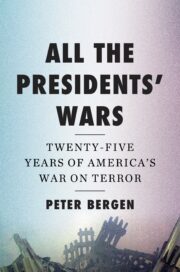
All the Presidents’ Wars:
RECENT ARTICLES

UPCOMING EVENTS
Wednesday, September, 09, 2026
GLOBAL SUMMIT ON TERRORISM AND POLITICAL VIOLENCE, NYC
Thursday, September, 10, 2026
Denver, CELL
Friday, September, 11, 2026
Duke University
Tuesday, September, 15, 2026
Lessons Learned: America’s Post-9/11 Wars, New America DC
Thursday, September, 17, 2026
Georgetown University
Tuesday, September, 22, 2026
International Spy Museum, DC. All the Presidents’ Wars, book event
Thursday, September, 24, 2026
Monterey World Affairs Council, Monterey, CA
Sunday, September, 27, 2026
ALL THE PRESIDENTS’ WARS: TWENTY-FIVE YEARS OF AMERICA’S WAR ON TERROR — AT CONN AVE, Politics & Prose, DC
Wednesday, September, 30, 2026
Gerald Ford School of Public Policy, “25 Years After 9/11: Reflections on the US War on Terror”, U. Michigan, Ann Arbor, MI
Thursday, October, 01, 2026
Arizona State Univ. , Tempe AZ
Monday, October, 05, 2026
Opal Group, DC
Thursday, October, 08, 2026
World Affairs Council of Connecticut, online 7p ET
Tuesday, October, 13, 2026
Arms Control book event, Amy Nelson, New America, DC
Monday, October, 19, 2026
Doha Security Forum, Qatar
Friday, November, 06, 2026
“American Valor,” Omni Shoreham, DC
RECENT FILM AND TV SERIES
GHOSTS OF BEIRUT: SHOWTIME
The Fall of Osama bin Laden, National Geographic
BIN LADEN'S HARD DRIVE, NATIONAL GEOGRAPHIC

