Did Robert O’Neill really kill bin Laden? CNN.com
Did Robert O’Neill really kill bin Laden?
By Peter Bergen
updated 6:24 PM EST, Tue November 4, 2014
Watch this video
Navy SEAL says he’s bin Laden’s shooter
STORY HIGHLIGHTS
Three years after Osama bin Laden’s death, Robert O’Neill says he was the one who killed him
Peter Bergen says the killing was a team effort and there is some dispute over what happened
Bergen: Other SEALs have raised questions about the account given by O’Neill
Editor’s note: Peter Bergen is CNN’s national security analyst, a vice president at New America and professor of practice at Arizona State University. He is the author of “Manhunt: The Ten-Year Search for bin Laden — From 9/11 to Abbottabad.” An earlier version of this article appeared in March 2013.
(CNN) — Former Navy SEAL Robert O’Neill said in an interview with The Washington Post that he was the one who fired the final shot to kill Osama bin Laden in 2011.
Two Special Operations sources confirmed to me that O’Neill was one of the shooters in bin Laden’s room.
But did he really kill bin Laden? And, ultimately, does it even really matter who shot bin Laden since the SEAL raid in Abbottabad, Pakistan was so clearly a team effort.
O’Neill has told his story before in a lengthy profile in Esquire in 2013 in which O’Neill was described not with his real name but only as “the Shooter.”
In the Esquire piece, O’Neill/The Shooter was said to have encountered al Qaeda’s leader face-to-face in the top-floor bedroom of the compound in Abbottabad where he’d been hiding for more than five years.
The Shooter said the al Qaeda leader was standing up and had a gun “within reach,” and it was only then that the Shooter fired two shots into bin Laden’s forehead, killing him. That account was in conflict with the narrative from another raid participant in a wildly successful book, “No Easy Day.”
Another member of the secretive SEAL Team 6, which executed the bin Laden raid, told CNN the story of the Shooter as presented in Esquire is false. According to this serving SEAL Team 6 operator, the story is “complete BS.”
Twenty-three SEALs and their interpreter launched the assault on the bin Laden compound just after midnight on the morning of May 2, 2011. They shot and killed bin Laden’s two bodyguards, one of bin Laden’s sons and the wife of one of the bodyguards. They also wounded two other women.
Will the Bin Laden shooter step forward? SEAL from Bin Laden raid faces probe
The first three SEALs to make it to the top floor of the compound were “the point man,” “the Shooter” profiled by Esquire, and Matt Bissonnette, the SEAL who wrote “No Easy Day” under the pseudonym Mark Owen.
What actually happened the night of the raid, according to the SEAL Team 6 operator who I interviewed, is that the “point man” ran up the stairs to the top floor and shot bin Laden in the head when he saw what looked like bin Laden poking his head out of his bedroom door. The shot gravely wounded al Qaeda’s leader.
Having taken down bin Laden, the point man proceeded to rush two women he found in the bedroom, gathering them in his arms to absorb the explosion in case they were wearing suicide vests, something that was a real concern of those who planned the raid.
Two more SEALs then entered bin Laden’s bedroom and, seeing that he was lying mortally wounded on the floor, finished him off with shots to the chest.
This account of bin Laden’s demise is considerably less heroic than the Shooter’s version in Esquire, in which he says he shot bin Laden while he was standing up and only after he saw that the al Qaeda leader had a gun within reach.
The SEAL Team 6 operator who spoke to me says there is no way the Shooter could have seen a gun in bin Laden’s reach because the two guns that were found in the bedroom after the shooting were only discovered after a thorough search and were sitting on a high shelf above the frame of the door that opened to the room.
The SEAL operator also points out there was a discussion before the raid in which the assault team was told “don’t shoot the guy (bin Laden) in the face unless you have to” because the CIA would need to analyze good pictures of bin Laden’s face for its facial recognition experts to work effectively. Yet the Shooter in the Esquire story says he shot bin Laden on purpose twice in the forehead.
A U.S. official familiar with the details of the raid said the SEAL Team 6 operator’s version is in line with what happened. That account “has it right in my view,” the official said.
The SEAL Team 6 operator also tells CNN that the Shooter was “thrown off” the Red Squadron, the core of the SEAL Team 6 group that carried out the bin Laden raid, because he was bragging about his role in the raid in bars around Virginia Beach, Virginia, where SEAL Team 6 is based. In the Esquire article, the Shooter complains he is receiving no pension, since he left the military four years before the minimum 20 years required to be eligible.
After the article appeared, CNN spoke with Phil Bronstein, the Esquire writer who says he passed along CNN’s written questions about the Shooter’s role in the raid to his story’s main character. The Shooter did not respond to those questions.
Stephanie Tuck, a spokeswoman for Esquire, said via email the magazine stood by its story.
“The Esquire article, ‘The Shooter: The Man Who Killed Osama Bin Laden,’ in the March 2013 issue, is based on information from numerous sources, including members of SEAL Team 6 and the Shooter himself, as well as detailed descriptions of mission debriefs.”
According to present and former members of SEAL Team 6, the “point man” who fired the shot that likely mortally wounded bin Laden will never “in a million years” speak publicly about his role in the raid, and they lauded his courageous decision to throw himself on the two women in bin Laden’s room.
The new account of the bin Laden raid provided by the serving SEAL Team 6 operator is essentially the same as in Bissonnette’s “No Easy Day.” Bissonnette says he was one of the first to run into the bedroom and he saw that the point man’s shots had mortally wounded bin Laden. Bissonnette says he then shot the dying al Qaeda leader as he lay on the floor.
Present and former members of SEAL Team 6 say they regard Bissonnette as more credible than the Shooter.
Balanced against that, according to a story filed by CNN’s Barbara Starr last year after the publication of “No Easy Day,” the head of U.S. special operations, Adm. William McRaven, contacted members of the Navy SEAL team that killed bin Laden. According to Pentagon officials, the SEALs said bin Laden was standing in his bedroom when he was shot, and they believed that he posed a threat because there were weapons in the room. This account tends to bolster the story the Shooter told Esquire.
In a previous CNN.com story about the Esquire profile, I noted that I was the only outside observer allowed to tour bin Laden’s Abbottabad compound before it was demolished in late February 2012.
During that tour, I looked around the bedroom where bin Laden was killed. The Pakistani military officers who were guiding me pointed out a patch of dark, dried blood on the low ceiling of bin Laden’s bedroom.
This patch of congealed blood seems to be consistent with the Shooter’s story that he fired two shots at the forehead of a “surprisingly tall terrorist” while he was standing up. At the time, the precise location of bin Laden when he was shot was not a matter of dispute.
But the blood patch could also be consistent with the account that it was the “point man” who first shot bin Laden. The point man is 5 feet 6 inches tall and was shooting upward at a tall man as he poked his head out of his bedroom.
The compound is, of course, now gone, so it is no longer possible to reconstruct what happened the night of the raid based on forensic evidence.
Finally, by all accounts, it was a confusing situation the night of the raid. One of the SEAL team’s helicopters had crashed, and there was a firefight with one of bin Laden’s bodyguards. All the electricity in the compound and the surrounding neighborhood was off on a moonless night and the SEALs were wearing night vision goggles, which only allowed them limited vision.
What seems incontrovertible is that the point man, the Shooter and Bissonnette were the first three SEALs to assault bin Laden’s bedroom. But to determine exactly which of them killed him might never be possible.
What is certain is that it was a team effort.
Five days after the bin Laden raid, members of the SEAL team who carried out the mission briefed President Barack Obama.
According to those in the room, the SEAL team commander explained to the President, “If you took one person out of the puzzle, we wouldn’t have the competence to do the job we did; everybody’s vital. It’s not about the guy who pulled the trigger to kill bin Laden, it’s about what we all did together.”
First line of defense against terrorism: Mom and Dad, CNN.com
First line of defense against terrorism: Mom and Dad
By Peter Bergen and David Sterman
updated 5:03 PM EDT, Wed October 29, 2014
 A Syrian refugee wraps herself in a blanket as she stands near tents in the Suruc district near Sanliurfa, Turkey, on Thursday, October 2. As many as 200,000 people have left the area surrounding the Syrian city of Kobani, also known as Ayn al-Arab, because of the militant group ISIS, the Syrian Observatory for Human Rights said in September.
STORY HIGHLIGHTS
- 3 Colorado girls are intercepted on their way to the Middle East, allegedly to join ISIS
- Their families alerted authorities, who were able to find them in Frankfurt airport
- Peter Bergen: Families often spot signs of radicalization and alert officials
- More terrorism plots disrupted by families than by controversial NSA surveillance
Editor’s note: Peter Bergen is CNN’s national security analyst, a vice president at New America and professor of practice at Arizona State University. He is the author of “Manhunt: The Ten-Year Search for bin Laden — From 9/11 to Abbottabad.” David Sterman is a research associate at New America.
(CNN) — Last week, three teenage girls from Denver were alleged to have tried to join ISIS.
The girls were stopped by FBI officials as they transited Frankfurt airport in Germany and were sent back to Colorado.
The key lead in this case wasn’t high-tech surveillance by the National Security Agency or a tip by a government informant, but a tip to the FBI by the girls’ worried families.
Assad Ibrahim, the Sudanese-American father of one of the girls, received a call from his daughter’s Denver school telling him she was missing. When he tried calling her, she did not pick up.
Ibrahim went to the father of the other two girls to check whether their passports were missing. They were.
The families then went to the FBI, which intercepted the girls at the Frankfurt airport.
The key role that families play in preventing violent extremism is often overlooked in favor of focusing on more exotic counterterrorism measures such as the National Security Agency’s surveillance programs or the use of paid informants.
In fact, a survey by the New America Foundation of 251 jihadist terrorism cases in the United States since 9/11 found that almost a third of the individuals accused of engaging in some kind of terrorist crime have been implicated by a tip from a family member or a member of the Muslim-American community.
By contrast, only a little more than 1% of these cases was generated by one of the NSA’s most controversial surveillance programs, in which the agency collected every American’s phone data for several years.
Families are often critical in stopping radicalizing individuals from stepping over the edge into militant activity. Take Adam Dandach, a 20-year-old Orange County man who was charged in July with committing passport fraud in an effort to join ISIS. His mother hid his passport so he could not leave the country.
When more than 20 Somali-Americans left from Minnesota after 2007 to fight for the al Qaeda affiliated Al Shabaab group in Somalia, family and community members played critical roles in the ensuing FBI investigation.
After Abdirizak Bihi’s nephew, Burhan Hassan, left to fight for Al Shabaab in Somalia in November 2008, Bihi worked to organize community cooperation with the government’s investigation.
As Ralph Boelter, who oversaw the FBI’s investigation, put it in 2009 when the Justice Department unsealed charges against eight men accused of supporting Al Shabaab, “It is through the sustained and dedicated efforts of the Minneapolis Joint Terrorism Task Force and the support of the Somali-American community that today we are able to disclose some of the significant progress we have achieved in this critical investigation.”.
Families are not a panacea. Sometimes family members intervene with a radicalizing individual, but the intervention doesn’t work.
Shannon Conley, a 19-year-old Colorado woman, pleaded guilty in September to conspiring to provide material support to ISIS. Her family sought to dissuade her from seeking to join jihadists in Syria, but their efforts failed and she was arrested on April 8 at Denver International Airport on her way to Syria.
Samir Khan traveled to Yemen from Charlotte, North Carolina, in 2009 where he became the editor of al Qaeda in the Arabian Peninsula’s Inspire magazine despite several attempts by his family members and elders from the local Muslim-American community to dissuade him from his militant views.
Two years later Khan was killed in a U.S. drone strike in Yemen.
Sometimes a family will warn U.S. authorities about a radicalizing child, but the warning isn’t sufficiently followed up on. The Nigerian “underwear bomber,” Umar Farouk Abdulmutallab, tried to blow up a bomb secreted in his underwear over Detroit on Christmas Day 2009. Luckily the bomb failed to detonate.
A month earlier, Abdulmuttalab’s father had gone to the U.S. Embassy in Abuja, Nigeria, and told State Department officials there that he believed his son was meeting with extremists in Yemen. The U.S. Embassy in Nigeria issued a warning to the U.S. National Counterterrorism Center, but Abdulmuttalab was not put on the “no fly” list and the center’s analysts did not make an effort to determine if Abdulmuttalab possessed a valid U.S. visa.
Families are often, of course, the first to notice if a son or daughter is radicalizing and are a key bulwark against extremism. Why and how some people radicalize is a subject that is complex, but one indicator is usually unambiguous and that is that radicalizing individuals will often spend a great deal of time on jihadist websites or consuming jihadist social media.
Many parents don’t have much of a clue about what is happening online, but a common sense approach if they suspect their son or daughter is radicalizing is to get a better handle on their children’s social media use and profile.
Read CNNOpinion’s new Flipboard magazine.
Follow us on Twitter @CNNOpinion.
Join us on Facebook/CNNOpinion.
What we learn from ISIS’ online magazine, CNN.com
What we learn from ISIS’ online magazine
By Peter Bergen and Emily Schneider
updated 8:28 AM EDT, Mon October 20, 2014
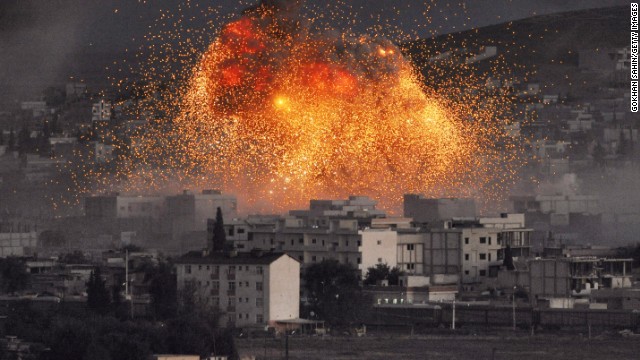 An explosion rocks Kobani, Syria, during a reported car-bomb attack by ISIS militants on Monday, October 20. Civil war has destabilized Syria and created an opening for the militant group, which is also advancing in Iraq as it seeks to create an Islamic caliphate in the region.
STORY HIGHLIGHTS
- ISIS has published four issues of online magazine detailing its aims
- Peter Bergen says the group is stressing its territorial ambitions and sectarian approach
- Unlike al Qaeda, which recruits terrorists vs. the West, ISIS wants to be a state, he says
- Bergen: ISIS is focused on sustaining and extending its insurgencies in Syria and Iraq
Editor’s note: Peter Bergen is CNN’s national security analyst, a vice president at New America and professor of practice at Arizona State University. He is the author of “Manhunt: The Ten-Year Search for bin Laden — From 9/11 to Abbottabad.” Emily Schneider is a research associate at New America.
(CNN) — ISIS is looking to take over a good chunk of the Middle East — if not the entire Muslim world. At least, that’s the message the terrorist movement is sending in its English online magazine, Dabiq.
In Dabiq’s first issue, which debuted in early July, the magazine declared that a “new era has arrived” for Muslims. Photographs in the webzine of ISIS militants in American armored vehicles rolling through Iraq seemed to buttress that claim.
Graphic photos of dead soldiers from Iraqi forces litter the pages of each of the issues of Dabiq, and articles detail skirmishes across Iraq and Syria.
Each issue of the magazine — there have been four so far, appearing at roughly monthly intervals — starts with a foreword that contains an inspirational message for readers, before diving into longer pieces that extol the virtues of ISIS and provide updates on the group’s military campaign. ISIS members fervently believe that they have established a true “caliphate” in the areas that they control, a supposed distant echo of the perfect Islamic rule of the Prophet Mohammed and his immediate successors in the seventh century.
Overall, the magazine is quite religious in tone. Excerpts from rulings by Muslim scholars are included in every issue, as are religious rationales for the actions of ISIS.
In the most recent issue, an ISIS writer reasoned that capturing women from the Yazidis, an Iraqi minority group, to use as sex slaves was acceptable under ISIS’ version of Sharia law, since the Yazidis are polytheists, a great heresy in Islam. Showing some convoluted logic, the ISIS writer also asserted that enslaving Yazidi women is a good way to stop adultery, since a man having sex with a concubine is legal under ISIS’ interpretation of Islamic law, but sexual relations outside of marriage with free women are forbidden.
The magazines are also, unsurprisingly, highly sectarian, repeatedly showing images of Shia shrines and tombs that have been blown up by ISIS, a organization made up of members of the Sunni sect. ISIS believes these sites to be idolatrous. Iraqi Army soldiers — who are generally Shia — are referred to as “apostates” and graphic photos of their executions by ISIS fighters are a staple of the magazine.
Other articles aim to reassure readers that ISIS, which in June renamed itself the Islamic State, is an actual state that provides social services and reconstructs critical infrastructure. The magazine asserts that administrators govern towns after the main ISIS fighting force moves on and the most recent issue of Dabiq includes photos with captions showing “services for Muslims,” including street cleaning, electricity repairs, care homes for the elderly and cancer treatment centers for children.
The first issue of Dabiq even had a sort of classified ad for “all Muslim doctors, engineers, scholars, and specialists” to come and join ISIS.
The most recent installment of Dabiq asserts that two new wilayat, or provinces, had been established in the region where the Syrian-Iraqi border had once been. The magazine describes the new provinces as a successful step in “eliminating any remaining traces of the kufri, nationalistic borders.” Pictures of a military parade celebrating the announcement accompany the article, along with pictures of a well-staffed checkpoint, a bustling marketplace, and ISIS police patrolling the area.
In many ways Dabiq is not a new phenomenon. Osama bin Laden’s Service Office during the 1980s Afghan war against the Soviets produced a similar magazine, Jihad, which was widely available around the Muslim world, was translated into many languages and was principally a fund-raising and recruiting tool designed to encourage young Muslim men to travel to Afghanistan and neighboring Pakistan to support the Afghan jihad.
More recently, al Qaeda in the Arabian Peninsula from its headquarters in Yemen has been publishing Inspire, another well-produced online magazine. Inspire, published for the past four years, clearly served as something of a model for Dabiq. Both are well laid out and feature graphics and photos prominently.
The Dabiq feature titled “In the Words of the Enemy,” where a helpful quote from an official or analyst from the West is included, is a direct copy of an Inspire feature. Dabiq’s most recent issue features a portion of U.S. Secretary of Defense Chuck Hagel’s testimony before the Senate Armed Services Committee in which he discussed how much of a threat ISIS is to the United States.
But the two webzines share few similarities beyond that. Inspire was very much focused on recruiting lone-wolf jihadists and inspiring homegrown extremism in the West, but Dabiq includes only a few vague sentences about carrying out attacks in the West.
Where Inspire included instructions on bomb-making and building weapons to carry our attacks in the West, Dabiq focuses almost entirely on the actions of ISIS in Iraq and Syria and encourages followers to join the jihad there. In the third issue of Dabiq an ISIS writer asserts, “This life of jihad is not possible until you pack and move to the Khilafah,” meaning to leave your home and travel to ISIS’ areas of control in Iraq and Syria.
The purpose of the Dabiq webzine is quite different from Inspire: It is to encourage and perpetuate ISIS’ successful insurgencies in Iraq and Syria, not to foster homegrown extremism or lone-wolf attacks in the West.
That’s about the only good news that one can glean from Dabiq.
Islamophobia, Extremism, and the Domestic War on Terror : A discussion with Arun Kundnani on his new book The Muslims are Coming! at New America DC
Islamophobia, Extremism, and the Domestic War on Terror : A discussion with Arun Kundnani on his new book The Muslims are Coming!
Tuesday, October 28, 2014
12:15 pm – 1:45 pm
RSVP
Map it

In The Muslims Are Coming!: Islamophobia, Extremism, and the Domestic War on Terror, Arun Kundnani notes that the new front in the War on Terror is the homegrown enemy, domestic terrorists who have become the focus of sprawling counterterrorism structures in the United States and across Europe. Domestic surveillance by police forces and government agencies has mushroomed— at least 100,000 Muslims in America have been secretly under scrutiny. In Britain, police officers compiled a secret suspect list of more than 8,000 al-Qaeda “sympathizers,” and almost 300 children aged fifteen and younger were among the potential extremists investigated.
While the revelations by former National Security Agency contractor Edward Snowden have caused some to question the rise, even the legality, of these national surveillance states, Western governments continue to focus on the threats posed by homegrown extremists, particularly as the Islamic State attracts foreign fighters from around the world
Based on several years of research and reportage, in locations as disparate as Texas, New York, and Yorkshire, and written in engrossing, precise prose, Kundnani’s The Muslims Are Coming! is the first comprehensive critique of Western counter-radicalization strategies. He notes that the new policies and policing campaigns have been backed by an industry of freshly-minted experts and liberal commentators, and looks at the way these debates have been transformed by the embrace of a narrowly-configured and ill-conceived anti-extremism stance.
The New America Foundation is pleased to welcome Mr. Kundnani for a discussion about his book, his findings, and the impact the War on Terror has had on its targets.
Join the conversation online using #IslamophobiaTalk and following @NewAmerica.
Participants
Arun Kundnani
Author, The Muslims Are Coming!: Islamophobia, Extremism, and the Domestic War on Terror
@ArunKundnani
Peter Bergen
Director, International Security Program, New America
Modern War in Theory and Practice : A discussion with Dr. John Nagl of his new book Knife Fights at New America, DC.
MODERN WAR IN THEORY AND PRACTICE
A discussion with Dr. John Nagl on his new book Knife Fights
Modern War in Theory and Practice : A discussion with Dr. John Nagl on his new book Knife Fights
Monday, October 27, 2014
1:15 pm – 2:45 pm
RSVP
Map it

Knife Fights: A Memoir of Modern War in Theory and Practice by Dr. John Nagl, a retired Lieutenant Colonel in the U.S. Army and a former president of the Center for a New American Security, is a profound education in 21st Century warfare – its theory, its practice, and the often-tortured relationship between the two.
As an army tank commander in the first Gulf War, fresh out of West Point and Oxford, Dr. Nagl could already see that America’s military superiority meant that the age of conventional combat was nearing an end. He was an early convert to the view that America’s greatest future threats would come from asymmetric warfare – guerrillas, terrorists, and insurgents – and wrote Learning to Eat Soup with a Knife, a book that eventually became the bible of the counterinsurgency movement. Nagl argued it was necessary for the U.S. Army to understand the nature of the insurgency, but also to be more flexible in its response, adjusting its strategy to properly deal with the threat.
While Dr. Nagl worked with Gen. David Petraeus on rewriting core army doctrine in the middle of two wars, helping their new ideas win acceptance in one of the planet’s most conservative bureaucracies, he has not been blind to the cost or consequences of counterinsurgency, noting that in war, there are only bad choices; the question is really which ones are better and which ones are worse.
The New America Foundation is pleased to welcome Dr. Nagl for a discussion about his book, his work on the United States’ counterinsurgency efforts, and the revolution in modern warfare that he helped lead.
Join the conversation online using #knifefights and following @NewAmerica.
Participants
Dr. John Nagl
Lieutenant Colonel, U.S. Army (retired)
Author, Knife Fights: A Memoir of Modern War in Theory and Practice
Headmaster, The Haverford School
Daniel R. Green
Defense Fellow, The Washington Institute for Near East Policy
Peter Bergen
Director, International Security Program, New America
What lures Americans to Syria fight, CNN.com
What lures Americans to Syria fight
By Peter Bergen and David Sterman
updated 7:25 AM EDT, Tue October 14, 2014
A Syrian refugee wraps herself in a blanket as she stands near tents in the Suruc district near Sanliurfa, Turkey, on Thursday, October 2. As many as 200,000 people have left the area surrounding the Syrian city of Kobani, also known as Ayn al-Arab, because of the militant group ISIS, the Syrian Observatory for Human Rights said in September.
STORY HIGHLIGHTS
- 12 Americans have been charged with supporting militant groups in Syria or have died there
- Peter Bergen: They are young, mostly not college grads, likely to have traveled through Turkey
- None is of Syrian descent; they represent a wide mix of ethnic backgrounds, he says
- Bergen: All but two of the 12 were active on jihadi social media
Editor’s note: Peter Bergen is CNN’s national security analyst, a vice president at New America and Professor of Practice at Arizona State University. He is the author of “Manhunt: The Ten-Year Search for bin Laden — From 9/11 to Abbottabad.” David Sterman is a research associate at New America.
(CNN) — Over the past two years, 12 Americans have been charged with supporting militant groups fighting in Syria or have died while fighting with such groups.
Who are they? Of the dozen Americans drawn to fight with ISIS or the al Qaeda affiliated Nusra Front, a profile does appear to be emerging: They are young, typically high school graduates and college students, who are self-recruited online by what they view as exciting video propaganda pouring out of ISIS and Nusra, and they seek to reach the Syrian battlefields by traveling via Turkey.
The dozen Americans are a rainbow of ethnicities; of South Asian, East Asian, Caucasian, Middle Eastern and African-American descent, according to a survey by New America.
For example, Sinh Vinh Ngo Nguyen, a 24-year-old man of Vietnamese descent from California, pleaded guilty last year to attempting to provide material support to a terrorist organization. In the plea agreement, he admitted that he had fought in Syria.
None of the dozen appears to be of Syrian descent.
This is in contrast to the some 30 Americans who were drawn to fight in Somalia from 2007 onward alongside the al Qaeda affiliated Al-Shabaab group. They were largely of Somali descent and were overwhelmingly from Minnesota, where there is a large Somali-American population.
The 12 American militants drawn to the Syrian conflict come from a wide range of states: California, Colorado, Florida, Illinois, Minnesota, New York, North Carolina and Texas.
They are also generally young with an average age of 24. Three teenagers are among those charged:
— Shannon Conley, a 19-year old California womanpleaded guilty last month to attempting to join ISIS.
— Mohammed Hamza Khan, a 19-year-old Illinois manarrested this month, allegedly sought to join ISIS. He is awaiting trial.
— Abdella Tounisi from Chicago was 18 when he wascharged last year with seeking to support Nusra in Syria. He is on trial.
The Americans seeking to fight in Syria are not a particularly educated group. For the nine of the 12 individuals for whom educational attainment is known, none graduated from college.
Perhaps critically, all but two of the 12 were active on jihadi social media. ISIS in particular has made a determined effort to recruit Western fighters over social media, for example releasing a 55-minute English languagepropaganda and recruitment video on Twitter last month.
The heavy social media use of individuals traveling to Syria is something of a boon for American security services. The social media use of Douglas McCain, a 33-year-old man from Minnesota, who died fighting with ISIS in August, reportedly landed him on a terrorist watch list and helped the United States track him.
Once individuals are radicalized and are convinced to join ISIS or Nusra, they often decide to travel to Syria through Turkey.
— Moner Abu Salha, a 22-year-old from Florida, explained how he traveled to Turkey and met up with jihadist facilitators there in a propaganda video that was released in August after he died conducting a suicide bombing in Syria.
— Douglas McCain also traveled through Turkey earlier this year.
— Adam Dandach, a 20-year-old from Orange County, California, was arrested in July for passport fraud en route to Turkey allegedly to join ISIS. He is on trial.
— Mohammed Hamza Khan purchased tickets to travel to Turkey via Austria according to the complaint filed in his case.
The importance of the Turkish route into Syria likely provides the key to reduce the number of Americans traveling to fight in Syria. For example, look at the case of Donald Morgan, a 44-year-old from North Carolina, who sought to travel to fight in Syria but has not been charged with a terrorism-related crime. He was turned back at Istanbul Airport by Turkish authorities this summer.
There are reports that Turkey may be stepping up its efforts to close the routes that allow foreigners to reach the Syrian conflict and join jihadist groups. We can only hope that is the case.
U.S. law enforcement has also made a determined effort to track Americans engaged in the Syrian conflict. Seven of the 12 individuals charged in the past two years were monitored closely by an FBI informant. Even in the case of Moner Abu Salha, who returned from training in Syria to the States in May 2013, a tip to the FBI from a friend he tried to recruit when he was back in the States placed him on the FBI’s radar.
Still there are limits to that tracking.
FBI Director James Comey was asked by the CBS show “60 Minutes” earlier this month whether he knew the identity of the dozen or so Americans believed to be fighting in Syria.
Comey said, “I think of that, dozen or so, I do. I hesitate only because I don’t know what I don’t know.”
Future of War Conference, New America-Arizona State, Washington DC
First Annual Conference
February 24-25, 2015
Ronald Reagan Building and International Trade Center
1300 Pennsylvania Avenue NW
Washington, DC
Co-Sponsored by
Arizona State University’s Center on the Future of War
and
New America
The First Annual Future of War Conference brings together a diverse, interdisciplinary collection of experts to discuss the profound social, political, economic, and cultural implications of the changing nature of war and conflict. The theme of the event is “How is Warfare Changing?,” which we explore through a consideration of three sub-themes: “How Are Emerging Technologies and Strategies Redefining the Practice of War?;” “Are We Living in a Forever War?;” and “Can We Better Understand How Warfare is Evolving by Reflecting on History?” The conference also launches the Future of War Project, which links New America, a DC-based think tank and civic engagement enterprise, and Arizona State University, one of the nation’s largest and most innovative public research universities.
CNN is the leading media partner for the conference and will live-stream panels on CNN.com. DefenseOne will also be a media partner for this event.
Confirmed presenters and moderators include current and former policymakers from multiple U.S. government agencies, members of the military, journalists, scholars, and international affairs experts.
GOVERNMENT
- Sen. John McCain – U.S. Senator, Arizona; Chairman, Senate Armed Service Committee.
- The Honorable Suzanne Spaulding – Under Secretary, National Protection and Programs Directorate, U.S. Department of Homeland Security.
- The Honorable Tom Malinowski – Assistant Secretary, Bureau of Democracy, Human Rights, and Labor, U.S. Department of State.
- Dr. Arati Prabhakar – Director, Defense Advanced Research Projects Agency.
- The Honorable Michèle Flournoy – Co-Founder and CEO, Center for a New America Security; Former Under Secretary of Defense for Policy, U.S. Department of Defense.
- The Honorable Sharon Burke – Senior Advisor, New America; Former Assistant Secretary of Defense for Operational Energy Plans and Programs, U.S. Department of Defense.
- Dr. Janine Davidson – Senior Fellow for Defense Policy, Council on Foreign Relations; Former Deputy Assistant Secretary of Defense for Plans, U.S. Department of Defense.
- Bay Fang – Senior Fellow, International Security Program, New America; Former Deputy Assistant Secretary of State for European and Eurasian Affairs, U.S. Department of State.
- Dr. Anne-Marie Slaughter – President and CEO, New America; Former Director of Policy Planning for the U.S. Department of State.
- The Honorable Harold Koh – Sterling Professor of International Law, Yale Law School; Former Legal Advisor, U.S. Department of State.
- Anish Goel – Senior South Asia Fellow, International Security Program, New America; Former Senior Director for South Asia, National Security Council.
- Shamila Chaudhary – Senior South Asia Fellow, New America; Former Director for Afghanistan and Pakistan, National Security Council.
- Dr. Douglas Ollivant – Partner, Mantid International; ASU Future of War Senior Fellow, New America; Former Director for Iraq, National Security Council.
- Emma Sky – Senior Fellow, Jackson Institute for Global Affairs, Yale University; Former High Level Advisor in Iraq for the U.S. and U.K. Governments.
MILITARY
- Gen. Raymond Odierno –Chief of Staff, U.S. Army.
- Adm. Michelle J. Howard – Vice Chief of Naval Operations, U.S. Navy.
- Lt. Gen. H.R. McMaster – Commanding General, U.S. Army Training and Doctrine Command.
- Vice Adm. (ret.) Ann Rondeau – Former President, National Defense University.
- Maj. Gen. Najim Abed al-Jabouri – Former Mayor, Tal Afar, Iraq; Distinguished Research Fellow, Near East South Asia Center for Strategic Studies, National Defense University.
- Maj. Gen. (ret.) Charles Dunlap – Professor of the Practice of Law; Executive Director, Center on Law, Ethics and National Security, Duke University.
- Col. (ret.) Ioannis Koskinas – CEO, Hoplite Group; Senior Fellow, International Security Program, New America; Retired U.S. Air Force Officer, Special Operations.
- Dr. David Kilcullen – ASU Future of War Senior Fellow, New America; Author, The Accidental Guerilla; Former Senior Advisor on Counterinsurgency to former Secretary of State Condoleezza Rice and Gen. David Petraeus.
- Chris Fussell – Partner, McChrystal Group; Senior Fellow, New America; Navy SEAL Lt. Commander (Reserves).
- Dave Silverman – Co-Founder and CEO, McChrystal Group; Former Navy SEAL Officer.
- Midshipman Zane Markel – Midshipman, Center for Cyber Security Studies, U.S. Naval Academy.
MEDIA
- Kevin Baron – Executive Editor, DefenseOne.
- Wolf Blitzer – Anchor, The Situation Room, CNN.
- Gordon Lubold – Senior Military Writer, DefenseOne.
- Thomas E. Ricks – Senior Advisor for National Security, New America; Contributing Editor, Foreign Policy; Author, The Generals: American Military Command from World War II to Today.
- Jim Sciutto – Chief National Security Correspondent, CNN.
- Barbara Starr – Pentagon Correspondent, CNN.
- Jake Tapper – Chief Washington Correspondent; Anchor, The Lead, CNN.
ACADEMIA
- Dr. Brad Allenby – Lincoln Professor of Engineering and Ethics, Ira A. Fulton Schools of Engineering; Affiliated Faculty, Center on the Future of War, Arizona State University.
- William Banks – Distinguished Professor of Law; Director, Institute for National Security and Counterterrorism, Syracuse University.
- Dr. Gaymon Bennett – Assistant Professor of Religion, Science, and Technology, Arizona State University.
- Nadya Bliss – Co-Director, Security and Defense Systems Initiative, Arizona State University.
- Dr. Philip Bobbitt – Herbert Wechsler Professor of Federal Jurisprudence; Director, Center for National Security Law; Columbia Law School; Author, The Shield of Achilles and Terror and Consent: The Wars for the 21st Century.
- Rosa Brooks – Senior Fellow, International Security Program, New America; Professor, Georgetown University Law Center.
- Dr. Michael Crow – President, Arizona State University.
- Dr. Mary (Missy) Cummings – Associate Professor, Duke University; Director, Humans and Automation Laboratory, Massachusetts Institute of Technology; Former U.S. Navy Fighter Pilot.
- Dr. Werner Dahm – Chief Scientist, Security and Defense Systems Initiative, Arizona State University; Former Chief Scientist, U.S. Air Force; ASU Foundation Professor; Professor Emeritus, University of Michigan.
- Laura A. Dickinson – ASU Future of War Fellow, New America; Oswald Symister Colclough Research Professor of Law, George Washington Law School.
- Sir Lawrence Freedman – Professor of War Studies, King’s College London; Author, Strategy: A History.
- Dr. David Gartner – Co-Director, Center for Law and Global Affairs, Arizona State University.
- Dr. Ryan Goodman – Anne and Joel Ehrenkranz Professor of Law, New York University School of Law; Editor-in-Chief, Just Security Blog.
- Dr. Karen Greenberg – Director, Center on National Security, Fordham University School of Law.
- Orde Kittrie – Professor of Law, Sandra Day O’Connor College of Law, Arizona State University; Visiting Scholar, School of Advanced International Studies, Johns Hopkins University.
- Dr. Gary Marchant – Lincoln Professor of Emerging Technologies, Law, and Ethics; Faculty Director of the Center for Law, Science, and Innovation, Arizona State University.
- Dr. Oriana Mastro – Assistant Professor of Security Studies, Edmund A. Walsh School of Foreign Service at Georgetown University; Officer, U.S. Air Force Reserves.
- Naz Modirzadeh – Founding Director, Program on International Law and Armed Conflict, Harvard Law School.
- Dr. Ian Morris – Professor of Classics and Professor of History, Stanford University; Author, Why the West Rules – for Now: The Patterns of History, and What They Reveal About the Future.
- Dr. Steven Pinker – Professor, Department of Psychology, Harvard University; Author, The Better Angels of Our Nature: Why Violence Has Declined.
- Dr. George Poste – Chief Scientist, Complex Adaptive Systems Initiative, Regents’ Professor and Del E. Webb Chair in Health Innovation, Arizona State University.
- Daniel Rothenberg – Fellow, New America; Professor of Practice, Arizona State University; Co-Director, Future of War Program.
- Dr. Sheldon Simon – Director, Center for Asian Studies, Arizona State University.
THINK TANKS
- Peter Bergen – Vice President, Director of Studies, New America; Professor of Practice, Arizona State University; Co-Director, Future of War Project.
- Alan Davidson – Vice President, Open Technology Institute, New America.
- Michael Lind – ASU Future of War Fellow; Co-Founder, New America.
- Dr. Peter W. Singer – Strategist and Senior Fellow, New America; Author, Ghost Fleet: A Novel of the Next World War (forthcoming).
Drones and Aerial Observation, New America DC
Drones and Aerial Observation
New Technologies for Property Rights, Human Rights, and Global Development
Wednesday, July 22, 2015
08:00 AM – 02:45 PM
1899 L Street NW
Washington, DC 20036
RSVP
Clear and secure rights to property—land, natural resources, and other goods and assets—are crucial to human prosperity. Most of the world’s population lacks such rights. That lack is in part a consequence of political and social breakdowns, and in part driven by informational deficits. Unmanned Aerial Vehicles (UAVs), also known as drones, by virtue of their aerial perspective, are able to gather large amounts of information cheaply and efficiently, as can unpowered aerial platforms like kites and balloons.
That information, in the form of images, maps, and other environmental data, can be used by communities to improve the quality and character of their property rights. These same tools are also useful in other, related aspects of global development. Drone surveillance can help conservationists to protect endangered wildlife and aid scientists in understanding the changing climate; drone imagery can be used by advocates and analysts to document and deter human rights violations; UAVs can be used by first responders to search for lost people or to evaluate the extent of damage after natural disasters like earthquakes or hurricanes.
Earlier this year, New America launched a website, drones.newamerica.org, which comprises a database of such uses of drones, as well as the first comprehensive compilation of global drone regulations. In conjunction with this July 22nd Symposium, New America is publishing a primer that discusses the capabilities and limitations of unmanned aerial vehicles in advancing property rights, human rights and development more broadly. The primer contains both nuts-and-bolts advice to drone operators and policy guidance. Though drones have substantial potential—in particular they are capable of making new maps cheaply, in a decentralized fashion—they are also a technology with pitfalls.
Please join Anne-Marie Slaughter, New America’s president and CEO, for a half-day discussion of these important issues. Breakfast and lunch will be served.
This program is made possible by the support of Omidyar Network and Humanity United.
Follow the discussion online using #NewAmericaDrones and following @NatSecNAF.
Agenda:
8:00 am Registration and Breakfast
9:00 am Welcome Remarks
Anne-Marie Slaughter, President and CEO, New America
Peter Rabley, Director, Investments, Property Rights, Omidyar Network
9:30 am Mapping for Property Rights
Irendra Radjawali, University of Bonn, on Indonesia
Aldo Watanave, Peruvian Ministry of Culture, on Peru
Gregor Maclennan, Digital Democracy, on Guyana
Moderator: Faine Greenwood, New America
10:15 am Political Geography of Aerial Imaging: Ethics, Surveillance and Privacy
Shannon Dosemagen, Public Lab
Lisa Ellman, Hogan Lovells
John Verdi, National Telecommunications and Information Administration
Moderator: Konstantin Kakaes, New America
10:45 am Practicalities of Mapping
Walter Volkmann, Micro Aerial Projects
Mathew Lippincott, Public Lab
Georgi Tushev, Tushev Aerials
Moderator: Rob Thompson, UAV Consultant
11:15 am Drones and Conservation
Serge Wich, Liverpool John Moores University
11:30 am The Regulation of UAVs: Air Safety, Privacy and New Technologies
Leslie Cary, ICAO
Ella Atkins, University of Michigan
Troy Rule, Arizona State University
Moderator: Margot Kaminski, Ohio State University
12:15 pm Drones and Peacekeeping: the DRC and Beyond
Konstantin Kakaes, New America
Walter Dorn, Canadian Forces College
12:45 pm Lunch
1:15 pm Drones and Disaster Response
Patrick Meier, Humanitarian UAV Network
Abi Weaver, American Red Cross
C.J. Guiness, Unity Development Group
Moderator: Craig Whitlock, Washington Post
2:00 pm The Future of Commercial Drones
Darryl Jenkins, American Aviation Institute
Bradford Foley, Foley Strategies
2:30 pm Concluding Remarks
Peter Bergen, Vice-President, New America
Sun Valley Writers Conference, Sun Valley, Idaho
Save the dates for SVWC 2015: July 17 – 20
Sun Valley Writers’ Conference is a 501(c)(3) Idaho nonprofit corporation
© 2010 Sun Valley Writers’ Conference | Copyright Notice | Like us on 
Today’s Terrorism: Today’s Counterterrorism, Fordham University, 113 West 60th Street, NYC
Today’s Terrorism: Today’s Counterterrorism
Featuring FBI Director James Comey
November 3, 2014
Fordham University, 12th Floor Lounge 113 West 60th Street, NYC
8:30 am – 4:30 pm
Schedule
8:30 am – 9:00 am: Morning Reception
8:50 am – Opening Remarks by Karen J. Greenberg
9:00 – 9:45 am
Keynote Speech: James Comey, Director of the FBI, Introduction by David Kelley
9:45 am – 11:00 am
ISIS: Today’s Threat – A Look at the Changing Complexion of Terrorism
Feat. Matthew Olsen, Nelly Lahoud, Michael Sheehan, Karen Greenberg (moderator)
11:00 am – 12:15 pm
Counterterrorism and the Threat of Foreign Fighters: Syria, Iraq and Beyond
Feat. John Carlin, David Scharia, Ali Soufan, Rebecca Weiner, Dina Temple-Raston (moderator) 12:30 pm – 1:30 pm
Luncheon Keynote: “The United States and Homegrown Jihad” with Peter Bergen 1:30 pm – 2:00 pm – Lunch and coffee break
2:00 pm – 2:45 pm
Anatomy of a Terrorism Case: The Brooklyn Bridge Shooting
with David Raskin and Phil Hirschkorn
2:45 pm -4:00 pm
The Role of the Internet and Social Media in Terrorist Recruitment and Counterterrorism
Feat. Zainab Ahmad, John Cohen, Dafna Linzer, Deborah Feyerick (moderator) 4:00 pm – 4:30 pm – Afternoon Reception






