Now ISIS has drones? CNN.com
Now ISIS has drones?
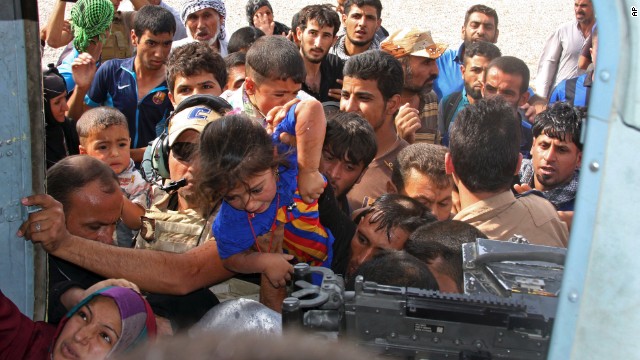 Iraqi Shiite Turkmens, mostly women and children, try to board an Iraqi Army helicopter aid flight bringing in supplies to the town of Amerli, Iraq, on Saturday, August 30. Amerli had been surrounded by fighters from the terror group ISIS since mid-June, but on Sunday the siege was broken by Iraqi security and volunteer forces, according to retired Gen. Khaled al-Amerli, an Amerli resident and member of its self-defense force.
- Peter Bergen, Cynthia Schneider: Video seems to show that ISIS has surveillance drone
- They say this highlights new reality: Terrorist groups have technology once used by states
- They say Hezbollah says it has used them; Hamas says it has armed and unarmed drones
- Writers: Some 80 nations now have drones. We need ‘Geneva Convention’ to govern their use
Editor’s note: Peter Bergen is CNN’s national security analyst, a director at the New America Foundation and the author of “Manhunt: The Ten-Year Search for bin Laden — From 9/11 to Abbottabad.” Emily Schneider is a research associate at the New America Foundation.
(CNN) — In a video uploaded to YouTube on Saturday purportedly by the terrorist group ISIS, various scenes of jihadist propaganda flash across the screen: militants reading verses from the Quran and examining a map of northern Syria, clips of violent clashes and explosions.
But this video had something else in it that previous videos released by ISIS have not: Surveillance footage apparently shot by a drone.
The almost 14-minute video shows aerial views of Syrian Army Military Base 93 near Raqqa province in northern Syria.
ISIS militants attacked the base on August 7, deploying suicide bombers driving truck bombs to soften up resistance in scenes that are also shown in the videotape that was released Saturday.
The caption over the surveillance footage of the Syrian military base reads: “From the drone of the army of the Islamic State.”
That ISIS appears now to be using a relatively sophisticated surveillance drone to plan its military operations underlines an important development: Technology that was once the monopoly of states is now being used by terrorist groups. In April, for example, the Israeli military said it had shot down a drone off the coast of Haifa and that it was operated by Hezbollah, the militant Shiite group operating out of Lebanon.
Hezbollah denied responsibility for the drone, but had claimed earlierthat it had operated another drone that had flown 35 miles into Israel in October.
Hamas, too, has drone capabilities. On July 14, Israel shot down a Hamas-operated drone that was flying in Israeli airspace above Ashdod, a city in southern Israel, marking what is believed to be the first time the militant group had sent an unmanned aircraft into Israeli territory.
Hamas then posted a video online that showed another drone, this one with four small rockets under its wings, flying over what analysts believe could also be Israeli airspace.
According to Hamas, its military wing, the al-Qassam Brigades, has engineered three different types of drones: ones for surveillance purposes; ones that can be armed; and ones that can operate as self-guided missiles — a sort of “suicide drone.”
Israel subsequently bombed what it claimed was a Hamas-run drone facility in Gaza.
Libyan opposition fighters targeting Libyan dictator Moammar Gadhafi started using drones for surveillance during the summer of 2011 when they bought a Scout drone from a Canadian company.
The Libyan opposition needed a way to survey its routes before sending rebels into areas where Gadhafi’s soldiers were stationed. The four-rotor helicopter that dangles a stabilized camera seemed like the perfect option. The drone cost between $100,000 and $200,000, according to an article by Laura Rozen for Yahoo News.
Armed drones have been deployed in combat by only three countries: the United States, the United Kingdom and Israel. However, according to a count by the New America Foundation, some 80 countries have some kind of drone capability, whether armed or unarmed. Russia, China and Iran are among the nations that possess armed drones but haven’t used them in combat
That terrorist and militant organizations have acquired and used drones during combat operations for surveillance purposes shows how rapidly this technology is proliferating. This is why it is crucial to have some kind of international agreement that governs the use of armed drones by both states and “nonstate actors.”
One could imagine the creation of some kind of Geneva Convention that specifies as a matter of international law when the use of armed drones could be sanctioned outside of conventional war zones to kill terrorists.
Such a convention would also help to prevent the sale or transfer of sophisticated drone technology to nonstate actors such as ISIS.
An American’s gateway to jihad, CNN.com
An American’s gateway to jihad
Iraqi Shiite Turkmens, mostly women and children, try to board an Iraqi Army helicopter aid flight bringing in supplies to the town of Amerli, Iraq, on Saturday, August 30. Amerli had been surrounded by fighters from the terror group ISIS since mid-June, but on Sunday the siege was broken by Iraqi security and volunteer forces, according to retired Gen. Khaled al-Amerli, an Amerli resident and member of its self-defense force.- Peter Bergen: New video of American suicide bomber shows Turkey networks key in jihad
- He says Moner Abu-Salha describes how Turkey was gateway in al Qaeda connection
- He says “homegrown” terrorists a key concern in U.S., but so far none have attacked on U.S. soil
- Bergen: Turkey must step up efforts to stem flow of fighters through country to Syria, Iraq
Editor’s note: Peter Bergen is CNN’s national security analyst, a vice president at the New America Foundation and the author of “Manhunt: The Ten-Year Search for bin Laden — From 9/11 to Abbottabad.” David Sterman is a research associate at the New America Foundation.
(CNN) — On Wednesday, a propaganda video appeared on the Internet featuring Moner Abu-Salha, the U.S. citizen from Florida who died conducting a suicide bomb attack in Syria for al Qaeda in May.
The video — the third in a series of al Qaeda videos about Abu-Salha–underlines the importance of militant networks in Turkey that have enabled many hundreds of fighters from the U.S. and other Western nations to travel to fight with jihadist groups in the civil wars that are tearing apart Syria and Iraq.

Abu-Salha says he travelled from the States to Turkey where he eventually connected with representatives of the Nusra Front, al Qaeda’s Syrian affiliate, explaining, “From tons of research I knew that mujahideen [holy warriors] come from all around the world, they come to Istanbul. I heard that the Turkey-Syrian border is close.”
Abu-Salha says that he was inspired to go to fight in the Syrian “holy war” by a lecture by the notorious Yemeni-American militant cleric, Anwar al-Awlaki who said this about traveling to jihad: “It’s like a cliff, you jump off the cliff but you don’t know if the water is deep or shallow. … You just have to jump and put you’re (faith) in Allah that the water is going to be deep and you won’t be harmed.”
As Abu-Salha tells it, he arrived in Turkey with barely enough money for a Turkish visa and no contacts, but he eventually encountered a member of al Qaeda in Turkey who was bearded, dressed all in black and was missing an arm.
The al-Qaeda fighter didn’t speak English but Abu-Salha said, “I’m mujahidin, I’m mujahidin,” which the man understood and he took him on a bus to meet another al Qaeda member who did speak some English. Abu-Salha recalls, “They get me something to eat. I tell them I come to fight jihad. I want to feel, die shaheed (as a martyr).”
He says that the members of al Qaeda then took Abu-Salha to a “safe house” in Turkey where he encountered two other al Qaeda fighters who had been wounded and who were recovering in the house.
Abu-Salha stayed at the safe house for a month, he says, before he was spirited across the border into Syria.
The issue of “homegrown” American extremists fighting in Iraq and Syria has raised significant concerns among counterterrorism officials. The government is tracking about 100 Americans who have fought or attempted to fight in the Syrian conflict.
Douglas McArthur McCain, who grew up in Minnesota, died while fighting for the ultra-militant Islamic State in Syria this past weekend.
In addition to Abu-Salha and McCain, eight Americans have been charged with crimes related to supporting or attempting to support militant jihadist groups in Syria and Iraq.
However, for now, no American involved in the Syrian and Iraqi conflicts has been charged with plotting an attack inside the United States. Both Moner Abu-Salha and Douglas McCain died fighting in the region rather than conducting attacks in their own country.
Gen. Martin Dempsey, the chairman of the Joint Chiefs of Staff, told reporters on August 25 that there are, so far, no signs of “active plotting against the homeland” by the Islamic State.
As fears heighten of the potential threat from returning Western foreign fighters who have traveled to Syria or Iraq, restraining the flow of these fighters through Turkey must be a key objective.
A European diplomat in Turkey told Reuters, “In recent months especially we’ve seen a real hardening in Turkey’s attitude, a recognition that this is a potential threat to their national security and a desire to take more practical steps through intelligence channels, police channels.”
There are signs that Turkey’s new efforts may be having an effect. One Islamic State spokesman told the Washington Post, “It is not as easy to come into Turkey anymore.”
Abu-Salah’s recounting of his travel illustrates the potential risks foreign fighters take when seeking to reach Syria — which may be exploitable by security services. Of his initial attempts to connect with militants in Turkey he said: “It was very dangerous what I was doing because I could have went to jail.”
If Turkey’s new measures to disrupt the foreign fighter flow continue and a coalition can be built to adequately track and disrupt movement of militants into Syria and Iraq, the threat posed by Americans and other Westerners fighting with jihadist groups in the region may diminish over time.
The man who hunted bin Laden, Saddam and the pirates, CNN.com
The man who hunted bin Laden, Saddam and the pirates
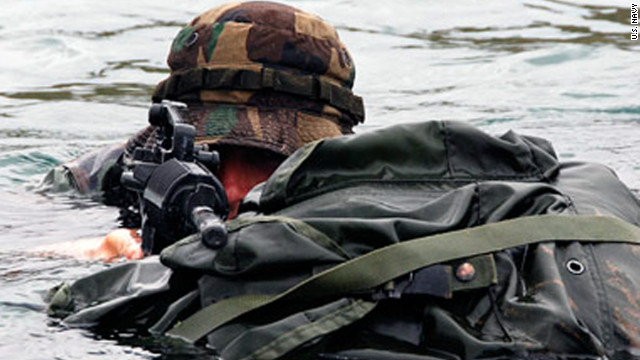 SEALs pioneered underwater warfare tactics, and are the only special forces personnel who are capable of advanced aquatic fighting tactics.
- Peter Bergen: Adm. William McRaven stepped down as head of U.S. Special Operations Command
- He says McRaven not only led the bin Laden raid planning but wrote the book on special ops
- McRaven identified six key elements needed for success in special operations
- Bergen: Troops under his command have deployed to 92 nations
Editor’s note: Peter Bergen is CNN’s national security analyst, a vice president at the New America Foundation and the author of “Manhunt: The Ten-Year Search for bin Laden — From 9/11 to Abbottabad,” from which this article is, in part, adapted.
(CNN) — On Thursday in Tampa, U.S. Secretary of Defense Chuck Hagel presided over a change of command ceremony during which Adm. William “Bill” McRaven handed over the reins of Special Operations Command to his successor, Gen. Joseph Votel.
As McRaven stepped down he observed, “We are in perilous times.” He pointed out that U.S. Special Operations Forces are helping to fight the fast-growing Islamic State in Iraq; the al Qaeda-linked Abu Sayyaf in the Philippines; the militant group Boko Haram in Nigeria, and al Qaeda and the Taliban in the Afghanistan-Pakistan region.
McRaven also said, “We are in the golden age of Special Operations” in which elements of the 67,000 men and women under his command have deployed to 92 countries.
Now, after more than 3½ decades working in the world of special operations, Bill McRaven, 58, is retiring. In his next incarnation he will become chancellor of the University of Texas.
As Hagel pointed out in his speech on Thursday that celebrated McRaven’s storied career, no one has written McRaven’s full history, but if it ever was to be written it “would need to be heavily redacted” because so much of it took place in the “black” (secret) arena.
“Revered” is the word you often hear about McRaven in the special operations community. That’s in part because even as a three-star admiral, about once a month in Afghanistan, McRaven went out with his teams on risky snatch-and-grab missions. (His predecessor as the commander of Joint Special Operations Command, Gen. Stanley McChrystal, also went out regularly on such missions and is similarly held in the highest regard.)
The book
Hagel pointed out in his Thursday speech that McRaven also has “literally written the book on Special Operations.” Indeed, McRraven’s 1995 book, “Spec Ops,” is the standard text on the subject.
It features lucid dissections of eight decisive special operations actions, ranging from the British forces who used midget submarines to badly damage the Tirpitz, a key Nazi battleship, in 1943; to the Nazi rescue the same year of the Italian dictator Benito Mussolini from his anti-Fascist captors; to the raid at Entebbe in 1976 that freed Israeli hostages held in Uganda by Palestinian terrorists.
For his book, McRaven interviewed many of the key participants in the raids that he examined, and he traveled to the sites of the operations.
— Repetition meant frequent and realistic rehearsals so that the “friction” of actual battle was reduced.
— Surprise meant catching the enemy entirely off guard; for example, the Nazi rescuers of Mussolini crash-landed gliders on a mountain near the hotel where the Fascist leader was being held and rescued him without a shot being fired.
— Security meant confining the knowledge of the operation to a small circle.
— Speed meant that “relative superiority” over the enemy needed to be achieved in the first few minutes of the attack, and that the entire mission should be completed in no more than a half-hour.
— Simplicity ensured that the goal of the operation was well understood by each of the soldiers involved — “release the hostages” at Entebbe.
— Purpose meant that the soldiers were completely committed to the mission.
But McRaven’s influence on “spec ops” goes far beyond just the book he wrote. McRaven helped establish a curriculum at the Naval Postgraduate School in Monterey, California. And after taking up a job in the White House just weeks after 9/11, he became one of the principal authors of the Bush administration’s counterterrorism strategy.
During the Iraq War, McRaven led the shadowy Task Force 121, which tracked down Saddam Hussein in December 2003. Much of the public credit for Saddam’s capture went to conventional army units, but it was, in fact, the Special Operations forces under McRaven’s command who did much of the work to find the Iraqi dictator.
Rescue of Capt. Phillips
From the beginning of the Obama presidency, McRaven has been the key to some of the most sensitive U.S. military operations.
On the sweltering evening of April 13, 2009, several hundred miles off the coast of Somalia, as dusk deepened over the Indian Ocean, three shots rang out. All the bullets found their targets: three Somali pirates in a small, enclosed lifeboat bobbing on the darkening sea.
For the previous five days the pirates had held hostage Richard Phillips, the American captain of the Maersk Alabama container ship. President Barack Obama had authorized the use of deadly force if Phillips’ life was in danger. Unbeknownst to the pirates, the USS Bainbridge warship was shadowing them, and days earlier a contingent of SEALs had parachuted at night into the ocean near the Bainbridge.
The SEALs had taken up positions on the fantail of the Bainbridge and were carefully monitoring Phillips and his captors. One of the pirates had just pointed his AK-47 at the American captain as if he were going to shoot him.
That’s when the SEAL team commander on the Bainbridge ordered his men to take out the pirates. Three U.S Navy SEAL sharpshooters fired simultaneously at the pirates from a distance of 30 yards in heaving seas at nightfall, killing them all.
Obama called McRaven, then the leader of Joint Special Operations Command, to tell him, “Great job.”
The flawless rescue of Capt. Philips was the first time that Obama — only three months into his new job — had been personally exposed to the capabilities of America’s secretive Special Operations counterterrorism units, whose skills Obama would come to rely upon increasingly with each year of his presidency.
How bin Laden was found
It is, of course, the raid that killed Osama bin Laden on May 2, 2011, that has ensured McRaven’s place in the history books as the architect of the operation.
During the spring of 2011 McRaven formulated the plan for the assault on the compound in Abbottabad, Pakistan where bin Laden was believed to be hiding.
The planning for the raid was deeply informed by the key principles he had laid out in “Spec Ops.” McRaven explained, “It was a simple plan, carefully concealed, repeatedly rehearsed, and exercised with surprise, speed, and purpose.”
Following extensive realistic rehearsals of the raid in both North Carolina and Nevada that included a full-scale model of the compound bin Laden was believed to be hiding in, McRaven went to the White House to give Obama his assessment of the plausibility of the mission.
When he was outlining to the President and his war cabinet the planned Abbottabad helicopter raid, McRaven said, “In terms of difficulty, compared to what we’re doing on a nightly basis in Afghanistan, what we’re doing in Iraq, this is not among the most difficult missions technically. The difficult part is the sovereignty issue with Pakistan and flying for a long stretch of time over Pakistani airspace.”
Obama knew that the intelligence regarding bin Laden’s presence at the compound was always circumstantial, but the president had confidence that McRaven and his men would be able to execute the mission successfully, whether the al Qaeda leader was in fact at the Abbottabad compound, or not.
The night of the raid, when one of the stealth helicopters carrying a SEAL team crashed inside bin Laden’s compound, McRaven — who was narrating the progress of the operation from his command post in Afghanistan to the White House — didn’t skip a beat, saying without altering his tone: “We will now be amending the mission.”
Around 15 minutes after the helicopter had crashed, on his audio feed, McRaven heard a SEAL team member give the code word “Geronimo.” Each step of the operation had been labeled with a letter of the alphabet, and G meant that bin Laden was “secured.”
McRaven relayed the “Geronimo” to the White House. He assumed that meant bin Laden was now dead, but suddenly thought, “What if we captured him?”
So McRaven asked the SEAL ground force commander, “Is he EKIA [enemy killed in action]?” A few seconds later, the answer came back: “Roger, Geronimo EKIA.”
Then McRaven announced to the White House, “Geronimo EKIA.” There were gasps in the situation room, but no whoops or high fives. The President quietly said, “We got him, we got him.”
What’s next for special operations
On Thursday, McRaven gave his final speech as the leader of American Special Operations. In his dress whites, the famously unflappable four-star admiral concluded, his voice quavering with emotion, “It has been the greatest honor of my life to lead the men and women of Special Operations Command.”
The United States owes a real debt to McRaven and to his wife, Georgeann, who, like many other military spouses, has also served her country stoically as her husband deployed repeatedly to war zones after 9/11.
McRaven’s successor General Votel, previously led the military’s elite and secretive Joint Special Operations Command, which comprises units such as SEAL Team 6 and the Army’s Delta Force. As a colonel, Votel led the unit that five weeks after the 9/11 attacks established the first U.S. military base in Afghanistan and is widely viewed as the right officer to succeed McRaven.
As the United States and its allies pivot away from the post-9/11 conventional wars but still face threats from jihadist militants in countries in the Middle East, South Asia and North Africa, Special Operations Forces working “by, with and through” local militaries will be a key part of future U.S. military operations.
Among his other legacies, McRaven has put in place a Global Special Operations Forces network, which in practice mean a small presence of U.S. Special Operations and Special Forces personnel in dozens of countries around the world.
The goal of that network is twofold: To be better positioned to respond to an immediate crisis, such as the attack on the U.S. facility in Benghazi in 2012, and also to build up the capacity of local militaries so they can keep the peace themselves.
ISIS: Is it really a threat to the U.S.? CNN.com
ISIS: Is it really a threat to the U.S.?
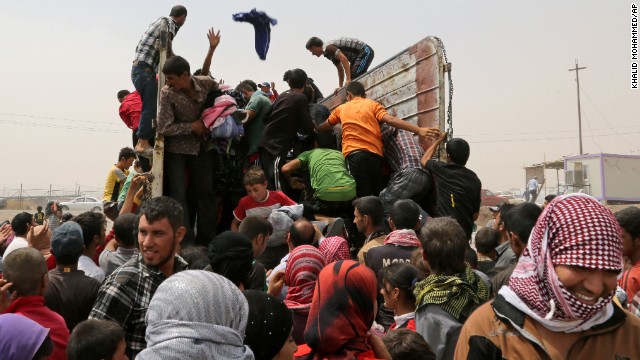 Displaced Iraqis receive clothes from a charity at a refugee camp near Feeshkhabour, Iraq, on Tuesday, August 19. They have been fleeing from the militant group ISIS, which has taken over large swaths of northern and western Iraq as it seeks to create an Islamic caliphate that stretches from Syria to Iraq.
- U.S. officials now see ISIS as a credible threat, on a par with al Qaeda
- Peter Bergen: Some lawmakers have exaggerated the current threat to U.S. from ISIS
- He says the problem is a potential issue, but few have been charged so far
- Bergen: Clearly ISIS is a potent force that must be countered in Middle East
Editor’s note: Peter Bergen is CNN’s national security analyst, a vice president at the New America Foundation and the author of “Manhunt: The Ten-Year Search for bin Laden — From 9/11 to Abbottabad.” David Sterman is a research associate at the New America Foundation.
(CNN) — U.S. officials are claiming that the terrorist group Islamic State in Iraq and Syria, or ISIS, is “now a credible alternative to al Qaeda.”
But what does that really mean in terms of ISIS’ potential threat to the United States? After all, al Qaeda hasn’t pulled off a successful attack in the States since 9/11, or indeed anywhere in the West since the London transportation bombings in 2005.
This month, Sen. John McCain, R-Arizona, criticized the airstrikes in Iraq ordered by President Barack Obama directed at ISIS as too limited, telling CNN’s Candy Crowley, “That is simply a very narrow and focused approach to a problem which is metastasizing as we speak. Candy, there was a guy a month ago that was in Syria, went back to the United States, came back and blew himself up. We’re tracking 100 Americans who are over there now fighting for ISIS. ISIS is attracting extreme elements from all over the world, much less the Arab world. And what have we done?”
The case McCain alluded to was that of Moner Mohammad Abu-Salha, who grew up in Vero Beach, Florida, and who conducted a suicide bombing in Syria in May on behalf of the Nusra Front, al Qaeda’s Syrian affiliate. According to The New York Times, Abu-Salha hadreturned to the United States after being trained by Nusra and then went back to Syria to conduct the suicide operation in which he died.
McCain asserted on CNN that 100 Americans were fighting with ISIS. In fact, according to U.S. officials, 100 is the total number of Americans believed to have fought or attempted to have fought with any of the many Syrian insurgent groups, some of which are more militant than others, and some of which are even aligned with the United States.
According to a count by the New America Foundation, eight people from the United States have been indicted with crimes related to trying to join ISIS or the Nusra Front. (By contrast, some 240 U.S. citizens and residents have been indicted or charged with some kind of jihadist terrorist crime since 9/11.)
Other cases appear more serious. In December, Sinh Vinh Ngo Nguyen, a U.S. citizen from Southern California, pleaded guilty to a charge of attempting to provide material support to al Qaeda. Between December 2012 and April 2013, Nguyen had traveled to Syria, where, he stated, he fought alongside the Nusra Front. On his return, Nguyen discussed with an informant his intent to participate further in jihad.
In August 2013, Gufran Mohammed, a naturalized American citizen living in Saudi Arabia, was charged with attempting to provide material support to the Nusra Front in Syria, by facilitating the recruitment of experienced fighters from al Qaeda’s Somali affiliate to Syria.
He pleaded guilty last month.
Opinion: How Iraq’s black market in oil funds ISIS
Yet so far no U.S. citizen involved in fighting or supporting the Nusra Front or ISIS has been charged with plotting to conduct an attack inside the United States despite the fact the war in Syria is now in its fourth year and the war in Iraq is in its 11th year. Indeed, some Americans who have traveled to Syria have ended up dead apparently because they have no combat experience to speak of; for instance, Nicole Mansfield from Flint, Michigan, was killed in Syria last year by forces loyal to the Syrian dictator Bashar al-Assad.
Further, ISIS’ predecessor, al Qaeda in Iraq, never tried to conduct an attack on the American homeland, although it did bomb three American hotels in Jordan in 2005.
And it’s also worth noting that in none of the successful terrorist attacks in the States since 9/11, such as the Boston Marathon bombings last year or Maj. Nidal Hasan’s massacre at Fort Hood, Texas, in 2009, did any of the convicted or alleged perpetrators receive training overseas.
Returning foreign fighters from the Syrian conflict pose a far greater threat to Europe, which has contributed a much larger number of foreign fighters to the conflict than the United States, including an estimated 700 from France, 450 from the United Kingdom and 270 from Germany.
Unlike in the United States, European countries have reported specific terrorist plots tied to returning Syrian fighters. Mehdi Nemmouche, a suspect in the May 24 shootings at a Jewish museum in Brussels, Belgium, that killed four people, spent about a year with jihadist fighters in Syria, according to the Paris prosecutor in the case. But Nemmouche’s case is the only instance of lethal violence by a returning Syrian fighter in the West.
Still, the United States must consider European foreign fighters returning from Syria as more than a European problem because many of those returning are from countries that participate in the U.S. visa waiver program and can enter the States without a visa.
Moreover, experienced al Qaeda operators are present in Syria. As one senior U.S. intelligence official put it to us, these are veteran members “with strong resumes and full Rolodexes.” The wars in Syria and Iraq allow such longtime fighters to interact with members of other al Qaeda affiliates. For example, in July, the United States adopted enhanced security measures at airports based on intelligence that bomb-makers from al Qaeda in the Arabian Peninsula were sharing their expertise in making bombs capable of evading airport security with members of the Syrian Nusra Front.
Despite these dangers, however, the threat to the United States from foreign fighters in Syria and Iraq remains only a potential threat.
The administration’s airstrikes in Iraq are properly focused upon the more imminent threats to U.S. government employees and American citizens in the Kurdish city of Irbil who are threatened by ISIS advances and the humanitarian catastrophe befalling the Yazidi population in areas controlled by the militant forces.
The last time there was a similar exodus of American citizens and residents to an overseas holy war was to Somalia following the U.S.-backed invasion of Somalia by Ethiopian forces in 2006. More than 40 Americans subsequently went to Somalia to fight with Al-Shabaab, an al Qaeda-affiliated group.
Opinion: ISIS beheading — what should U.S. do?
Just as is the case today in Syria, for a good number of the Americans who went to fight in Somalia it was a one-way ticket because 15 of the 40 or so American volunteers died there either as suicide attackers or on the battlefield.
In 2011, Rep. Peter King, R-New York, then-chairman of the House Homeland Security Committee, warned of Americans fighting in Somalia. “With a large group of Muslim-Americans willing to die as ‘martyrs’ and a strong operational partnership with al Qaeda leaders in Pakistan and in Yemen, al-Shabaab now has more capability than ever to strike the U.S. homeland.”
As it turned out, those Americans who returned from the Somali jihad did not attempt or carry out any kind of terrorist attack in the States.
Now King is back at it again, telling NBC last week, “ISIS is a direct threat to the United States of America. … They are more powerful now than al Qaeda was on 9/11.”
ISIS is surely a major problem for Iraq, and its tactics and strategy are abhorrent, as demonstrated by the beheading of American journalist James Foley, its use of crucifixions and its genocidal attacks on the small Yazidi minority. But that doesn’t mean it is a serious threat to the American homeland.
Should Western nations just pay ISIS ransom? CNN.com
Should Western nations just pay ISIS ransom?
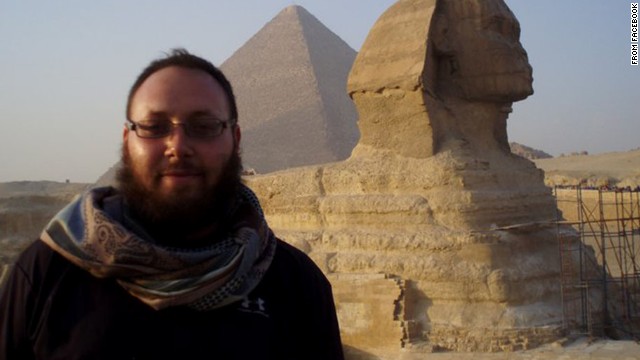 Freelance American journalistSteven Sotloff, seen here in a photo from Facebook, disappeared during a reporting trip to Syria in August 2013. His family kept the news a secret until he was seen at the end of a video from the Islamic extremist group ISIS that shows the beheading of another journalist, James Foley.
- Peter Bergen, Emily Schneider: ISIS wanted $132.5 million in ransom for James Foley
- Sometimes ransom works, but it can lead to more kidnapping, the writers say
- Minus a rescue or escape, options grim for nations — ransom or execution, they say
Editor’s note: Peter Bergen is CNN’s national security analyst, a director at the New America Foundation and the author of “Manhunt: The Ten-Year Search for bin Laden — From 9/11 to Abbottabad.” Emily Schneider is a research associate at the New America Foundation.
(CNN) — ISIS demanded 100 million euros ($132.5 million) in ransomfor the release of James Foley, the American journalist kidnapped and killed by the terrorist group in Syria, according to a spokesman for GlobalPost, the news website for which Foley freelanced.
It was never a serious demand, far exceeding the amounts of money paid for hostages held by jihadist militant groups in the past, which typically ranged up to several million dollars.
But the demand does shine a light on two uncomfortable facts about “Kidnap & Ransom,” or K&R, the dark netherworld of professionals who work to negotiate between murderous groups like ISIS and the terrified families whose loved ones have been kidnapped. It also includes their worried employers and Western governments such as France that will pay ransoms, and other governments, notably the United States and the United Kingdom, that will not.
The first uncomfortable fact is that if you pay a ransom a hostage is more likely to be released. The other is that every time a ransom is paid it increases the chance that other hostages will be taken to help fill the coffers of a terrorist group.
According to an investigation by The New York Times, al Qaeda and its affiliates have netted at least $125 million in ransoms since 2008. That finding is similar to a 2012 U.S. Treasury estimate that $120 million had been paid to terrorist organizations during the previous eight years.
 CEO: European governments paid for hostages
 Rescue mission had intelligence failures
Much of this revenue reportedly comes from France. French media reported that the government had paid 20 million euros (about $28 million) for the release of four employees of a French nuclear firm. They were held by an al Qaeda affiliate for three years in northern Niger and were released last year.
The French government denied paying a ransom, but The New York Times indicated — based on reports from Le Monde and Agence France-Presse — that France did pay in that case and has paid out a total of some $58 million to al Qaeda or related groups.
Not surprisingly, the Times also found that of the 53 hostages known to have been taken by al Qaeda and its affiliates during the past five years, a third were French.
The French government’s purported policy of negotiating with militant groups for the release of kidnapped citizens does appear to work. Four French journalists — Nicolas Henin, Pierre Torres, Edouard Elias and Didier François, who were kidnapped in Syria last year by ISIS —were released near the Turkish border in April, blindfolded and with their hands bound.
One of those hostages, Henin, had been held by ISIS alongside Foley. Henin is free, and Foley is dead.
These are the facts that policymakers must confront as they consider what to do about the other Western hostages still held by ISIS.
Who is ISIS currently holding?
ISIS holds three Americans, including Steven Sotloff, a freelance journalist who was kidnapped last August and who the terrorist group threatened to kill in the video it released showing Foley’s beheading.
The names of the other two Americans being held by ISIS have not been publicly disclosed; CNN is withholding their names and occupations.
Two Italian women are reported to be among the militant group’s newest captives. A Dane and a Japanese national were seized along with the two Italians. The group of four was recently moved to Raqqa, an ISIS stronghold in northern Syria.
For these hostages, there is always the chance that their governments will mount a rescue operation as the United States did in Syria in July to try and rescue Foley and the other Americans. That mission failed because the hostages had been moved from a location they had been kept in for some months.
There is also the possibility that hostages could escape, as American photographer Matthew Schrier did last year when he managed to crawl out of a window of the prison where he was being held in in the Syrian city of Aleppo by an Islamist militant group.
But such escapes are rare, and while successful rescue efforts do happen, they are fraught with risks for the hostages.
Linda Norgrove, for instance, a British aid worker held by the Taliban in Afghanistan in 2010, was killed in a U.S. rescue operation, likely by a grenade that exploded near her.
If there’s not an escape or a successful rescue effort, Western governments whose citizens are held by ISIS have only the options of either a negotiation involving ransom or the real possibility that their hostages may be executed.
This is the sobering choice that faces President Barack Obama and his national security advisers. It’s not much of a choice at all.
Freelance American journalistSteven Sotloff, seen here in a photo from Facebook, disappeared during a reporting trip to Syria in August 2013. His family kept the news a secret until he was seen at the end of a video from the Islamic extremist group ISIS that shows the beheading of another journalist, James Foley.- Peter Bergen, Emily Schneider: ISIS wanted $132.5 million in ransom for James Foley
- Sometimes ransom works, but it can lead to more kidnapping, the writers say
- Minus a rescue or escape, options grim for nations — ransom or execution, they say
Editor’s note: Peter Bergen is CNN’s national security analyst, a director at the New America Foundation and the author of “Manhunt: The Ten-Year Search for bin Laden — From 9/11 to Abbottabad.” Emily Schneider is a research associate at the New America Foundation.
(CNN) — ISIS demanded 100 million euros ($132.5 million) in ransomfor the release of James Foley, the American journalist kidnapped and killed by the terrorist group in Syria, according to a spokesman for GlobalPost, the news website for which Foley freelanced.
It was never a serious demand, far exceeding the amounts of money paid for hostages held by jihadist militant groups in the past, which typically ranged up to several million dollars.
But the demand does shine a light on two uncomfortable facts about “Kidnap & Ransom,” or K&R, the dark netherworld of professionals who work to negotiate between murderous groups like ISIS and the terrified families whose loved ones have been kidnapped. It also includes their worried employers and Western governments such as France that will pay ransoms, and other governments, notably the United States and the United Kingdom, that will not.
The first uncomfortable fact is that if you pay a ransom a hostage is more likely to be released. The other is that every time a ransom is paid it increases the chance that other hostages will be taken to help fill the coffers of a terrorist group.
According to an investigation by The New York Times, al Qaeda and its affiliates have netted at least $125 million in ransoms since 2008. That finding is similar to a 2012 U.S. Treasury estimate that $120 million had been paid to terrorist organizations during the previous eight years.
CEO: European governments paid for hostages
Rescue mission had intelligence failures
Much of this revenue reportedly comes from France. French media reported that the government had paid 20 million euros (about $28 million) for the release of four employees of a French nuclear firm. They were held by an al Qaeda affiliate for three years in northern Niger and were released last year.
The French government denied paying a ransom, but The New York Times indicated — based on reports from Le Monde and Agence France-Presse — that France did pay in that case and has paid out a total of some $58 million to al Qaeda or related groups.
Not surprisingly, the Times also found that of the 53 hostages known to have been taken by al Qaeda and its affiliates during the past five years, a third were French.
The French government’s purported policy of negotiating with militant groups for the release of kidnapped citizens does appear to work. Four French journalists — Nicolas Henin, Pierre Torres, Edouard Elias and Didier François, who were kidnapped in Syria last year by ISIS —were released near the Turkish border in April, blindfolded and with their hands bound.
One of those hostages, Henin, had been held by ISIS alongside Foley. Henin is free, and Foley is dead.
These are the facts that policymakers must confront as they consider what to do about the other Western hostages still held by ISIS.
Who is ISIS currently holding?
ISIS holds three Americans, including Steven Sotloff, a freelance journalist who was kidnapped last August and who the terrorist group threatened to kill in the video it released showing Foley’s beheading.
The names of the other two Americans being held by ISIS have not been publicly disclosed; CNN is withholding their names and occupations.
Two Italian women are reported to be among the militant group’s newest captives. A Dane and a Japanese national were seized along with the two Italians. The group of four was recently moved to Raqqa, an ISIS stronghold in northern Syria.
For these hostages, there is always the chance that their governments will mount a rescue operation as the United States did in Syria in July to try and rescue Foley and the other Americans. That mission failed because the hostages had been moved from a location they had been kept in for some months.
There is also the possibility that hostages could escape, as American photographer Matthew Schrier did last year when he managed to crawl out of a window of the prison where he was being held in in the Syrian city of Aleppo by an Islamist militant group.
But such escapes are rare, and while successful rescue efforts do happen, they are fraught with risks for the hostages.
Linda Norgrove, for instance, a British aid worker held by the Taliban in Afghanistan in 2010, was killed in a U.S. rescue operation, likely by a grenade that exploded near her.
If there’s not an escape or a successful rescue effort, Western governments whose citizens are held by ISIS have only the options of either a negotiation involving ransom or the real possibility that their hostages may be executed.
This is the sobering choice that faces President Barack Obama and his national security advisers. It’s not much of a choice at all.
KORENGAL: This Is What War Feels Like, Screening, New America, Washington
KORENGAL: This Is What War Feels Like

Directed and produced by best-selling author and filmmaker Sebastian Junger, KORENGAL picks up where the Academy Award®-nominated documentary RESTREPO left off. The film tells the gripping story of Battle Company 2/503 of the 173rd Airborne Brigade and their time in the remote Korengal Valley, the epicenter of the U.S. war effort in Afghanistan at the time (2007-2008). With new, never-before-seen footage from Afghanistan, as well as post-deployment interviews with the soldiers, KORENGAL gives audiences an intimate view of what it means to be at war — and to come home from war.
Hosted by New America, the event will kick off with a reception at 5:30pm. Anne-Marie Slaughter, the President and CEO of New America, will introduce the film, which will be screened at 6:15. Following the conclusion of the screening, filmmaker Sebastian Junger will join New America Vice President Peter Bergen and other experts on stage for a discussion about the film.
In addition to raising awareness about the experiences of combat veterans, the event will benefit Team RWB and its community-based programs for veterans. Donations are optional and proceeds will go to supporting programs, such as the Veteran Ambassador Program, Veteran Athletic Camps, and a Leadership Development Program, which give both veterans and the communities they live in the tools they need to reintegrate into all aspects of civilian life.
 To donate to Team RWB, please click here.
ABOUT TEAM RWB
Team Red, White and Blue is a national non-profit organization dedicated to enriching the lives of America’s veterans by connecting them to their communities through physical and social activity. Team RWB employs a community-based approach that engages veterans in communities where they live, supporting more than 30,000 veterans in 70 official Team RWB communities throughout the country.
PARTICIPANTS
Director and Producer, RESTREPO
Congressman Jim McDermott
Member of Congress, Washington State 7th District
Blayne Smith
Executive Director, Team RWB
Moderator:
Peter Bergen
Vice President, Director of Studies, New America
“Al Qaeda: On the March or on the Decline?” School of Politics and Global Studies, Arizona State, Phoenix

World Summit on Counter-Terrorism, Interdisciplinary Center (IDC) Herzliya, Israel
ICT’s 14th International Conference – Speakers
Terrorism’s Global Impact
September 8-11, 2014
Interdisciplinary Center (IDC) Herzliya, Israel
List of Speakers at ICT’s 14th International Conference: World Summit on Counter-Terrorism.
Speakers
The all-American al Qaeda suicide bomber, CNN.com
The all-American al Qaeda suicide bomber
By Peter Bergen
updated 2:29 PM EDT, Thu July 31, 2014
Moner Mohammad Abu-Salha recorded videotape for al Qaeda before suicide bombing
Peter Bergen says the 22-year-old’s story highlights risks of Western fighters in Syria
He says hundreds of Europeans are taking part in the war, and so are some Americans
Bergen: Tracking the foreign fighters is a key priority for counterterrorism efforts
Editor’s note: Peter Bergen is CNN’s national security analyst, a director at the New America Foundation and the author of “Manhunt: The Ten-Year Search for bin Laden — From 9/11 to Abbottabad.”
(CNN) — Seconds before he detonated the massive truck bomb that killed him and a number of Syrian soldiers two months ago, Moner Mohammad Abu-Salha radioed other fighters in al Qaeda to say, “I see paradise and I can smell paradise.”
That in itself may not be unusual. But what should focus our attention is the identity of the bomber — he was an American.
The son of a Palestinian father and an Italian-American mother, Abu-Salha grew up in Vero Beach, Florida, where he played high school football.
Abu-Salha, who was 22, is the first American suicide bomber known to have died in Syria.
On Monday, an al Qaeda-affiliated group in Syria released a half-hour videotape in which Abu-Salha explained his rationale for the impending suicide mission.
The video is an important window into the worldview of a Western recruit to al Qaeda drawn to the Syrian civil war, which is now in its fourth year. And the video also helps illuminate the recruitment techniques that the group has used to draw Westerners to the conflict, estimated to now number around 2,000.
Photos: Syrian civil war in 2014 Photos: Syrian civil war in 2014
In the video, Abu-Salha is shown tearing up his American passport and then the passport is set on fire. Next he is shown wearing a green camouflage vest and holding an AK-47 rifle delivering a diatribe to the camera directly.
Speaking in a strong American accent, Abu-Salha explicitly appeals to fellow militants in the States and the United Kingdom, saying that coming to fight with al Qaeda was so simple that he arrived in Syria “with only $20 in my pocket.” Abu-Salha explained that “Allah made it easy for me” as he traveled from the States to Turkey and from there crossed over into neighboring Syria.
Abu-Salha paints a grim picture of life in the United States compared with the supposed joys of his life as a holy warrior: “Just sitting down five minutes drinking a cup of tea with mujahedeen (holy warriors) is better than anything I’ve ever experienced in my whole life. I lived in America! I know how it is. You have all the fancy amusement parks, and the restaurants, and the food, and all this crap and the cars and you think you’re happy. You’re not happy, you’re never happy. I was never happy. I was always sad and depressed. Life sucked. … All you do is work 40, 50, 60 hours a week.”
Over footage of a woman in an all-enveloping black burqa who is shooting an automatic rifle, Abu-Salha tells the story of a Russian woman working for al Qaeda who conducted a suicide operation in Pakistan. Abu-Salha says, “She’s a thousand men. Not like you men who sit at home.” In other words, you are not a real Muslim man if you don’t travel to come join the jihad.
Abu-Salha also paints a vision of what life in paradise will be for those who are killed fighting in Syria. In paradise, he says, “A tree will pick the fruit off of itself and hand it to you,” while you will find a woman so beautiful that “you would die from her beauty.”
Abu-Salha’s videotape establishes some key recruiting themes for Westerners whom al Qaeda wants to draw into the Syrian war: That it is purportedly easy to come and fight in Syria; that life in the West is nothing compared with life you will lead as a holy warrior; that real men do jihad; and if you do end up getting “martyred” in the war, “paradise” will welcome you with beautiful women.
Toward the end of the tape, Abu-Salha contemplates his own impending suicidal attack and death. Fighting back tears, Abu-Salha addresses his family back in the Florida, saying, “I love you Mom.” He also addresses his oldest brother: “I love you bro. … Look after our sister and our little brother.”
At the end of the tape, a truck that is decorated with the distinctive al Qaeda black flag with white writing is driven off, and then in the distance there is a massive explosion.
Abu-Salha is one of about 100 Americans who have traveled to Syria or have tried to do so as the civil war there grinds on. Not all of these U.S. citizens have joined al Qaeda or its splinter groups, but a number have done so. The New York Times reported Thursday that Abu-Salha had returned to the States for several months after he had received militant training in Syria and before he returned there to conduct his final mission.
So far nine Americans have been charged with traveling, attempting to travel or facilitating the travel of others to fight in Syria with militant jihadist groups, according to a count by the New America Foundation.
The most recent case was that of Michael Todd Wolfe, 23, who pleaded guilty to attempting to join an al Qaeda splinter group in Syria. Wolfe was arrested June 17 as he tried to fly out of George Bush International Airport in Houston.
Syria is attracting a lot more Westerners than the Iraq War ever did because it’s the perfect Sunni jihad. Syrian dictator Bashar al-Assad belongs to the small Alawite sect and is therefore considered a heretic by many Sunnis; al-Assad runs a secular regime, and therefore he is considered by Sunni militants to be an apostate, and he is inflicting a total war on his Sunni population.
As a result, there are many hundreds of “foreign fighters” who have traveled to Syria from European “visa waiver” countries who do not need visas to travel to the United States, including 700 from France, 450 from the United Kingdom, 270 from Germany and dozens from each of the Scandinavian countries.
U.S. officials assert that jihadist groups in Syria are already shifting their focus to conducting attacks on the United States and Europe. Speaking at a security conference last week in Aspen, Colorado, U.S. Homeland Security Secretary Jeh Johnson said some Syrian jihadists “are actively trying to recruit Westerners, indoctrinate them and see them return to their home countries with an extremist mission.”
The problem in Syria is compounded by the fact that, according to both British counterterrorism officials and U.S. intelligence officials, senior al Qaeda members based in Pakistan have traveled to Syria to direct operations there. They are known as the Khorasan group. Khorasan is an ancient term for an Islamic empire that once incorporated what is now Afghanistan.
What can be done? Western governments are keenly aware of the problem of Syrian veterans coming home both radicalized and trained. The problem is that in some European countries with hundreds of returnees it is just not possible to monitor all of them. That was vividly illustrated by the case of Mehdi Nemmouche, who traveled to Syria last year and is accused in the May 24 shooting at the Jewish Museum in Brussels, Belgium, that left four people dead.
Information sharing between Western governments about the identities of those who have traveled to Syria and have received militant training is the key to preventing more incidents such as the one at the Jewish Museum in Brussels.
U.S. general’s killing may be a bad omen, CNN.com
U.S. general’s killing may be a bad omen
By Peter Bergen and David Sterman
STORY HIGHLIGHTS
On Tuesday, an Afghan soldier killed a U.S. major general in an insider attack
Writers: Insider attacks nothing new, but it’s an ominous sign as combat troops withdraw
They say advisory forces who stay might be more vulnerable to insider attacks
Writers: Pentagon says trust between Afghans, Americans is solid: Trust is key
Editor’s note: Peter Bergen is CNN’s national security analyst, a director at the New America Foundation and the author of “Manhunt: The Ten-Year Search for bin Laden — From 9/11 to Abbottabad.” David Sterman is a research assistant at the New America Foundation.
(CNN) — On Tuesday, an Afghan soldier killed a U.S. major general and wounded a German brigadier general, as well as up to 15 others, in an attack at the Marshal Fahim National Defense University in the Afghan capital, Kabul.
The attack is an ominous sign regarding the potential risks to American service members as the majority of U.S. forces withdraw from Afghanistan.
If a Bilateral Security Agreement between the United States and Afghanistan is signed in coming months, the United States is likely to keep a residual force of around 9,800 troops in Afghanistan after the withdrawal of all U.S. combat troops at the end of 2014.
This residual force would serve in an advisory role to Afghan troops, which could further expose American forces to insider attacks.
Officials identified the American who was killed as Maj. Gen. Harold Greene. Rear Adm. John Kirby, the Pentagon spokesman, said the Afghan soldier who carried out the attack was shot and killed.
Although directed at high-ranking officers, it was far from the first insider attack on coalition troops in Afghanistan.
According to a count by the New America Foundation, there have been 82 such attacks on coalition personnel over the course of the Afghan War. The numbers refer to Afghan police and army members attacking NATO troops.
Respected U.S. General killed in attack Confidence in Afghan security shaken?
During the early years of the war, there were very few insider attacks. But they took off in 2011. That year, the number rose to 14, followed by a peak of 40 in 2012.
At least 145 U.S. and other NATO soldiers have been killed by Afghan soldiers, according to New America’s data.
So far, in 2014 there have been only three such attacks, including Tuesday’s in Kabul, and an attack on June 23 in Gardez, Paktia, where two American military advisers were injured in a shooting by an Afghan police officer.
Before that, on February 12, two American Special Forces members were killed in Afghanistan’s Kapisa province by gunmen wearing Afghan National Security Force uniforms.
In April 2011, in an attack that killed the most coalition personnel, an Afghan military pilot killed eight American soldiers and a military contractor during a meeting in the operations room of the Afghan Air Corps at Kabul Airport.
Insider attacks have taken their largest toll on troops from the United States, which contributes the largest contingent of forces to operations in Afghanistan
Military members from Albania, Australia, France, Germany, Italy, New Zealand, Norway, Slovenia, Spain and the United Kingdom have also been targets.
Still, the number of deaths in insider attacks on foreign forces has been declining — although they spiked in 2012, when 59 coalition members were killed. In 2011, there were 36; in 2013, there were 18.
The United States took several steps after insider attacks became a large-scale problem, including improving vetting of Afghan security personnel and putting more counterintelligence assets into the field to try to detect threats.
Kirby downplayed the significance of Tuesday’s attacks, asserting that he has “seen no indication that there’s a degradation of trust between coalition members and their Afghan counterparts.”
Maintaining that trust as U.S. combat troops withdraw will be key.
FEATURED BOOK

All the Presidents’ Wars:
RECENT ARTICLES

UPCOMING EVENTS
Tuesday, December, 08, 2026
USC DC, All the Presidents’ Wars, book event
Tuesday, January, 12, 2027
NY Historical, All the Presidents’ Wars: 25 Years of America’s War on Terror Featuring: Peter Bergen, David M. Rubenstein (moderator), NYC
Wednesday, February, 10, 2027
Metropolitan Club, DC, All the Presidents’ Wars event
RECENT FILM AND TV SERIES
GHOSTS OF BEIRUT: SHOWTIME
The Fall of Osama bin Laden, National Geographic

BIN LADEN'S HARD DRIVE, NATIONAL GEOGRAPHIC

