Will the U.S. negotiate with terrorists? CNN.com
Will the U.S. negotiate with terrorists?
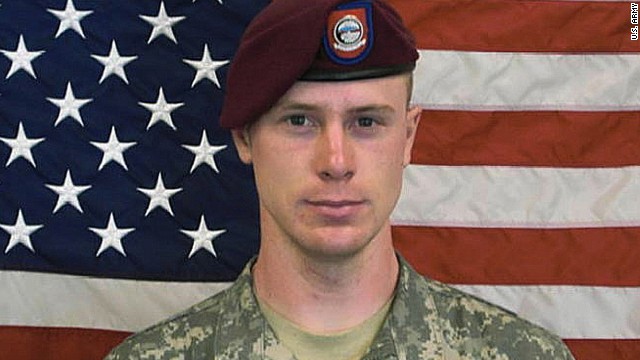 This undated image provided by the U.S. Army shows Sgt. Bowe Bergdahl, who has been held by insurgents in Pakistan since 2009. Extremely sensitive discussions are under way with intermediaries overseas to see if there is any ability to gain his release, a U.S. official told CNN on February 19.
- Peter Bergen: The U.S. won’t negotiate with terrorists, but will it make an exception?
- Sgt. Bowe Bergdahl is believed to be held by the Haqqani group, a terror wing of Afghan Taliban
- Bergen: Talks would be held with Afghan Taliban, which is not directly a terrorist group
- Bergen: U.S. combat troops leaving Afghanistan, it’s time to swap POWs, including Bergdahl
Editor’s note: Peter Bergen is CNN’s national security analyst, a director at the New America Foundation and the author of “Manhunt: The Ten-Year Search for bin Laden — From 9/11 to Abbottabad.” Bailey Cahall is a policy analyst at the New America Foundation.
(CNN) — The U.S. government’s long-stated position is that it won’t negotiate with terrorists. But are there exceptions?
U.S. Army Sgt. Bowe Bergdahl, an American prisoner of war, is believed to be held in Pakistan by the Haqqani group.
The Haqqani group is part of the larger Taliban network and has engaged in a range of attacks on civilian targets in Afghanistan, such as the U.S. Embassy in Kabul.
Earlier this month, the U.S. Treasury Department named three of the Haqqani group’s leaders as “Specially Designated Global Terrorists,” and noted that the organization “poses a grave threat to U.S. civilians, military personnel, and our broader interests in the Afghanistan-Pakistan region.”
Two years ago, the U.S. State Department also formally listed the Haqqani network as a foreign terrorist organization.
Yet on Monday, The Washington Post quoted U.S. officials who said the government was going to resume talks with the Afghan Taliban and offer to trade five Taliban prisoners held at the detention facility at Guantanamo Bay for Bergdahl, who has been held since 2009.
Does that mean the United States is negotiating with a terrorist group?
In fact, the Haqqanis are part of the larger Afghan Taliban network, but the Afghan Taliban itself is not listed by the U.S. State Department as a foreign terrorist organization, which enables the United States to have direct talks with the Afghan Taliban, which it has been doing for years secretly, according to multiple U.S. officials familiar with the talks.
This means that discussions about the release of Bergdahl with the Afghan Taliban are not directly with a terrorist organization per se, but instead with an insurgent group that has a terrorist wing.
For some this may seem to be a distinction without a difference, but as a matter of U.S. policy this is a very important distinction. Consider the case of another American who is held hostage in Pakistan, Warren Weinstein, a contractor for the U.S. Agency of International Development who was kidnapped by al Qaeda in Lahore, Pakistan, more than two years ago.
In December, a proof-of-life video was released to international media outlets, in which Weinstein called on President Obama to negotiate for his release. As with Bergdahl, the release of Guantanamo detainees was among his captors’ conditions.
U.S. officials have called for Weinstein’s release. But the United States has never negotiated with al Qaeda and would not want to encourage the group to kidnap other Americans living in Pakistan, so it seems out of the question that U.S. officials would negotiate with al Qaeda for Weinstein’s release.
That said, U.S. officials will certainly be working behind the scenes to put pressure on the Pakistan government to try to secure Weinstein’s release.
The fact that Bergdahl is being held by the Haqqanis does raise another issue, however, which is: Even if you get a deal with the Afghan Taliban for Bergdahl’s release, would the Haqqani network, which operates quite independently from the Afghan Taliban, go along with it?
The consensus among Taliban experts is, likely, yes. Anand Gopal, a fellow at the New America Foundation who has interviewed multiple members of the Afghan Taliban and the Haqqani network, says the Haqqanis would honor such a deal because “they take great pains to present themselves as part of the mainstream Taliban movement — even if in practice they are independent — and not going along would be an affront to the Taliban, possibly damaging relations.”
According to the Washington Post report, the U.S. government has not yet made a formal offer for Bergdahl, who has spent almost five years in captivity. But the political situation around Bergdahl’s release may be shifting slightly in favor of a resolution. In 2103, the Obama administration quietly released 11 prisoners from Guantanamo and it didn’t generate much criticism from opponents of the administration.
Two months ago, Congress also eased up on some of the restrictions that had previously prevented prisoners being released from Guantanamo.
Also, U.S. combat troops in Afghanistan are pulling out at the end of December, which is, of course, a key Taliban demand. This means, as both a practical and legal matter, that the United States will then no longer be at war in Afghanistan, although there will likely be some residual force of U.S. soldiers in an advisory role post-2014.
When wars are over, the warring parties traditionally exchange their prisoners of war. With all U.S. combat soldiers returning home from Afghanistan during the course of this year, it is high time for Bergdahl to be one of them.
Does NSA Bulk Surveillance Stop Terrorists
http://www.newamerica.net/sites/newamerica.net/files/policydocs/Bergen_NAF_NSA%20Surveillance_1_0_0.pdf
Target an American with drones? CNN.com
Target an American with drones?
By Peter Bergen, CNN National Security Analyst
updated 5:35 PM EST, Tue February 11, 2014
U.S. may kill American terror suspect
STORY HIGHLIGHTS
Peter Bergen: U.S. officials reported to be considering targeting an American citizen
He says Obama authorized killing of Anwar al-Awlaki by U.S. drone in Yemen
Attorney general said U.S. citizens aren’t immune to attack, put forth criteria for these cases
Bergen: Many Americans would argue such a decision requires review by courts
Editor’s note: Peter Bergen is CNN’s national security analyst, a director at the New America Foundation and the author of “Manhunt: The Ten-Year Search for bin Laden — From 9/11 to Abbottabad.”
(CNN) — President Barack Obama is the first American president known to have authorized the assassination of a US citizen.
On September 30, 2011, Anwar al-Awlaki, a U.S. citizen by virtue of his birth in New Mexico in 1971, was killed by an American drone in Yemen along with another U.S. citizen, Samir Khan, who grew up in New York City and Charlotte, North Carolina.
Al-Awlaki had played an operational role in al Qaeda’s affiliate in Yemen, al Qaeda in the Arabian Peninsula — for instance, tasking the “underwear bomber,” Umar Farouk AbdulMutallab, to bring down an American airliner over the United States.
AbdulMutallab attempted to bring down Northwest Flight 253 over Detroit on Christmas Day 2009, but luckily his underwear bomb didn’t detonate correctly.
Khan had played more of a supporting role for AQAP as the editor of the group’s online magazine, Inspire, which has inspired a number of terrorists, including the two brothers suspected of bombing the Boston Marathon last year.
The killings of two American citizens by a U.S. drone without a judicial process caused considerable outrage on both the left and the right.
Since then there has been far more public discussion of the secretive drone program, both by U.S. government officials, including President Obama, and at public hearings about drones in Congress. But will al-Awlaki and Khan be the last Americans to die in a U.S. drone strike?
U.S. officials are now debating whether to kill with a drone another American citizen who is part of al Qaeda and believed to be plotting attacks against the United States, a senior U.S. official tells CNN.
The Associated Press first reported this development but is withholding the name of the targeted individual.
There has been speculation but no confirmation about who the individual might be. At least a couple of other American citizens or permanent residents are known to play important roles in al Qaeda today.
One name that has been mentioned in media reports is that of California-born Adam Gadahn, who for the past decade has operated as a leading al Qaeda propagandist. In 2006 Gadahn was the first American charged with treason in more than half a century.
However, there is, at least so far, no public information that Gadahn has played an operational role in al Qaeda’s terrorist plots, and therefore it is unlikely that he would be placed on a “kill list,” unless his role in al Qaeda has changed of late from propagandist to operational planner.
According to a senior U.S. administration official, Gadahn is not the subject of the ongoing high-level discussions about whether a new name should be added to the kill list.
In a letter to the Senate Judiciary Committee in May 2013, U.S. Attorney General Eric Holder laid out the legal rationale the government uses to determine if an American citizen can be killed in a drone strike.
In the letter, Holder said that based on Supreme Court decisions during World War II, merely being an American citizen does not make one “immune from being targeted.” Holder also asserted that an American who poses an “imminent threat of violent attack against the United States” and is in a location where capture “is not feasible” could be killed.
Holder explained that al-Awlaki “plainly satisfied all these conditions” as he had recruited the underwear bomber and instructed him to blow up an U.S. airliner “when it was over American soil.” Al-Awlaki was also killed in a remote part of Yemen where a U.S. ground operation to capture him was deemed unfeasible by the Obama administration.
There is a certain irony in Holder’s legal reasoning. The FBI was monitoring al-Awlaki’s e-mail account for years before he was killed. To monitor his e-mail, the FBI had to get a court order.
Yet the decision to target al-Awlaki for death was made without any kind of judicial proceeding. As Vicki Divoll, a former assistant general counsel for the CIA, nicely put it a year before al-Awlaki was killed in the drone strike, “Awlaki’s right to privacy exceeds his right to life.”
Khan was killed in the same drone strike that killed al-Awlaki, but according to a senior U.S. official, that was unintentional and was merely a byproduct of Khan traveling in the same car as al-Awlaki when the drone strike occurred.
In sum, Khan’s role as the editor of Inspire magazine was not enough to put him on a kill list.
When it comes to targeting a U.S. citizen for death, American officials, by their own account, will make particular efforts to determine how dangerous an al Qaeda operative that person really is. In the eyes of many Americans, however, a decision to kill one of their own should also be subject to judicial review.
Follow us on Twitter @CNNOpinion.
Join us on Facebook/CNNOpinion.
A terror group too brutal for al Qaeda? CNN.com
A terror group too brutal for al Qaeda?
 Medical personnel look for survivors after a reported airstrike in Aleppo, Syria, on Saturday, February 1. The United Nations estimates more than 100,000 people have been killed since the Syrian conflict began in March 2011. Click through to see the most compelling images taken during the conflict, which is now a civil war:
- A Syrian rebel group has been disowned by al Qaeda
- Peter Bergen says al Qaeda’s central leadership seems put off by the group’s brutality
- The split could weaken al Qaeda’s grip in Syria, after it made advances there, he says
- Bergen: U.S. officials believe more Americans have gone to fight vs. the Syrian regime
Editor’s note: Peter Bergen is CNN’s national security analyst, a director at the New America Foundation and the author of“Manhunt: The Ten-Year Search for bin Laden — From 9/11 to Abbottabad.”
(CNN) — When even al Qaeda publicly rejects you because you are too brutal, it’s likely a reasonable indicator that you are.
A long simmering dispute between “al Qaeda Central,” headed by Ayman al-Zawahiri, and the most brutal al Qaeda affiliate in Syria, generally known as the Islamic State of Iraq and Syria, surfaced publicly on Monday.
On jihadist websites, al Qaeda’s central leadership posted a noticesaying ISIS “is not a branch of the al Qaeda group.”
It is the first time in its quarter century history that al Qaeda has officially rejected one of its affiliates.
Why did this happen? ISIS and another al Qaeda affiliate known as the Nusra Front have been fighting each other in Syria for several weeks now.
This open warfare caps a dispute between ISIS and Nusra about who is boss in Syria that has been brewing since ISIS released a statement in April announcing its official merger with Nusra.
A leader of Nusra rejected the merger, and in June, al-Zawahiri annulled the merger. ISIS, in turn, rejected al-Zawahiri’s annulment of the merger. (This is a fine example of what Freud usefully termed “the narcissism of minor differences.”)
Al-Zawahiri is clearly fed up with ISIS’s open rejection of his overall leadership of the al Qaeda network. Moreover, he is likely quite concerned about how ISIS is alienating ordinary Syrians by a brutal campaign that has involved the public beheading of opponents and the imposition of Taliban-style rule on the population, including the banning of smoking, music and unveiled women in public.
Al Qaeda’s leader has seen this movie before — in western Iraq in 2006, when al Qaeda in Iraq (the parent organization of ISIS) imposed a brutal Taliban-like rule on the population that caused the Sunni tribes in western Iraq to rebel against al Qaeda in an uprising known as “the Sunni Awakening.”
The Sunni Awakening, with a heavy assist from the U.S. military, led to al Qaeda losing control of much of western Iraq by 2008.
Nusra seems to have learned from the mistakes of al Qaeda in Iraq and is not imposing Taliban-style rule in the areas of Syria that it controls and is instead operating in a Hezbollah-like manner, providing social services. The group, for instance, provides bread and electricity in the eastern Syrian city of Ash Shaddadi, where it also controls the city’s wheat silos and oil wells.
 Al Qaeda ‘disowns’ affiliate, ‘a PR move’
 Regional players role in Syrian peace
 Teenage refugee won’t give up on Syria
Nursa also is engaging in the kind of alliance-building that al Qaeda affiliates generally have not been able to pull off because they regard compromise as a deviation from their God-given beliefs. Nusra has, for instance, allied with more moderate elements of the Syrian opposition to fight against ISIS during the past several weeks.
Nusra, in fact, represents what al Qaeda’s core leadership wants in one of its affiliates: A group that doesn’t tarnish the al Qaeda brand by using brutal tactics against fellow Muslims.
This has been a core concern for al Qaeda for the past decade. Al-Zawahiri sent a letter to al Qaeda in Iraq in the summer of 2005 admonishing the group against its campaign of killing Shia civilians.
Similarly, Osama bin Laden wrote a private letter to the al Qaeda-aligned Somali terrorist group, Al-Shabaab, in 2010 telling the organization to stop attacking in the central market of the Somali capital, Mogadishu, because such attacks were killing Muslim civilians.
Also in 2010, al Qaeda leaders wrote a private letter to the leader of the Pakistan Taliban telling him forcefully to suspend his group’s campaign of attacks against mosques and markets, which was killing hundreds of Pakistani civilians.
The difference now is that al Qaeda has gone public with its displeasure with ISIS and is also officially cutting the group off.
Despite the bitter differences between the two al Qaeda-aligned groups in Syria, senior U.S. counterterrorism officials tell me they are “All Syria. All the time.”
That is because al Qaeda affiliated groups in Syria and neighboring Iraq now control more territory in the Arab world than at any time in their history; a swath of land that runs from northwestern Syria some 400 miles to the east into western Iraq.
On Tuesday, CIA Director John Brennan testified before the House Intelligence Committee: “There are camps inside of both Iraq and Syria that are used by al Qaeda to develop capabilities that are applicable, both in the theater, as well as beyond.” Brennan asserted that these camps represent a real threat to the United States.
Adding to their concerns, U.S. counterterrorism officials tell me that more Americans have traveled to fight in Syria than was previously understood. They believe some 70 Americans have fought there over the past three years. Previous estimates suggested only a handful of Americans had done so.
U.S. counterterrorism officials are rightly concerned that Americans who have fought in Syria will return to the States radicalized and perhaps even to plan to carry out terrorist attacks.
That said, it isn’t clear how many of the 70 Americans who are estimated to have fought in Syria have done so alongside the al Qaeda-aligned groups or with other more moderate rebel groups who are fighting the Bashar al-Assad regime with some degree of American support.
Surge: An Insider’s Account of the Controversial Strategy that Changed the Outcome of the Iraq War, New America, Washington
Surge
An Insider’s Account of the Controversial Strategy that Changed the Outcome of the Iraq War
|
Friday, February 7, 2014 12:15 p.m. – 1:45 p.m. New America Foundation 1899 L Street NW, Suite 400
Washington, DC 20036
|
|


In 2007, President George W. Bush announced his plan to send more than 20,000 additional troops into Iraq, a highly contested campaign designed to stem out-of-control violence in the country and to alter the course of a war on the verge of failure. It was a controversial strategy during a time of widespread public dissatisfaction with the administration and the situation in Iraq. As Gen. David Petraeus’s executive officer, Col. Peter R. Mansoor saw the impacts of the surge firsthand.
In his new book, Surge: My Journey with General David Petraeus and the Remaking of the Iraq War, this respected military historian provides the first insider’s view of the dramatic change in strategy in Iraq and of how counterinsurgency operations played out on the ground in 2007 and 2008. Using newly declassified primary source documents, unpublished manuscripts, interviews, and published sources, along with his personal recollections of the events in question, Mansoor explains how Bush, Iraqi Prime Minister Nouri al-Maliki, U.S. Ambassador Ryan Crocker, Petraeus, and other U.S. and Iraqi political and military leaders shaped the surge from the center of the maelstrom in Baghdad and Washington.
The New America Foundation is pleased to welcome Col. Mansoor for a discussion about the surge strategy, its implementation, and new insights on a war whose consequences continue to reverberate through the region.
Copies of Mansoor’s book will be available for purchase by cash, check, or credit card.
Join the conversation online using #IraqSurge and following @NatSecNAF.
Peter R. Mansoor
Colonel, U.S. Army (Retired)
Author, Surge: My Journey with General David Petraeus and the Remaking of the Iraq War
General Raymond E. Mason, Jr. Chair of Military History, Ohio State University
Joel Rayburn
Lieutenant Colonel, U.S. Army
Research Fellow, National Defense University
Director, National Security Program, New America Foundation
To RSVP for the event, click on the red button or go to the event page: http://newamerica.org/events/2014/surge
For questions, contact Liana Simonds at New America at (202) 735-2829 orsimonds@newamerica.org.
Churchill’s First War, New America, Washington
Churchill’s First War

For more than a decade, the United States has been engaged in a war in Afghanistan, fighting the forces of terrorism. Over a century ago a similar story played out there as British troops fought a vicious frontier war against Pashtun tribesmen. These tribesmen were in essence the forefathers of today’s Taliban and tribal insurgents. Young Winston Churchill, then a cavalry lieutenant, wrote a vivid account of his experiences serving in Afghanistan. That book — The Story of the Malakand Field Force — written more than a hundred years ago, is required reading for military commanders on the ground, both American and British.
Churchill’s campaign in Afghanistan is the subject of acclaimed author and foreign correspondent Con Coughlin’s new book, Churchill’s First War: Young Winston at War with the Afghans. Combining historical narrative, interviews with contemporary key players, and the journalist’s eye for great color and analysis, Churchill’s First War provides a rare insight into both the nineteenth-century “Great Game” and the twenty-first century conflict that has raged longer than World War II.
The New America Foundation is pleased to welcome Mr. Coughlin for a discussion about the findings in his book and the lessons and warnings Churchill’s experience can teach us today.
Copies of Coughlin’s book will be available for purchase by cash, check, or credit card.
Join the conversation online using #winstonatwar and following @NatSecNAF.
If you are unable to join us in person, please tune in to our live webcast of the event. No signup is required to view the streaming video.
PARTICIPANTS
Author, Churchill’s First War: Young Winston at War with the Afghans
Executive Foreign Editor, Daily Telegraph
Peter Bergen
Director, National Security Program, New America Foundation
Lamar College: Port Arthur, TX
03/17/2014 – Journalist Peter Bergen to headline LSC-PA Distinguished Lecture Series |
|
PORT ARTHUR – Osama bin Laden, leader of the al-Qaeda, existed as one of the most wanted men in the world after he orchestrated the attack on the World Trade Center buildings in New York.Years before those horrific attacks, journalist Peter Bergen arranged for the first television interview with bin Laden, one in which he declared war against the United States for the first time to a Western audience.Now, Bergen brings his first-hand accounts of those who call for war against the United States, national security practices in the U.S., and the war on terror as the Distinguished Lecture Series keynote speaker at Lamar State College-Port Arthur on Tuesday, March 25.The event begins at 7 p.m. at the Carl Parker Multipurpose Center, located on the campus of Lamar State College-Port Arthur, 1800 Lakeshore Drive. Admission to the event is free of charge.Bergen is a print and television journalist, documentary producer, and the author of four books, three of which were New York Times bestsellers and three of which were named books of the year by the Washington Post.He is the director of the national security studies program at the New America Foundation in Washington D.C.; a fellow at Fordham University’s Center on National Security and CNN’s national security analyst. He has held teaching positions at the Kennedy School of Government at Harvard University and at the School of Advanced International Studies at Johns Hopkins University.His most recent book, a New York Times bestseller, is “Manhunt: The Ten Year Search for bin Laden, from 9/11 to Abbottabad”.His 2011 New York Times bestseller was “The Longest War: The Enduring Conflict between America and Al-Qaeda”. His previous book was “The Osama bin Laden I Know: An Oral History of al Qaeda’s Leader”. Bergen is also the author of “Holy War, Inc.: Inside the Secret World of Bin Laden”.Bergen has reported on al-Qaeda, Afghanistan, Pakistan, counterterrorism, homeland security and countries around the Middle East for a range of American newspapers and magazines including the New York Times, Los Angeles Times, Foreign Affairs, The Washington Post, Wall Street Journal, The Atlantic, Rolling Stone, TIME, The Nation, The National Interest, Mother Jones, Newsweek, Washington Times and Vanity Fair. He is a contributing editor at The New Republic and writes a weekly column for CNN.com. He has also written for newspapers and magazines around the world such as The Guardian, The Times, The Daily Telegraph, International Herald Tribune, Prospect, El Mundo, La Repubblica, The National, Der Spiegel and Die Welt. He has worked as a correspondent or producer for multiple documentaries that have aired on National Geographic, Discovery and CNN.Previously he worked for CNN as a producer on a wide variety of international and U.S. national stories. From 1985 to 1990 he worked for ABC News in New York. In 1983 he traveled to Pakistan for the first time with two friends to make a documentary about the Afghan refugees fleeing the Soviet invasion of their country.Bergen has a M.A. in Modern History from New College, Oxford University. He won an Open Scholarship when he went up to New College in 1981. Before that he attended Ampleforth. He was born in Minneapolis in 1962 and was raised in London. He is married to the documentary director/producer Tresha Mabile. |
Rutgers Living History Society to Present Ambrose Award to Peter L. Bergen, Journalist and National Security Analyst
Rutgers Living History Society to Present Ambrose Award to Peter L. Bergen, Journalist and National Security Analyst

NEW BRUNSWICK, N.J. – The Rutgers Living History Society will present its 2014 Stephen E. Ambrose Oral History Award to Peter L. Bergen, broadcast journalist and the author of several books on Osama bin Laden’s personal war with the United States.
The Rutgers Living History Society, comprising participants in the Rutgers Oral History Archives program, will honor Bergen at its annual meeting on Friday, May 16. Richard Edwards, Rutgers’ executive vice president for academic affairs, will present the award.
“Oral history is about listening to people tell their stories – all sorts of people, and all sorts of stories,” Bergen said. “The Rutgers Living History Society and the Rutgers Oral History Archives contribute unstintingly to that effort. I’m proud to receive this award and to be associated, through the society and the archives, with great practitioners of this art.”
Bergen is a CNN national security analyst and frequent commentator on the network. He directs the New America Foundation’s National Security Program in Washington, D.C., and is a fellow at Fordham University’s Center on National Security. He is also a member of the Homeland Security Project, the organization established as a successor to the 9/11 Commission.
In 1997, Bergen produced CNN’s historic interview with Osama bin Laden, in which bin Laden publicly declared war on the United States. He is the author of several books on bin Laden and the war on terror, including Manhunt: The Ten-Year Search for Bin Laden – from 9/11 to Abbottabad (Crown, 2012); The Longest War: The Enduring Conflict Between America and Al-Qaeda (Free Press, 2011); The Osama bin Laden I Know: An Oral History of al Qaeda’s Leader (Free Press, 2006); and Holy War, Inc.: Inside the Secret World of Osama bin Laden (Free Press, 2001).
Bergen was born in Minneapolis and was raised in London. In 2008, he was an adjunct lecturer at the Kennedy School of Government at Harvard University and an adjunct professor at the Paul H. Nitze School of Advanced International Studies at Johns Hopkins University from 2003 to 2007. From 2003 to 2011 he was a research fellow at New York University’s Center on Law and Security.
Bergen is on the editorial board of Studies in Conflict and Terrorism and has testified before a dozen congressional committees, including the U.S. House of Representatives Homeland Security Committee and the U.S. Senate Foreign Relations Committee. He is editor of the South Asia Channel, a joint publication of Foreign Policy, the New America Foundation and the School of Advanced International Studies at Johns Hopkins University.
Past recipients of the Stephen E. Ambrose Award include presidential historian Michael Beschloss, filmmaker Steven Spielberg, broadcast journalist and author Tom Brokaw, documentary filmmaker Ken Burns, military historian Rick Atkinson and Studs Terkel.
Getting Beyond 2014 in Afghanistan, US Institute of Peace, Washington
|
||||||||||||||||||||||||||||||||||||||||||||||||
| To view this email as a web page, go here. |
|
||||||||||||||||||||||||||||||||||||||||||||||||||||
This email was sent to: bergenpeter@aol.com
We respect your right to privacy – view our policy |
||
Update Profile and Subscription Preferences | Unsubscribe From All Emails |
||
Aspen Security Forum, Aspen CO July 23-26
Registration for the 2014 Aspen Security Forum is now open!
To answer critical questions about homeland security and counterterrorism, the Aspen Institute’s Homeland Security Program, in partnership with The New York Times and CNN’s Security Clearance website, presents the fifth annual Aspen Security Forum, July 23-26, 2014.
The Forum is an annual summer gathering at our signature “Aspen Meadows” campus in Colorado of top-level present and former government officials from all relevant homeland security agencies (the White House; Departments of Homeland Security, Defense, State, Justice, and Treasury; the intelligence community; and Congress); industry leaders (large and small homeland security and counterterrorism-related companies, as well as private equity investors, merchant and investment bankers, venture capitalists, and other financiers); leading thinkers (in other think tanks and academe); nationally noted print and broadcast journalists; and concerned citizens. During three days of in-depth conversation, participants explore various aspects of aviation security; maritime security; border security; mass transit security; critical infrastructure protection; “soft targets” security; cyber-security; intelligence; counterterrorism strategy; terrorism finance; and more.
Aspen Security Forum Wednesday, July 23 – Saturday, July 26, 2014 Aspen, CO
Confirmed speakers to date for the 2014 Aspen Security Forum include:
- Chief of Staff of the U.S. Army General Ray Odierno
- Transportation Security Administration Administrator John Pistole
- National Counterterrorism Center Director Matthew Olsen
- Commander of the North American Aerospace Defense Command and U.S. Northern
Command General Charles Jacoby
- Defense Advanced Research Projects Agency Director Arati Prabhakar
- Assistant Secretary of Defense for Nuclear, Chemical, and Biological Defense Programs
Andrew Weber
- General Counsel of the Office of the Director of National Intelligence Robert Litt
- National Security Agency General Counsel Raj De
- Department of Homeland Security Domestic Nuclear Detection Office Director Huban
Gowadia
- U.S. Permanent Representative to NATO and former Special Assistant to the President for Afghanistan and Pakistan Douglas Lute
- Ambassador of Pakistan to the U.S. Jalil Abbas Jilani
- Ambassador of Egypt to the U.S. Mohamed Tawfik
- Ambassador of Germany to the U.S. Peter Ammon
- CNN National Security Analyst Peter Bergen
- Woodrow Wilson Center for International Scholars Director, President, and CEO Jane Harman
- The European Union’s Counterterrorism Coordinator Gilles de Kerchove
- Former Secretary of Homeland Security Michael Chertoff
- Former Central Intelligence Agency and National Security Agency Director General
Michael Hayden
- Former National Counterterrorism Center Director Michael Leiter
- Former Federal Bureau of Investigation Director Robert Mueller
- Former Director of National Intelligence Admiral Dennis Blair
- Former Central Intelligence Agency Acting and Deputy Director John McLaughlin
- Former Director of National Intelligence Ambassador John Negroponte
- Former National Security Advisor Stephen Hadley
FEATURED BOOK

All the Presidents’ Wars:
RECENT ARTICLES

UPCOMING EVENTS
Tuesday, December, 08, 2026
USC DC, All the Presidents’ Wars, book event
Tuesday, January, 12, 2027
NY Historical, All the Presidents’ Wars: 25 Years of America’s War on Terror Featuring: Peter Bergen, David M. Rubenstein (moderator), NYC
Wednesday, February, 10, 2027
Metropolitan Club, DC, All the Presidents’ Wars event
RECENT FILM AND TV SERIES
GHOSTS OF BEIRUT: SHOWTIME
The Fall of Osama bin Laden, National Geographic

BIN LADEN'S HARD DRIVE, NATIONAL GEOGRAPHIC

